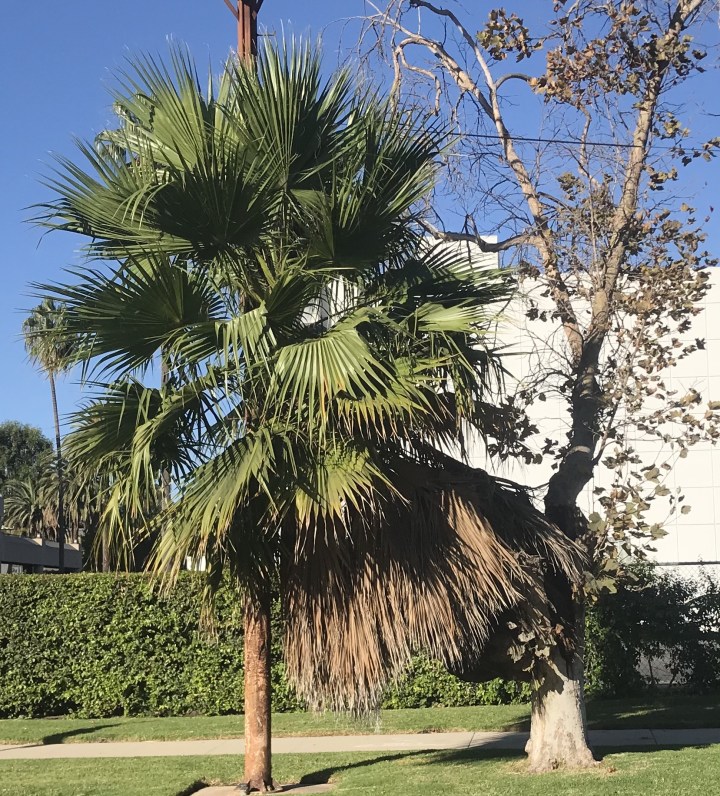
 A plant that clings to another plant for support without parasitizing it is an epiphyte. Some do it to get a bit more sunlight closer to the ceiling of a dense forest. Others do it to get up off of the forest floor to avoid competition with conventionally terrestrial plants. Maybe some just want to avoid grazing animals. It is often difficult to determine why plants do what they do.
Spider plants, ephiphyllums and many types of orchids, bromeliads and ferns are some of the more familiar epiphytes. Most do not actually cling to trees. They instead live in the crotches of limbs where debris from the foliar canopy above accumulates. Either way, they do not need much organic matter in which to disperse their roots, and some need none at all. Many collect what they need from the air and precipitation.
This is not about an epiphyte.
It is about a Mexican fan palm that thought it was epiphyte.
You might have though that the picture above depicts a common Mexican fan palm next to a surly London planetree. With closer inspection, you will notice that the palm lacks a trunk at ground level. The utility pole visible below the palm is not attached to it, and does not support it. Yet, the palm does not just hover there. It grew from a cavity in the London planetree.
Most of us know how many plants self sow in weird places. Sometimes they appear where they are welcome. Usually, they end up in pots with other plants, too close to pavement, or in rain gutters that have not been cleaned out enough. Of course, big trees commonly appear under utility cables. Once in a while something self sows in a decaying cavity of a tree.
Most of us have enough sense to remove self sown trees and plants that appears where they can not live for long without causing problems. Those of us who hire gardeners tend to trust and hope that the gardeners would exhibit the same sort of common sense. After all, that is part of what they are payed significant money for.
Unfortunately, Mexican fan palms are not epiphytic. They are just too heavy, even when young.

 Tony Tomeo