Redgum eucalyptus is famously adaptable and resilient.
Although not quite as aggressive, sloppy, big or structurally deficient as the notorious blue-gum eucalyptus, the red-gum eucalyptus, Eucalyptus camadulensis, is one of the ‘other’ eucalyptus that give eucalyptus a bad reputation. It is realistically too big and messy for refined urban gardens, and can be combustible if overgrown or too abundant. It is consequently probably not available in nurseries, despite being one of the most common species of eucalyptus (second only to blue-gum) in California. Red-gum eucalyptus has the advantage of being one of the most resilient large scale trees for unrefined or semi-wild landscapes, and works well where it has space to grow in many of the local county parks.
Silver mountain gum needs no irrigation once established.
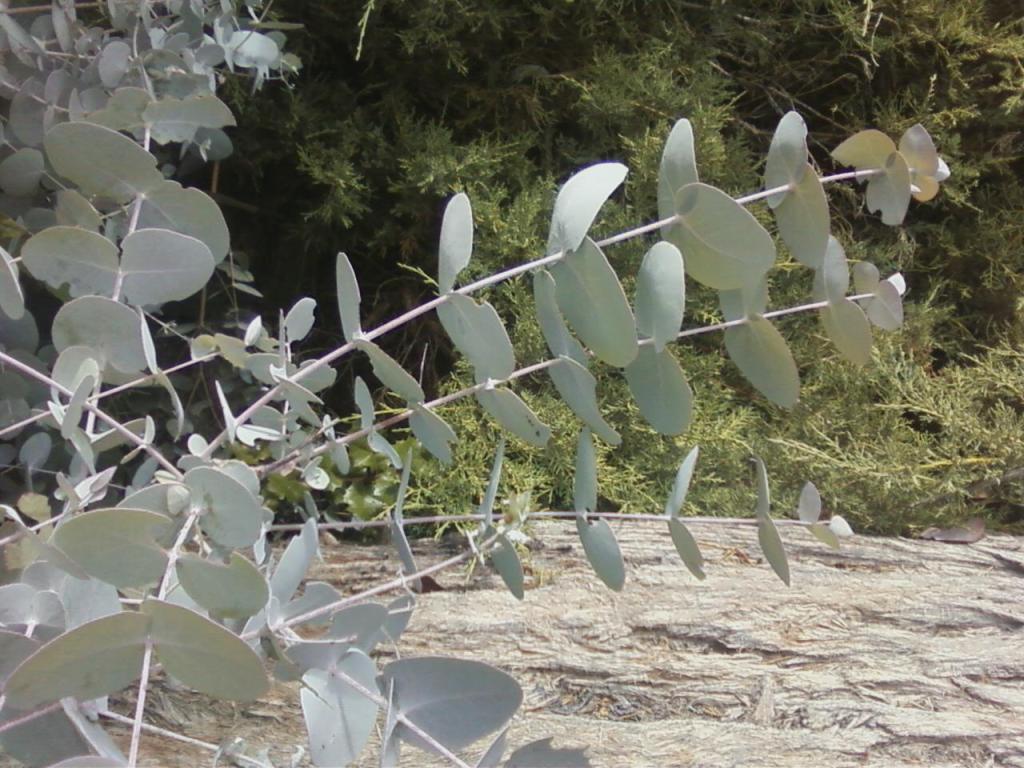
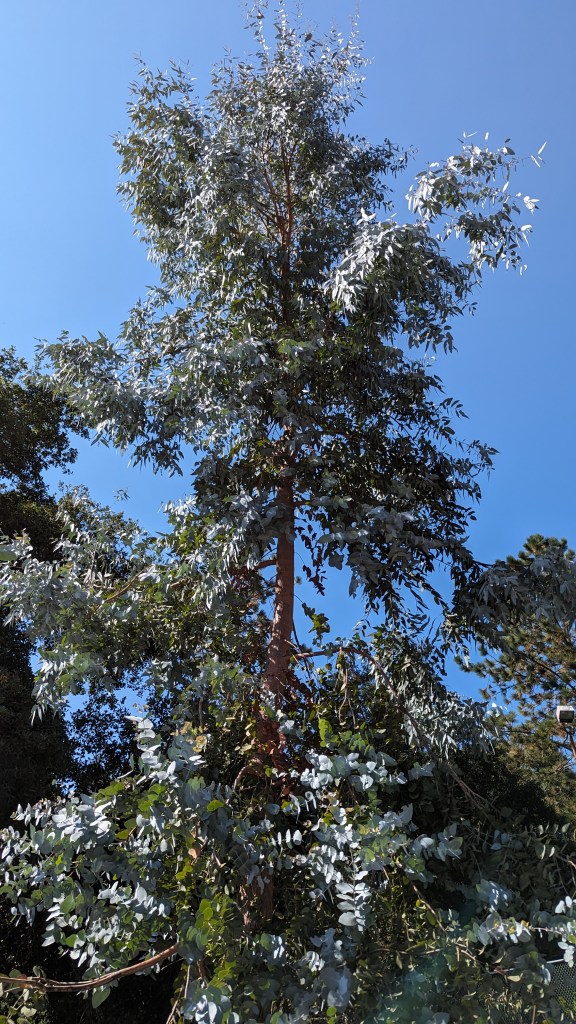
The bulky trunk and limbs, and shaggy bark of silver mountain gum, Eucalyptus pulverulenta, seem like they should be associated with a more imposing tree. Mature specimens are rarely more than twenty five feet tall. Those that try to get taller often fall over or break apart because they are unable to support their own weight, particularly if watered too generously. Aggressive pruning in spring and summer limits size, and also promotes an abundance of silvery juvenile foliage, which is popular as cut foliage.
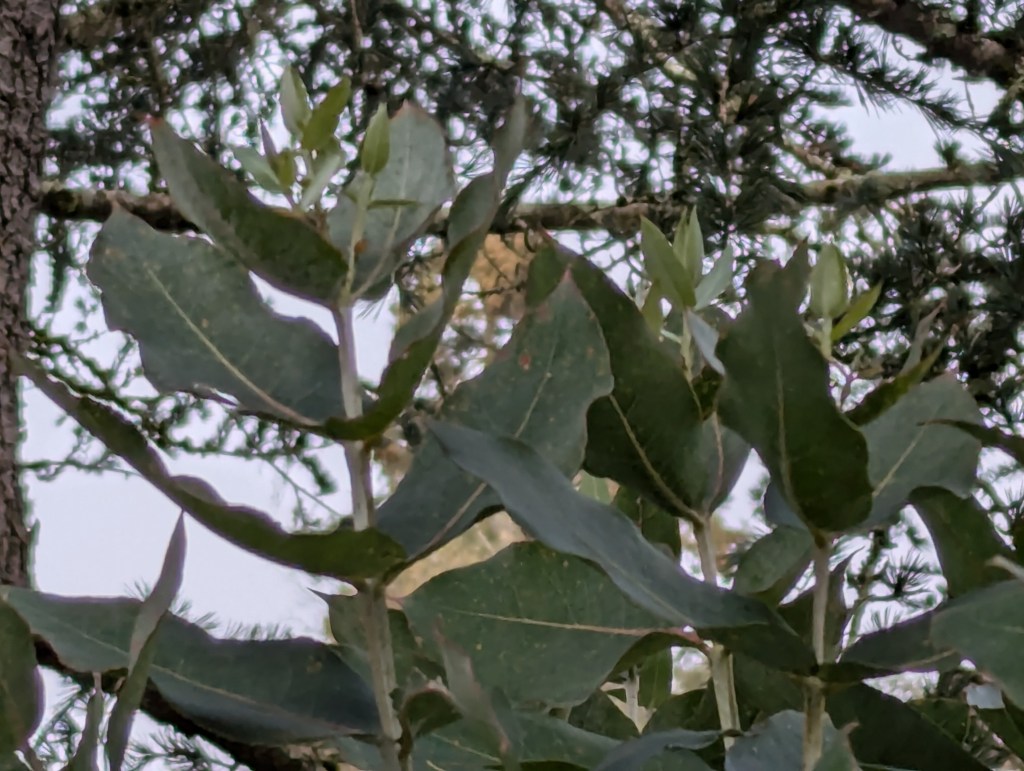
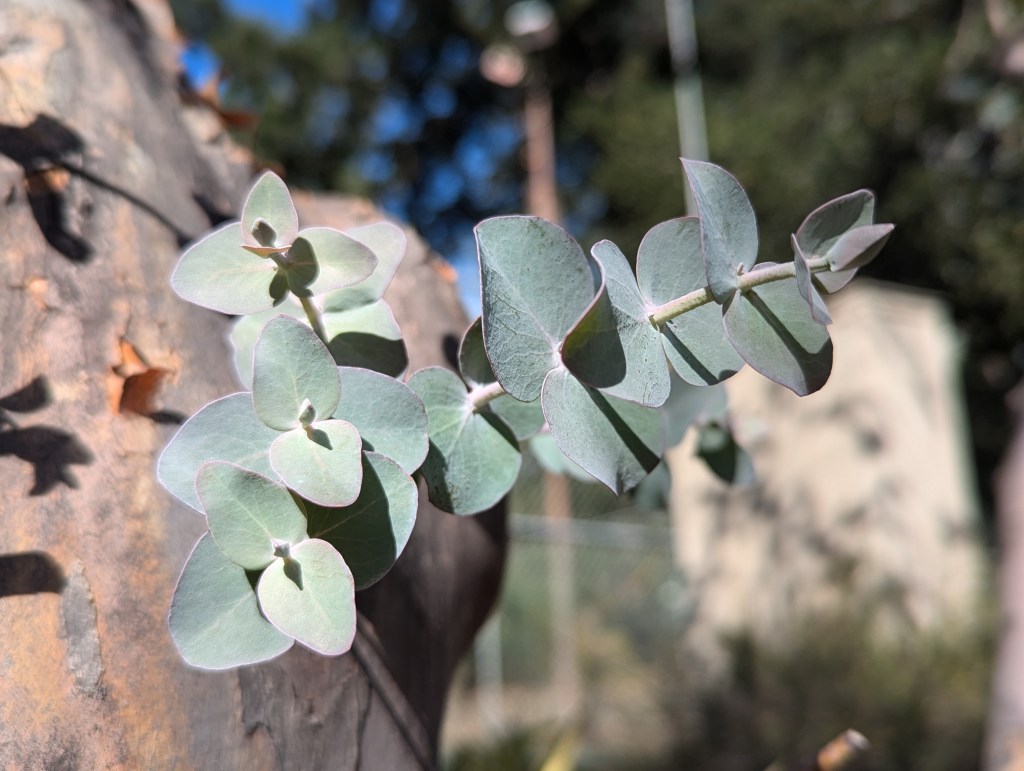
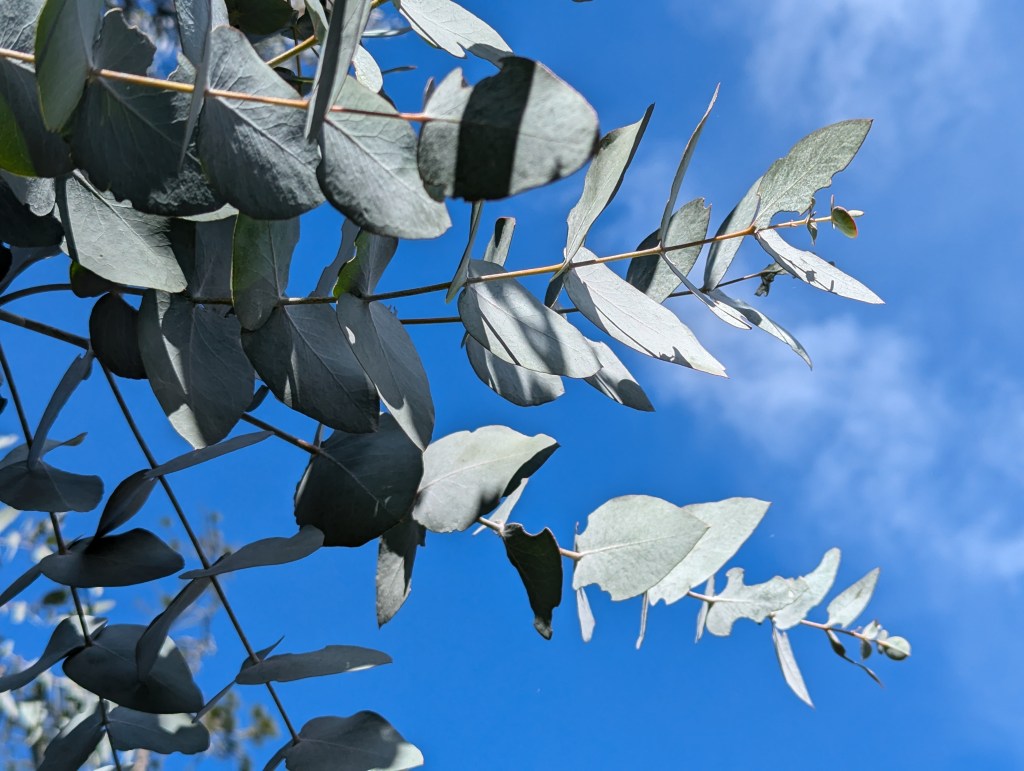
Juvenile leaves are round and sessile (without petioles or stalks), and arranged in strict four-ranked formation. (Each pair of opposite leaves alternates with similar but perpendicular pairs.) Adult foliage is almost lanceolate (lance shaped) and not quite as silvery. Small, white, staminate flowers (without obvious petals) bloom between leaves from autumn through winter. Young stems have peeling bark.
Like almost all eucalypti, silver mountain gum gets established most efficiently and grows best if planted while small. They are actually best grown from seed, which can sometimes be obtained online. The next best option, which is actually least common, is #1 (1 gallon) trees. #5 (5 gallon) trees are typically the smallest trees available. Larger trees are likely to have problems dispersing their roots. Once established, silver mountain gum needs no fertilizer or watering.
Eucalyptus has a bad reputation. Regardless, the worst of the genus and its only cultivar that I am aware of inhabit my gardens. Four less offensive species inhabit a landscape at work. Actually, several species of Eucalyptus are not only appropriate for home gardens, but are also naturally very well adapted to local chaparral climates. Their bad reputation is an unfortunate result of the bad behavior of merely one of hundreds of species, which happens to be the second of these Six. Eucalyptus camaldulensis, red gum allegedly also contributed to that reputation, but more so in Southern California than here, as it is rare locally. Half of these six show sessile juvenile foliage, rather than petiolate adult foliage. Pictures of high foliage were taken from significant distances.
1. Eucalyptus globulus ‘Compacta’, bushy blue gum is my least favorite eucalyptus, since it is a contrarily runty cultivar of an otherwise grand species, but here it is in my garden.
2. Eucalyptus globulus, blue gum is too grand for my garden, though, so can not develop a natural form. It is pollarded for its aromatic juvenile foliage, but has a few adult leaves.
3. Eucalyptus cinerea, silver dollar tree, which is not the same as silver dollar gum, may be confused with silver mountain gum, since their botanical names are interchangeable.
4. Eucalyptus pulverulenta, silver mountain gum is very distinct from silver dollar tree. I find their confusion to be annoying. Botanical nomenclature is designed for simplicity.
5. Eucalyptus sideroxylon, red ironbark grew from a small root sucker with merely a few roots. I got it from a stump in another landscape, and am impressed by its performance.
6. Eucalyptus citriodora, lemon gum is delightfully aromatic, and, as its name suggests, is rather lemony. Its foliage will soon be too high on lanky bare trunks to reach, though.
Rhody and I were in Capitola to attend to a few important tasks. Consequently, I did not take any pictures from home or work. My ‘Six’ for this week are therefore totally random without a theme.
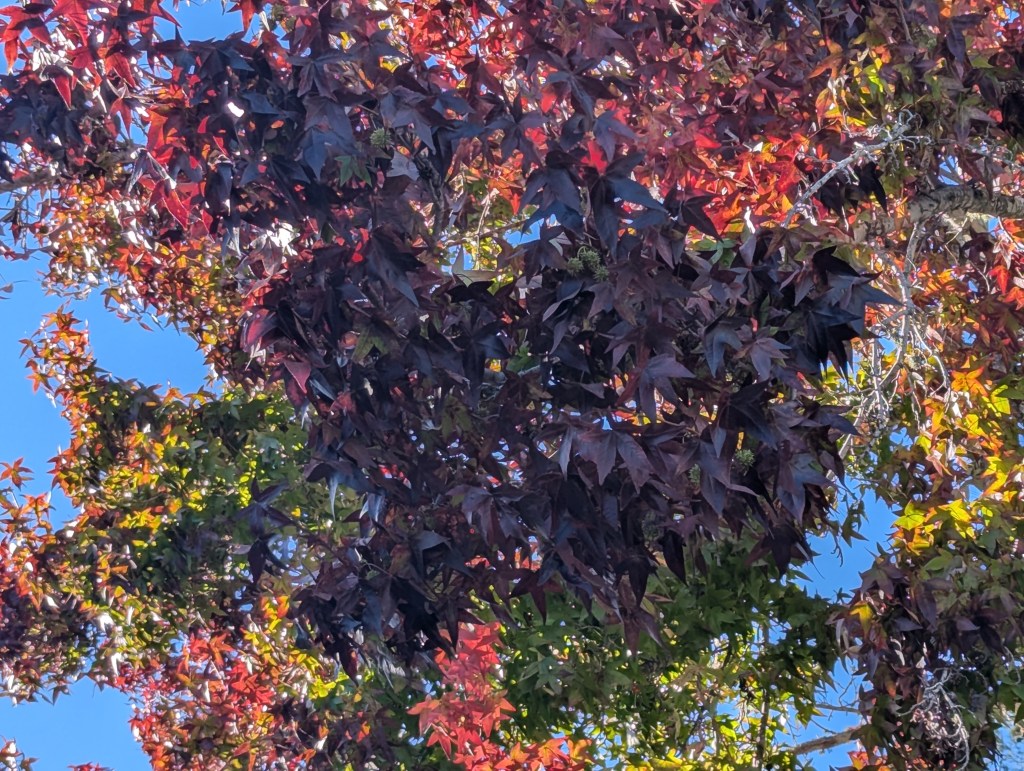
1. Liquidambar styraciflua, sweetgum does not require much chill to exhibit exemplary foliar color for autumn. This deep garnet red is almost too dark to be visually appealing. It looks like it should be in Vermont rather than here on the Central Coast of California.
2. Archontophoenix cunninghamiana, king palm is more common closer to Los Angeles than here. I know of only a few here, and almost all are somewhat shabby like these are. King palm is less tolerant of slightly excessive chill than sweetgum is of inadequate chill.
3. Eucalyptus citriodora, lemon gum is also more common in Southern California, likely because it prefers warmer winters. Although these are reasonably happy here, not many are so happy within the Santa Clara Valley on the other side of the Santa Cruz Mountain.
4. Cortaderia jubata, pampas grass is the aggressively invasive sort which is naturalized so wickedly on the West Coast of California and Oregon. This is not a good picture, since it shows only its bloom peeking above the edge of the cliff, with foliage concealed below.
5. Eucalyptus globulus, blue gum is another aggressively invasive naturalized species. It has a completely different personality, though. Where it competes with other tall trees, it grows very high, and is very combustible. This exposed tree is relatively short and stout.
6. Carpobrotus edulis, Hottentot fig, which most of us know incorrectly as ice plant, was imported from South Africa more than a century ago, and is now so abundant that some believe that it is native. Technically, it is invasive too, but it is not easy to dislike as such.
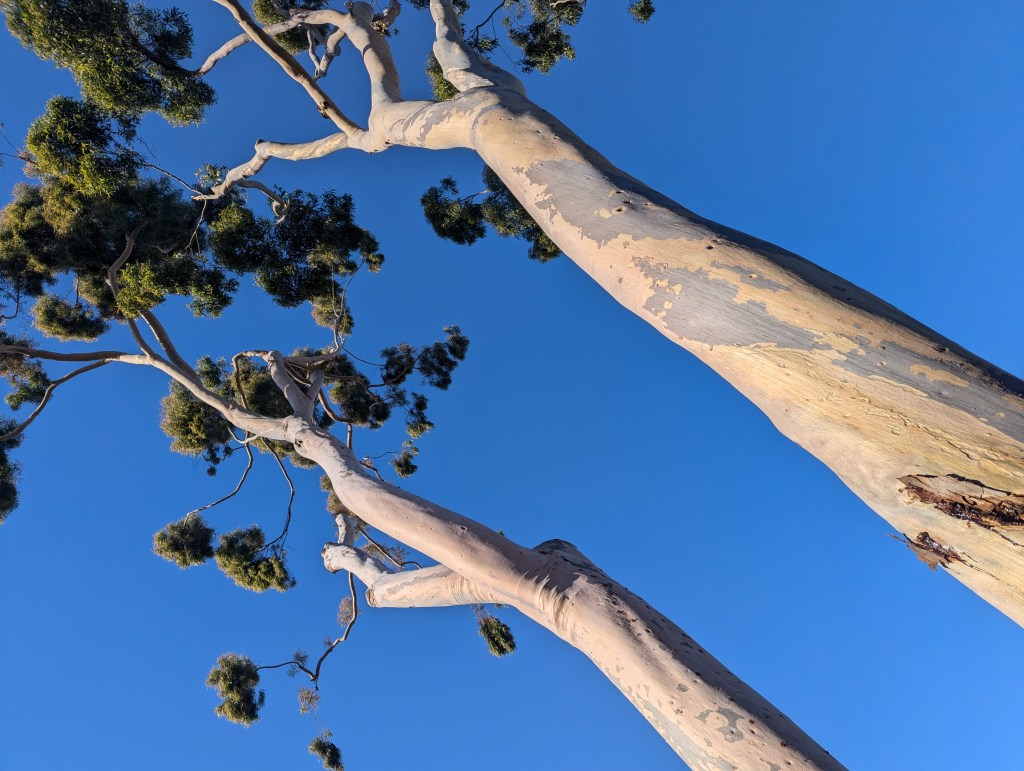
Eucalyptus citriodora, lemon gum, is one of several species that I miss from the more southern portion of the Central Coast and Southern California. San Luis Obispo, where Brent and I studied horticulture at Cal Poly, and where I learned to appreciate this particular species, is technically within the same climate zone as Los Gatos. Nonetheless, many species that are popular in Southern California are more popular there than here, perhaps because of the proximity to Southern California. I got this picture on the inland edge of Highway 101 in Carpinteria on the return trip from Los Angeles. It demonstrates how sculptural the elegantly slender, smooth and pallid trunks and limbs of lemon gum are. The airy foliage is delightfully aromatic, but is too high to reach among trees that are sufficiently mature to be so sculptural. A few other eucalypti are similarly but distinctly sculptural. Some develop heftier trunks and limbs. Some develop blotched or uniformly coarse bark. Also, several other genera, such as coast live oak, camphor and ‘Marina’ madrone, develop sculptural form. Such form should be more of a consideration for modern landscape design, as it was until about the late 1970s, when trees like European white birch and the last of the complaisant eucalypti slowly became passe. It is actually gratifying to notice that a few daring horticulturists are experimenting with some of the smaller species of eucalypti that could have become popular years ago, as well as a few that had not yet been introduced. Where lemon gum might eventually grow too large, smaller species, such as Eucalyptus caesia, gungurru, might be more proportionate. Of the more than seven hundred species of Eucalyptus available, more than a few must be appropriate to refined home gardens, and more than a few of such are likely sculptural.
As expected, the second half of my vacation was delayed. Then, very unexpectedly, all of our delays worked out. Rhody, Carson and I left exactly on time. Then, as unexpectedly, and just an hour from our first destination at Brent’s Jungalow, we were diverted to our final destination near Buckeye near Phoenix in Arizona. The explanation is as tedious as the additional six hour drive, at night and partially through Los Angeles style traffic. We are here now but got almost no pictures yet. We stopped only briefly in San Luis Obispo, where Brent and I were in school from 1985 to 1990, and where a few of our friends live.
1. From his shelf in back, through the dirty windshield, and through the dirty window of a cafe, Rhody stared impatiently at me as I tried to enjoy a bit of coffee the day before we left. ‘Hot Lips’ Salvia microphylla to the left is the only vegetation visible in this picture.
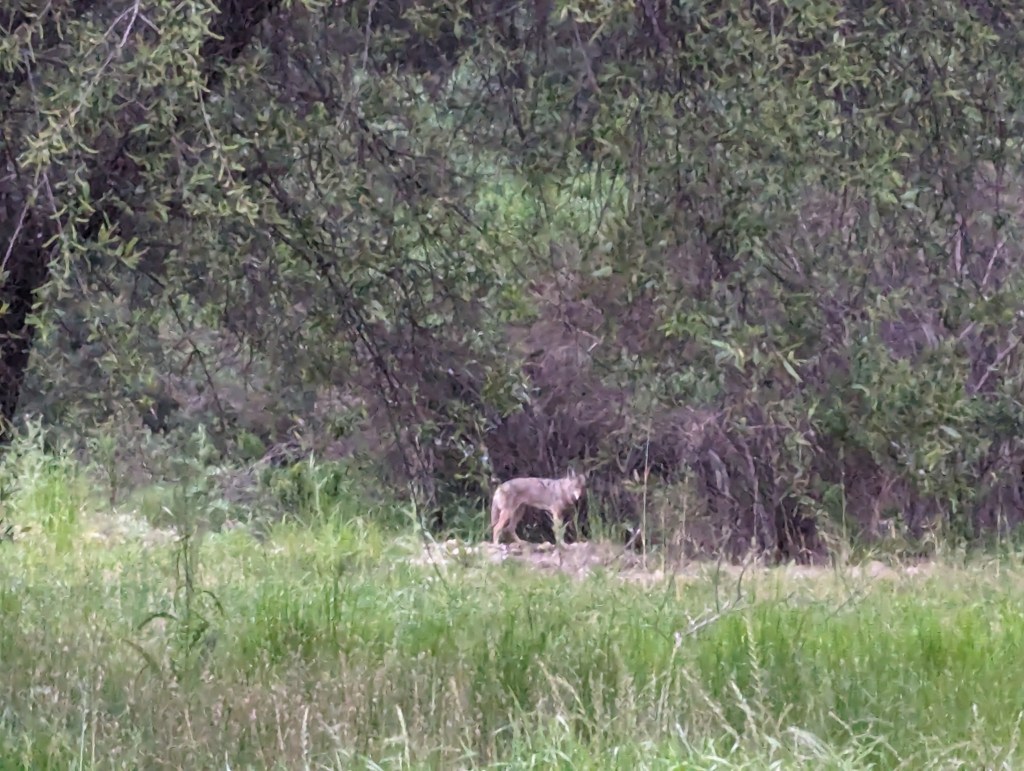
2. Wile E. Coyote also stared at me impatiently, at the end of the same day, as I finished a last task prior to leaving. I can not identify the vegetation that is visible in this picture. I suspect that the tree to the left and above is a common Pacific willow, Salix lasiandra.
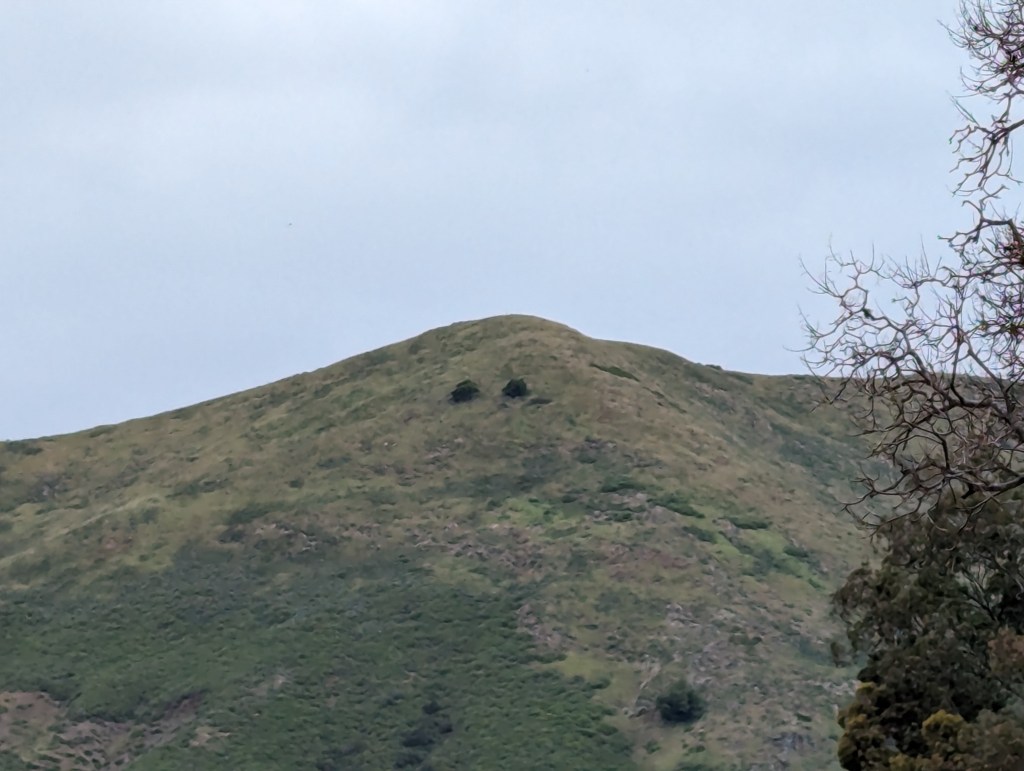
3. The hills have eyes. I have no idea what the pair of shrubs at the center of this picture are. I only know that they have not changed since I arrived at Cal Poly in 1985. I got this picture right outside of my classmate’s office in the Alan A. Erhart Agriculture Building.
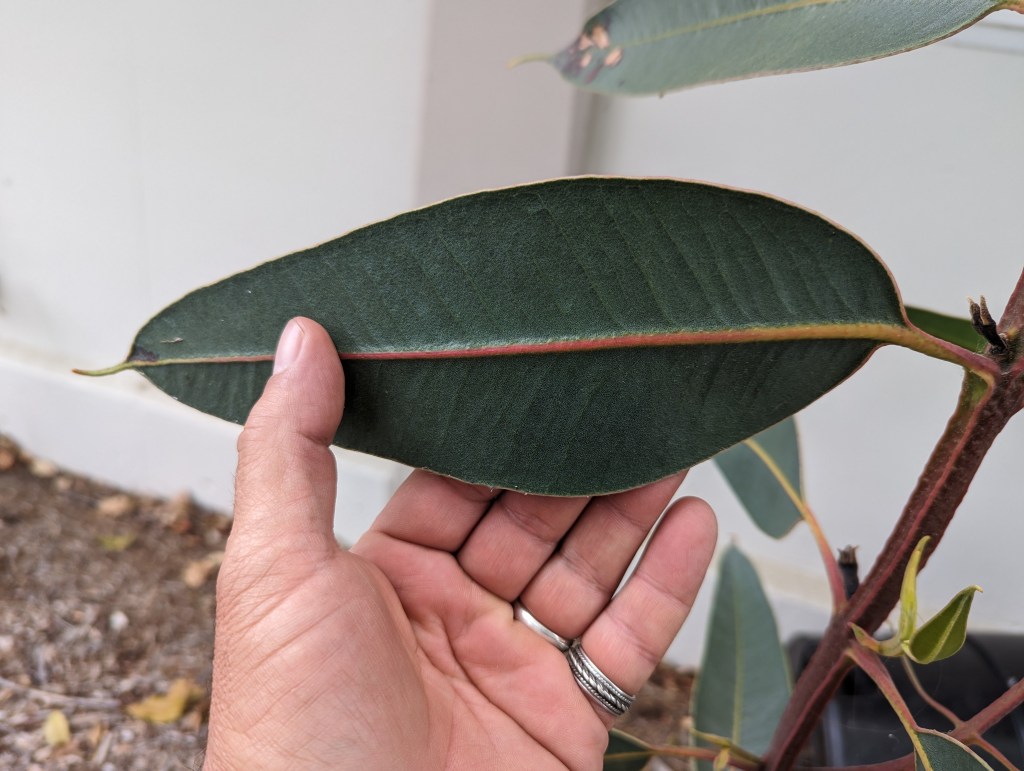
4. Also right outside of my classmate’s office, several specimens of unidentified eucalypti were recently installed. I recognize none of them. This specimen exhibits remarkably big leaves for the genus. These trees are very close to where I first met Eucalyptus torquata.
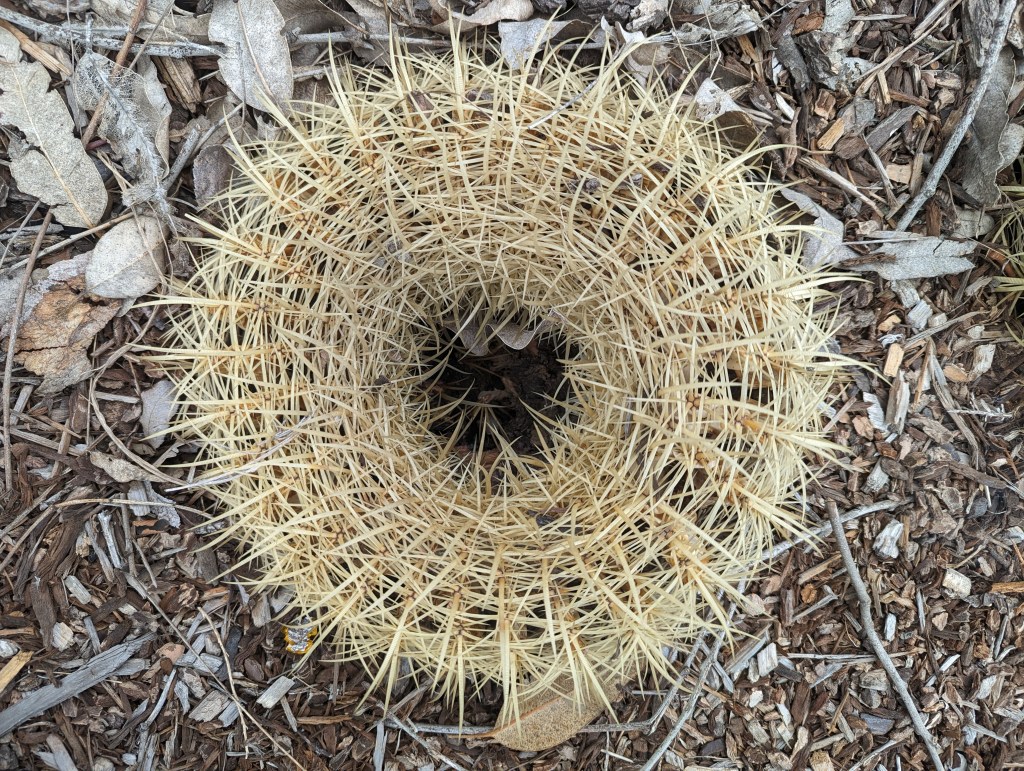
5. Barrel cactus, Echinocactus grusonii, dies ugly. It looks like something out of a horror movie, or like it consumed a horror movie. I suspect that this and several other similarly imploded carcasses decayed because of automated irrigation that is intolerably frequent.
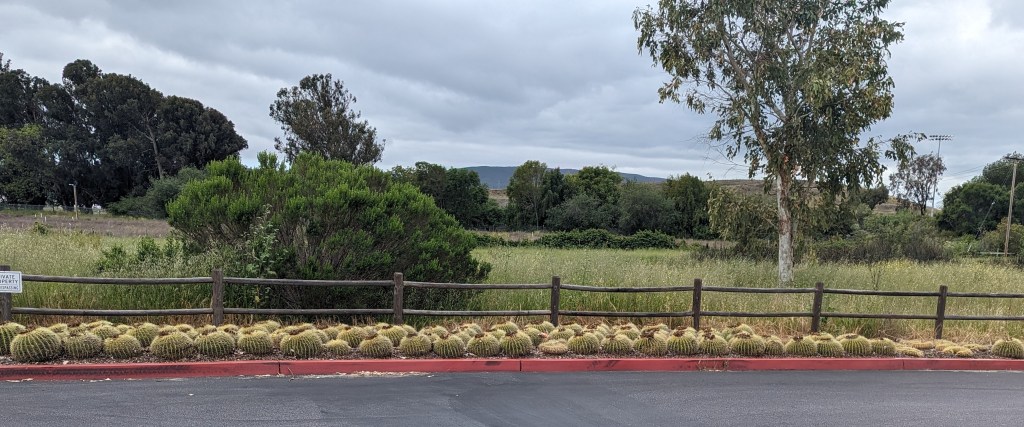
6. Is this good or bad landscape design? I typically prefer uniformity and symmetry, but this seems to be excessive. Several rotting specimens, mostly to the right, are disrupting the symmetry, but also leaving voids. I got this random picture as I left San Luis Obispo.
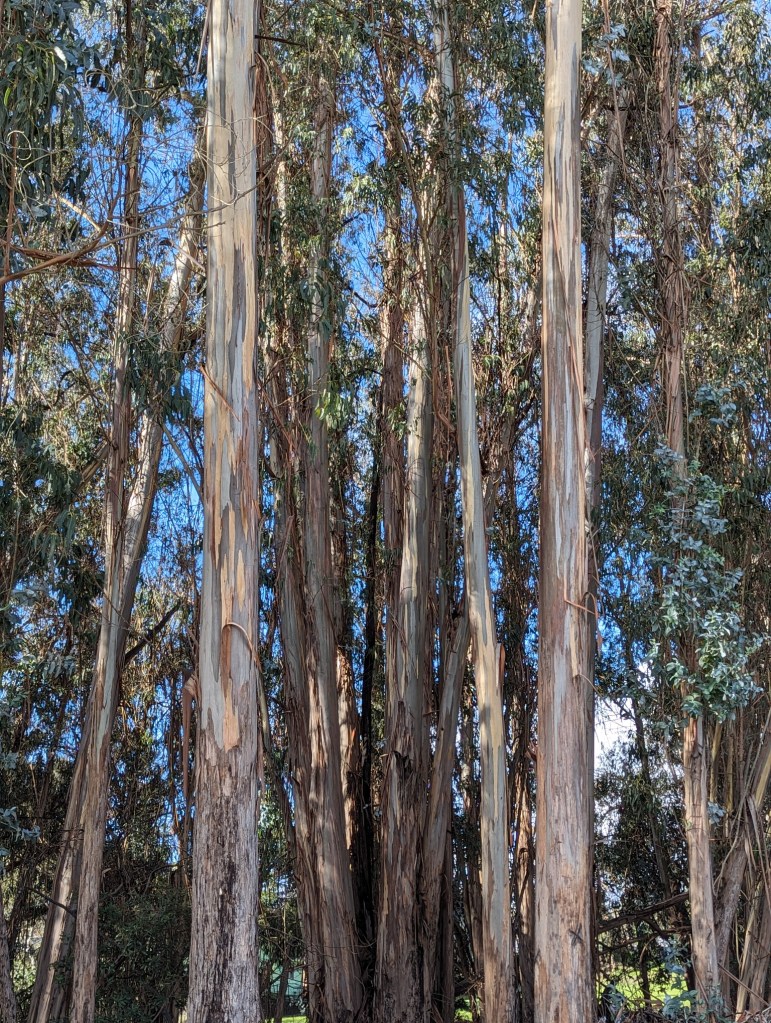
Almost no one adds blue gum, Eucalyptus globulus, to a landscape intentionally. Almost everyone who is familiar with it understands why. It is much too big and much too messy. Even where space is sufficient for it to mature, it is innately hazardous. It sheds big limbs from very high up. It often disperses its roots too shallowly to maintain adequate stability.
However, blue gum inhabits a few home gardens. Some were already there as gardens developed around them. Some grew from seed from nearby trees. Blue gum naturalizes in some regions. Mature trees are tall enough to share their shade, debris and seed with a few gardens. The copious debris inhibits weeds, but also inhibits desirable vegetation.
Blue gum in the wild is one of the tallest trees in the World. Naturalized trees commonly grow more than a hundred and fifty feet tall here. They stay shorter in windy situations. The tall and straight trunks constantly shed long strips of smooth tan bark. Fresher bark is tan, gray, greenish or even pinkish. The curved lanceolate leaves are quite aromatic. Ovoid juvenile leaves are bluish gray, and even more aromatic. Fuzzy staminate bloom is white.
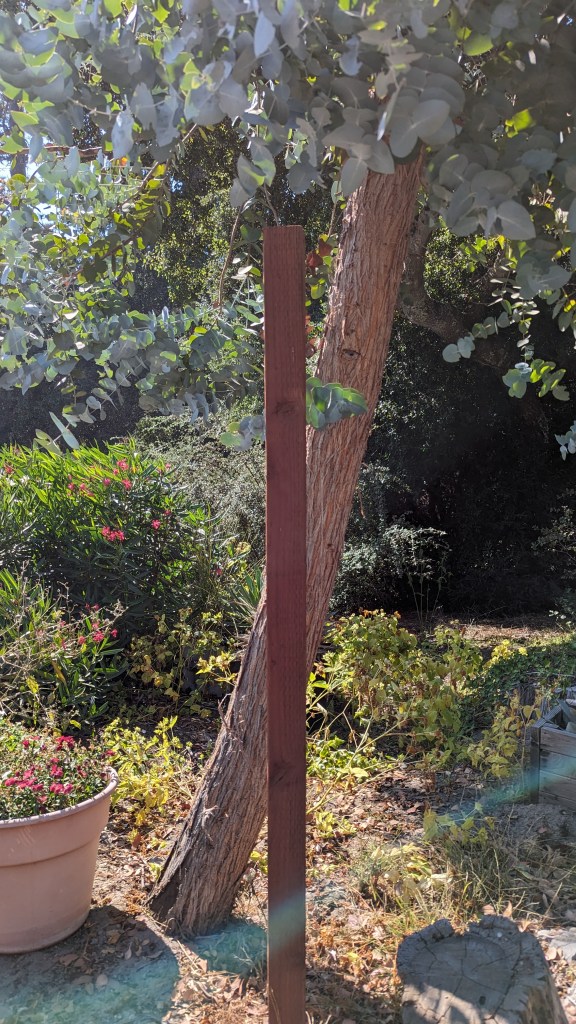
The vertical post demonstrates how much the tree trunk leans.
A few tree species should’ve had a V8. That includes more than a few individual trees. It applies to enough individuals of a species to indicate that the need is almost typical of the particular species.
The need for a V8 is derived from old advertisements for the V8 beverage that depicted those who were deficient in adequate consumption of V8 as leaning prominently. V8 is a juice beverage that is composed of juices of eight vegetables; tomatoes, carrots, celery, beets, parsley, lettuce, watercress and spinach. Hence, V8. It balances a diet so that those who consume it stand upright rather than lean.
In horticultural slang, the need for a V8 refers to a leaning trunk.
Any tree of any species has potential to develop a leaning trunk, and consequently appear to be in need of a V8. Some species innately develop leaning trunks though. No one seems to know why, but specimens of such species with vertical trunks are oddly uncommon or perhaps rare.
For example, so many ginkgo trees lean at such similar angles that, among some groups, their distinctive lean seems to be a normal characteristic of the species. It is variable though. Many individual trees that are isolated from others are quite vertical. So are some groups of street trees. However, many or most specimens of other groups of street trees lean at very similar angles, although in random directions.
Italian stone pines are more likely to lean, also at relatively similar angles, and also in random directions. Locally, vertical trunks are rare among this species. However, within their native range, vertical trunks are typical.
Argyle apple (eucalyptus) is almost comparable to Italian stone pine in regard to its typical need for a v8. I have seen a few with vertical trunks. I was determined for ours to be among them. I bound the trunk to keep it straight as it grew. I installed it with the trunk as vertical as the sign post next to it. When wind caused it to lean slightly while it was smaller than it is now, I pushed it back into position. Actually, I might have done that a few time. However, as it matured, it became more difficult to push back into position. Eventually, it refused to budge from its leaning position. Now, like most of the species, this specimen also seems to be in need of a V8.
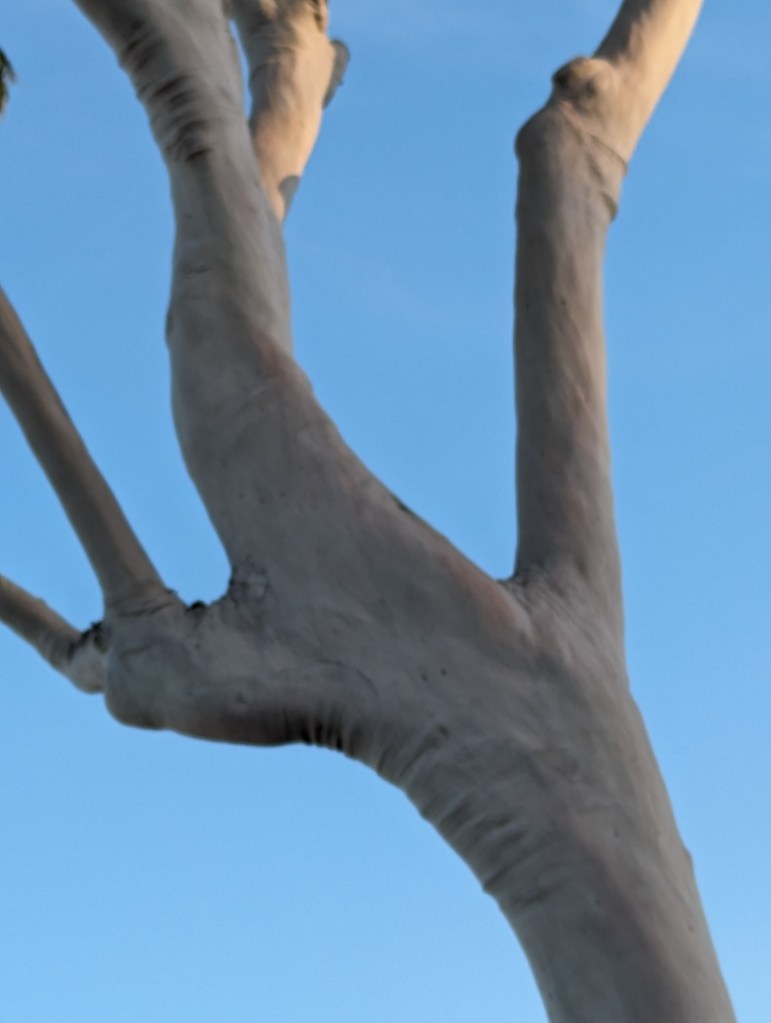
After the base of the trunk insisted on leaning, the upper portion of the trunk assumed vertical posture.
Red gum eucalyptus is notably drought tolerant. Apparently, it can also temporarily tolerate saturation.
Although not quite as aggressive, sloppy, big or structurally deficient as the notorious blue-gum eucalyptus, the red-gum eucalyptus, Eucalyptus camadulensis, is one of the ‘other’ eucalyptus that give eucalyptus a bad reputation. It is realistically too big and messy for refined urban gardens, and can be combustible if overgrown or too abundant. It is consequently probably not available in nurseries, despite being one of the most common species of eucalyptus (second only to blue-gum) in California. Red-gum eucalyptus has the advantage of being one of the most resilient large scale trees for unrefined or semi-wild landscapes, and works well where it has space to grow in many of the local county parks.









 Tony Tomeo