 Spruce happen to very compatible with the landscape style here. They fit in nicely with surrounding redwoods, but are more proportionate to sunny spots of some of the refined landscapes. We intend to add a few into some of the landscapes as they get renovated. They will stay branched to the ground, like big dense shrubbery, with the personality of distinguished forest trees.
Several dwarf Alberta spruce, which is a very compact cultivar of white spruce, have been incorporated into landscapes that were renovated during the past few years. They really are dinky though, and stay smaller than most shrubbery. Some of the very compact cultivars of blue spruce that we would like to add next will eventually get significantly bigger, but do not grow fast.
A few spruce that grow more like tree rather than shrubbery would be really excellent. The taller blue spruce with more open branch structure are no longer available from local nurseries, but could be ordered. I particularly want to try any of the white, black, red, Engelmann or Sitka spruce that are endemic to North America, although I know some might not be happy here.
Sitka spruce just happened to become available. A colleague brought these eight seedlings back from the coast up near the Oregon border, and will probably get a few more. They are prolific there, and get pulled like many other weeds. At the rate they are growing, they could get planted into a landscape even before we get any blue spruce! I am already very pleased with them.
For a while, I grew each of the six North American spruce, but only in cans. Since these Sitka spruce arrived, I have been wanting to get the other five. White spruce is ‘sort of’ here. Blue spruce will arrive soon enough.
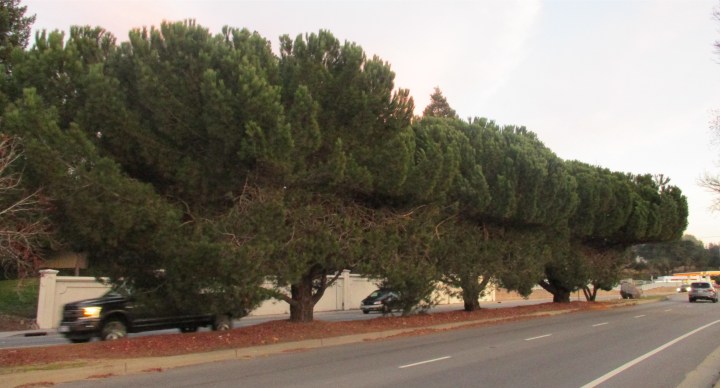 Even though it can get about fifty feet tall and wide, Italian stone pine, Pinus pinea, often gets planted as a small living Christmas tree into confined urban gardens. It gets so big so fast that it can get to be a serious problem, as well as expensive to remove, before anyone notices. It is really only proportionate to large public spaces such as parks or medians for big boulevards. The bulky trunks typically lean one way or another. The long limbs spread laterally to form an unusually broad and flat-topped canopy.
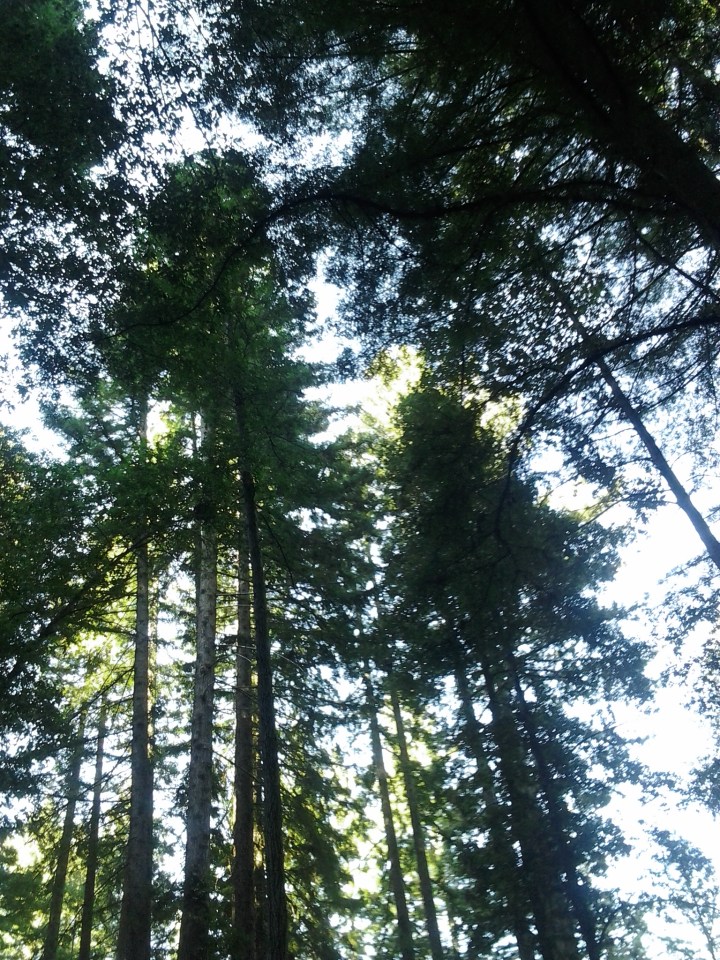 As the deciduous trees that will soon be coloring for autumn defoliate for winter, the evergreen trees will become more prominent. Some evergreen trees will drop some of their foliage along with deciduous trees through autumn and winter. Many drop some of their old foliage as new foliage develops in spring, or later in summer. All are on distinct schedules, but are never completely bare.
 Of all the Official State Trees, the coastal redwood, Sequoia sempervirens, of California is the grandest. Seriously, it is the tallest tree in the World, so it really ‘is’ the grandest! The tallest is 380 feet tall! Although the related giant redwood of the Sierra Nevada develops bigger trunks, the bulkiest coastal redwoods are thirty feet wide at the base! The oldest are more than 2,000 years old!
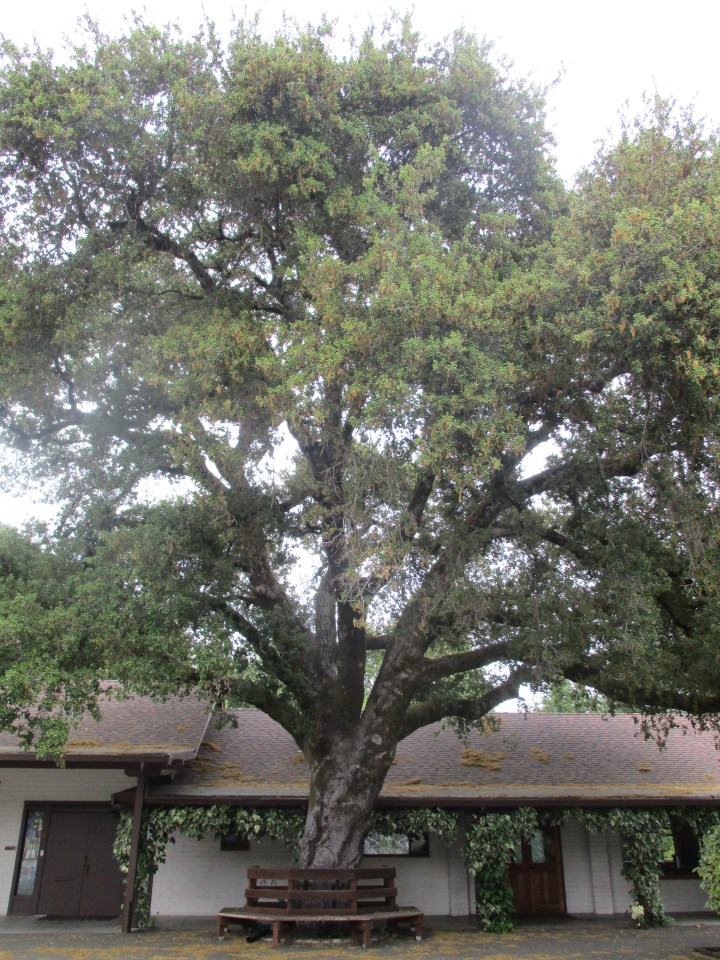 The valley oak of the Sacramento Valley, San Joaquin Valley, and coastal valleys to the west, is the grandest oak of North America. Within the coastal half of that range, and extending down past San Diego, the coat live oak, Quercus agrifolia, is a nearly comparable second grandest. The biggest subjects may be as tall as seventy feet, and nearly as wide, with trunks wider than ten feet!
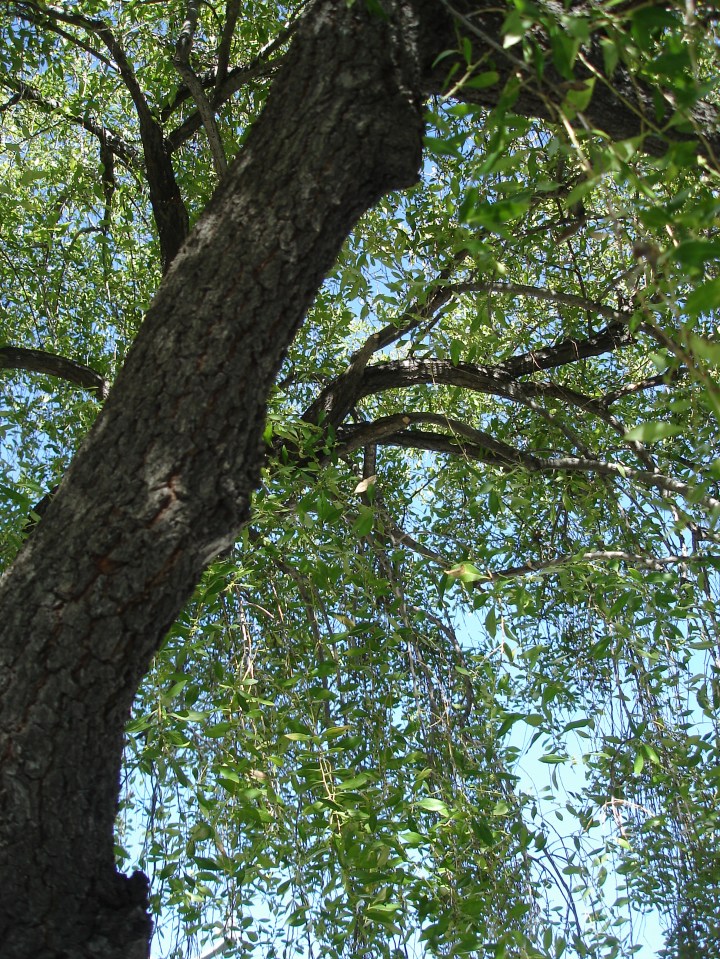 It does not grow fast, but by the time it gets old, mayten, Maytenus boaria, might be tall enough to reach upstairs eaves, and nearly as broad. The main trunk and limbs are nicely outfitted with uniformly checked grayish bark. Smaller stems are so very limber that it is a wonder that trees are able to gain any height at all. These stems arch gracefully, with their wiry tips hanging vertically.
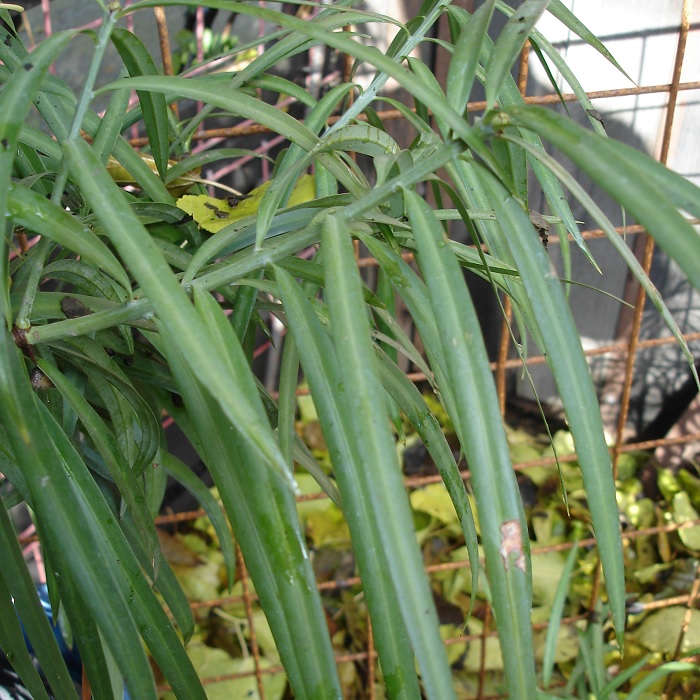 Of the various specie of podocarpus, and as the name implies, the long leafed yellowwood, Podocarpus henkelii, has the longest leaves. They can get about six inches long, and hang elegantly from upwardly curving branches. This glossy evergreen foliage can be quite dense. It is dark green in full sun, and can be a slightly bluish in partial shade, particularly as new growth develops.
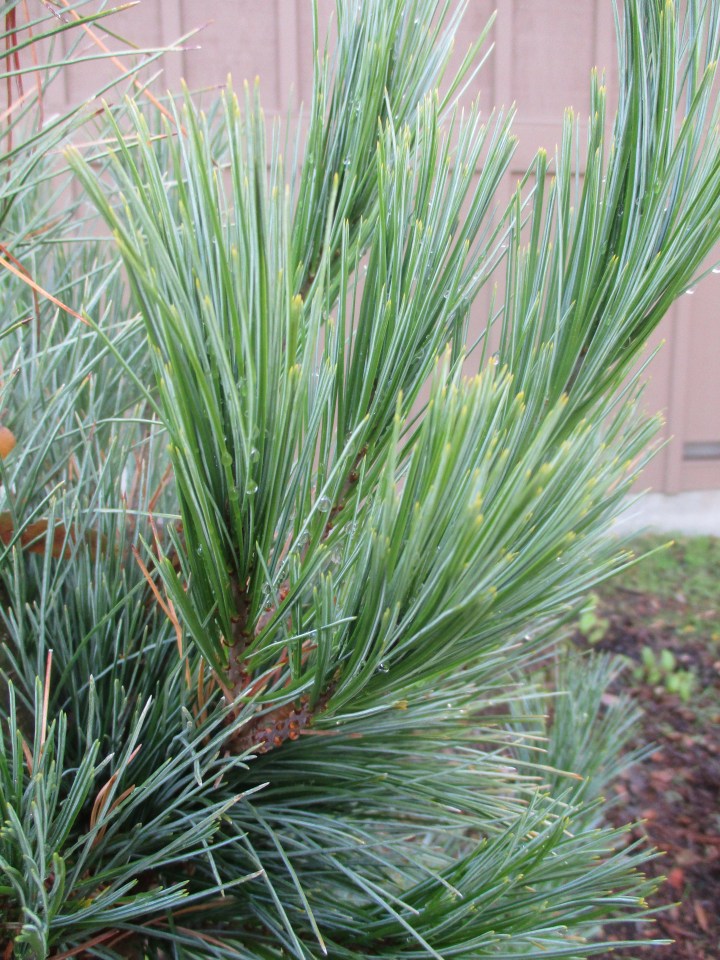 The big name of this little pine takes some explaining. Domingo pine is a cultivator of an interspecific hybrid of two distinct specie, Eastern white pine, Pinus strobus, and Mexican white pine, Pinus ayacahuite. Until a better name in invented, it is known as Pinus strobus X ayacahuite ‘Domingo’. It is typically but incorrectly abbreviated as Pinus ‘Domingo’, or Pinus strobus ‘Domingo’.
 All around town, there are Italian stone pines, Canary Island pines, Monterey pines and Aleppo pines that are much too big for the home gardens that they live in. Some are too close to pavement or foundations. Others are under utility cables. Many are shading or crowding out other more desirable plants. What most have in common is that they started out as living Christmas trees.
 Tony Tomeo