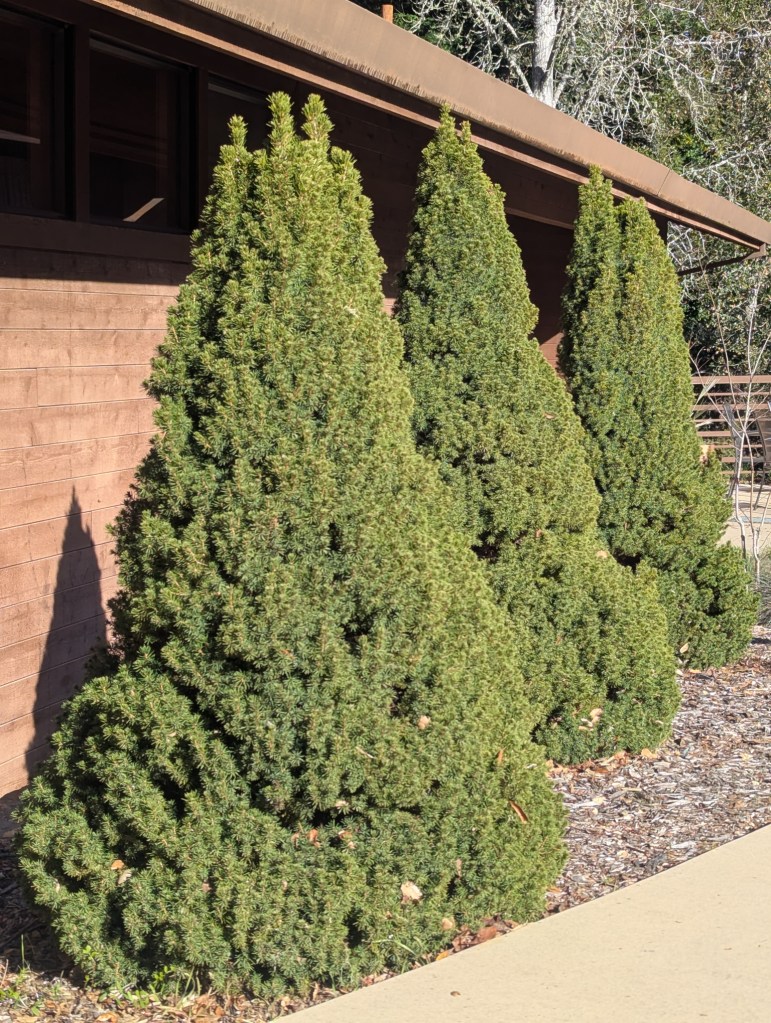
It is a diminutive tree with a big name. Picea glauca var. albertiana ‘Conica’ is commonly known as dwarf Alberta spruce. It is a type of white spruce that grows more as shrubbery than as a tree. After many years, it may be only eight feet tall and four feet wide with strict conical form. Because of its form and tame growth, it is practical as a live Christmas tree.
Potted specimens may remain potted for several years. They maintain their conical form quite naturally without shearing or pruning. Their finely textured needles are only slightly bristly. Their primary disadvantage as a Christmas tree is their foliar density. They do not extend lateral stems for Christmas ornaments to dangle from. Their foliar aroma is slight.
Dwarf Alberta spruce is splendid for formal landscapes. Alternatively, it can instill a bit of formality or symmetry into otherwise relaxed landscapes. Although it does not grow very wide, it should have room to grow. Pruning or shearing for containment compromises its strictly conical form. Potted specimens rely on frequent irrigation, but are not demanding.
Sawara false cypress cultivars do not develop into real trees.
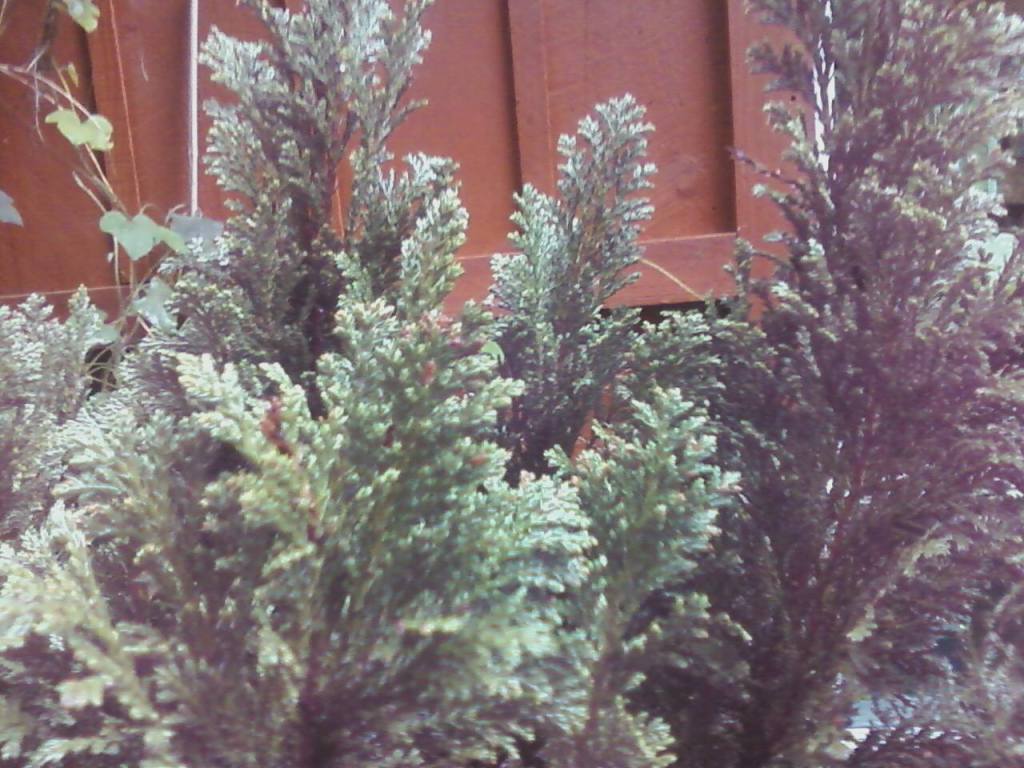
Just like other types of false cypress, the Sawara false cypress, Chamaecyparis pisifera, naturally gets much larger than its many cultivars that are sometime grown in gardens for their colorful and interestingly textured foliage. Although not large trees, they can get nearly thirty feet tall in wild groves in Japan. Most garden varieties stay less than ten feet tall, and some stay much shorter.
‘Cyano-Viridis’ (‘Boulevard’), with feathery blue green foliage, is one of the more popular cultivars. It grows slowly to more than six feet tall and broad. ‘Filifera’ has very different foliage, with tightly fitting scale leaves on limber cord shaped branches. It stays a bit shorter but can get a bit broader. ‘Mops’ is similar to ‘Filifera’, but stays about a foot and a half tall and broad. ‘Filifera Aurea’ and ‘Golden Mops’ are just like ‘Filfera’ and ‘Mops’, but with yellow foliage.
Reflected glare or harsh exposures can burn foliage. Full sun is not a problem, unless enhanced by glare from surrounding pavement or lightly colored walls. Partial shade is not a problem either, but compromises foliar color, particularly yellow.
Shearing or major pruning deprives false cypress of their naturally appealing forms and textures. They should therefore get plenty of space for their mature size, and get trimmed lightly for shape only when necessary.
Cultivars are much more compact than the simple species.
Fifty foot tall Port Orford cedar trees, Chamaecyparis lawsoniana, like those that get harvested for timber from their native range on the south coast of Oregon and the northwest corner of California are almost never found in refined gardens. Their remarkably diverse garden varieties mostly stay less than half as tall, as dense, compact trees or large shrubbery that resembles arborvitaes. Many have bluish or greyish foliage. Some have gold foliage. Finely textured needle-like juvenile foliage that is so prominent among young plants continues to appear sporadically with scale-like adult growth as plants mature. The small round cones are not prominent. Like related arborvitae, Port Orford cedar tolerates a bit of shade.
Like the majority of cedars, Eastern redcedar, Juniperus virginiana, is not really a ‘cedar’. According to its genus name, it is a juniper. That may be why it is less common here than within its native range. Even in its native range, most grow wild rather than in cultivation. Junipers gained an unfavorable reputation after becoming overly common decades ago.
Eastern redcedar has traditionally been more utilitarian than merely aesthetic. It can be a delightful Christmas tree, either cut or potted. While old cedar closets are native incense cedar, cedar chests are Eastern redcedar. Baton Rouge derived its name from a red stick demarcation pole. Indigenous people traditionally used Eastern redcedar for such poles.
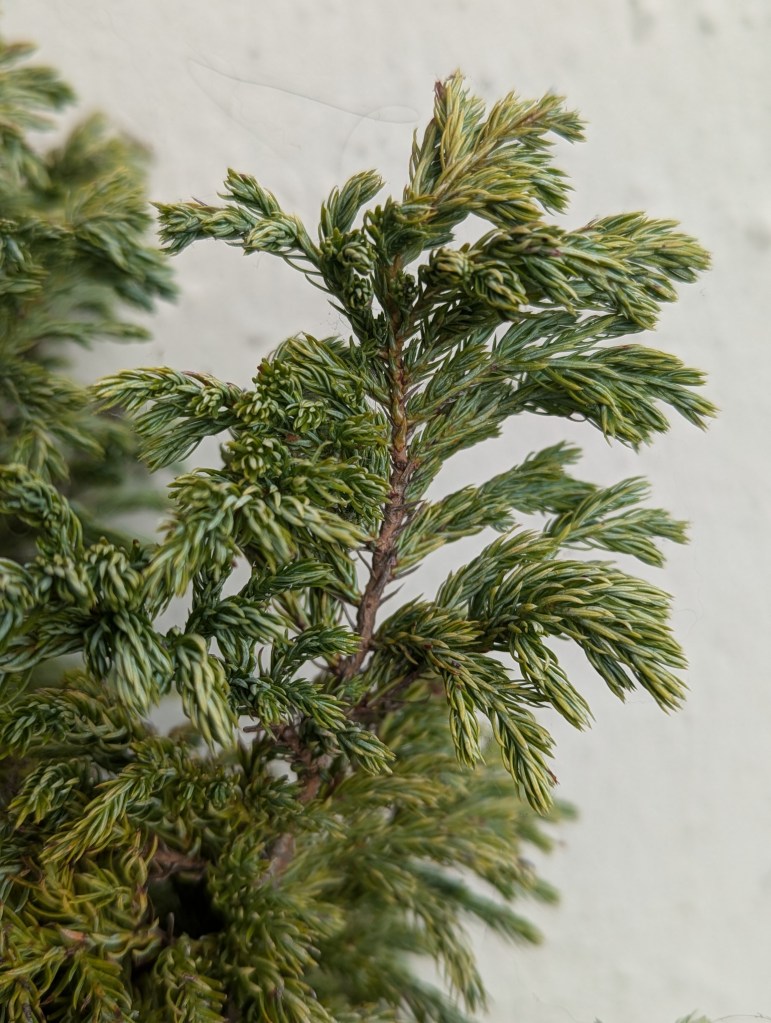
Wild Eastern redcedar trees are variable and range in height from fifteen to fifty feet high. Cultivars develop compact conical or columnar form. Some are grayish or golden green. The small evergreen foliar scales, particularly juvenile foliage, can be somewhat prickly. The rusty red to grayish brown bark can display a handsomely fibrous or shaggy texture. The ‘silicicola‘ variety of Eastern redcedar is rare.
It is difficult to imagine Sawara cypress, Chamaecyparis pisifera, as a timber tree. Within its native range in Japan, it can grow as tall as one hundred and fifty feet. Its trunk can be six feet wide. It is no surprise that it grows slowly though. Its more familiar types rarely grow taller than ground floor eaves. Only the oldest and biggest are nearly thirty feet tall.
Sawara cypress cultivars are uncommon, and some are rare. Among them, ‘Boulevard’ is less uncommon. It has feathery bluish foliage, and can grow eight feet tall. Supposedly, it can eventually grow nearly three times as tall. ‘Filifera Aurea’ has bright yellowish foliage on limber cord like stems. It supposedly gets taller, but it is typically lower and mounding.
Although its cultivars are more diverse, Sawara cypress resembles compact arborvitaes. Its densely evergreen foliage has a similarly soft texture. Its bark is similarly ruddy with a similarly fibrous texture. Individual scale leaves are less than a sixteenth of an inch long. Sawara cypress classifies as the false cypress because it is not of the genus Cupressus.
Christmas trees grow on farms rather than forests, but some farms are in forests.
(This is an old article from 2011, so much of the information within is no longer relevant.)
Douglas, grand, white and Noble firs, as well as sierra redwoods, Monterey pines and at least fourteen other varieties of Christmas trees can be found and cut at Santa’s Tree Farm and Village near Half Moon Bay. Certainly, no one needs that many Christmas trees; and most select only one. Yet it is good to know that somewhere within such a vast selection, there is the perfect Christmas tree. Santa’s Tree Farm and Village also provides wreathes, garlands, tree stands, flocking, fire retardant and delivery.
On weekends, Sleighbells Gift Shop is open from 9:00 a.m. to 4:00 p.m.; and through December 18, Santa Visits between 9:30 a.m. and 4:30 pm.. For $2, children from two to ninety-two and older can ride the train from 9:30 a.m. to 4:00 p.m., as weather allows. Younger children ride for free. Santa’s Tree Farm is open between 8:00 a.m. and 5:00 p.m. on weekends (except for closing at 1:00 p.m. on Christmas Eve), and from 9:00 a.m. to 5:00 p.m. on weekdays.
Except for trees on the Diamond lot and pre-cut trees, prices range from $46 to $69. VISA and Mastercard and leashed dogs are welcome. Santa’s Tree Farm and Village is at 78 Pilarcitos Creek Road at Highway 92, six and a half miles from Highway 280 on the way to Half Moon Bay. Coupons, showtimes (yes, ‘showtimes’) and more information can be found at the website http://www.santastreefarm.com, or by telephoning 650 – 726 2246.
Atlantic cedar, Austrian pine, Arizona cypress, Leyland cypress Scott’s pine, sugar pine, white fir, as well as many other varieties of Christmas trees can also be obtained from Crest Ranch Christmas Tree Farm, located in the Santa Cruz Mountains west of the San Lorenzo Valley. Douglas firs, pines, cedars and cypress are $37 up to five feet tall, and $7.40 for each additional foot. White and Greek fir varieties are $42 up to five feet tall, and $8.40 for each additional foot. All sales are cash or check. An ATM is available.
The beautifully scenic picnic area is a good excuse to bring lunch, or at least get something at the snack bar. Leashed dogs are welcome. More information can be found at the website http://www.crestranch.com or by telephoning 831 – 426 1522. Crest Ranch Christmas Tree Farm is open from 8:00 a.m. to 5:00 p.m. until December 20, and is located at 12200 Empire Grade outside of Felton.
In the wild, Atlas cedar can get almost a hundred feet tall. Bluish gray or rarely yellowish cultivars which are popular for home gardens are generally more compact. Perhaps they could get as grand as wild trees after a few centuries. Weeping blue Atlas cedar, Cedrus atlantica ‘Glauca Pendula’ is an strange one. It can barely stand fifteen feet tall and wide.
The trunks and limbs of weeping blue Atlas cedar are initially so pliant that they sag onto the ground without support. New stems try to grow upward, and may do so for a few feet, or may hang downward after achieving only a few inches of height. Trunks need binding for either straight or serpentine form. They lignify slowly as they mature and gain caliper.
Weeping blue Atlas cedar requires commitment. Indiscriminate pruning or shearing ruins the naturally sculptural form. Such pendulous growth necessitates meticulous grooming, although it may not be necessary very often within spacious situations. Expanding trunks eventually absorb the curves of serpentine form. Low stems can sprawl over the ground.
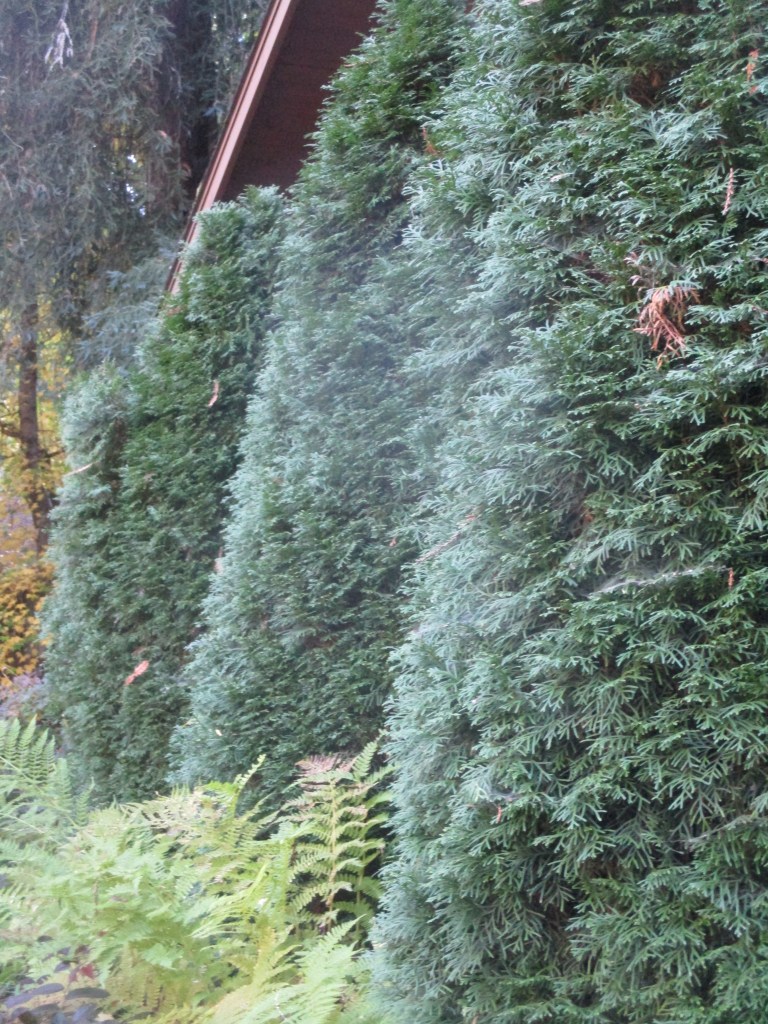
During the Colonial Period of America, American arborvitae, Thuja occidentalis, was one of the first native species to become popular for home gardening. It is native as far south as the Great Smoky Mountains, and as far east as Minnesota. Wild trees can be fifty feet tall, with trunks as wide as three feet. They might grow larger to compete with other trees.
Of course, the oldest cultivated varieties, as well as relatively modern cultivars, are much more compact. Many modern cultivars are hybrids. Some are different species. They are densely evergreen shrubbery that work well as hedging. Their distinctly ruddy or grayish brown bark is barely visible. Their bloom is unimpressive. Foliage is their primary asset.
It is quite an asset. Although arborvitae is conducive to shearing, its billowy foliar texture is too appealing to compromise by frequent shearing. Scale leaves are barely more than an eighth of an inch long, like those of junipers, but are more pliable on soft and flattened foliar sprays. Such sprays are delightful coniferous evergreens for wreaths and garlands.
With such densely foliated low limbs reaching the ground, Colorado blue spruce functions as much as large shrubbery as a small tree.
Colorado and Utah share the same stately state tree; the Colorado blue spruce, Picea pungens, which is native to the Rocky Mountains between Arizona, New Mexico and southern Idaho. Colorado blue spruce are stoutly conical trees that grow slowly to eventually get more than seventy five feet tall. Where they need to compete with other trees in forests, the biggest are nearly twice as tall with trunks nearly five feet wide. However, because they grow so slowly, and do not get much bigger then they need to, well exposed trees stay proportionate to home gardens for many decades. Many shrubby compact cultivars actually stay less than ten feet tall. Foliage can be grayish green to silvery pale blue. The stiff and sharply pointed needles are about three quarters to an inch and a quarter long, and densely set on relatively rigid stems.
The elegant silvery blue foliage of the Colorado blue spruce is striking either in front of or behind darker evergreen foliage, like that of redwoods or junipers. These stout and densely foliated trees make any garden look a bit more woodsy.
Hollywood juniper had formerly been the only popular juniper of tree form. As it became less popular during the past few decades, cultivars of the once obscure Rocky Mountain juniper, Juniperus scopulorum, became more popular. Also, a few more modern cultivars became available. Now, the once overly common Hollywood juniper is quite uncommon.
Rocky Mountain juniper is naturally rather grayish for protection from the harsh exposure of the high elevations which it inhabits. Cultivars are grayer, bluish or silvery, and mostly develop symmetrically conical form. Old specimens that were initially conical eventually grow as small trees with rounded and relatively dense canopies, perhaps on bare trunks.
‘Skyrocket’ and ‘Blue Arrow’ are very narrow like Italian cypress that grow only fifteen feet tall. ‘Wichita Blue’ and ‘Moonglow’ are stoutly conical. ‘Blue Arrow’ and ‘Wichita Blue’ are bluish green. ‘Skyrocket’ and ‘Moonglow’ are silvery gray. Established specimens do not require much water, but develop better foliar color with warmth and occasional watering.






 Tony Tomeo