 Spruce happen to very compatible with the landscape style here. They fit in nicely with surrounding redwoods, but are more proportionate to sunny spots of some of the refined landscapes. We intend to add a few into some of the landscapes as they get renovated. They will stay branched to the ground, like big dense shrubbery, with the personality of distinguished forest trees.
Several dwarf Alberta spruce, which is a very compact cultivar of white spruce, have been incorporated into landscapes that were renovated during the past few years. They really are dinky though, and stay smaller than most shrubbery. Some of the very compact cultivars of blue spruce that we would like to add next will eventually get significantly bigger, but do not grow fast.
A few spruce that grow more like tree rather than shrubbery would be really excellent. The taller blue spruce with more open branch structure are no longer available from local nurseries, but could be ordered. I particularly want to try any of the white, black, red, Engelmann or Sitka spruce that are endemic to North America, although I know some might not be happy here.
Sitka spruce just happened to become available. A colleague brought these eight seedlings back from the coast up near the Oregon border, and will probably get a few more. They are prolific there, and get pulled like many other weeds. At the rate they are growing, they could get planted into a landscape even before we get any blue spruce! I am already very pleased with them.
For a while, I grew each of the six North American spruce, but only in cans. Since these Sitka spruce arrived, I have been wanting to get the other five. White spruce is ‘sort of’ here. Blue spruce will arrive soon enough.
 Ah, something vintage! Remember Hollywood juniper, Juniperus chinensis ‘Kaizuka’ (or ‘Torulosa’) flanking big two-car garage doors of mid century modern homes? Those that are still around after half a century are big and strikingly sculptural, like miniature Monterey cypress for home gardens. They get about fifteen feet tall and ten feet wide, but have potential to get significantly larger.
 The ‘X’ preceding its Latin name ‘X Cupressocyparis leylanii‘ designates Leyland cypress as a hybrid of two distinct genera, namely Monterey cypress and Nootka cypress. (Those who consider the parents to be two species of the same genus know Leyland cypress as Cupressus X leylandii.) The many cultivars combine desirable qualities of both parents, but also innate weaknesses.
 As the colorful deciduous trees go bare, the evergreen trees get more attention. A weeping white spruce, Picea glauca ‘Pendula’, really stands out. It grows slowly to only about fifteen feet tall and maybe five feet wide, so does not need as much space as a typical spruce tree. What makes it so distinctive is the weirdly pendulous stems that hang limply from a strictly vertical trunk. It is hard to believe that it is only a different variety of the same species as the dwarf Alberta spruce, which is very short, dense and symmetrically conical, with stout little stems. The foliage of weeping white spruce is lighter green than that of most other spruces, but is not as blue as that of blue spruce. The short and stiff needles are rather prickly to handle.
 Pretty soon, as autumn weather starts to get cooler, some deciduous plants will develop brilliant color before defoliating for their winter dormancy. Throughout the rest of the year, evergreen plants with gold, silver, bronze, bluish, purplish, reddish or variegated foliage are more colorful than common green foliage is. A few deciduous plants with colored foliage turn different colors in autumn.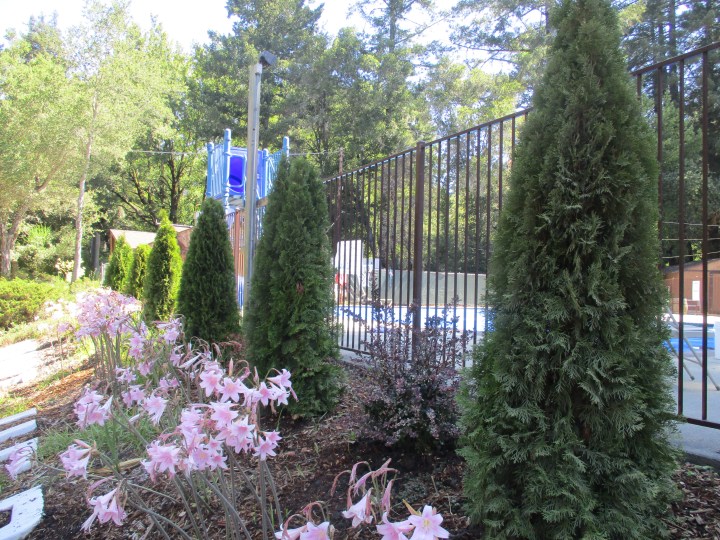
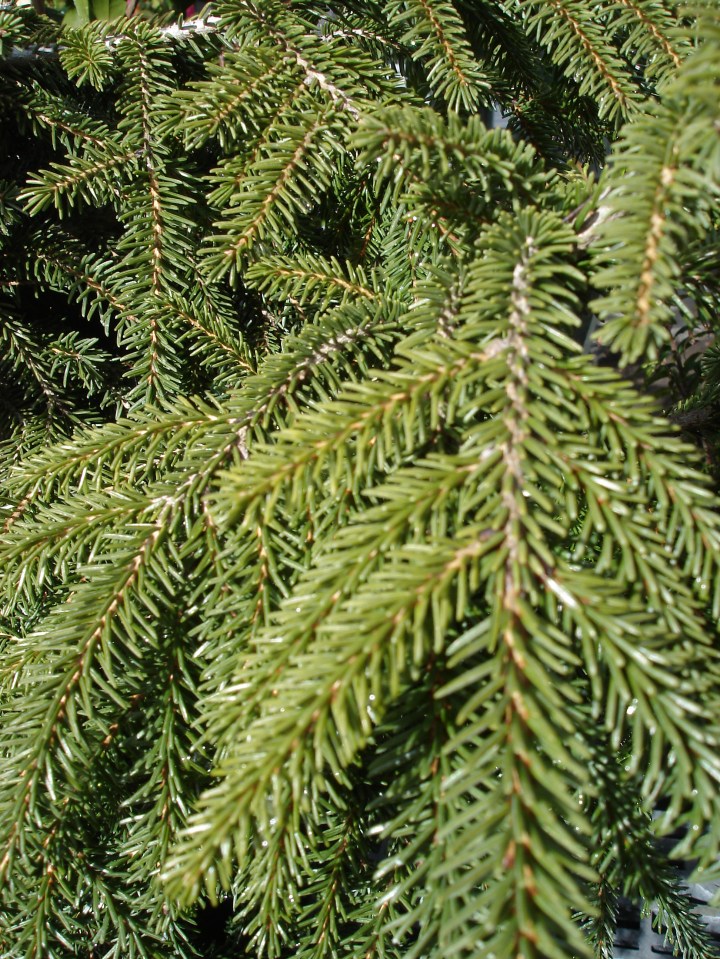 If it got as big as it does in the wild, Oriental spruce, Picea orientalis, would not fit into many home gardens. It can get more than a hundred feet tall! Fortunately, it does not often get much more than twenty five feet tall locally. Trees that compete with taller trees in forested landscapes might get to forty feet tall. Their symmetrically conical canopies get about fifteen or twenty feet broad.
 Conifers are the most prominent forest trees in North America, but are notably scarce in home gardens. Except for compact varieties of juniper (which were probably too common years ago) and arborvitae, most conifers are trees that get too big for residential gardens, and few adapt to regular pruning that might keep them contained. Almost all are evergreen, so block sunlight in winter.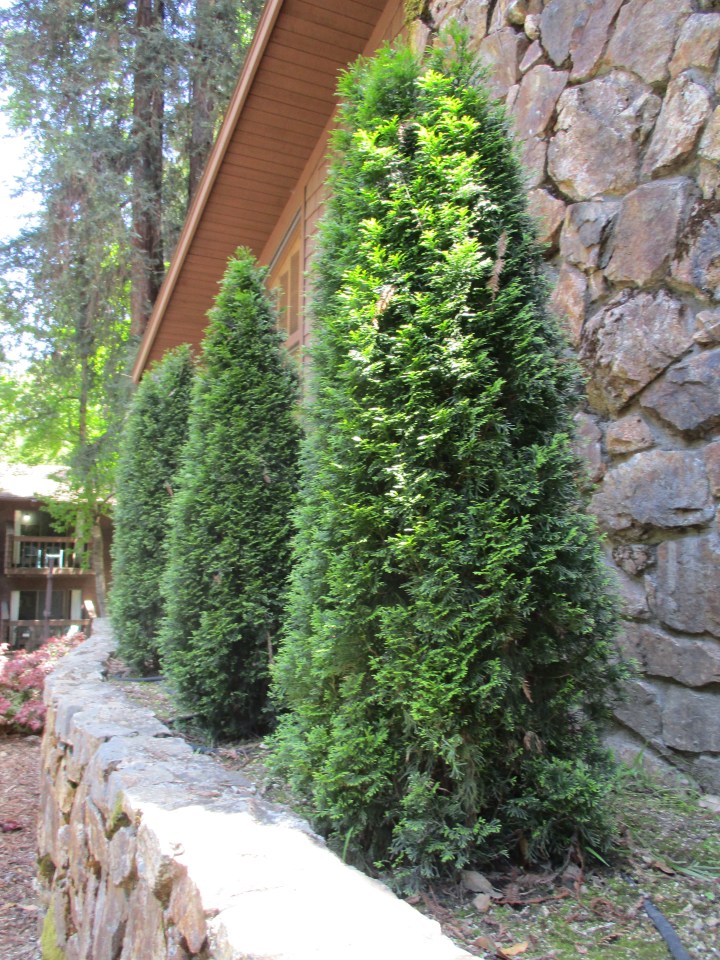
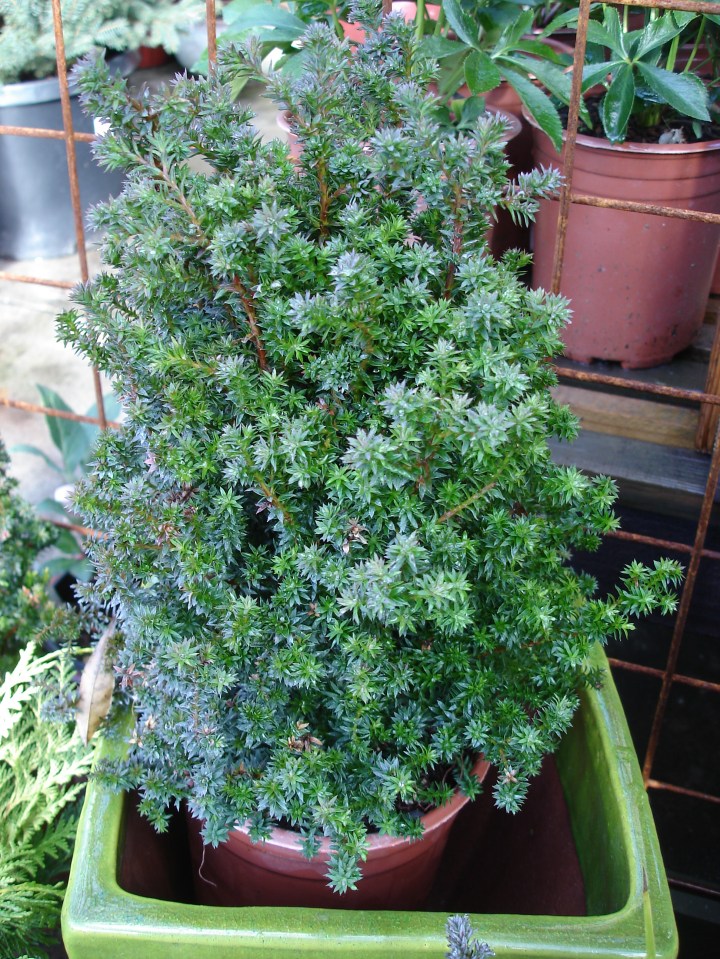 Is it red or white? Actually, it is neither. ‘Whitecedar’ is the common name for Chamaecyparis thyoides, which is a formidable coastal conifer from Maine to Mississippi. ‘Red Star’ is a much smaller garden variety. Its finely textured foliage is bluish green when it first emerges in spring, and can turn slightly purplish or bronzed gray if it gets cold enough in winter, but never turns red.
 Between New England and the Pacific Northwest, the boulevard cypress, Chamaecyparis pisifera ‘Cyano-viridis’, is classified as a small tree, even though it gets no bigger than large shrubbery. Locally, only very mature specimens reach the eaves, without getting much more than half as broad. Trunks and limbs remain concealed by fluffy evergreen foliage. Warm and dry air limit growth.
 Tony Tomeo