Six on Saturday: Cooling Weather

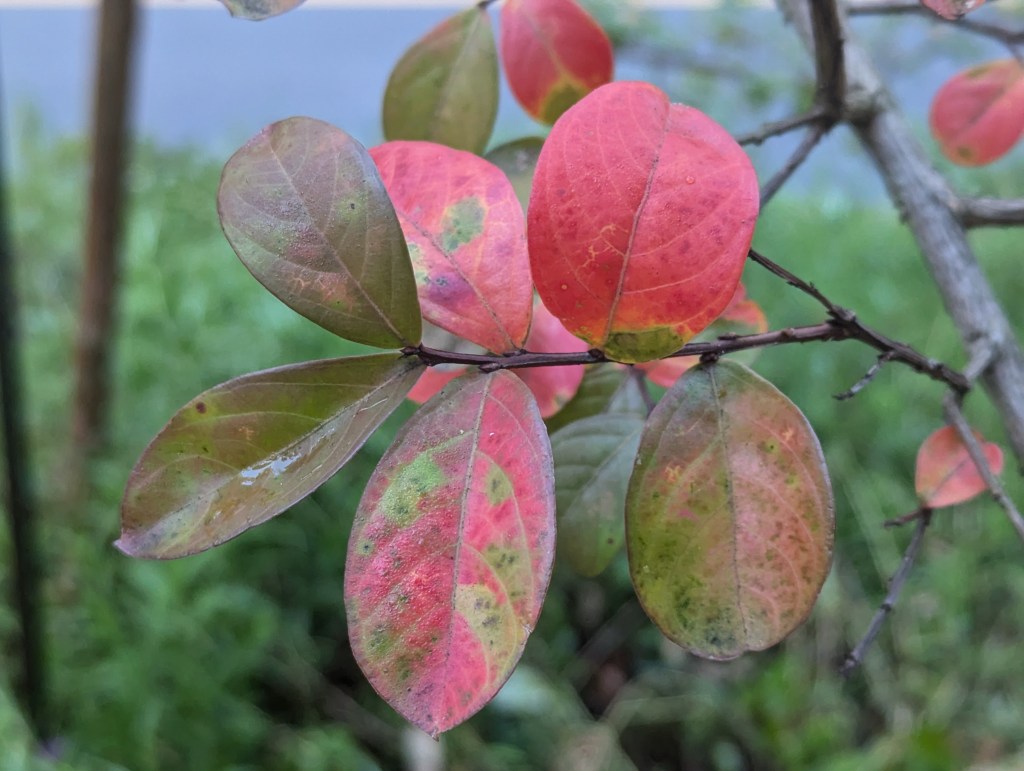
It is looking a bit more like autumn as a few more species respond to cooling weather by discoloring or deteriorating before defoliation.

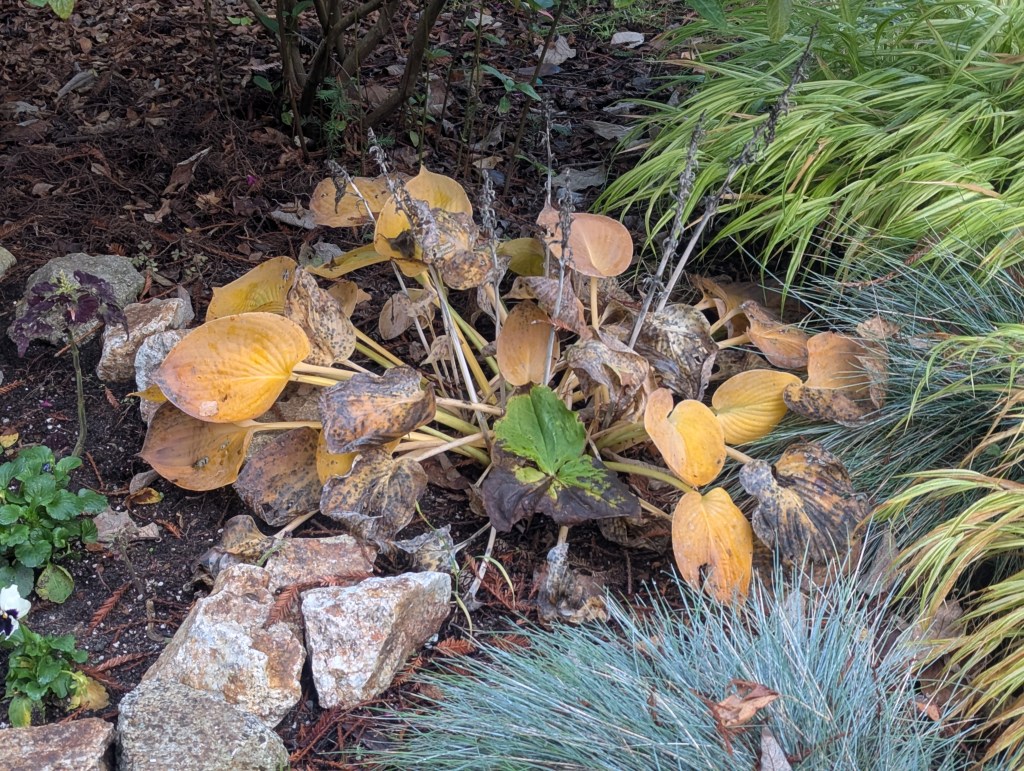
1. Hosta plantaginea, hosta is really looking shabby now. Actually though, it never really looked all that good. The difference is that this shabbiness is because of cooling weather.
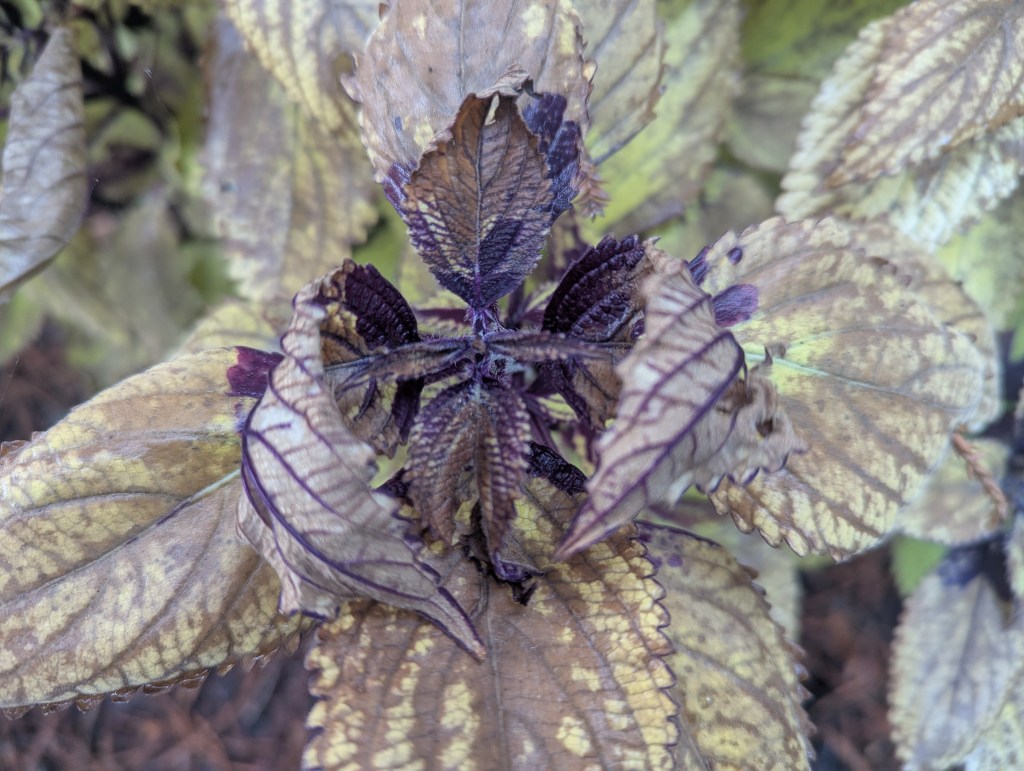
2. Plectranthus scutellarioides, coleus, which looked so splendid for Six on Saturday two weeks ago, is beginning to succumb to cooling weather, as is typical for this time of year.
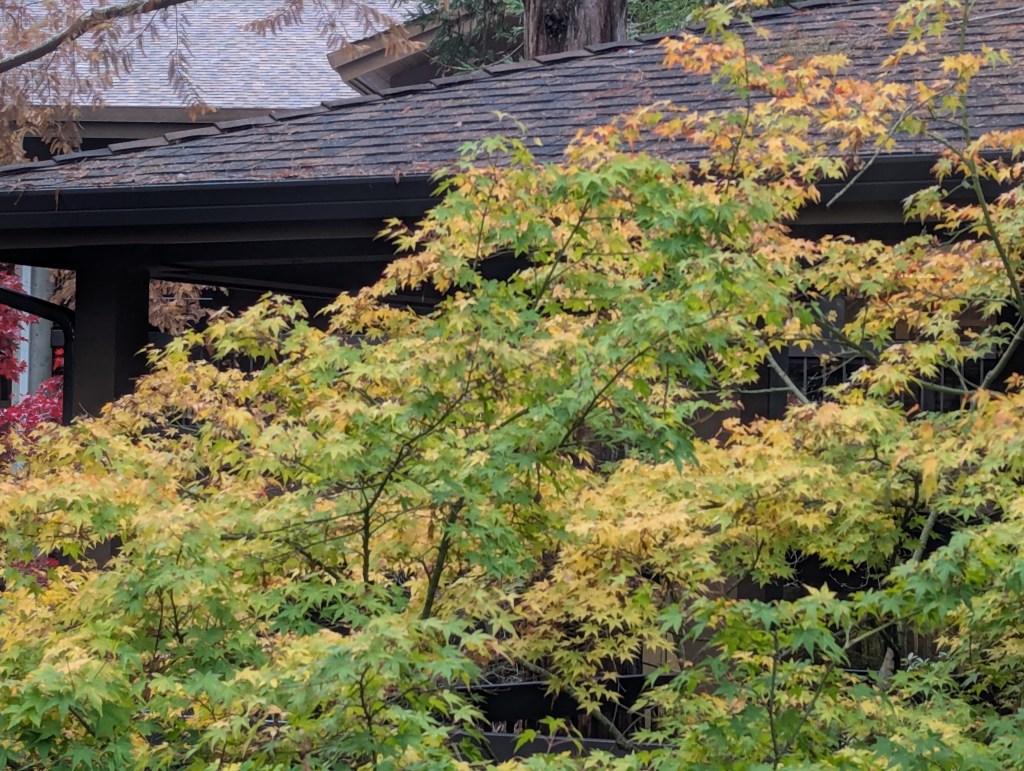
3. Acer palmatum, Japanese maple, which was still green for Six on Saturday two weeks ago, is now beginning to yellow in response to cooling weather, as it should for autumn.
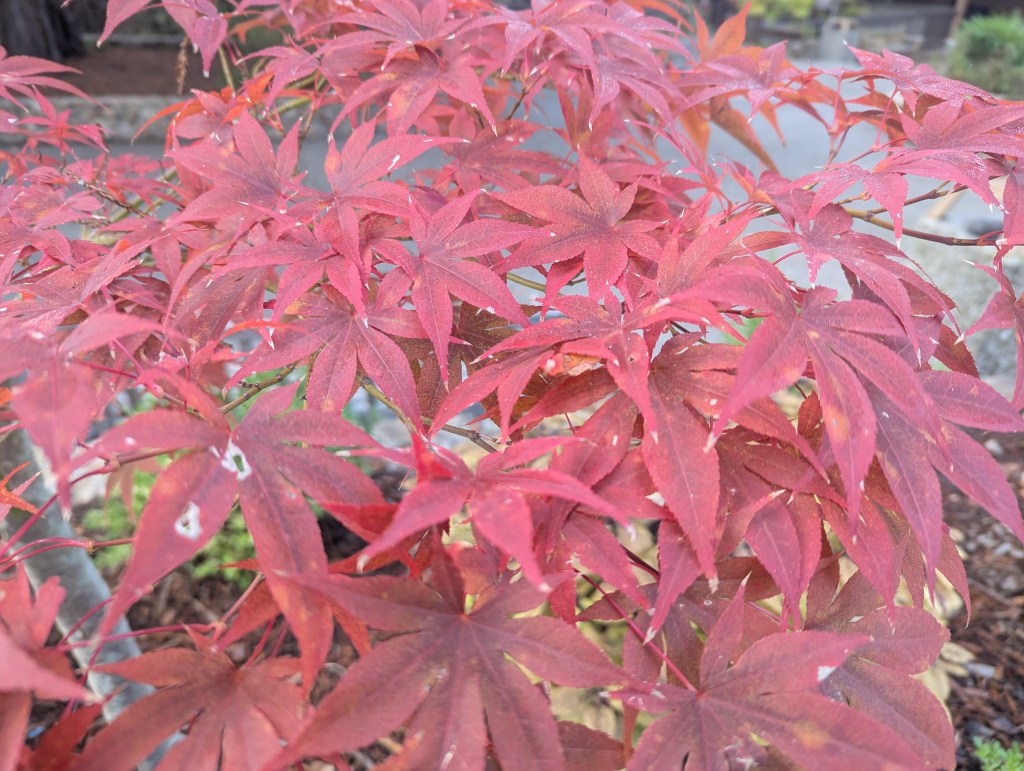
4. Acer palmatum ‘Bloodgood’ Japanese maple was already bronzy red, but is beginning to turn a bit brighter red because of the cooling weather. Its color may linger for a while.
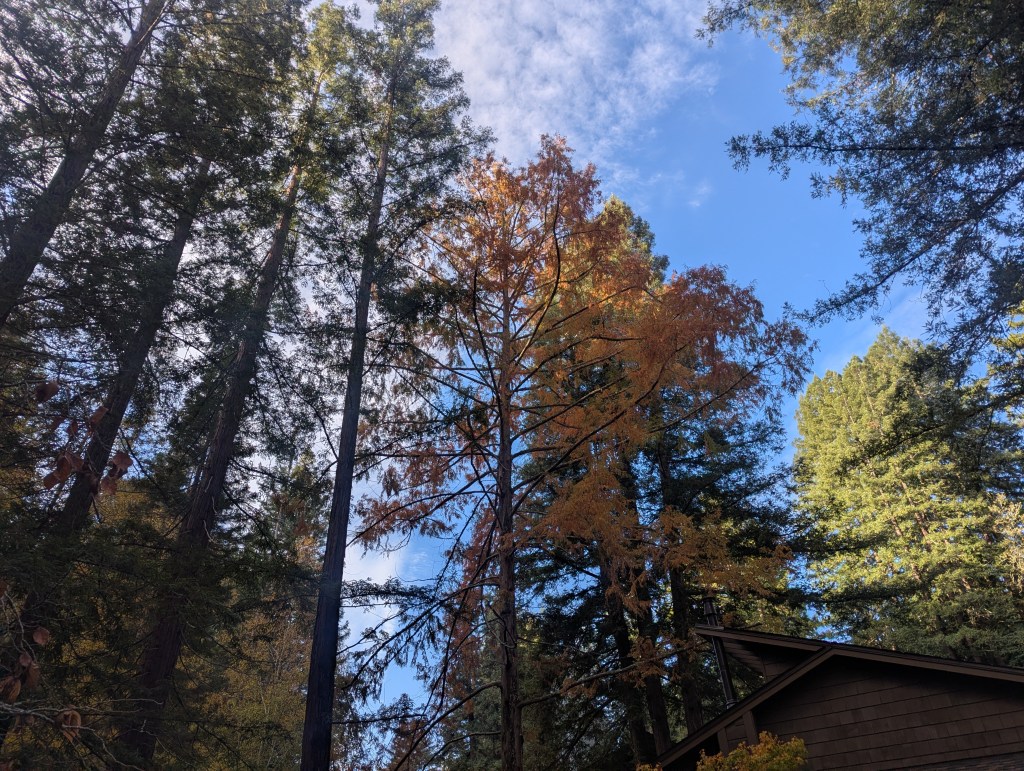
5. Metasequoia glyptostroboides, dawn redwood is likewise beginning to yellow because of cooling weather. It eventually turns brown while all the other redwoods remain green.
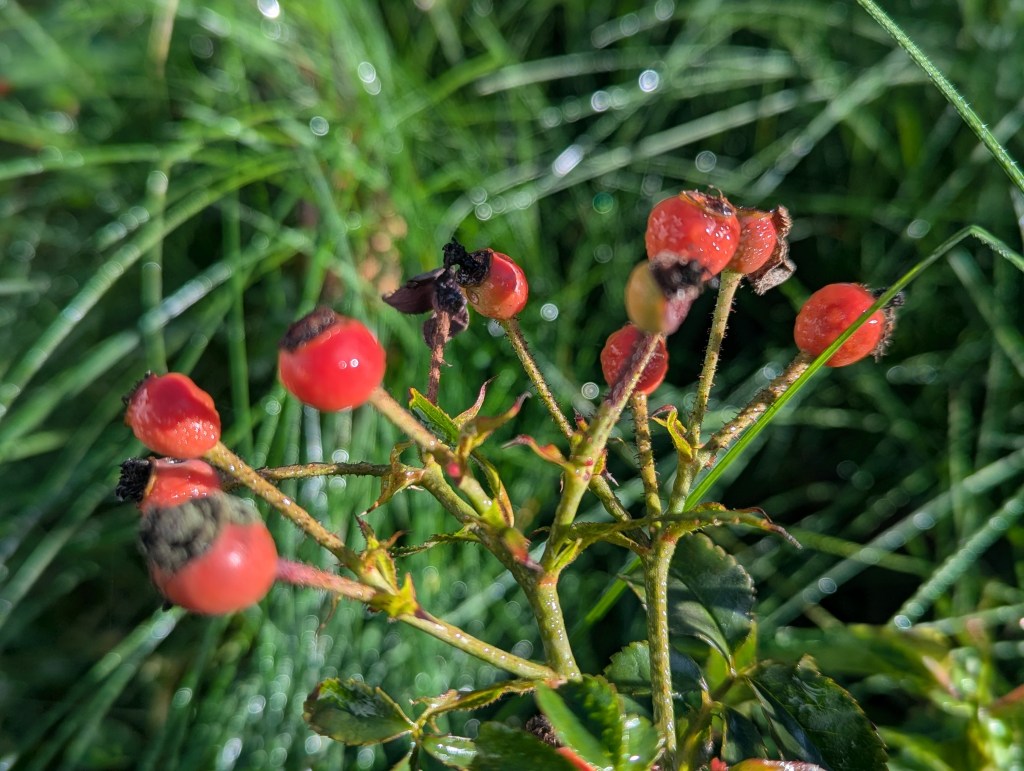
6. Rosa, carpet rose is the only one of these six that is not responding to cooling weather as it produces a few rose hips. I did not expect this. Rose hips are rare in our landscapes.
This is the link for Six on Saturday, for anyone else who would like to participate: https://thepropagatorblog.wordpress.com/2017/09/18/six-on-saturday-a-participant-guide/
Chinese Pistache

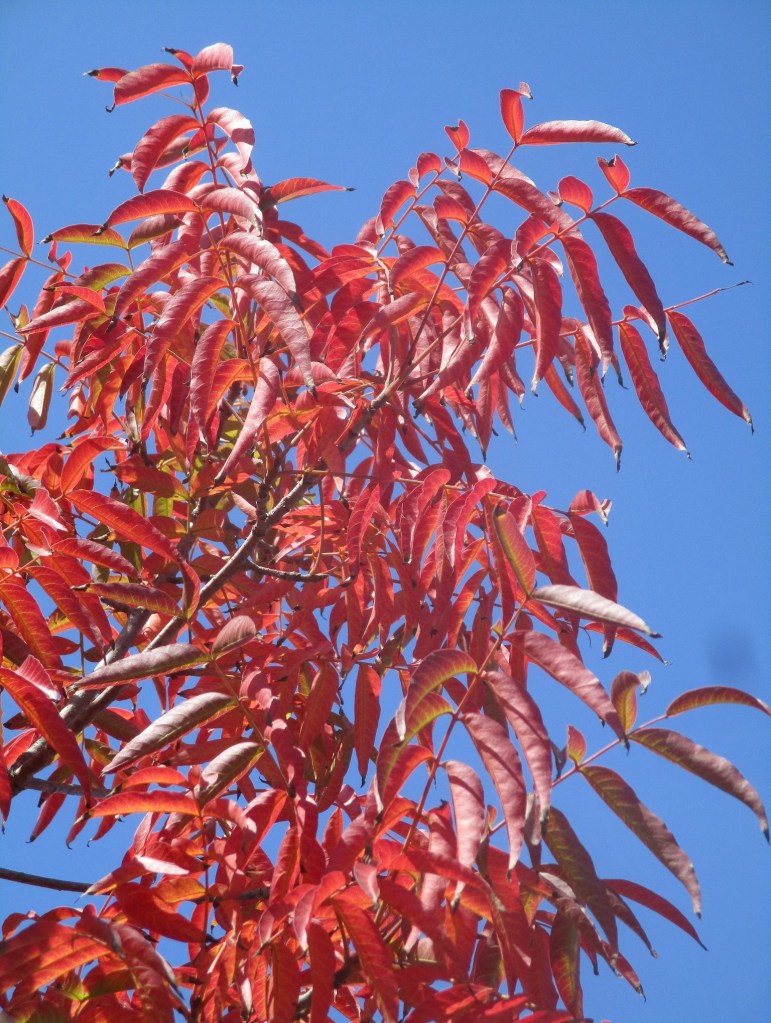
Chinese pistache develops fiery foliar color.

Chinese pistache, Pistacia chinensis, does not need too much chill to begin to turn color. In some climates, it is already yellowing. With cooler weather, it will develop fiery orange and red foliar color. Not only does it color reliably with mild weather, but it actually retains its color better. It could defoliate more efficiently within frostier, windier or rainier weather.

Chinese pistache grows about thirty feet tall and broad. Old trees can eventually grow to about forty feet tall. Some old trees are female, so can produce annoyingly abundant red berries. Modern trees should be fruitless male cultivars. Pinnately compound leaves are about nine inches long, with a dozen or so leaflets. Leaflets are two or three inches long.

Because of its resiliency, Chinese pistache is among the more popular shade trees here. Established trees do not need much irrigation and can likely survive with none. Frequent irrigation can promote shallow root dispersion, which can damage pavement. Otherwise, Chinese pistache is a good street tree. It merely needs pruning for clearance over roads, sidewalks and driveways.

Autumn Foliar Color

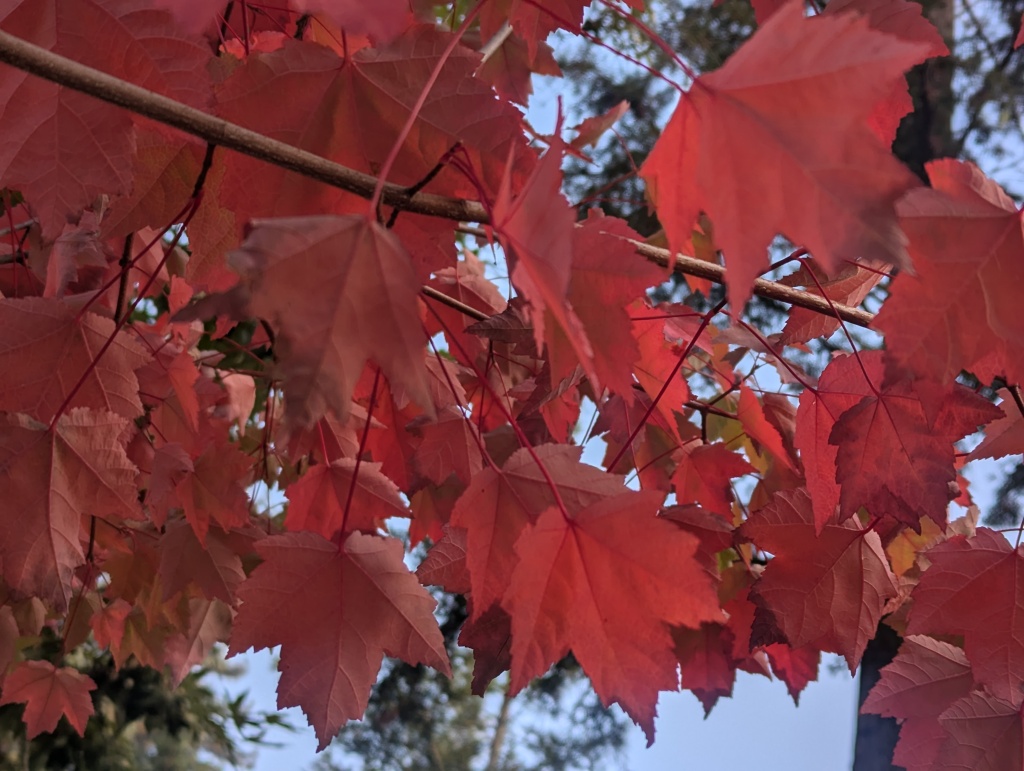
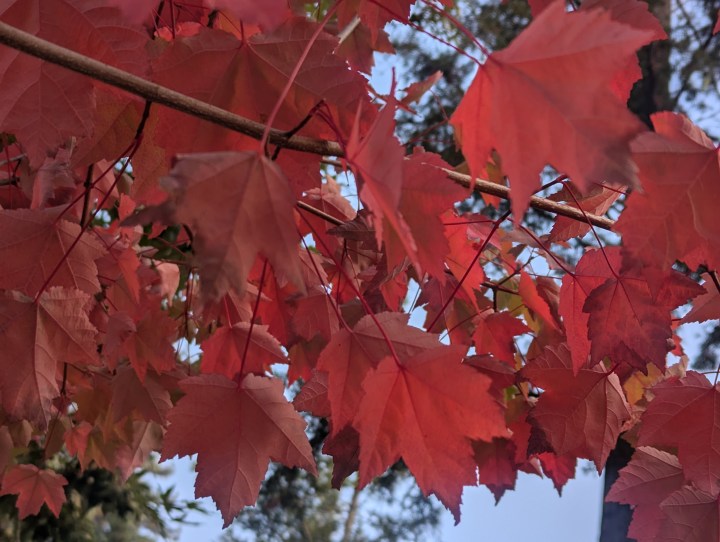
Red maple colors nicely, but the color does not last for long.

Spray paint is no way to get good autumn color in the garden. The healthy rich green king palm out front would look ridiculous and be very embarrassed, not to mention unable to breath, if it were painted yellow, orange and red, like the sweetgum trees that will soon be getting so colorful in the neighborhood now that the weather is getting cool.

Just like every other feature in the garden, autumn foliar color takes proper planning. Most of the plants with the most impressive autumn color happen to be substantial trees, so are not as easy to accommodate in as many situations as flowering annuals are. There are a few smaller shrubby plants and perennials that provide autumn foliar color, but almost all are deciduous, so defoliate to leave bare branches through winter.

Boston ivy (which is not really ivy) is probably the most colorful of climbing vines. It is a bit too aggressive for small spaces though, and damages painted surfaces and just about anything that it gets a hold of. It is best on concrete walls, which is why it is so prominent on freeway soundwalls and overpasses. Grapevine and wisteria are only moderately colorful.

Currant, crape myrtle, pomegranate, smoke tree and redbud are a few of the shrubby plants that provide good color in autumn. Crape myrtle and Eastern redbud are actually more commonly small trees. Many of the Japanese maples with good autumn color are small trees that stay smaller than most shrubbery.

Sweetgum, Chinese pistache, flowering pear and maidenhair tree are the best trees for autumn color, though maidenhair tree turns only bright yellow without the oranges and reds that the others get. Where well exposed, Japanese persimmon is comparable to Chinese pistache. Fruiting pear, apple, apricot, plum, prune and almond trees are not quite as colorful.

Several of the North American and European maples are remarkably colorful, but do not hold their foliage as long as sweetgum does. Silver maple and box elder (maple) happen to be less colorful than the other maples. Various poplars and locusts, as well as tulip tree and black walnut can almost get as bright yellow as maidenhair tree does.

Six on Saturday: Peeping

Autumn foliar color is scarce here, not because the weather is too mild, but because it is not such a priority within landscape design. A few species can develop such color as they do where autumn weather is cooler. Of course, some do not. Native California sycamore is a stately deciduous tree with striking form while bare through winter, but contributes minimal color.

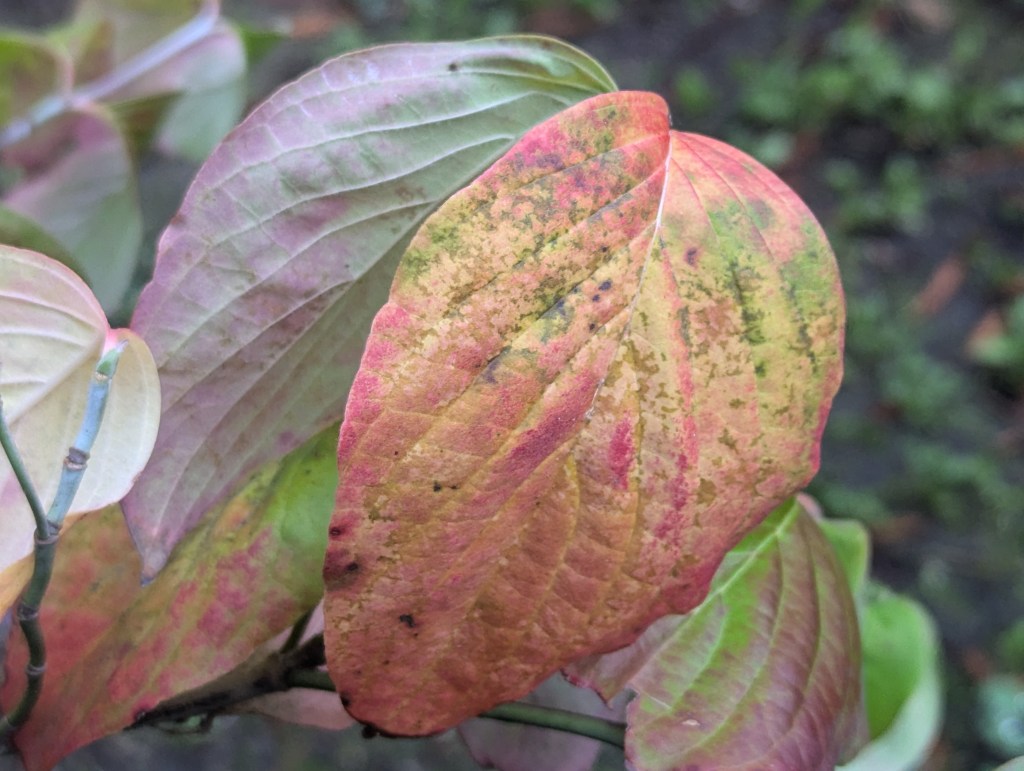
1. Cornus florida, flowering dogwood is just beginning to exhibit foliar color for autumn. It performs surprisingly well in the Santa Cruz Mountains above the Santa Clara Valley.

2. Lagerstroemia indica, crape myrtle is also starting to exhibit foliar color for autumn. It may do so before the weather gets cool, as if it somehow knows what time of year it is.

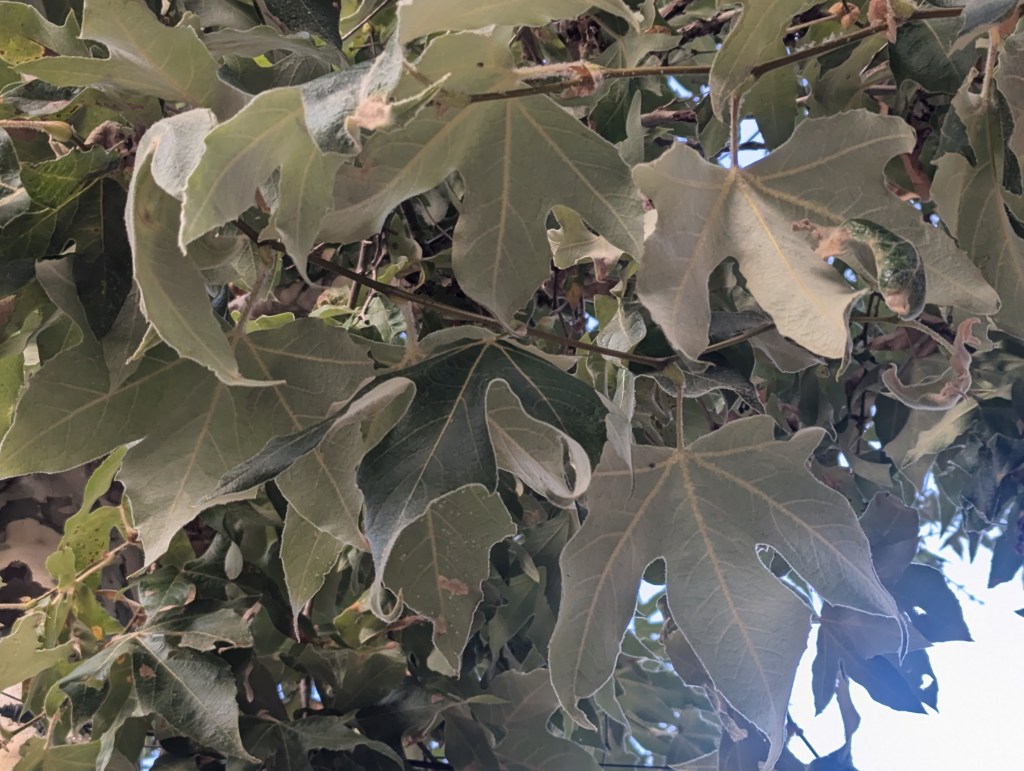
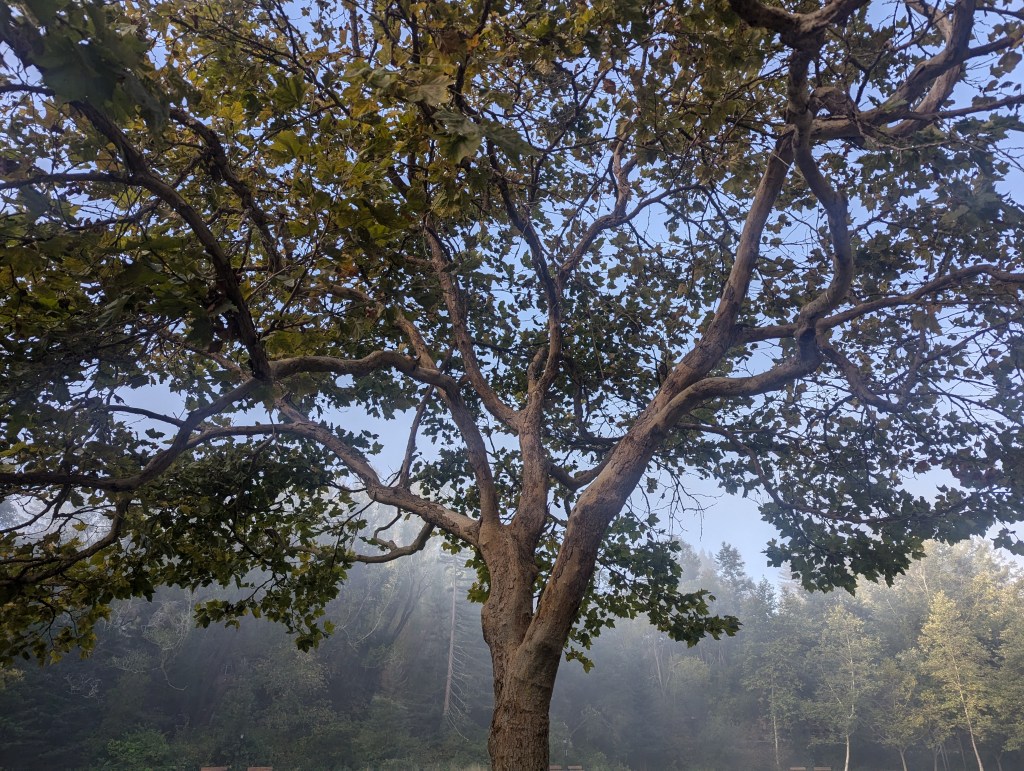
3. Platanus racemosa, California sycamore does not know or care what time of year it is. It is more likely to yellow in response to hot and dry summer weather than to do so now.

4. Platanus X acerifolia, London plane tree is the sycamore with maple foliage. It is just beginning to yellow, but ultimately, does not do much more than that before defoliation.

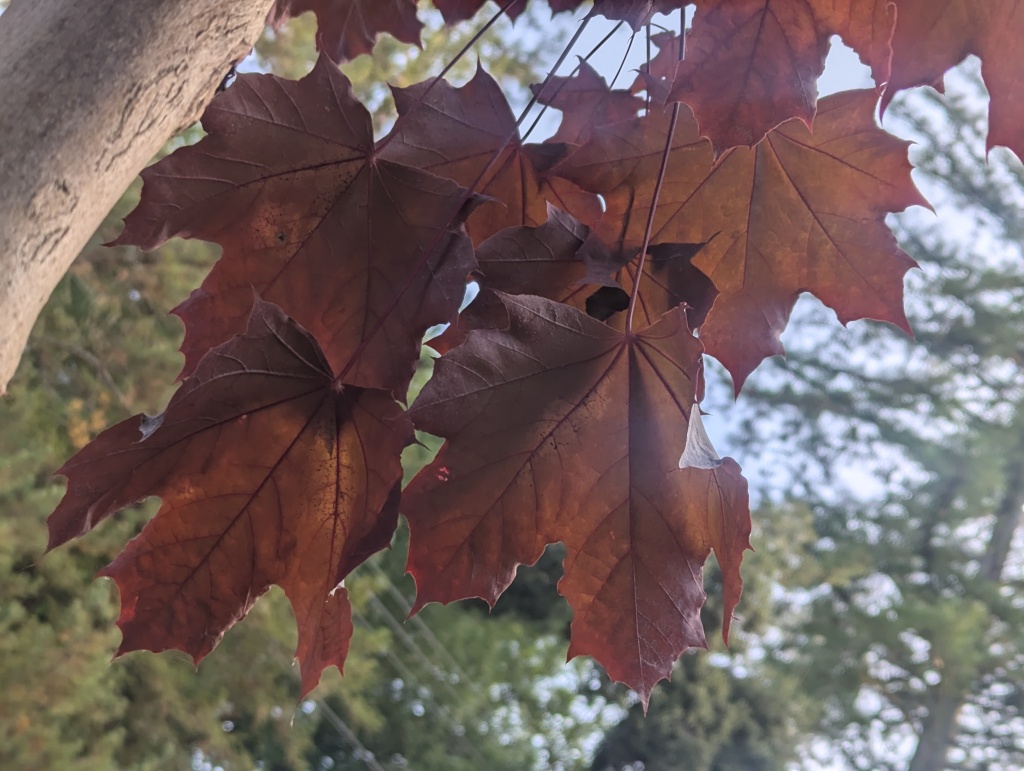
5. Acer platanoides, Norway maple is the maple with sycamore foliage. This cultivar has bronze foliage through summer, so develops its yellow foliar color for autumn quite late.

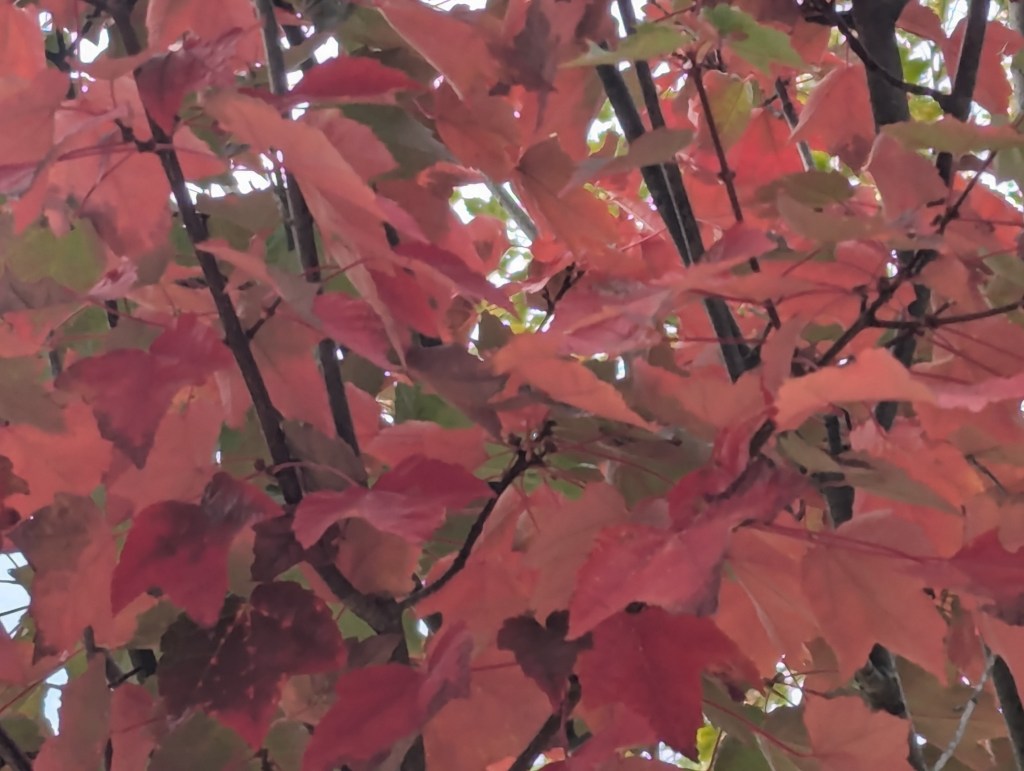
6. Acer rubrum, red maple, like crape myrtle, can develop foliar color for autumn before cool weather, as if it knows what time of year this is. It defoliates relatively early though.

This is the link for Six on Saturday, for anyone else who would like to participate: https://thepropagatorblog.wordpress.com/2017/09/18/six-on-saturday-a-participant-guide/
Autumn Foliar Color Within Mild Climates.

Pistache does not need much chill to develop exquisite foliar color.

Cooler climates may not have so much annual flower color to choose from at the end of summer, but have more autumn color from trees and a few shrubs and vines. The weather is of course different every year, so autumn color is never predictable. Just as some of the typically colorful trees may not be so spectacular every year, some of the more mundane trees may be surprisingly colorful if the weather is just so.

In milder climates, sweetgum (Liquidambar), flowering pear and Chinese pistache are generally the most reliable for the most color as the weather gets cooler. All three exhibit a good range of color, from clear yellow, through orange and bright red. Sometimes, particular colors are more prominent, or even exclusive. For example, Chinese pistache can be completely orange without yellow or red. Some cultivars of sweetgum specialize in particular color ranges. For example, ‘Burgundy’ turns dark red or purplish red without much yellow or orange.

In cooler climates, maples color well. Sugar maple is perhaps the most colorful, comparable even to sweetgum. Unfortunately, it does not hold onto its foliage as tightly, and soon looses it to slight wind or rain. Red maple colors just as reliably, but is more red and brown with less yellow and orange. Norway maple typically turns yellow or somewhat orange. Silver maple turns only dingy yellow, but gets big enough to make quite a show.

The best bright yellow is probably provided by maidenhair (Ginkgo biloba) tree. Birch, honey locust, tulip tree, fruitless mulberry, some willows and poplars can be comparable if the weather turns cool suddenly. Redbud, dogwood, hawthorn and flowering cherry are more subdued shades of yellow, but are grown more for their spring flowers anyway. Persimmon probably provides the best brightest orange foliage, followed by abundant and comparably bright orange fruit!

Some ash, some oaks, Chinese tallow tree, parrotia and dawn redwood all provide their own flavors of autumn color. Dawn redwood and pin oak actually turn simple brown, which some people think makes the trees look dead! Raywood ash turns a nice burgundy red or purplish. However, the old fashioned Modesto ash (which is a type of Arizona ash) turns as bright yellow as fruitless mulberry does. Not all crape myrtles have good fall color, but some are as colorful as sweetgum is. Various hazels, spiraeas and viburnums are colorful shrubbery in autumn. Wisteria vines, which are known more for their colorful spring flowers, turn yellow.

Red Alert

Acer platanoides

Acer platanoides ‘Schwedleri’, is Schwedler’s maple, which is an old fashioned cultivar of Norway maple. It is not a red maple. However, because its new foliage initially emerges with deep burgundy red color, it is often mistaken for red maple, particularly where red maple is uncommon. Its deep burgundy red foliar color does not last long before developing deeper purplish bronze color, with tiny contrastingly greenish yellow flowers. For autumn, the foliage turns yellow. Schwedler’s maple was a common street tree for the many large tracts of suburban homes that were built within the Santa Clara Valley during the late 1950s. Although it has not been available from nurseries for the past few decades, at least two similar but more modern and darker bronze cultivars of Norway maple are becoming more available. Modern cultivars are generally sterile, so are not invasive like the simple species has been within some ecosystems that are more favorable to naturalization than that of the Santa Clara Valley. The Norway maple in the picture above is not ‘Schwedleri’ but looks very much like it.

Acer rubrum is the real red maple, not just because of its often bright red autumn foliar color, but primarily because of its red floral buds that emerge immediately prior to foliation in spring. However, prior to autumn, its foliage is simple green. Red maple was rare here prior to 1990, and by the turn of the Century was still only mildly popular in the Santa Clara Valley. It could be more popular than it is, and realistically, performs better as a street tree than cultivars of Norway maple. Although not as colorful as bronzed cultivars of Norway maple are through summer, its vibrant yellow, orange and typifying red autumn foliar color is superior, even in response to only mild chill.

Acer rubrum

Ginkgo

Ginkgo tree develops brilliant yellow color.

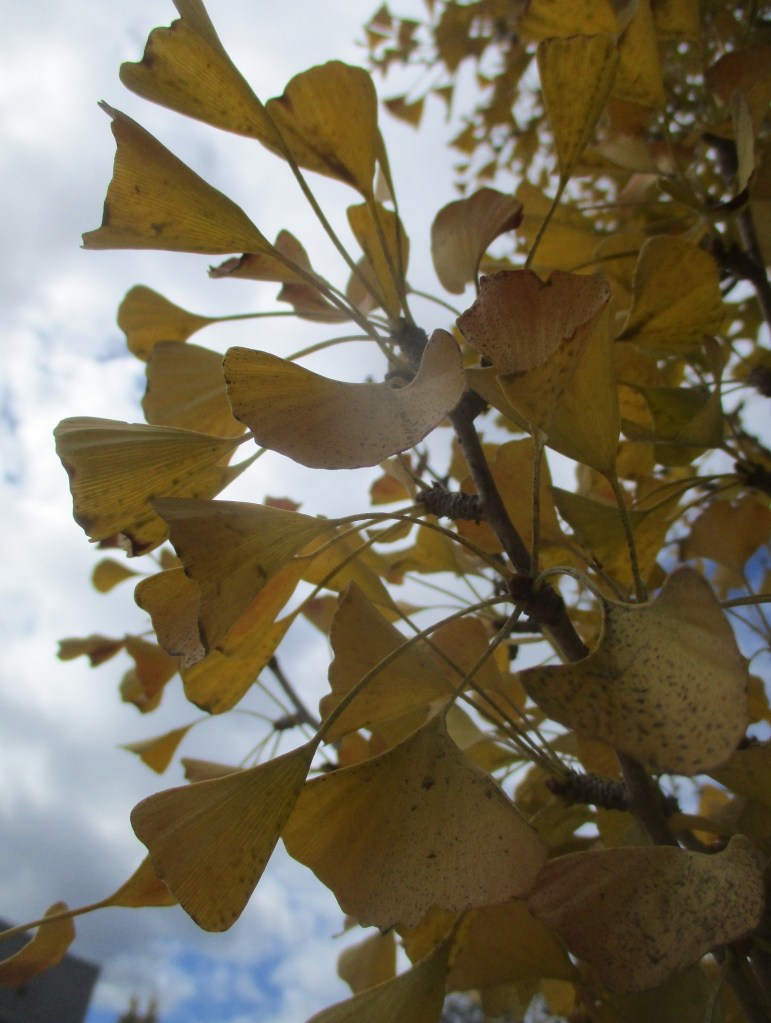
Minimal chill is sufficient for ginkgo, Ginkgo biloba, to develop brilliant yellow foliar color. Mild weather actually enhances retention of foliage after it colors. Colder weather or frost accelerates efficient defoliation. Although less messy, it ruins the spectacular display too soon. Autumn foliar color is monochromatically yellow, but is the best yellow of autumn.

Some old ginkgo trees produce messy fruit with objectionable aroma. This characteristic limited their practicality and popularity. Modern cultivars, though, are male and therefore fruitless. Female cultivars are very rarely available, and mostly only by online purchase. Their fruit and the nuts within are edible. However, only mature trees can be productive.

Ginkgo trees grow somewhat slowly, but can eventually get taller than fifty feet. Modern cultivars are rather slender and perhaps lanky while young. They retain their elegantly irregular structure as they broaden with maturity. Leaves are about two or three inches long. Their venation radiates outward from their petioles, like fishtails, with paired lobes.

Autumn Foliar Color Takes Planning

Some Norway maples are colorful through summer, and then turn yellow for autumn.

Spray paint is no way to get good autumn color in the garden. The healthy rich green king palm out front would look ridiculous and be very embarrassed, not to mention unable to breath, if it were painted yellow, orange and red, like the sweetgum trees that will soon be getting so colorful in the neighborhood now that the weather is getting cool.

Just like every other feature in the garden, autumn foliar color takes proper planning. Most of the plants with the most impressive autumn color happen to be substantial trees, so are not as easy to accommodate in as many situations as flowering annuals are. There are a few smaller shrubby plants and perennials that provide autumn foliar color, but almost all are deciduous, so defoliate to leave bare branches through winter.

Boston ivy (which is not really ivy) is probably the most colorful of climbing vines. It is a bit too aggressive for small spaces though, and damages painted surfaces and just about anything that it gets a hold of. It is best on concrete walls, which is why it is so prominent on freeway soundwalls and overpasses. Grapevine and wisteria are only moderately colorful.

Currant, crape myrtle, pomegranate, smoke tree and redbud are a few of the shrubby plants that provide good color in autumn. Crape myrtle and Eastern redbud are actually more commonly small trees. Many of the Japanese maples with good autumn color are small trees that stay smaller than most shrubbery.

Sweetgum, Chinese pistache, flowering pear and maidenhair tree are the best trees for autumn color, though maidenhair tree turns only bright yellow without the oranges and reds that the others get. Where well exposed, Japanese persimmon is comparable to Chinese pistache. Fruiting pear, apple, apricot, plum, prune and almond trees are not quite as colorful.

Several of the North American and European maples are remarkably colorful, but do not hold their foliage as long as sweetgum does. Silver maple and box elder (maple) happen to be less colorful than the other maples. Various poplars and locusts, as well as tulip tree and black walnut can almost get as bright yellow as maidenhair tree does.

Sweetgum

Sweetgum is impressively colorful for autumn.

This might be the most spectacular and most reliable of autumn foliage available locally. Sweetgum, Liquidambar styraciflua, begins to develop a brilliant blend of yellow, orange and red in response to the earliest mild chill of autumn. It defoliates slowly to retain much of its colorful foliage through the earliest rain and wind of winter, and perhaps even later.

Sweetgum leaves are palmate, and about four inches wide, with five pointed lobes. One very rare cultivar has hierarchically lobed leaves, with lobes on lobes. Another has blunt lobes. Some cultivars as well as individual trees favor particular foliar colors for autumn. ‘Burgundy’ exhibits more dark red color than typical, and retains foliage later than typical.

Mature trees can grow fifty feet tall, but are not very broad. They can get taller and lankier to compete with other tall trees. Their upright form conforms to grove arrangement within large landscapes and parks. Unfortunately, their aggressive roots can displace concrete. Their branches can be structurally deficient. Their spiky and hard fruit can be obnoxious.

Autumn Foliage In Mild Climates

Minor chill initiates autumn foliar color.

Colorful foliage is always present. After all, green is a color, even without any other color or variegation. Defoliation of deciduous foliage during autumn reveals evergreen foliage beyond, even if fading through winter. Immediately prior to defoliation though, deciduous foliage of quite a few species temporarily becomes spectacularly colorful autumn foliage.

Whether deciduous or evergreen, foliage that is most colorful during spring and summer contains chlorophyll. Regardless of how variegated, reddish, purplish, yellowish or other color it might be, it is also green to some degree. It could not be photosynthetically active otherwise. Colorful autumn foliage exhibits brighter color as its chlorophyll decomposes.

Autumn foliage is most spectacular where it is native, such as New England. Much more of it inhabits forests than home gardens. It is not spectacular within forests here because only a few sparsely dispersed native species produce impressive foliar color for autumn. Its naturally local scarcity likely contributes to its limited popularity within home gardens.

Locally mild weather also limits the popularity as well as the potential of autumn foliage. Many of the most colorful maples of New England merely turn blandly pallid yellow prior to hastily premature defoliation here. However, several other species develop exemplary foliar color in response to minor chill, and seem to be as happy here as in New England.

Chinese pistache, sweetgum, flowering pear and ginkgo are four trees that most reliably provide autumn foliage here. Crape myrtle is a smaller tree that is almost as reliable, and blooms splendidly for summer. Persimmon gets as colorful as Chinese pistache, with an abundance of fruit. Boston ivy is a vine with color that is comparable to that of sweetgum.

Of course, even the most appealing of plants are not perfect. Their innate characteristics are relevant to selection. For examples, trees occupy significant space. Ginkgo becomes bright yellow, but without any other color. Sweetgum produces obnoxiously prickly fruits. Flowering pear is susceptible to fireblight. Boston ivy clings to surfaces and ruins siding, paint and fences.