Combustible debris accumulates in gutters and behind chimneys.
There are several reasons why fireplaces are not nearly as commonly used as they once were. Modern building regulations have prevented construction of newer fireplaces (except pellet stoves). Many fireplaces that were ruined by the Loma Prieta Earthquake were never replaced; partly because there are other more efficient sources of heat, and partly because of the concern of air quality. The fuel that was once relatively easy to obtain from orchards that were getting removed to relinquish their land for urban development has been exhausted.
Regardless, those of us who use fireplaces need to be certain that they do not become overwhelmed by trees or climbing vines. Cypress, cedars, pines and some fan palms are remarkably combustible and hazardous when they get too close to chimneys, particularly if the roofs below are covered with old fashioned cedar shingles.
All trees and vines should be pruned away from chimneys so that they are out of reach of sparks and heat. The more combustible trees should get more clearance than deciduous trees (that are bare through winter) need. Nearby Monterey pines, Cypress and any trees that tend to accumulate debris should be groomed of debris, even if their limbs are already pruned back for sufficient clearance.
Trees should also be pruned for clearance from roofs and gutters; and any accumulated debris should be removed. Even before the weight becomes sufficient to cause damage, the motion of limbs in the wind is abrasive to roofs. Older roofs, particularly cedar shingles, will deteriorate under any accumulation of organic debris, particularly as it gets wet from rain.
Autumn foliar color is a reminder that, regardless of pleasant weather, it really is autumn. The days are getting shorter. The weather is getting cooler. Households with operational fireplaces or wood stoves may resume using them. Firewood will therefore become more of a desirable commodity. A few trees might require pruning for clearance from chimneys.
Only several decades ago, firewood was much more popular than it is now. More homes that were modern for their time featured fireplaces. Other options for heating, such as gas and electricity, were relatively more expensive. Firewood was still more readily available from nearby orchards, farms or forests. Air pollution was not such a concern like it is now.
Almost no modern homes feature fireplaces now. Modern building codes in most regions disallow installation of fireplaces or wood stoves. Gas and even electric heating systems are more efficient than in the past. Many orchards and forests that provided firewood are now gone. Not many who inhabit houses with fireplaces have time to cut and split wood.
Besides, fireplaces and wood stoves lack thermostats or any method of regulation. They also generate considerable volumes of ash and are messy to clean. Enough firewood for the season occupies significant space in a garden. Then, firewood must be brought in to the fireplace or wood stove. It is no wonder that modern heating systems are so popular.
Nonetheless, firewood is not completely obsolete. It is a renewable resource that literally grows on trees. Many tree service businesses sell mixed firewood as a byproduct of their work. Ideally, they prefer to leave it where they perform their work, for whomever wants it. Woodcutters provide specific types of firewood from private forests, or perhaps orchards.
By now, firewood for this season must be seasoned, or completely dried. Otherwise, it is difficult to ignite, burns inefficiently, and produces excessive smoke. Wood that is still too fresh will be ready to burn for the next season. Although wood can eventually rot outside. Palm, cordyline and yucca trunks burn too fast without enough heat to work as firewood.
Despite the pleasant warm weather, it will be autumn soon. This is the time to get ready for cooler weather through autumn and winter. The plants in the garden do that on their own without our help. They somehow seem to know what time it is. We only need to clean up the mess and empty the gutters when deciduous trees start to drop their leaves later. Most of our work involves features that are not plants.
Winters are so mild here that some of our work often gets delayed until it becomes necessary. If needed, we can paint, stain and seal decks, fences, patios and anything else outside anytime the weather allows right through winter. Many of us leave patio furniture outside all year both because the weather is not too harsh on it, and because patios are usable spaces even through winter.
Firewood is also commonly neglected or not even needed, but for different reasons. Many fireplaces were damaged or destroyed by the Loma Prieta Earthquake decades ago, and never repaired or replaced. Modern building codes outlawed the construction of new fireplaces even prior to that; so newer fireplaces are instead pellet stoves. Those of us who still use old fireplaces and stoves have more difficulty obtaining wood now that the orchards are gone and the outskirts of town are so much farther from home.
The advantage of pellet stoves is that fuel (which looks like stove food) is always available so does not need to be accumulated, stored and seasoned. The fuel also burns cleaner. Synthetic logs (made from compressed wood byproducts and fuel) are an expensive alternative for conventional fireplaces and stoves, but also burn cleaner than wood, and are always available. They are lightweight and clean, so can be picked up at the store and brought home in the trunk of a small car whenever a fire is wanted in the fireplace.
Good old fashioned firewood is both more work and stigmatized because of pollution. Those of us who do not have firewood available within our own gardens can purchase it from some tree service companies. It is most commonly obtained already split and seasoned directly from the wood yard where the tree service company stores it. It can be delivered for a price. Some people even like to pay a bit extra to get it stacked.
Firewood obtained in this manner is typically a mix of random woods from trees found in local landscapes. There is often a preponderance of a particular type of wood. No one ever knows what to expect. The specific type of wood is designated only when a large tree or group of trees needs to be removed, and can be isolated from mixed wood. Palms and yuccas, known as ‘herbaceous trees’, do not produce effective firewood! A few pieces in a load of firewood should not hurt anything, but palm or yucca ‘wood’ should not be purchased. Mixed wood often contains some resinous wood and eucalyptus, which burns just fine, but produces a bit more soot that needs to be cleaned from chimneys.
Firewood should be obtained annually in quantities that are likely to be used each winter. It is perishable, and can rot if stored several years outside. Even if it does not rot, it can become infested with rodents if it stays idle too long. Besides, excessive firewood simply takes up space that could be used for something else.
Firewood was much more popular only a few decades ago. It was readily available from displaced orchards and nearby forests. Fireplaces and even a few woodstoves were not yet so uncommon. People were more motivated to cut and split firewood. More than now purchased it already cut and split. For heating, gas and electricity were more expensive.
Firewood is not so readily available nowadays. Forests are not so nearby. Orchards that were subject to displacement in the past are now completely gone. Most firewood that is available for purchase is a byproduct of arboriculture. Yet, it may not be much less costly than gas or electricity for warmth. Gas or electricity are more convenient and less messy.
Fireplaces and woodstoves are not so common nowadays either. Modern building codes prohibit them from new construction. Repair is rarely justifiable for any that incur damage from earthquakes. Because most are very rarely if ever in use, their removal is generally more practical. The many more households that are here now utilize much less firewood.
However, firewood is not obsolete. It is a renewable resource that very literally grows on trees. Some households consume only very minor volumes from their home landscapes. Some households purchase more significant volumes of it from tree service businesses. In some communities, it is available from woodcutters who harvest it from private forests.
Regardless of its source, firewood for this autumn and winter must be seasoned by now. In other words, after cutting and splitting, it needed time to dry thoroughly. Otherwise, it is difficult to ignite, produces excessive smoke, and burns inefficiently. Palm, cordyline and yucca trunks are not suitable for firewood. They burn fast, but do not produce much heat.
Average home gardens do not produce much firewood. However, removal of a single big tree can instantly provide an abundance. Tree services prefer to leave such wood where it falls. They usually cut it to fit fireplaces but do not split it. Those with an abundance are often happy to share, especially if they use none. It occupies space, and eventually rots.
Firewood must be seasoned by now. Fresh wood will be seasoned for next year.
There are several reasons why fireplaces are not nearly as commonly used as they once were. Modern building regulations have prevented construction of newer fireplaces (except pellet stoves). Many fireplaces that were ruined by the Loma Prieta Earthquake were never replaced; partly because there are other more efficient sources of heat, and partly because of the concern of air quality. The fuel that was once relatively easy to obtain from orchards that were getting removed to relinquish their land for urban development has been exhausted.
Regardless, those of us who use fireplaces need to be certain that they do not become overwhelmed by trees or climbing vines. Cypress, cedars, pines and some fan palms are remarkably combustible and hazardous when they get too close to chimneys, particularly if the roofs below are covered with old fashioned cedar shingles.
All trees and vines should be pruned away from chimneys so that they are out of reach of sparks and heat. The more combustible trees should get more clearance than deciduous trees (that are bare through winter) need. Nearby Monterey pines, Cypress and any trees that tend to accumulate debris should be groomed of debris, even if their limbs are already pruned back for sufficient clearance.
Trees should also be pruned for clearance from roofs and gutters; and any accumulated debris should be removed. Even before the weight becomes sufficient to cause damage, the motion of limbs in the wind is abrasive to roofs. Older roofs, particularly cedar shingles, will deteriorate under any accumulation of organic debris, particularly as it gets wet from rain.
Fireplaces and wood stoves are not completely obsolete. They are merely less common than they were years ago. Modern building codes prohibit them within new construction. For some that incur damage from earthquakes, removal is more practical than repair. Not many people use fireplaces and wood stoves nowadays anyway. Nonetheless, a few do.
Sources of firewood have also changed. Displacement of orchards and forests by urban developments had been reliable sources. Such orchards are now gone. Forests are now farther away, and protected from harvest. Instead, most wood fuel is now obtainable from the tree service industry. Scrap from tree maintenance and removal converts to firewood.
Unlike uniform firewood from former orchards, scrap wood is variable. Orchards produce only one type of firewood from their unvaried trees. Firewood from forests involves only a few species that may remain separate for sale. Scrap wood can include any species that a particular tree service encounters. Except for larger volumes, separation is impractical.
The tree service industry provides less firewood than displaced orchards and forests did. However, nowadays, less firewood is necessary. There are many more homes here than years ago, but very few consume wood for heat. Residents who choose to burn firewood are now generally less selective. Yet, some might separate mixed firewoods accordingly.
Tree services prefer to leave firewood where it lands. They charge for removal of excess firewood. They typically cut logs to firewood lengths, but do not split them. Neighbors are therefore sometimes pleased to share wood from removed trees. Tree services sell wood that they must remove, after splitting and seasoning it. They typically charge for delivery.
Firewood for this winter must have seasoned by now. Most types should have sufficiently seasoned if cut and split before last spring. Fresh firewood can not season so late during increasingly cool and damp weather. Scrap from winter pruning can become firewood for next winter. Palms and other monocots do not produce actual wood that burns efficiently.
Despite the pleasant warm weather, it will be autumn soon. This is the time to get ready for cooler weather through autumn and winter. The plants in the garden do that on their own without our help. They somehow seem to know what time it is. We only need to clean up the mess and empty the gutters when deciduous trees start to drop their leaves later. Most of our work involves features that are not plants.
Winters are so mild here that some of our work often gets delayed until it becomes necessary. If needed, we can paint, stain and seal decks, fences, patios and anything else outside anytime the weather allows right through winter. Many of us leave patio furniture outside all year both because the weather is not too harsh on it, and because patios are usable spaces even through winter.
Firewood is also commonly neglected or not even needed, but for different reasons. Many fireplaces were damaged or destroyed by the Loma Prieta Earthquake decades ago, and never repaired or replaced. Modern building codes outlawed the construction of new fireplaces even prior to that; so newer fireplaces are instead pellet stoves. Those of us who still use old fireplaces and stoves have more difficulty obtaining wood now that the orchards are gone and the outskirts of town are so much farther from home.
The advantage of pellet stoves is that fuel (which looks like stove food) is always available so does not need to be accumulated, stored and seasoned. The fuel also burns cleaner. Synthetic logs (made from compressed wood byproducts and fuel) are an expensive alternative for conventional fireplaces and stoves, but also burn cleaner than wood, and are always available. They are lightweight and clean, so can be picked up at the store and brought home in the trunk of a small car whenever a fire is wanted in the fireplace.
Good old fashioned firewood is both more work and stigmatized because of pollution. Those of us who do not have firewood available within our own gardens can purchase it from some tree service companies. It is most commonly obtained already split and seasoned directly from the wood yard where the tree service company stores it. It can be delivered for a price. Some people even like to pay a bit extra to get it stacked.
Firewood obtained in this manner is typically a mix of random woods from trees found in local landscapes. There is often a preponderance of a particular type of wood. No one ever knows what to expect. The specific type of wood is designated only when a large tree or group of trees needs to be removed, and can be isolated from mixed wood. Palms and yuccas, known as ‘herbaceous trees’, do not produce effective firewood! A few pieces in a load of firewood should not hurt anything, but palm or yucca ‘wood’ should not be purchased. Mixed wood often contains some resinous wood and eucalyptus, which burns just fine, but produces a bit more soot that needs to be cleaned from chimneys.
Firewood should be obtained annually in quantities that are likely to be used each winter. It is perishable, and can rot if stored several years outside. Even if it does not rot, it can become infested with rodents if it stays idle too long. Besides, excessive firewood simply takes up space that could be used for something else.
Chimneys are easy to neglect. Some are external to the homes they serve. They occupy visible but minor garden space. Others are internal. Only portions that extend above their respective roofs are visible. Besides the use of accompanying fireplaces or woodstoves, they do not change with the seasons. Nonetheless, chimney clearance is very important.
Trees and vines often extend growth over the tops of chimneys. They grow most actively while chimneys are least active through spring and summer. Such growth is hazardously combustible within the exhaust of chimneys below. Essential chimney clearance pruning eliminates hazardous vegetation prior to the use of associated fireplaces or woodstoves.
Various eucalyptus, cypress, pine, cedar, juniper, fir, spruce, oak and bearded fan palms are very combustible. Deciduous oaks become less combustible as they defoliate during cooling weather though. Other deciduous vegetation is likewise less combustible by the time chimneys are most in use. Vines can accumulate debris directly on top of chimneys.
Vegetation within ten feet of a chimney should generally be two feet below the top of the chimney or fifteen feet above it. More combustible vegetation justifies more clearance or more vigorous grooming. Accumulated dry detritus is more hazardous than fresh foliage. Burning vegetation drops burning debris onto other combustible vegetation and material.
Of course, fireplaces, woodstoves and their associated chimneys are not as common as they were in the past. Most municipalities banned them from new construction during the past many years. Removal of chimneys that incur damage from earthquakes is generally more practical than repair. Chimney clearance becomes unnecessary without chimneys.
Furthermore, few surviving chimneys experience as much use as they did decades ago. Modern heating systems are much more practical and efficient. They generate no smoke to offend neighbors. They are unregulated by ‘no-burn’ alerts. Now that urbanization has replaced orchards and woodlands, firewood might be expensive from local tree services.
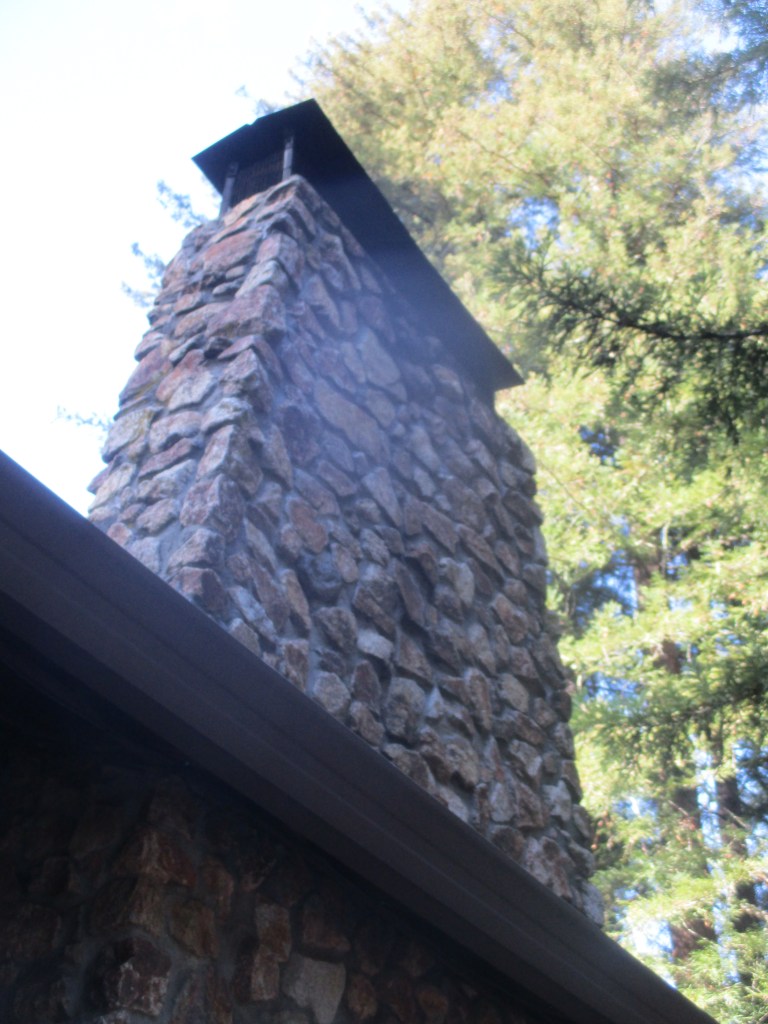
Even as autumn weather cools, smoke rising from a simple old fashioned brick chimney is a rare sight nowadays. A smoking stovepipe is rarer. Modern building codes forbid the installation of new fireplaces or wood stoves within most municipalities here. Modern air quality ordinances severely limit the use of existing fireplaces and wood burning stoves.
Furthermore, existing fireplaces and wood stoves are neither as popular nor as common as they had been. After an earthquake, a faulty chimney is likely to justify removal rather than repair. An unused wood stove wastes too much space. Old orchards that generated inexpensive firewood as they relinquished their space to urban development are extinct.
There are a few advantages to these modern trends though. Modern homes consume so much less energy for heating than older homes because of efficient insulation. Insulation of older homes retains heat that fireplaces generate, so that less wood is needed. Almost every surviving chimney has a spark arrestor. Modern roof materials are noncombustible.
Nonetheless, vegetation that gets too near to a chimney that is in use can be hazardous. Even if clearance was adequate last winter, trees, vines and large shrubbery grew since then. It does not take long for such vegetation to overwhelm a chimney, or encroach a bit more than it should. It does not take too much vegetation to be hazardously combustible.
Clinging vines like English ivy and Boston ivy sometimes climb up and then over the top of a chimney. Although not especially combustible, they will burn directly over a fireplace or wood stove. Just like gutters do, vines can accumulate leaves that fall from deciduous trees to become more combustible. Birds or rodents can build combustible nests in them.
Evergreen trees and big shrubbery are similarly combustible over a chimney. Deciduous trees are generally not as hazardous. Conversely, cypress, pine, cedar, eucalyptus, large junipers, and ungroomed palms are very combustible. Eucalyptus foliage will burn while fresh, if it gets hot enough. The other trees tend to accumulate very combustible detritus.
Firewood from tree services might be an unknown mix.
Fireplaces and wood stoves simply are not as common as they were only a few decades ago. Because of modern building codes, most that get damaged by earthquakes get removed or replaced by pellet stoves. The orchards that once provided so much inexpensive firewood while they were being cleared for urban development are now gone. The wood yards in the relatively arboraceous outskirts of town are farther away. Many municipalities have established ordinances to limit smoke, although this is not a problem if well seasoned wood gets burned properly, and only means that fireplaces can not be used on ‘spare the air’ days.
Firewood can be purchased from tree services that need to dispose of wood anyway. Because it is only a byproduct of tree work, it will likely need to be stored and seasoned the year before it is needed, just like orchard wood. (Firewood from wood yards gets seasoned before it gets sold.) Some types of wood that are often mixed in leave a bit more residue in chimneys, necessitating more frequent chimney sweeping. Realistically though, chimneys should be cleaned regularly anyway.
Because firewood is perishable, it should be obtained annually, in quantities that will be used in a single winter. It can rot if stored outside too long. If stored in a shed or garage too long, it can get infested with rodents. Besides, too much firewood occupies quite a bit of space.
Synthetic logs (made from compressed wood byproducts and fuel) are an effective, clean and efficient alternative to real wood that do not need to be seasoned. Each log burns about as long as several real logs, and produces about as much heat, so only a few go a long way. They are always available from supermarkets, and can be brought home with the groceries. Pellet stoves that consume fuel pellets that look like stove food are even more efficient. However, there is no substitute for a fire with real wood in a real fireplace or wood stove.




 Tony Tomeo