‘The Wise Old Owl’

Filoli

(This article is several years old, so contains outdated information.)

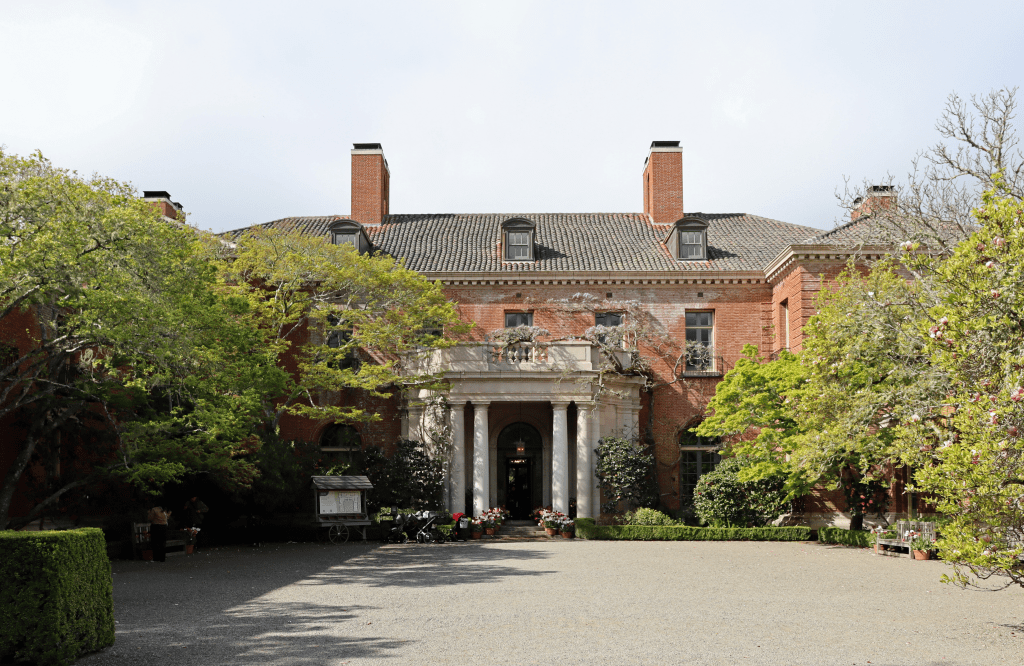
The sixteen acres of gardens of Filoli are spectacular and horticulturally compelling throughout the year. However, the weather through winter, although more pleasant than other places in the world, is not always quite so compelling or conducive to garden tours. At Filoli though, this is not a problem. More than six hundred volunteers and the Filoli staff merely bring the outdoors indoors, by selecting materials from the garden to adorn the interior of the 36,000 square foot Filoli residence for ‘The Wise Old Owl’, the annual fund raising Holiday Traditions Boutique.

While perusing The Wise Old Owl merchandise, guests can enjoy how so much more than flowers can be brought in from the garden to deck out the home. Bare stems, gnarly limbs, evergreen foliage, pine cones, bark and all sorts of bits and pieces of the autumn and winter garden demonstrate the potential for alternatives to traditional cut flowers that we may not even recognize as useful materials in our own gardens. Of course, there will be no shortage of the less abundant flowers that bloom through the season and decoration that are not out of the garden, as well as live music to enhance the display. Regardless of horticultural interest or boutique merchandise, the grand residence at Filoli is worth visiting even on the least eventful day of the year.

There are too many events within the Event to describe here. Guests can visit http://www.filoli.org to plan ahead and make reservations for buffet lunches and evening bistro dining, as well as an elegant Saturday Evening Dinner Party with dancing in the Ballroom. Children six to twelve years of age can enjoy a Children’s Tea on the finale of The Wise Old Owl on December 3.

The Wise Old Owl begins in only a few days on November 25, and continues through December 3. The hours of operation and admission are variable relative to the various events throughout the main Event. Reservations for specific events can be arranged and more information can be found online

Tickets can be purchased online, by fax or by telephoning Filoli weekdays between 9:00 a.m. and 4:00 p.m. At 650 – 364 8300 X 508. Order forms for fax transactions can be downloaded from the website and sent to 650 – 503 2090. Admission is limited; and tickets get exhausted somewhat early. Tickets are neither refundable nor exchangeable. Filoli is located at 86 Canada Road in Woodside (94062).

Color Selection

There are not many colors that bearded iris can not provide.

If I could select my favorite color for the flowers in the garden, they would all bloom white. There is no more perfect color. White may be bright or pale, but lacks the many shades that other colors have. There is no need to select between deep blue or sky blue, bright yellow or pastel yellow, purple or lavender. White is simply white.

The main problem with white, or any other color, is that no color is the right color for every situation. Also, some flowers are simply not at their best in white. Camellias, oleanders and fruit trees look great in white. However, nearly white marigolds, sunflowers and nasturtiums are interesting oddities that are excellent in the right spot, but are not nearly as flashy as the more traditional bright yellow and orange shades are.

My two favorite geraniums are actually reddish orange and fuchsia pink, and really look horrid in bloom together. They are my favorites nonetheless, because I have been growing them since my sophomore year at Prospect High School! I have taken cuttings with me whenever I relocated since then. I enjoy the garden too much to grow things that I do not enjoy.

Flower colors probably should be compatible with the colors and architecture of associated residences and other buildings, as well as the neighborhood. Yet, we all have different tastes. It is more important to grow flowers with the colors that we enjoy, even if they are not exactly perfect for their particular situations. Fortunately, compatible colors are more likely to also be enjoyable.

White happens to be useful in shaded areas, or with an abundance of deep green, such as wax privet hedges. White brightens an area, even in conjunction with other colors. It also softens richer colors like purple or red.

Darker shades of purple, red and blue should be out in the open, since they can make shaded areas seem even darker. Lighter shades, including lavender and pink, can work almost anywhere. True blue happens to be uncommon among flowers, even though the very common lily of the Nile is typically blue.

Yellow and orange seem at home in sunny spots, and also brighten shaded spots if not overdone. Yellow contrasts with purple. Orange contrasts with blue. Orange marigolds and cobalt blue lobelia might look odd in abundance, but can be striking as a border to a perennial or annual bed. Many of us like a random mix of any color; but too much mix over a large area can look like a garage sale of colors. Black, gray and brown flowers are rare and mostly grown by those of us who really appreciate them; since they look quite odd in the wrong situations. Black hollyhock, pansy and bearded iris are perhaps the best blacks, while other black flowers are not so convincing. Gray iris are still quite rare. Brown sunflowers are becoming more popular.

Chameleon

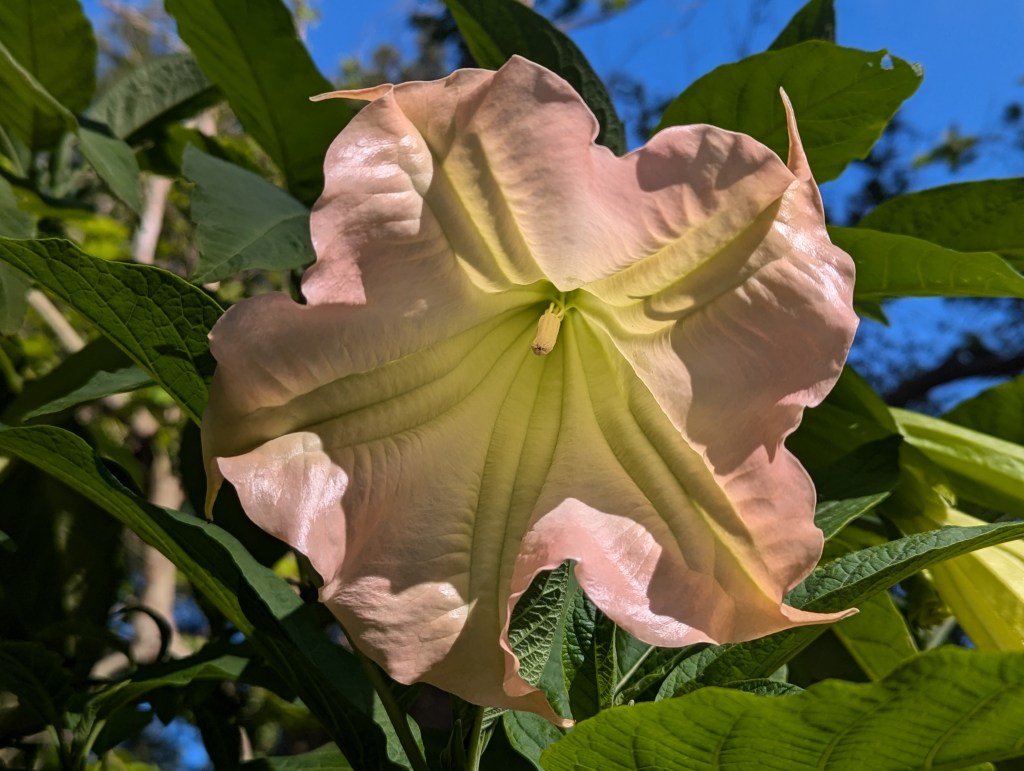
What color is this? It looks pink to me. A day earlier, though, it looked peachy orange. At various times last year and the year earlier, this same angel’s trumped bloomed more orangish orange, yellow and even white. I can not remember its schedule now, but I know that it has been weirdly variable. It is one of four cultivars of angel’s trumpet here, but the only one that will not decide on a color for its bloom.

One of the other four angel’s trumpets here blooms with double white flowers. My favorite, although relatively diminutive, blooms with single white flowers. The most vigorous is ‘Charles Grimaldi’, which blooms with single yellow flowers. A formerly fifth cultivar with big single pink flowers unfortunately rotted without replacements over winter a few years ago.

This particular angel’s trumpet grew from scrap that I took from a green waste pile at the curb of a job site in eastern San Jose several years ago. I took it because I found the pastel orange foliar color of the specimen that it was likely pruned from to be appealing. I had no idea that it would bloom with so many other comparably appealing floral colors.

Not Steel Magnolias

Aspidistra elatior, cast iron plant, is a foliar perennial. In other words, it is grown more for its lush and famously resilient evergreen foliage than for its bloom. The resiliency of its foliage accounts for its common name. Its bloom does not account for much. In fact, it is rarely seen. This is not because it is rare, but because it is not much to see. Such bloom is typically obscured by the lush evergreen foliage. Even if exposed, as in these pictures, it is not prominent. Individual flowers are tiny and dark, and do not extend much above grade. They seem to be designed for pollination by ants or other insects that might walk over them on the ground. In the picture above, one flower is blooming to the far left, another is beginning to bloom to the far right, and a third floral bud seems to be developing below that which is is beginning to bloom to the far right. Even the closeup of the far left bloom below is more weird than visually appealing. The floral form, texture and color suggest that they are intended to attract flies. I did not notice if the floral fragrance was consistent with that assumption, nor do I want to. I know what sort of fragrances flowers disperse to attract flies. However, I suspect that if such floral fragrance were notably objectionable, cast iron plant would be known for sometimes producing it, or not be quite as popular as it is.

Alternatives For Fresh Flowers

Form develops as color fades.

There are so many choices for flowers to grow for cutting between spring and the end of summer. For autumn and winter though, the choices are somewhat limited. Of the few things that bloom this time of year, there are fewer that are good cut flowers, and even fewer that bloom continually or profusely enough to provide an abundance of flowers until other flowers start to become available again in spring. Besides, who wants to go out to the garden in wintry weather to get flowers to bring into the home?

Many plants have other parts that are showy enough to substitute for cut flowers in the home. Cut foliage, stems, seedpods and even bark can be useful. Some flowers can be dehydrated to last all year, but look nothing like they do while fresh; and the process is somewhat involved. The most convincing alternative to fresh flowers is probably dried flowers.

Not many flowers dry well. Almost all simply turn brown and deteriorate. Only a few remain intact and also keep some of their color. Roses and hydrangeas are commonly dried, although their colors fade and they become shriveled. Yarrow and baby’s breath likewise change their appearance as they dry, but not quite as much. It is not so obvious as their tiny flowers shrivel.

The best dried flowers look somewhat fresh when they are actually dried. Strawflower, statice, globe thistle and globe amaranth are four of the best examples. These flowers are actually rather ‘crispy’ while they are still fresh, and only become crispier as they dry. If left in the garden, the flowers deteriorate only because of exposure to weather, and eventually rot in winter rain.

Simply as fresh cut flowers, strawflower, statice, globe thistle and globe amaranth flowers last longer than just about any other flower. They can even be separated from mixed bouquets and dried as the other flowers deteriorate and get discarded. They only need the lower portions of their stems that were originally soaking in water to be cut off if significantly deteriorated.  

However, most dried flowers probably look best if dried immediately after getting cut, since their foliage yellows more as it dries slowly. Lightweight flowers, like baby’s breath and statice (except bulky perennial statice) can be arranged fresh but without water, and simply allowed to dry as they are arranged. The only potential problem with this technique is that flowers may be difficult to separate and recycle later.

Flowers are more often laid out to dry individually and then arranged afterward. Globe thistle and globe amaranth are rather pliable and can wilt while drying, which can change the shape and consistency of a formerly fresh floral arrangement. Once dried though, their stems remain firm, and they can then be arranged more permanently. Most flowers are adequately dry in about a week indoors (or outdoors in warm dry weather).  

Because strawflowers are rather bulky on soft stems that may wilt, they dry with straighter stems if hung upside down while drying. The biggest flowers should be hung singly. Smaller flowers can be hung in small bunches. This works for heavy flowers like roses, and wide flowers like yarrow as well.

Dried Flowers Were Formerly Fresh

Some faded bloom retains striking form.

All sorts of flowers bloom through autumn as well as winter. Honeysuckle still exudes its richly sweet summery fragrance. Honestly though, most flowers bloom for spring or early summer. They finished a while ago, and are now going to seed. Even flowers that bloom repeatedly do so less now. This is when floral design can get creative with dried flowers.

Straw flower, statice and globe amaranth are among the most familiar of all dried flowers. While still fresh, they already seem to be dry. They do not seem to change much as they dry. They neither fade nor wilt very much. Only their stems sag. If they hang upside down as they dry, their stems remain straight as they stiffen. Their foliage is likely unimportant.

Rose and hydrangea are among less conventional dried flowers that actually look dried. They fade and shrivel, but somehow develop a distinct visual appeal. Amaranth, celosia, lavender and globe thistle fade and wilt only somewhat. Because amaranth stems curve downward anyway, they need not hang to dry. Lavender stems can dry before collection.

Pampas grass and cattails are big and bold dried flowers that were popular in the 1970s. Hairspray should contain dislodged fuzz that otherwise escapes pampas grass bloom. It can also prevent cattail bloom from bursting to disperse its fuzz. Cattails typically grow in marshes, where they are difficult to reach. Pampas grass foliage inflicts nasty paper cuts.

Some dried flowers are better dried than fresh. Some are mere by products of bloom that deteriorated earlier. Dried floral trusses of lily of the Nile, without their seed capsules, are quite striking. So are dried floral spikes of New Zealand flax and some yuccas. They are merely deadheading debris otherwise. Even dried queen Anne’s lace is worth recycling.

Dried flowers do not necessarily need to be of floral origin. Dried bird of Paradise leaves develop weirdly twisty form. Colorful deciduous leaves can be as colorful in the home as in the garden. So can firethorn and cotoneaster berries. Twigs of ‘Sango Kaku’ Japanese maple and red twig dogwood provide color with form. These are only obvious examples. There are many more to experiment with.

Floral Color Communicates To Pollinators

Flowers attract their pollinators with color.

Bloom is bountiful for spring. It is more abundant now than it will be at any other time of year. Early bloom has more time to produce more seed prior to autumn and winter. Also, it can most efficiently exploit its pollinators who are also most active in spring. The most prominent blooms appeal to such pollinators with floral color. Their effort is remarkable.

Most bloom within most natural ecosystems here relies on wind for pollination. Although very efficient, it lacks prominence. Some grasses seem to produce seed without evident bloom. Because such vegetation does not rely on pollinators, it has no need to advertise. Toyon produces tiny but prominently profuse flowers for both wind and insect pollination.

Most species within home gardens rely on pollinators rather than wind for pollination. At least their ancestors did. They originally developed both floral color and floral fragrance to attract pollinators. Extensive breeding enhanced color and fragrance, but also caused sterility for some. Others are not true to type. Their visual appeal became less practical.

Obviously, such visual appeal and associated practicality are subjective. Although less practical for procreation, enhanced bloom is more practical for home gardens. Most who enjoy flowers appreciate enhanced floral color and enhanced floral fragrance. They are unconcerned with how species that provide such bloom procreate. Looks are everything.

Besides, some pollinators can still enjoy most enhanced floral color. A few flowers are so genetically modified that they confuse some pollinators. A few insects die of exhaustion while trying to gain entry. Generally though, most get what they came for or safely leave without it. Many who enjoy gardening also enjoy pollinating insects and hummingbirds.

Ultimately, floral color is personal. Many garden enthusiasts prefer specific color ranges or specific colors. Many prefer an abundance of color. Some prefer more subdued floral color. Some prefer specific types of flowers to provide floral color. Bloom season may be another concern. Some want more winter bloom while nearby gardens lack floral color. Many prefer major spring bloom. Some like random bloom through the year.

Wise Old Owl (2011)

There is more to cut flowers than flowers.

(This is an old article from 2011, so much of the information within is no longer relevant.)

The sixteen acres of gardens of Filoli are spectacular and horticulturally compelling throughout the year. However, the weather through winter, although more pleasant than other places in the world, is not always quite so compelling or conducive to garden tours. At Filoli though, this is not a problem. More than six hundred volunteers and the Filoli staff merely bring the outdoors indoors, by selecting materials from the garden to adorn the interior of the 36,000 square foot Filoli residence for ‘The Wise Old Owl’, the annual fund raising Holiday Traditions Boutique.

While perusing The Wise Old Owl merchandise, guests can enjoy how so much more than flowers can be brought in from the garden to deck out the home. Bare stems, gnarly limbs, evergreen foliage, pine cones, bark and all sorts of bits and pieces of the autumn and winter garden demonstrate the potential for alternatives to traditional cut flowers that we may not even recognize as useful materials in our own gardens. Of course, there will be no shortage of the less abundant flowers that bloom through the season and decoration that are not out of the garden, as well as live music to enhance the display. Regardless of horticultural interest or boutique merchandise, the grand residence at Filoli is worth visiting even on the least eventful day of the year.

There are too many events within the Event to describe here. Guests can visit http://www.filoli.org to plan ahead and make reservations for buffet lunches and evening bistro dining, as well as an elegant Saturday Evening Dinner Party with dancing in the Ballroom. Children six to twelve years of age can enjoy a Children’s Tea on the finale of The Wise Old Owl on December 3.

The Wise Old Owl begins in only a few days on November 25, and continues through December 3. The hours of operation and admission are variable relative to the various events throughout the main Event. Reservations for specific events can be arranged and more information can be found online

Tickets can be purchased online, by fax or by telephoning Filoli weekdays between 9:00 a.m. and 4:00 p.m. At 650 – 364 8300 X 508. Order forms for fax transactions can be downloaded from the website and sent to 650 – 503 2090. Admission is limited; and tickets get exhausted somewhat early. Tickets are neither refundable nor exchangeable. Filoli is located at 86 Canada Road in Woodside (94062).

Queen Anne’s Lace

Goodness! Apologies for this dreadful picture!

There are actually a few different flowers known as Queen Anne’s lace. The most common species, Daucus carota, that has naturalized and even become somewhat of a weed in some areas, has two and a half inch broad, flat-topped trusses of delicately minute but abundant flowers, with a single red flower at the center of each truss. Apparently, Queen Anne pricked a finger with a needle while making the lace, leaving a drop of blood. Modern varieties have broader and fluffier trusses, often lacking central red flowers. They are a popular ingredient or fill for mixed bouquets with more colorful flowers.

The biennial foliage of Queen Anne’s lace grows to about three feet tall in the first year, with weedy but intricately lacy leaves. It blooms in summer of the second year. It is very similar to poison hemlock, which is poisonous enough to kill Nero, so should not be allowed to grow in vegetable gardens or where toxicity might be a problem; just in case.