Color Selection

There are not many colors that bearded iris can not provide.

If I could select my favorite color for the flowers in the garden, they would all bloom white. There is no more perfect color. White may be bright or pale, but lacks the many shades that other colors have. There is no need to select between deep blue or sky blue, bright yellow or pastel yellow, purple or lavender. White is simply white.

The main problem with white, or any other color, is that no color is the right color for every situation. Also, some flowers are simply not at their best in white. Camellias, oleanders and fruit trees look great in white. However, nearly white marigolds, sunflowers and nasturtiums are interesting oddities that are excellent in the right spot, but are not nearly as flashy as the more traditional bright yellow and orange shades are.

My two favorite geraniums are actually reddish orange and fuchsia pink, and really look horrid in bloom together. They are my favorites nonetheless, because I have been growing them since my sophomore year at Prospect High School! I have taken cuttings with me whenever I relocated since then. I enjoy the garden too much to grow things that I do not enjoy.

Flower colors probably should be compatible with the colors and architecture of associated residences and other buildings, as well as the neighborhood. Yet, we all have different tastes. It is more important to grow flowers with the colors that we enjoy, even if they are not exactly perfect for their particular situations. Fortunately, compatible colors are more likely to also be enjoyable.

White happens to be useful in shaded areas, or with an abundance of deep green, such as wax privet hedges. White brightens an area, even in conjunction with other colors. It also softens richer colors like purple or red.

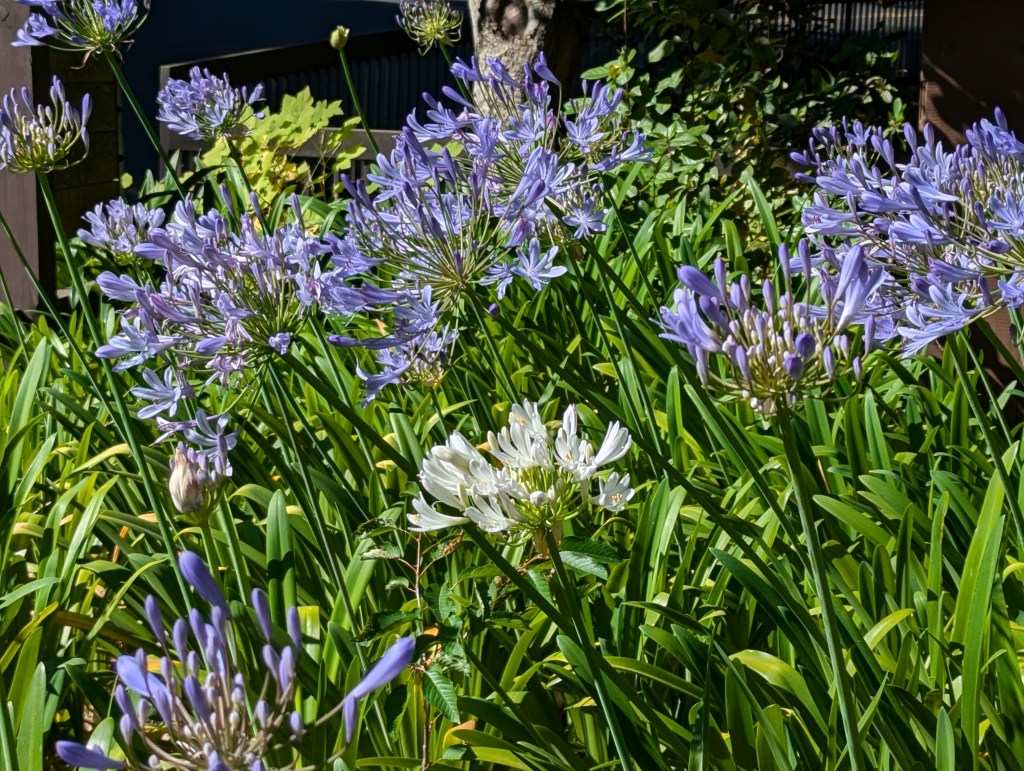
Darker shades of purple, red and blue should be out in the open, since they can make shaded areas seem even darker. Lighter shades, including lavender and pink, can work almost anywhere. True blue happens to be uncommon among flowers, even though the very common lily of the Nile is typically blue.

Yellow and orange seem at home in sunny spots, and also brighten shaded spots if not overdone. Yellow contrasts with purple. Orange contrasts with blue. Orange marigolds and cobalt blue lobelia might look odd in abundance, but can be striking as a border to a perennial or annual bed. Many of us like a random mix of any color; but too much mix over a large area can look like a garage sale of colors. Black, gray and brown flowers are rare and mostly grown by those of us who really appreciate them; since they look quite odd in the wrong situations. Black hollyhock, pansy and bearded iris are perhaps the best blacks, while other black flowers are not so convincing. Gray iris are still quite rare. Brown sunflowers are becoming more popular.
Chameleon

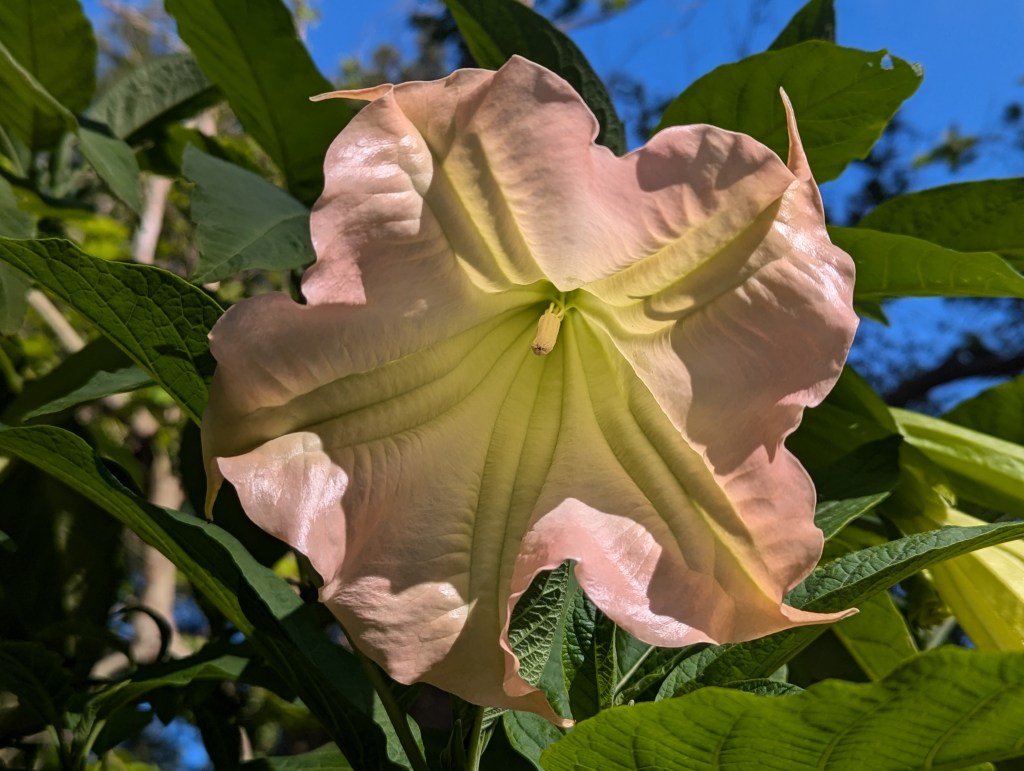
What color is this? It looks pink to me. A day earlier, though, it looked peachy orange. At various times last year and the year earlier, this same angel’s trumped bloomed more orangish orange, yellow and even white. I can not remember its schedule now, but I know that it has been weirdly variable. It is one of four cultivars of angel’s trumpet here, but the only one that will not decide on a color for its bloom.

One of the other four angel’s trumpets here blooms with double white flowers. My favorite, although relatively diminutive, blooms with single white flowers. The most vigorous is ‘Charles Grimaldi’, which blooms with single yellow flowers. A formerly fifth cultivar with big single pink flowers unfortunately rotted without replacements over winter a few years ago.

This particular angel’s trumpet grew from scrap that I took from a green waste pile at the curb of a job site in eastern San Jose several years ago. I took it because I found the pastel orange foliar color of the specimen that it was likely pruned from to be appealing. I had no idea that it would bloom with so many other comparably appealing floral colors.

Flowers Have An Agenda

Flowers are only as colorful or fragrant as they are to attract pollinators.

When the garden is full of bloom, we do not like to think that flowers have an agenda. All their colors and fragrances seem to be displayed merely for our benefit. Who really wants to know that procreation is their real priority; that all their efforts are merely to get pollinated to make seed for the next generation?

Because flowers are not mobile like animals and insects are, they need to rely on wind or pollinators to deliver their pollen to other flowers. Flowers that are more reliant on wind for pollination are not much to look, since they do not need to advertise. The wind needs no incentive to blow. Wind pollinated flowers are instead abundant and productive, to disperse as much of their light pollen as possible.

Flowers that need pollinators need to advertise. They offer all sorts of attractive colors, fragrances, nectar and pollen to attract their particular preferred pollinators. For example, those that exploit the services of hummingbirds appeal to their discriminating taste with sweet nectar in tubular flowers that are mostly in colors that hummingbirds like, orange or red.

All the variety among flowers is designed for the variety of pollinators that they employ. Flowers that rely on nocturnal moths are large and pale, often with infrared patterns (that people do not see) to be visible in moonlight to moths drawn to their sweet fragrance. The offensive fragrances and textures of fly pollinated flowers are delightful to flies. Many flowers appeal to multiple pollinators.

Bees are of course the busiest of pollinators, as they collect nectar and pollen to make honey. They visit any flower they encounter, but prefer those that make abundant and dense pollen that they can carry away. They are very fond of the many different fruit trees; such as apple, pear, apricot, cherry, plum and all their relatives, as well as citrus. They also dig eucalyptus, wild lilac (ceanothus), hebe, firethorn, bottlebrush, honeysuckle and roses.

The difficulty for bees is finding a constant supply of flowers. As apple and pear trees finish blooming, bees want to start visiting other flowers. Bees like a variety of just about any of the annual flowers, particularly pincushion flower, cornflower, snapdragon, foxglove, sunflowers, poppies and lupines. With a good mix, something should always be blooming. Bees are also very fond of catmint, ajuga, thyme, rosemary, penstemon, lavenders and the many salvias and sages.

Those who want to attract bees to the garden should therefore plan for a good mixture of flowers that bees like, so that there is always something to keep the bees happy. Many of their favorite flowers that may not seem very colorful to us use ultraviolet patters that are quite flashy to bees. The choices are not always so obvious.

However, those who do not like bees or are allergic to bee stings, should avoid an abundance of flowers that will attract them. Unfortunately, there are no flowers or plants to repel bees. Also, the coniferous (cone bearing) evergreens and many other wind pollinated plants that are less attractive to bees produce abundant light pollen that is so problematic for allergies.

White on Wednesday

Syringa vulgaris ‘Madame LeMoine’ French hybrid lilac bloomed bright white and right on time as March became April, and is not finished yet. It was somewhat of a surprise, since it remains canned until development of the landscape that it should eventually inhabit. It does not grow much while canned, so was not expected to be so spectacular in bloom. It is so spectacular that it was temporarily placed into a prominent position within another landscape, with its can mostly obscured by other vegetation, until it finishes bloom.

However, regardless of how spectacular it is, it reminds me that white is not necessarily the best color for all flowers. White happens to be my favorite color, and lilac happens to be among my favorite early spring flowers, but to me, lilac bloom should be lilac colored. I mean, it really should be that lavender or pastel purple color of traditional and formerly common old fashioned lilacs. The only advantage to this white floral color is that it would be appropriate to situations in which white is the most desirable color, or where lavender is undesirable.

Just as many flowers are at their best in white, some are best with other colors. Southern magnolia, lily of the valley, moonflower, gardenia, Easter lily and old fashioned calla are exclusively white, and would look weird in any other color. Gladiolus, tulip, hyacinth and rose can be all sorts of colors, but happen to excel at white. A few other flowers that can be all sorts of colors happen to not excel at white, such as bougainvillea, crape myrtle, English primrose, tropical hibiscus, wisteria and, of course, lilac. Both white crape myrtle and white bougainvillea happen to have been selected specifically for landscapes here, so perhaps white lilac is not so out of place.

Off Color

Borage can bloom pink, although it should fade to blue.

Borago officinalis, borage blooms almost exclusively with blue flowers. Those that bloom with white flowers are a naturally rare variant, although a slightly less than natural white blooming variety is available. Although white is my favorite color, I wanted to grow the more common sort that blooms with blue flowers merely because, to me, blue seems like the more natural color for the species. Besides, white borage flowers look rather bland. Actually, I am not much more impressed with blue borage flowers, but wanted to grow borage just to see what all the fuss was about. Though they were not expected to be viable, I was pleased that someone shared some expired seed with me. Because I expected none of them to grow, and expected that even less than none would grow if I delayed sowing them until after winter, I tossed the seed into the cans of other plants in the recovery nursery. I figured that if one or a few grew, I could pull them up and can them separately. Only a few days later, they all seemed to be germinated and growing! I extracted and plugged them into one more six-pack than a full flat of cells, which is forty-two seedlings! The problem is that summer is over, and borage does not overwinter well, even here. I am pleased with them nonetheless, and am confident that some can survive with shelter. I figured that with so many seedlings, that one or more might possibly bloom with white flowers. I noticed floral buds a while ago, so was watching for my first borage bloom. I was not expecting this! What is weirder is that all are blooming like this. Apparently, it is normal for borage to bloom with pink flowers that fade to blue during autumn.

Six on Saturday: Off Color

Perennial pea, lily of the Nile and dahlia displayed aberration of color earlier and started a trend.

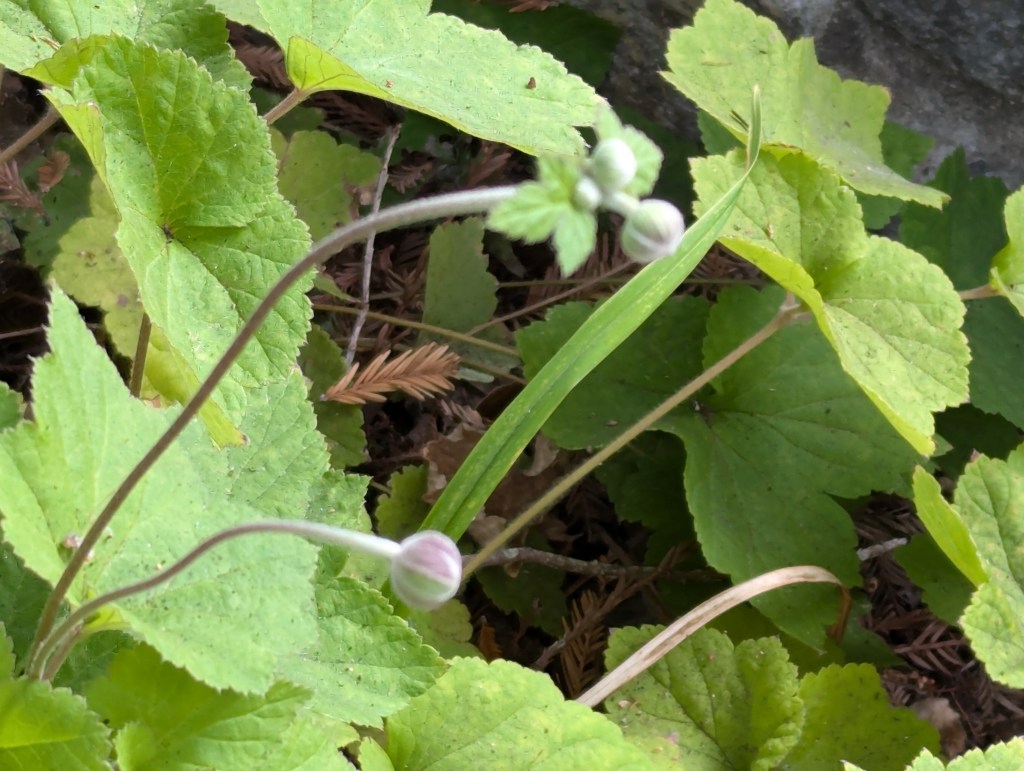
1. Eriocapitella hupehensis, Japanese anemone is enviable in other gardens. I neglect to remember that a minor bit of it survives in one of our landscapes. I ignore it because it is such a grungy almost grayish white without enough blush to be pink. I should see how it blooms now and then relocate it to a better situation where it might develop better color.

2. Hypoestes phyllostachya, polka dot plant is typically spotty with either white or pink. Two of seventy-two cell pack plugs exhibited this darker pinkish red. I got copies of it to perhaps grow as houseplants, at least until they will be happy in the garden next spring.

3. Chrysanthemum X morifolium, florist’s chrysanthemum seems to change color like a dahlia that I got a picture of last week. I thought that it bloomed orange last year, which was a surprise after it bloomed rusty red two years ago. I must not remember accurately.

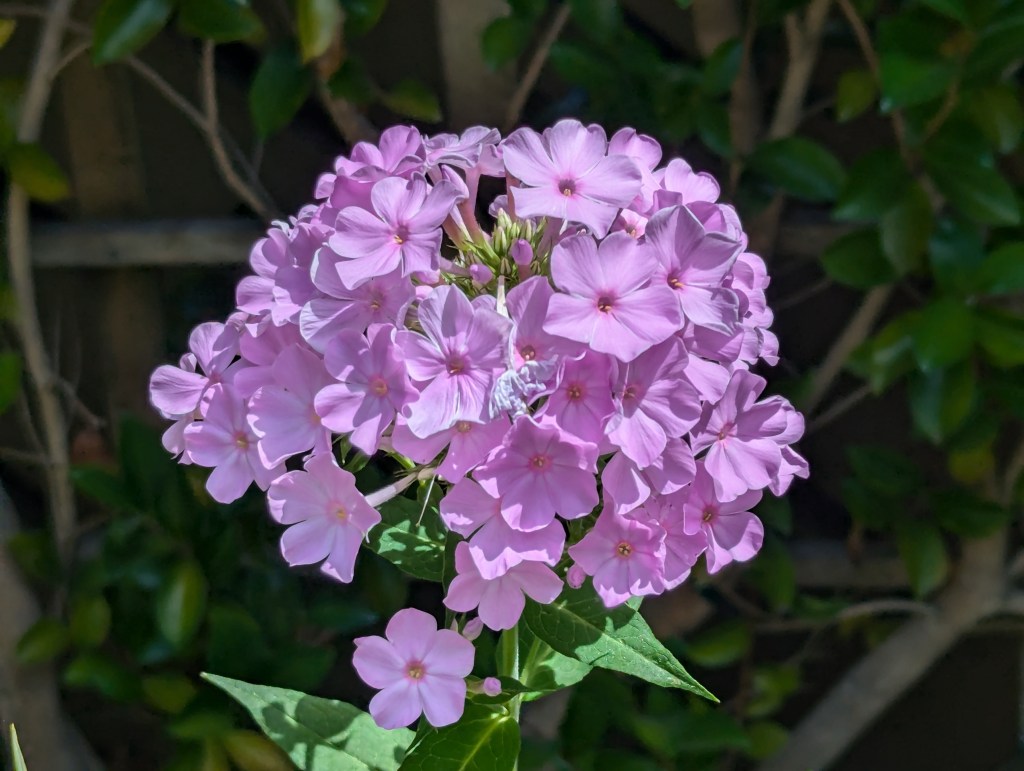
4. Phlox paniculata, garden phlox has bloomed exclusively white since it arrived here by unknown means a few years ago. Although I have been very pleased with its white color, and white happens to be my favorite color, I am also pleased with this new pink variant.

5. Amaryllis belladonna, naked lady did the opposite. It had always bloomed exclusively bright pink. Then, I found and isolated a few bulbs of a white blooming variant last year. An associate found two more in the same location this year. I like it much more in white!

6. Rhody is canine so lacks perception of red, which is the basis of these off colors. Most have more than they should, and one has none. Rhody sees them only as shades of gray.

This is the link for Six on Saturday, for anyone else who would like to participate: https://thepropagatorblog.wordpress.com/2017/09/18/six-on-saturday-a-participant-guide/

Four O’Clock

Two colors on one four o’clock.

Punctuality is not one of its primary attributes. Four o’clock, Mirabilis jalapa, is supposed to unfurl its flowers about four o’clock. It is more likely to do so a bit later here because of aridity. Flowers can remain open and mildly fragrant all night, but might close after about noon. Four o’clock grows vigorously with summer warmth, but also appreciates humidity.

Floral color ranges through various hues of pink, red, orange, yellow and white. Flowers commonly exhibit stripes, spots or patches of other color within this range. Flowers with completely different colors can bloom on the same stems. Simple bright pink flowers are typically the most fragrant. Other colors and mixed colors may lack fragrance completely.

Most four o’clock grow in their gardens without invitation. They sneak in as seed, but are too pretty to be weeds. They grow tuberous roots to overwinter as their foliage and stems later succumb to chill. Stems do not stand much more than three feet tall, but may sprawl twice as wide. Below their lush foliage, these lanky stems are vulnerable to disturbance and wind.

Border Carnation

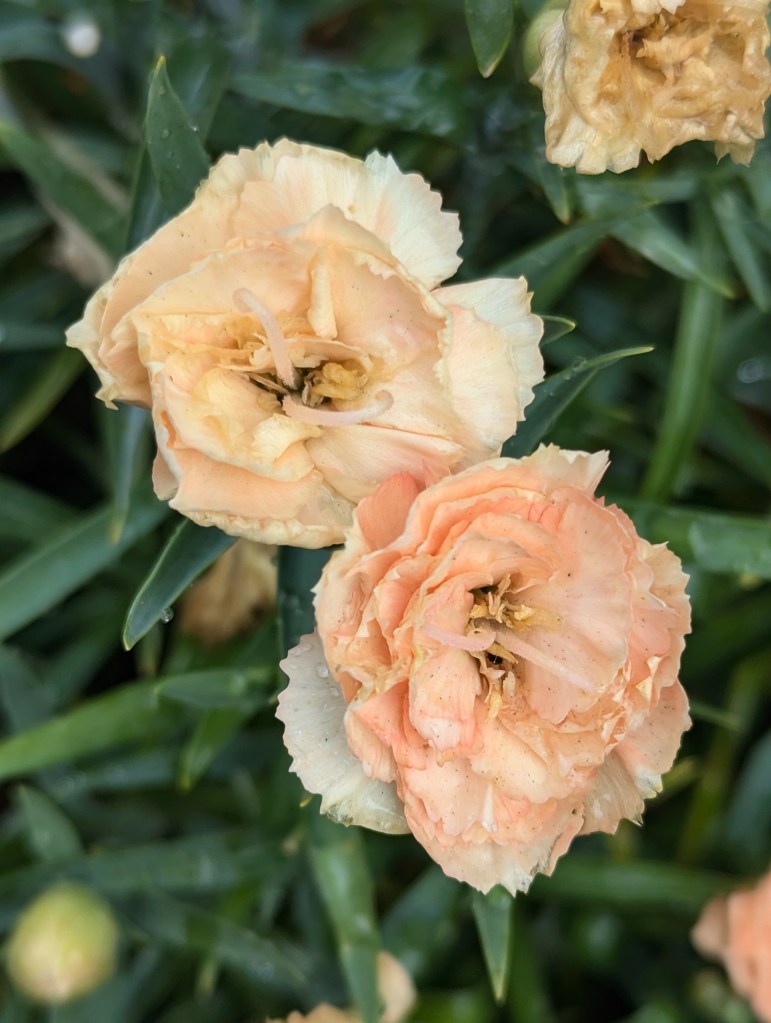
Border carnations stay short and compact.

Florist carnation, Dianthus caryophyllus, is not originally as colorful as it seems. It can be red, pink, pastel yellow, pastel orange or nearly purple. Most for the floriculture industries begin as white though. White carnations are conducive to dying with any color that might be in demand. They are therefore more versatile than those with a different natural color.

Furthermore, their natural floral color range is not as natural as it seems. It is the result of extensive breeding of several species. Consequently, several popular types of carnation lack species designation. This includes a few compact cultivars that are more popular as annuals than cut flowers. Within locally mild climates, they can be short term perennials.

Border carnations grow only a few inches tall and less than a foot wide. Eventually, very old specimens may grow more than a foot tall. Such big specimens are very rare though. Border carnation foliage is glaucous bluish gray. The short and very narrow leaves are in opposing pairs. Flowers are less than two inches wide, with delightfully spicy fragrance of clove.

4:00

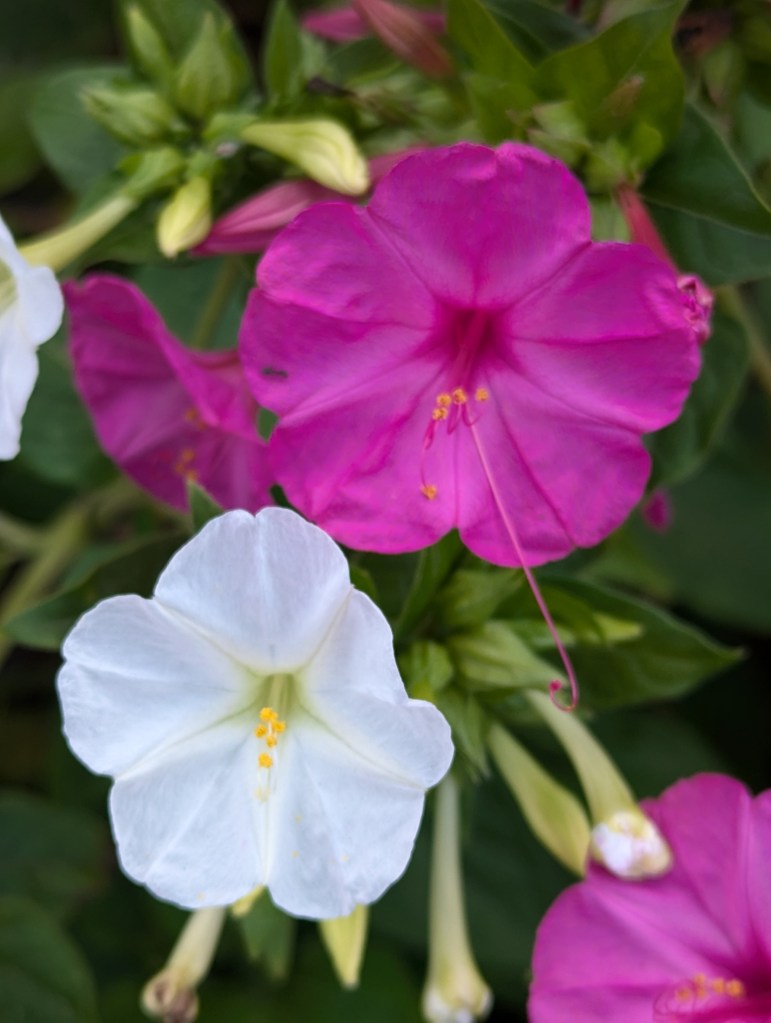
Mirabilis jalapa is known more commonly as four o’clock. It is spelled with letters rather than as 4:00 with numbers. This refers to the time in the afternoon when its bloom should be at its best. These pictures were taken prior to nine in the morning though. Apparently, it does not adhere to a strict schedule. I took these pictures because I was so impressed with the performance of these particular specimens. Those with yellow bloom above are so large that I came from across the road to confirm their identity. I do not expect this species to grow so large. They are about as big as small oleander! Those with white and pink bloom below are actually the same plant. The species commonly blooms with flowers of different colors, but such colors are typically not so divergent as clear bright pink and clear white. They are more typically blotched with colors of each other, such as white flowers with a few pink blotches in conjunction with pink flowers with a few white blotches. This species is somewhat naturalized here, but politely so. Although it generates copious seed, it is not migrating very far from where it is established.

Sports

This white lily of the Nile appeared this summer within this exclusively blue colony.

Horticulturally, a sport is a genetically variant growth. Although it is more common among extensively bred or genetically aberrative cultivars than simple species, the most basic of lily of the Nile can, on rare occasion, change floral color from blue to white or from white to blue, as I mentioned on the sixth of July. Unvariegated or ‘green’ sports are a more common annoyance among some cultivars with variegated foliage, such as popular cultivars of Euonymus japonica, since they grow faster with more chlorophyll, and can overwhelm the original and more desirable variegated growth. The yellow hybrid gladiola that I posted a picture of for Six on Saturday on the twenty-ninth of June could be a sport of an adjacent orange and yellow hybrid gladiola. I did not give it much consideration because I assumed it to be the first bloom that I noticed from one of a few bulbs that somehow survived for a few years longer than expected. Until last summer, the only hybrid gladiolas to survive from a mixed batch planted years earlier had been either purple or the aforementioned orange and yellow. However, now that the yellow bloom is gone, an equally unfamiliar orangish red bloom emerged from the same small colony of bulbs that had bloomed only orange and yellow. As their common name suggests, hybrid gladiolas are hybrids, so are innately genetically unpredictable, and therefore have potential to generate sports as they multiply. Although I do not know for certain that this new orangish red hybrid gladiola did not survive without blooming for the past few years, I sort of suspect that it and the new yellow hybrid gladiola are more recently developed sports of the original orange and yellow hybrid gladiola. I hope that both are as reliably perennial as the original.

This orangish red hybrid gladiola seems to be a sport of the orange and yellow hybrid gladiola.