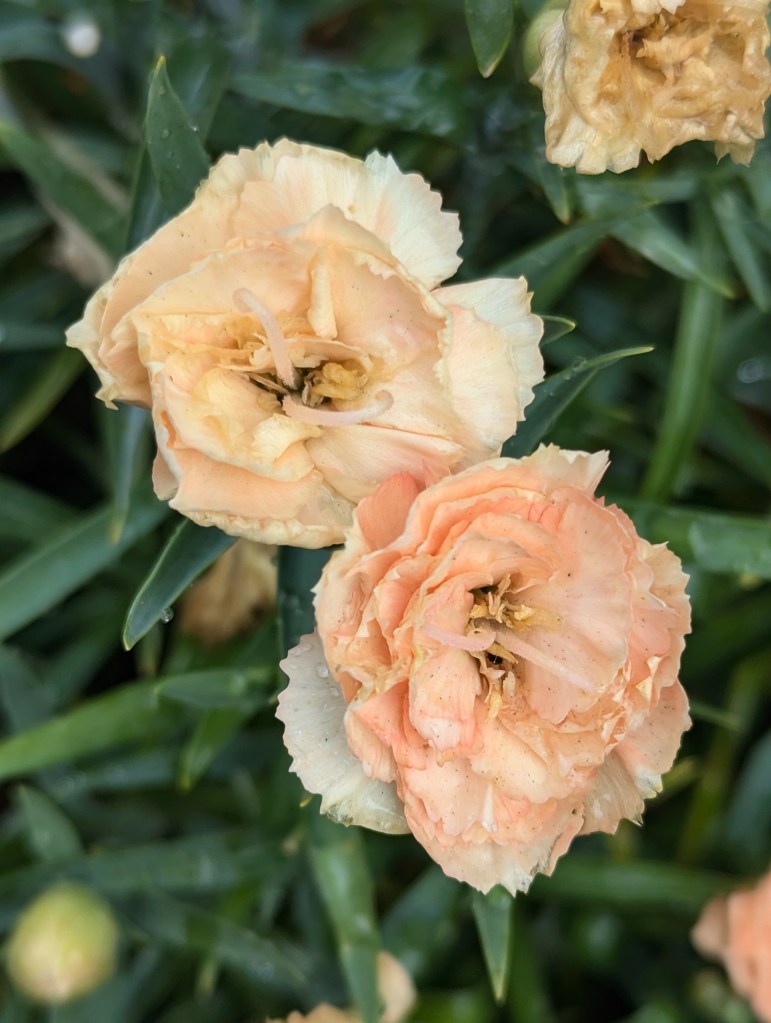
Florist carnation, Dianthus caryophyllus, is not originally as colorful as it seems. It can be red, pink, pastel yellow, pastel orange or nearly purple. Most for the floriculture industries begin as white though. White carnations are conducive to dying with any color that might be in demand. They are therefore more versatile than those with a different natural color.
Furthermore, their natural floral color range is not as natural as it seems. It is the result of extensive breeding of several species. Consequently, several popular types of carnation lack species designation. This includes a few compact cultivars that are more popular as annuals than cut flowers. Within locally mild climates, they can be short term perennials.
Border carnations grow only a few inches tall and less than a foot wide. Eventually, very old specimens may grow more than a foot tall. Such big specimens are very rare though. Border carnation foliage is glaucous bluish gray. The short and very narrow leaves are in opposing pairs. Flowers are less than two inches wide, with delightfully spicy fragrance of clove.
Roses from a home garden are not quite the same as roses from a florist or market. They mostly bloom on stems that are relatively thinner and shorter. Floral and foliar blemishes are more likely. As they unfurl, they can get a bit wider and disperse more fragrance. One of the more obvious differences is their seasonality. They are unavailable through winter.
Florist roses are likewise different from garden roses. They are not as limited by season, so are available at any time of year. Their elegantly straighter stems are relatively longer and a bit heftier. Blemishes are rare. Buds are generally plumper and likely to last longer, but may not unfurl completely. They are typically relatively narrow and a bit less fragrant.
Environmental factors cause most of the differences. Home garden roses develop with a relatively natural exposure to weather. Florist roses develop within synthetic greenhouse environments without natural weather. However, genetics cause some of the differences. Florist roses are not the same cultivars that are available from nurseries for landscaping.
The same applies to several florist quality potted plants. They also grow within unnatural environments. They also are cultivars that perform well for their specific purpose. Some cultivars are impractical for landscapes. Some take quite a while to adapt to landscapes. Many that are seasonally popular for particular Holidays may not last for long afterward.
Most azaleas and hydrangeas are landscape cultivars. Some are florist cultivars though. Landscape cultivars that grew outside in nurseries adapt efficiently to landscapes. Florist cultivars that grew in greenhouses take more time or may not adapt. Those that do might bloom with lavishly large florist type flowers. Such bloom may not be resilient to weather.
Several cultivars of florist carnations and chrysanthemums are also landscape cultivars. Florist lilies are the same that are seasonally available as dormant bulbs from nurseries. Adaptation to a garden can be stressful, especially for those that bloomed out of season. However, once they adapt, they might perform for several years as short term perennials.
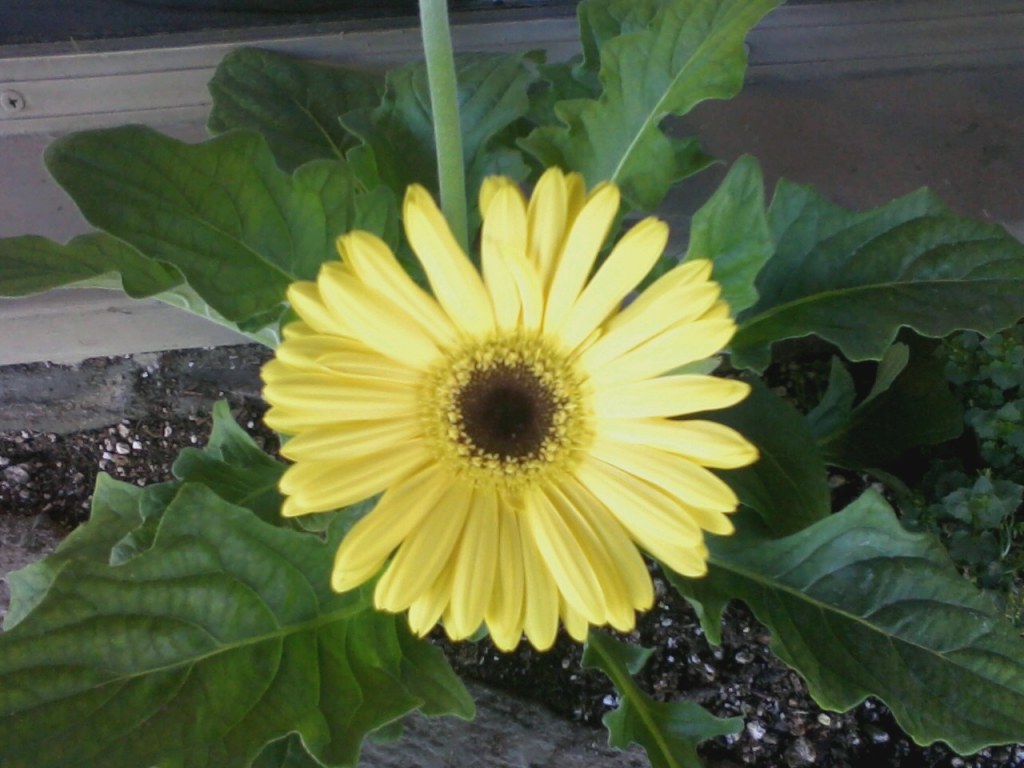
Transvaal daisy is very popular within the floricultural industries.
After rose, carnation, chrysanthemum and tulip, the fifth most popular cut flower is the Transvaal daisy, which is also commonly known as the gerbera daisy, Gerbera hybrida. The composite (daisy-like) flowers are typically about three to four and a half inches wide, in bright shades of yellow, orange, red, pink and white, with dark centers. They stand several inches high on bare stems, adequately above the lower, coarsely textured foliage. Transvaal daisies can bloom well for a month or more as potted houseplants in sunny spots, but rarely survive more than two months indoors. If planted in a sunny but not too harshly exposed spot in the garden as they begin to deteriorate, they can sometimes recover and continue to bloom as short lived perennials. They need good drainage but uniform moisture in organically rich soil.
Poinsettias are very popular blooming potted plants for about a month prior to Christmas. Then, most quietly disappear prior to spring. A few become foliar houseplants. Fewer go into home gardens to likely succumb to frost or neglect. Very few survive for more than a few years. It is not easy to recover from the procedures that forced them to bloom so well.
Forcing bloom is stressful. It provides unnaturally indulgent doses of stimuli that optimize floral performance. It involves any combination of deceptive environmental and chemical manipulation. Optimal bloom is the primary objective. Sustainability or even survivability after bloom is irrelevant. Forced plants are barely more than cut flowers with potted roots.
For example, poinsettias receive much more than the nutrition they require for exemplary growth and bloom. The greenhouses that they grow in maintain optimal temperature and humidity for them. Shading shortens their daylength to deceive them into believing that it is the season for bloom. Transition from such decadence to natural conditions is difficult.
Almost all fancy blooming potted plants that are available from supermarkets and florists, and several from nurseries, are forced to some degree. These include poinsettia, orchid, chrysanthemum, hydrangea, azalea, a few types of roses and various bulbs. Such bulbs include lily, narcissi, crocus, hyacinth and tulip. Some exhaust their resources by bloom.
Many forced plants are cultivars that are distinct from more common landscape cultivars. For example, many florist hydrangeas bloom with huge and very abundant floral trusses on short stems. They are spectacular in pots, but might not be so practical for landscape situations. Landscape hydrangeas support bloom higher over the ground on taller stems.
Their potential for inferior performance after their potentially difficult recovery from forcing should not necessarily disqualify forced plants from salvage. Short florist hydrangea can be delightful accessories to bigger landscape hydrangea. Moth orchids are impressively adaptable. Premature doubting of possible ultimate results can be more effort than trying.
What ever happened to those poinsettias and cyclamen from last Christmas?
Chrysanthemums, hydrangeas, azaleas, callas, kalanchoes and miniature roses can not really be as happy as they seem to be while in full bloom at the florist counter. Then there are all the seasonal blooming plants like Easter lilies and poinsettias. Wrapped in undraining mylar, often with ribbons and bows, they are actually quite humiliated.
All are forced to bloom in artificial greenhouse environments that are nothing like the home environments that they ultimately go to. As they finish bloom, most get retired directly to the garden where many are unable to adapt quickly and efficiently enough to survive for long. Many do not make it that far, but get sent to the compost or the trash by those who prefer to not prolong their agony.
These potted plants (which are actually known as ‘pot plants’ in the horticultural industries) are not like houseplants, since they are not actually expected to survive for long in the home. They are only expected to perform for a limited time while in bloom.
Adapting to the home environment is not the difficult part. Most potted plants can manage that for a while, but eventually want more sunlight. Hydrangeas, roses, Easter lilies and other deciduous plants also eventually want a cool winter for their dormancy. The problem is adapting to exposure to the sunlight and weather that these plants crave. Foliage can get scorched, frozen or desiccated.
As unsightly as plants can be during transition, most can eventually replace their greenhouse foliage with foliage that is adapted to their new environment in the garden if transitioned slowly and carefully. Large ‘forced’ flowers will eventually be shed or can be pruned off as they deteriorate. The more sensitive types of plants should be moved to a sheltered spot on a porch or in partial shade for a few months before being moved to more exposed spots. Once in the garden, they will want regular watering until their roots disperse.
Deciduous plants and bulbs can stay in the sheltered spot until they defoliate for winter. If put into their permanent location while dormant and bare, their new foliage that emerges in spring will be adapted to the new exposure.
Aloes, Christmas cactus and various other succulents are considerably more resilient and adaptable than the more common potted plants. Both rosemary and small olive trees that have become trendy during the past many years can likewise be adaptable if not kept in the home too long. Olive trees can stay potted indefinitely if pruned regularly, or can go into the garden where there is room to grow. Christmas trees are just as adaptable, but do not want to stay potted for long. Sadly though, most get much too big for home gardens.



 Tony Tomeo