Saint John’s Wort

Saint John’s wort is a survivor.

Saint John’s wort is the common name of a few species of Hypericum. Hypericum beanii sometimes gets the distinction of Bean’s Saint John’s wort. That sounds more like carob, Ceratonia siliqua, though. Carob is the locust bean that sustained Saint John the Baptist in the desert. Mr. Bean was actually a respected botanist of the Royal Botanical Garden.

This Saint John’s wort is not as invasive as naturalized sorts, but is as resilient. Although rarely available from nurseries, it survives in old and neglected landscapes. Established specimens need no irrigation, but perform better with it. This species is likely rare merely because of its resemblance to invasive sorts. It propagates quite efficiently from cuttings.

Hypericum beanii is a shrubby species, unlike more familiar ground cover types. It grows about two or three feet tall and wide. Its bright yellow flowers are about two inches wide, and bloom through summer. Foliage is deciduous where winter is cooler. Here, it is likely to linger until spring foliage replaces it. Partial shade is tolerable, but might inhibit bloom.

Lilac

Lilac is splendidly fragrant!

‘French Hybrids’ are not fuel efficient European cars. (However, if there were a French equivalent to the old Japanese Datsun ‘Z’ that was instead named the ‘S’, we could really see the ‘S car go!’) ‘French Hybrids’ are varieties of lilac with single or double flowers in various shades of lavender, pink, pale blue, pinkish red, purple and white. Some have flowers that are two-toned. ‘Primrose’ is an interesting shade of pale yellow. All are strongly but elegantly fragrant. 

Even though ‘French Hybrids’ have the advantage of being better adapted to mild winters, the original species of common lilac, Syringa vulgaris, and its older varieties seem to do just fine locally, and actually seem to be more fragrant. The only disadvantage is that almost all bloom with lavender flowers. ‘Alba’, with white flower, is rare. ‘Descanso Hybrids’ were developed for even milder winters.  

The individual tubular flowers are actually very small, but bloom in dense conical trusses that are typically about three or four inches long, and possibly twice as long. Trusses develop on year old stems, so pruning should be done right after bloom only, although dead-heading (removing deteriorating trusses) without pruning can be done at any time. The soft and sometimes light green leaves are about three inches long. Mature plants are often eight feet tall and nearly as broad, and can get twice as large.

Unlike most plants that get suckers that need to be removed, most lilacs should instead be pruned to remove older canes and to promote healthier growth of suckers. This process of ‘alternating canes’ continually replaces less productive deteriorating stems with vigorous new stems. Old fashioned grafted plants are the only lilacs that should have their suckers removed; but they are uncommon, and do not sucker as much anyway.

Azalea

Azalea bloom can almost obscure foliage.

Azaleas, which are species of Rhododendron, have been in cultivation for centuries. At least ten thousand cultivars are documentable. Most are interspecific hybrids. Only a few are selections or breeds of simple species. Most of their ancestral species are native to Asia, Europe or North America. Almost all cultivars that are available here are evergreen.

Azaleas can bloom profusely enough during April or May to almost obscure their foliage. Bloom may last for more than two weeks. Floral color ranges between white and red with many tints of pink, salmon and magenta. The most profuse flowers are as narrow as half an inch. Larger flowers may be three inches wide. Rare deciduous azaleas are fragrant.

Azaleas do not grow fast, but can eventually sprawl more than five feet wide. Some can grow nearly twice as wide. Although most do not grow much taller than three feet, some can grow twice as tall. Azaleas are naturally understory species, so can tolerate a bit of partial shade. They should not crave fertilizer. If they do, they prefer acidifying fertilizer.

Saskatoon

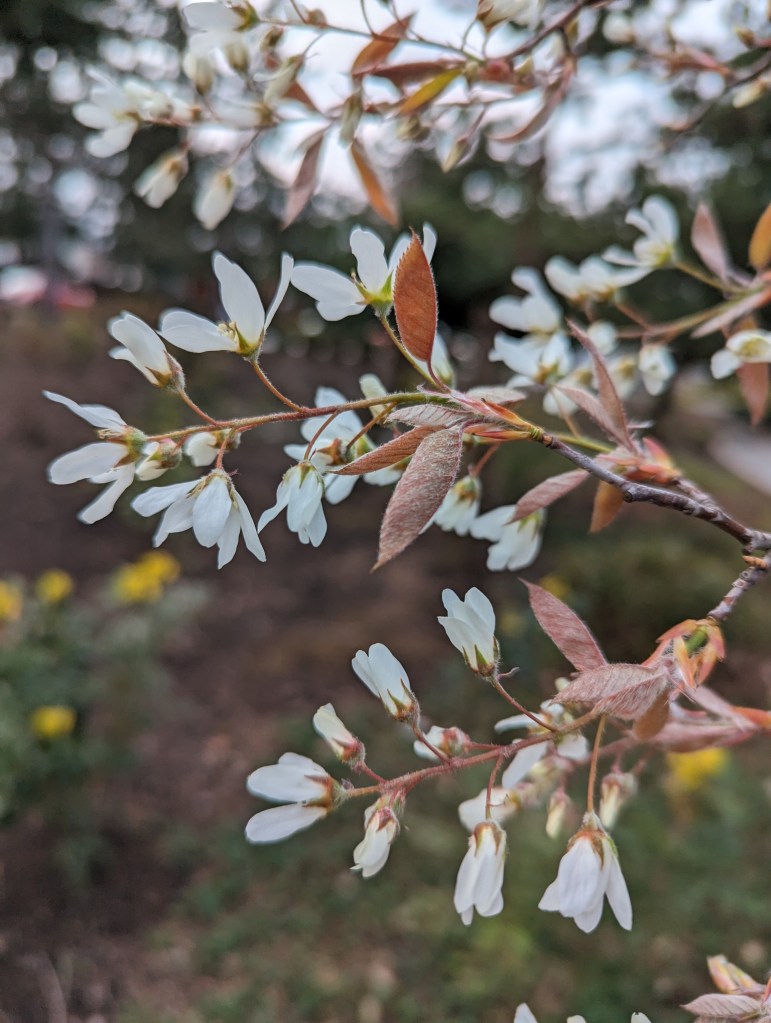
Saskatoon prefers significant chill during winter.

Of eighteen species that are native to North America, only two are native to California. Of these two, only one is native locally. However, some of the few nurseries that sell various saskatoons market them as native. Obviously, most are not. A few are hybrids. All of them are species of Amelanchier, and are still rare here. Their common names are numerous.

Serviceberry, sarvisberry or sarvis may be some of the more common of common names. Shadbush, shadwood or shadblow may be less common. Juneberry, chuckley pear, wild plum and sugarplum are likely regional names. They are more familiar where winters are cooler. Some sorts do not perform well locally because they prefer a bit more winter chill.

Saskatoons are locally popular primarily for their fruit, and only among a few enthusiasts. They are more available online than in nurseries. The fruits are pommes like tiny apples, but are only the size of blueberries. They ripen to blackish purple for summer. Their early spring flowers are like wispy apple flowers. Most Saskatoons grow less than ten feet tall. Some rarer types can grow thirty feet tall in favorable climates.

‘Yuletide’

Camellia sasanqua ‘Yuletide’

‘Yuletide’ Camellia sasanqua should bloom for Christmas, as the name implies. It typically does. However, it sometimes blooms early or late. It might be slightly late this year, but has been blooming for quite a while, and was beginning to bloom by Christmas.

It certainly is a delightful red. It seems to me that it can be slightly more reddish, with less of a pink influence, in some situations. Perhaps the bright yellow of the staminate centers cause it to appear as such within certain weather conditions or sunlight exposures. This particular flower may seem to be slightly pinkish as a result of distress. The hedge that it bloomed on had been infested with red spider mite earlier.

This particular cultivar of Camellia sasanqua develops distinctly upright and perhaps ovoid form, and can get quite tall. Most other cultivars develop more irregular or sprawling form, with long and limber stems, and relatively short stature.

I am impressed that this bloom is so resilient to wintry weather. Although much of the foliage is under a wide eave, most of the bloom is not under the eave, so has been exposed to both rain and frost. Apparently, Camellia sasanqua bloom is resilient to frost that is colder than it gets here. Camellia flower blight is common regionally, but mysteriously does not damage many flowers within the landscapes here. White and light pink Camellia japonica flowers are more vulnerable, but even they bloom quite nicely here, with only a few flowers succumbing before they finish bloom, and generally as their cumulative bloom cycle is finishing anyway.

Deer eat any cultivar of any species of Camellia, but avoid camellias here more mysteriously than camellia flower blight. I do not remember ever encountering damage that was caused by deer; and there are many camellias here.

Heath

Heath for winter. Heather for summer.

Heaths, which are several species of Erica, derive their name from their natural habitats. They are endemic to shrublands of acidic and seasonally dry soil of inferior quality. Such ecosystems, or heaths, do not sustain many big trees or shrubbery. Species from heaths should be resilient to dry chaparral summers. However, they dislike locally alkaline soils.

This is unfortunately why heaths are quite rare within gardens here. They are popular as blooming potted plants for winter, but become scarce afterward. Within planters of potting media, they may grow and bloom for many years. In the ground though, they are likely to languish without acidifying amendment. They prefer the company of coniferous species.

Heath blooms for winter or very early spring. Heather is a similar relation, but blooms for summer or autumn. Floral color ranges from white to pink to rustic purplish pink. Flowers are dinky but abundant. Comparably dinky evergreen leaves are like soft juniper scales. Almost all available heaths grow less than five feet high. Most grow less than a foot high.

flowering maple

Flowering maple should finish bloom soon.

The identities of the many different garden varieties are vague. Most are likely hybrids. A few might be simple species. Some that seem to be hybrids are really cultivars of simple species. Regardless, most flowering maples collectively qualify as Abutilon X hybridum. If all were hybrids, as their name implies, none would generate viable seed, as some do.

Flowering maple can grow somewhat fast, but tends to be lanky if it does so. It should be a bit fuller with slower growth or minor tip pruning. Several cultivars grow no higher than doorknobs, but others reach first floor eaves. Flowering maple demands regular watering and rich soil. It enjoys humid warmth, but may roast in arid heat with harsh sun exposure.

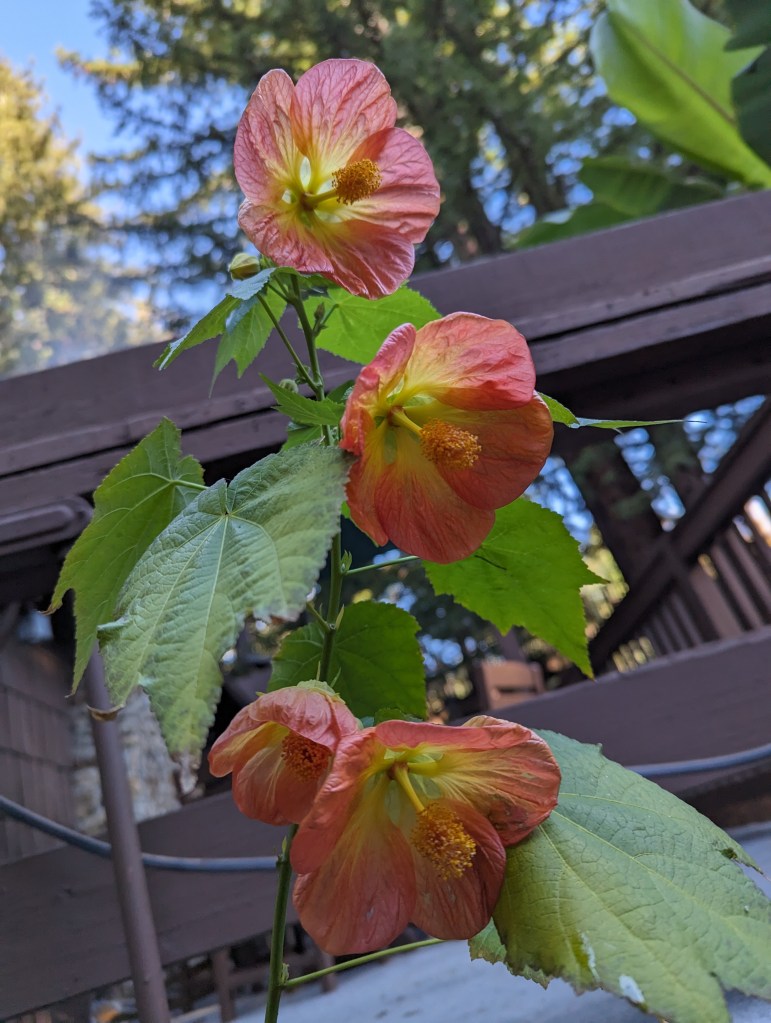
Bloom is sporadic from late spring until frost. The flowers resemble those of hibiscus, but are no more than three inches broad. Most are pastel tints of yellow, orange or pink, with prominently richer veining. Some are red, burgundy red or creamy white. The light green or variegated foliage may get a bit sparse through winter. Foliar lobes are quite variable, or lacking.

Lantana camara

The foliage is oddly aromatic.

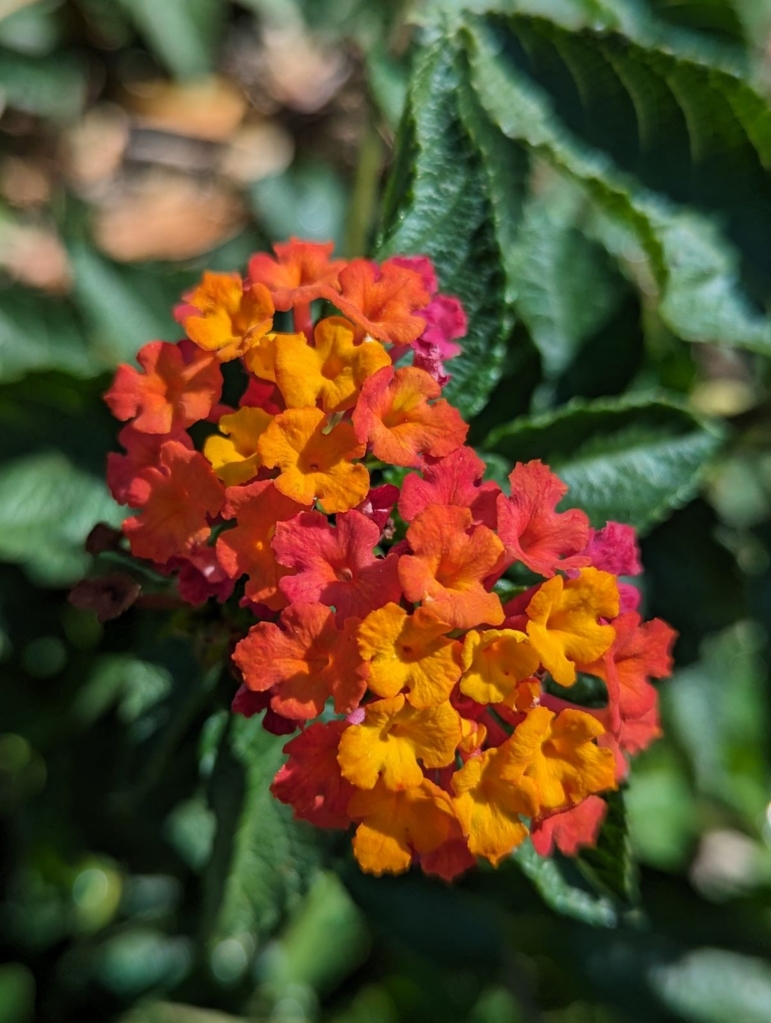
Even as most flowers of summer are finishing, the bright yellow, orange, red, pink and white blooms of Lantana camara continue to brighten gardens until the weather eventually gets too cool and damp for them to perform. This is quite impressive for a species that is endemic to the tropics of Central America, and has a taste for warmth. Blooms are actually one to two inch wide umbels of many small flowers. Individual flowers within each umbel may be different colors at different phases, so that each umbel may have blooms in as many as three different colors.

In the wild, Lantana camara can get almost six feet high and more than six feet broad. Garden varieties are of course much smaller and compact. Since Lantana camara does well in containers, a few cultivars that stay very compact and proportionate to container gardening have been developed, but unfortunately remain somewhat uncommon in nurseries. The potentially objectionably aromatic leaves are about two or three inches long and one or two inches wide, with minor serration and slightly sandy texture. Some dislike the foliar aroma, but many enjoy it.

Lantana camara is not too demanding, wanting only good warm exposure with no more than a bit of shade. Once established, it does not need much water, and can actually rot if watered too frequently, or if soil does not drain adequately. Excessive fertilizer will inhibit bloom. There are not many insects that bother Lantana camara, perhaps because it has an unpleasant flavor. It is actually toxic to animals that may try to eat it. However, butterflies really dig it.

Abutilon

Bloom may become more scarce with cooling weather.

Abutilon X hybridum grows wild from seed within some of our landscapes. Although not prolific enough to be naturalized, dispersion of any viable seed seems odd for hybrids, since most hybrids are sterile. Of course, I do not know for certain if their ancestors were actually Abutilon X hybridum. They could have been other simple species of some sort. Besides, the name seems to apply to any cultivar of unknown parentage, including a few that are not actually hybrids.

Furthermore, even those that are generally sterile hybrids only needed to produce a single viable seed to start the process. Such a seed would likely grow into something that is more genetically stable, and therefore less sterile than its parents. Regardless of their supposed genetic stability, or because of their lack of it, their individual floral color is delightfully variable.

I am no more certain about the common name of this genus, species or group of hybris, which I know simply as flowering maple. Some know it as Chinese lantern. A few may know it as Indian mallow or parlor maple.

I am not so keen on the flowering maple, or whatever it is, for refined landscapes. However, the landscapes here are not so refined, and some are quite rustic. They benefit from the relaxed style, sporadic bloom, and open form of whatever this is.

Bloom is always sporadic, but is a bit more abundant during warm weather. Conversely, it can get scant while the weather is cool through winter. I am impressed by the few flowers that continue to bloom on this particular specimen. So are the hummingbirds. Bloom will likely become more scarce now that the first mild frost occurred last night. Also, foliage may get sparse until warmer weather next spring initiates regeneration to continue the seasonal cycle.

Lantana

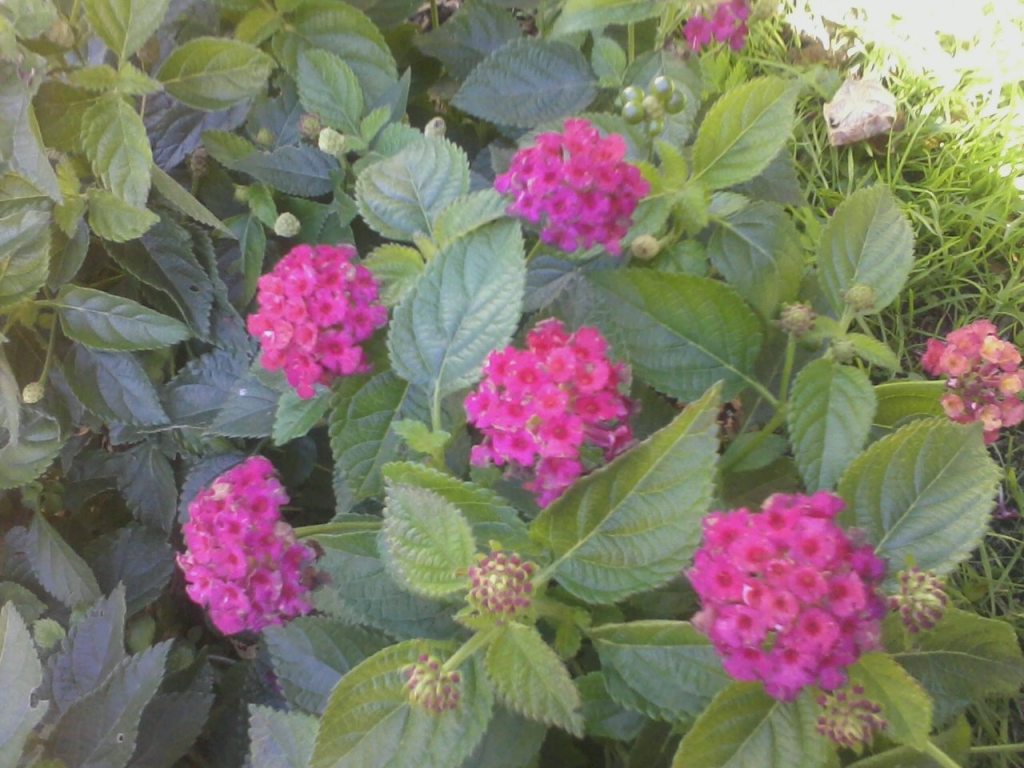
Lantana exudes a pungent foliar aroma.

Bloom continues as long as warm weather continues. Within warm exposures within the mildest of climates, it does not stop for long. Within cooler climates, Lantana camara may already be decelerating its bloom. Although remarkably resilient to arid warmth, it can be vulnerable to frost farther inland. Once established, lantana does not require much water.

Umbels of several tiny tubular flowers are about an inch and half wide. Individual flowers bloom progressively inward from the edges of their umbels. They are typically yellow, but then fade to orange, red or pink. Blooms therefore develop yellow centers within orange, red or pink edges. One cultivar is uniformly bright yellow. Another fades to creamy white.

Old fashioned lantana can eventually grow six feet tall. Congested old specimens might respond favorably to coppicing after winter. After coppicing, new growth can grow six feet high within its first season. Modern cultivars are generally shorter and relatively compact, and a few sprawl. Their very slightly raspy foliage is pungently aromatic when disturbed.