Blood Red Trumpet Vine

Blood red trumpet vine can get aggressive.

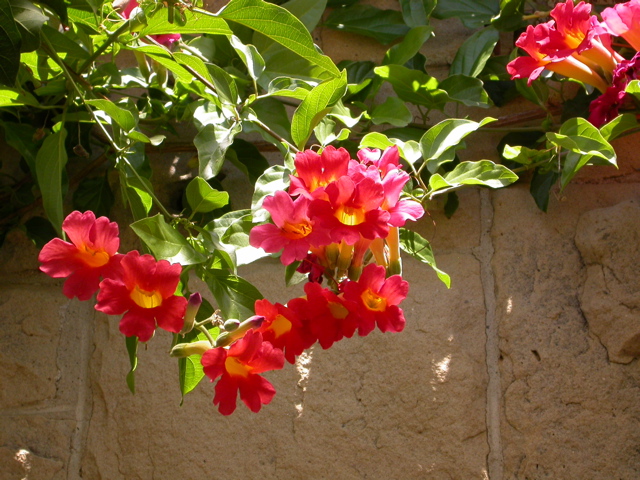
Abundant lush foliage is actually the main asset of blood-red trumpet vine, Distictis buccinatoria, with the sporadic clusters of three inch long tubular flowers blooming as an added benefit during warm weather. Bloom can certainly be impressive when least expected though; and has a sneaky way of getting a late blast of color out during Indian summer weather patterns, when the weather gets warm after a cool phase in autumn. Contrary to the name, the flowers are more ruddy orange with yellow throats than blood red. The rich green leaves are compound, with a pair of three inch long leaflets and a three fingered tendril reaching out from between.

The vines are somewhat aggressive and can climb more than twenty feet, so need adequate support. They should not be allowed to overwhelm smaller or slower plants, or escape out of reach into adjacent trees. The tendrils can grab onto and damage shingles and light fences, but are an advantage for covering chain link fences. Given the opportunity, blood-red trumpet vine can even climb rough cinder block or stucco walls.
Perennial Pea

Perennial pea is a naturalized wildflower.

Now that the weather is getting hot, perennial pea, Lathyrus latifolius, is finishing bloom. It needs warmth to bloom, so can begin between the middle or end of spring. However, it shrivels in heat, so can finish between the beginning and middle of summer. Sometimes, it can bloom for almost three months. Sometimes, it finishes almost as soon as it starts.

Perennial pea is more popular as a naturalized wildflower than within home gardens. Its seed is rarely available from nurseries. Young seedlings might not grow very big initially. Mature specimens can vigorously climb and creep more than seven feet in any direction. Their fibrous perennial roots are very difficult to kill. Propagation by root division is easy.

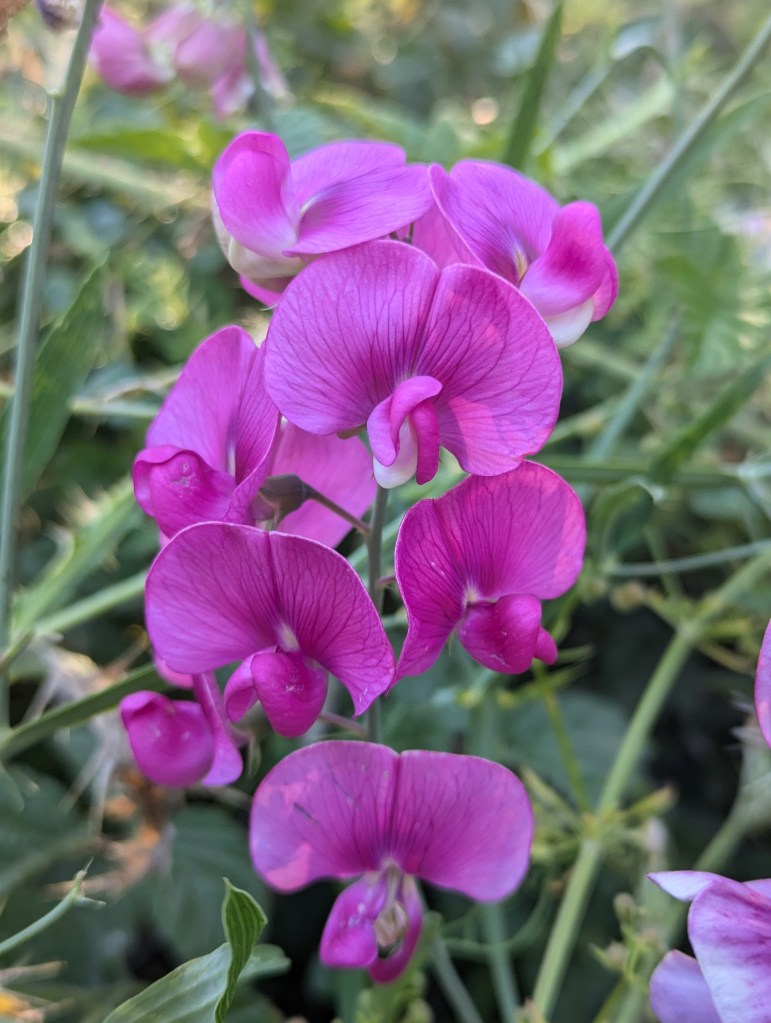
Almost all perennial pea blooms with an abundance of bright pinkish magenta flowers. A rare few bloom with slightly striated light pink flowers. A bit fewer bloom with bright white flowers. Bloom resembles that of annual sweet pea, but is less frilly and lacks fragrance. Slightly bluish foliage and stems have a soft texture, and recover slowly from disruptions. Any parts can be toxic if ingested.

P II

Hibbertia scandens

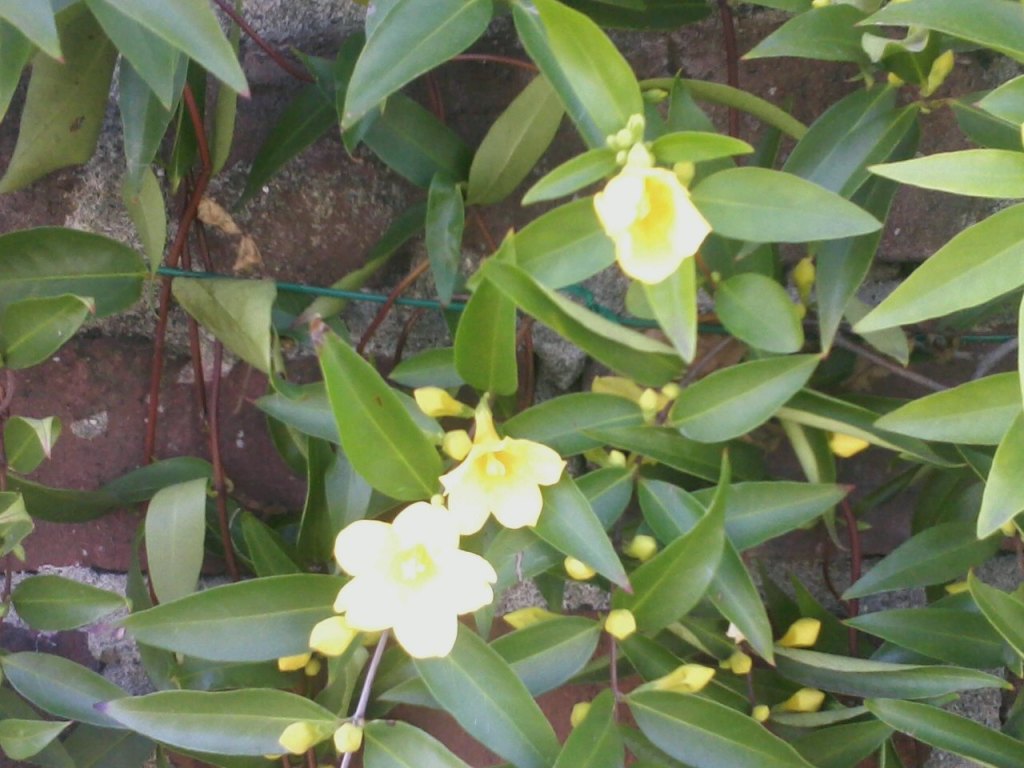
P was for pea last Sunday. Although the spelling has not changed since then, this is a different topic now, so is not actually a sequel. P just happens to also be for the floral fragrance of Hibbertia scandens, which, to some, resembles that of what tomcats do to designate their territory. Its several common names are no more appealing. It is known as golden guinea vine, climbing guinea flower and twining guinea flower. Rather than possibly offending others of Italian descent, I refer to it simply as snake vine. Contrary to its several other common names, it is not actually from the Guinea Region of Western Africa, but is instead from Eastern Australia and New Guinea. Incidentally, New Guinea is no more affiliated with Western Africa than it is with descendents of Italian Immigrants in America, or plump rodents who identify as pigs of the Andes Mountains on the West Coast of South America. I got a few cuttings of snake vine at the end of last September. One cutting is growing quite nicely. Another took time to bloom with this single flower that looks like Carl Junior did not quite beat the train. Its floral fragrance is almost disappointingly unobjectionable. I suspect that more are necessary to be perceptibly fragrant. From my limited experience with the species, I remember than only a profusion of bloom produced merely a slightly objectionable fragrance. Like so much of what I grow here, I have no idea of what to do with these new snake vines. Fortunately, they are more docile than the white perennial pea that I mentioned last Sunday, or the cup of gold vine that I mentioned earlier. Eventually, I should be able to accommodate some within at least one of the many refined landscapes at work. If so, I will not put enough of it within the same situation to generate annoyingly objectionable floral fragrance. Nor should any individual specimen be allowed to grow large enough to do so. I would be more tolerant of a slight bit of such fragrance within my home garden only because I happen to be fond of this species now that I have reacquainted with it.

P

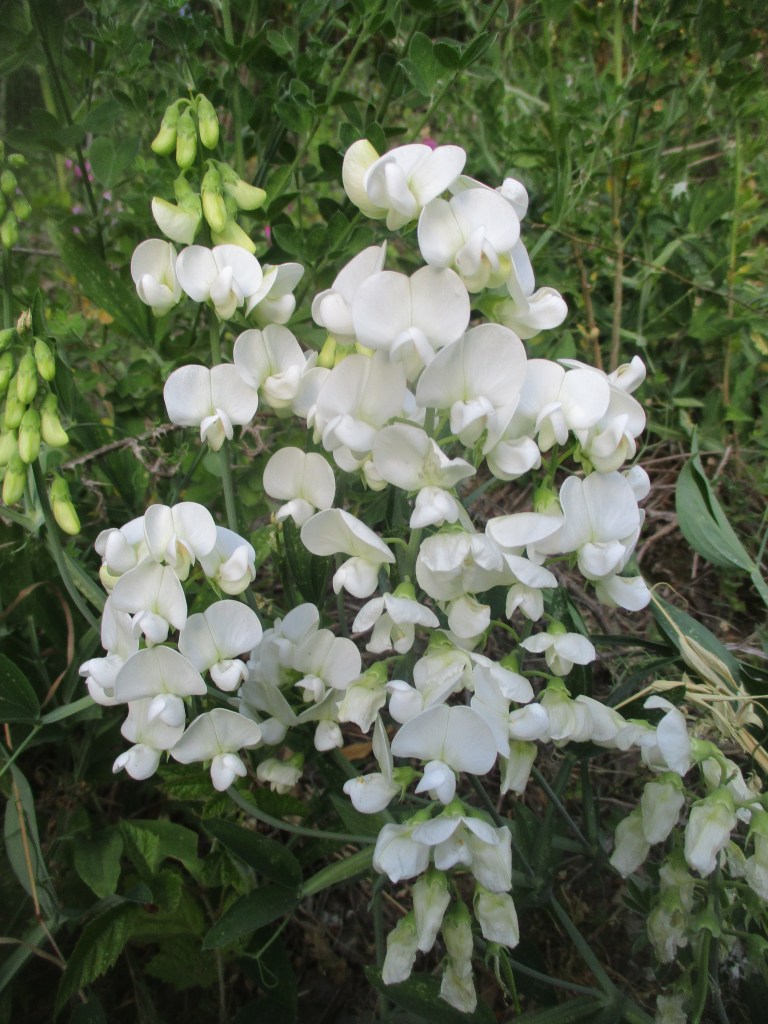
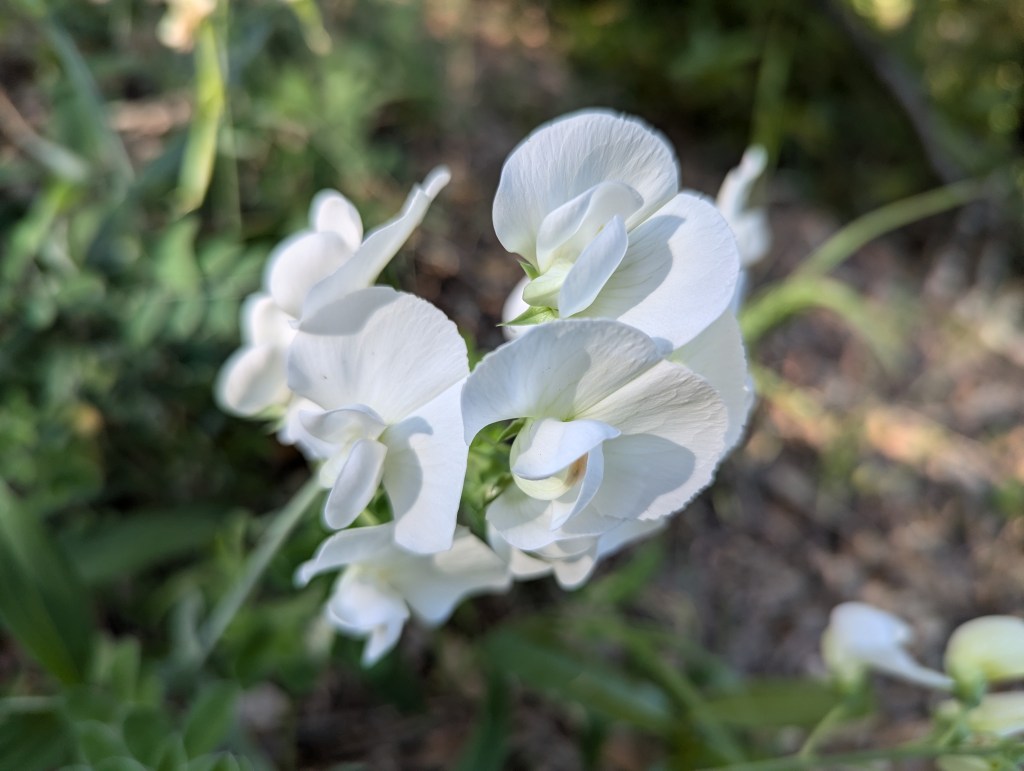
This dinky floral spike was all I needed to identify this as white Lathyrus latifolius.

P is for pea, or more specifically, perennial pea, or Lathyrus latifolius, which does not begin with P, but that is not the point. Perennial pea is a naturalized exotic species here. Within our landscapes, it is difficult to kill. I suspect that it is just as difficult to kill outside of the landscapes, although I have not tried. After all, it is quite pretty, and does not seem to be too invasive beyond situations that it finds to be favorable. Trying to kill what grows beyond the landscapes here would be futile anyway, since there is so much more of it beyond the boundaries of what we have access to. However, I would not want to add any to areas where it is not already established and interfering with local ecosystems. That leaves me with a dilemma. I just acquired a perennial pea that I want to grow more of, but there is no place to grow it. Almost all of the perennial pea here blooms obnoxiously bright purplish pink. Very few bloom lighter pink with a swirly pattern. About as few bloom white. I am told that perennial pea can bloom red, but I am getting to suspect that such red is what I consider to be obnoxiously bright purplish pink. Anyway, I found a perennial pea that blooms white a several years ago, and grew several copies of it. I shared all the copies until none were left. I thought that I could always return to the original source for more. Unfortunately, the source was buried under debris that was removed from a mudslide two winters ago. What a bummer! I had been watching for white perennial pea since then. Then, last Wednesday, I saw it! It was not much, since only one floral stalk was beginning to bloom, but it was enough for identification. I got a good bit of its upper taproot and stems for many cuttings. The base of the taproot remains as a more permanent source if I need it, and if nothing happens to it. I am so pleased with this acquisition, even though I have no idea of what to do with it, like so much of what grows out there.

This is a better picture of the original stock from three years ago.

Blood-Red Trumpet Vine

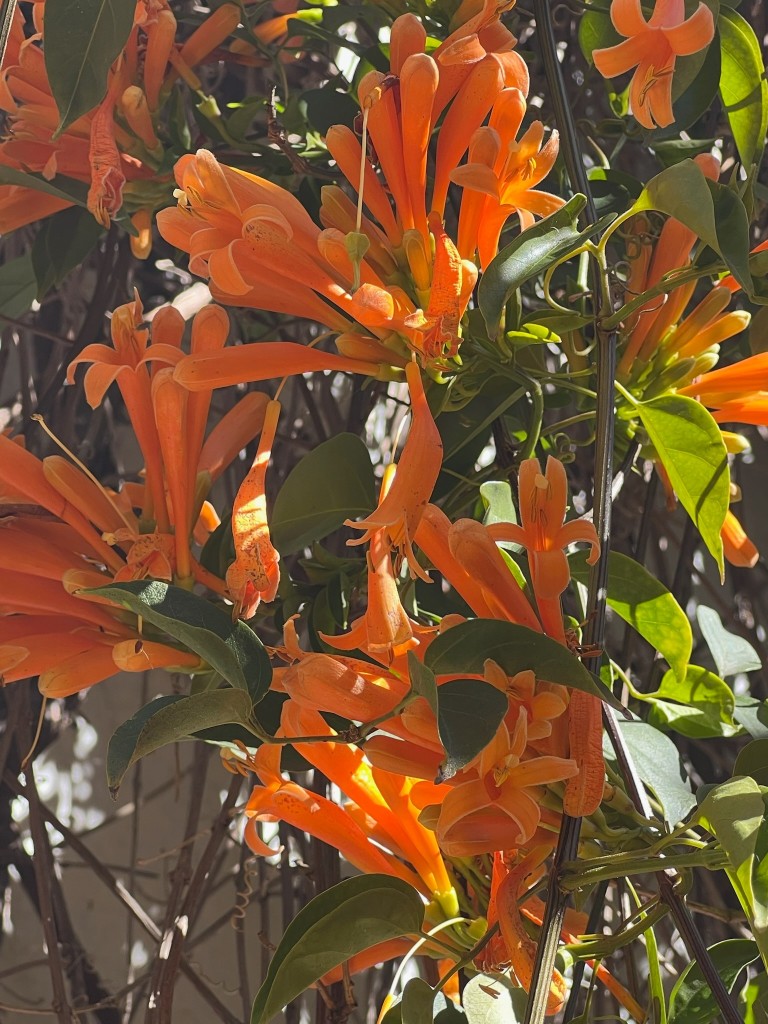
Blood red trumpet vine provides more lush foliage than bloom.

Abundant lush foliage is actually the main asset of blood-red trumpet vine, Distictis buccinatoria, with the sporadic clusters of three inch long tubular flowers blooming as an added benefit during warm weather. Bloom can certainly be impressive when least expected though; and has a sneaky way of getting a late blast of color out during Indian summer weather patterns, when the weather gets warm after a cool phase in autumn. Contrary to the name, the flowers are more ruddy orange with yellow throats than blood red. The rich green leaves are compound, with a pair of three inch long leaflets and a three fingered tendril reaching out from between.

The vines are somewhat aggressive and can climb more than twenty feet, so need adequate support. They should not be allowed to overwhelm smaller or slower plants, or escape out of reach into adjacent trees. The tendrils can grab onto and damage shingles and light fences, but are an advantage for covering chain link fences. Given the opportunity, blood-red trumpet vine can even climb rough cinder block or stucco walls.
What Is This?! II – Hibbertia scandens (sequel from last Saturday)

Hibbertia scandens, Guinea flower

Obviously, it is not cup of gold vine, Carolina jessamine, yellow jasmine, yellow trumpet vine, yellow orchid vine, yellow black eyed Susan vine or any of the vines with yellow flowers that Google suggested as its identity. It is more than obviously not lotus, which incidentally blooms with orange flowers rather than yellow, but was somehow, according to Google, a candidate for vines with yellow flowers. It is amazing what can and can not be found on Google.

Brent recognized this vine just like I did, but also like me, could not remember its identity. We had not seen much of it in many years, but could remember that it was somewhat common in coastal regions while we were in school during the late 1980s. It lived at a doughnut shop that we sometimes went to in Morro Bay, and seemed to smell as if a tom cat had marked his territory on it. I can remember it within old gardens of Carmel and Monterey, as well as Santa Cruz, where I found these cuttings. I also remember encountering it while inspecting median landscapes of some of the major roads of Morgan Hill in the late 2000s, and that it did not perform as well within the somewhat inland climate there. Brent observed that specimens in Santa Monica and Beverly Hills seemed to express the same preference for the more coastal climate of Santa Monica.

Now that I got it, I have no idea of what to do with it. I suppose that, without mentioning the faint but potentially slightly objectionable floral fragrance, I can convince neighbors that they want it in their gardens. Some of our landscapes are big enough for it to be pretty at a distance. At least I know what it is, Guinea flower, Hibbertia scandens.

Carolina Jessamine

It is the Official State Flower of North Carolina!

Along with lilac vine (Hardenbergia), daffodil and some acacia trees, Carolina jessamine, Gelsemium sempervirens, is one of the first flowers to bloom late in winter. The small, loose clusters of  inch long and wide tubular flowers are as bright yellow as those of the various acacia and daffodil, though not nearly as abundant, and actually barely abundant enough for their pleasant fragrance to get noticed. They provide nice contrast for the deep purple of lilac vine, particularly since both are complaisant vines that are often grown together. These twining vines can be kept below first floor eaves, but barely reach second floor eaves if allowed to grow wild. Leaves are about half an inch wide and two or maybe three inch long. Because Carolina jessamine is toxic, it should not be grown where children or inquisitive puppies might eat it. Incidentally, Carolina jessamine is the state flower of South Carolina.

Flame Vine

Flame vine bloom before spring here.

Like so many popular spring bulbs, flame vine, Pyrostegia venusta, may not delay bloom until spring as it should. Within the warmly sunny situations that it prefers, it is more likely to bloom during winter. It may wait until the end of winter or even the beginning of spring only where winter weather is cooler. Bloom is already finishing where winters are milder.

Bloom is spectacular, particularly while not much else blooms so copiously. It is about as profuse as bougainvillea bloom, but earlier. It is about as vibrant orange as poppy bloom, but earlier. With warmth, sunlight and regular watering, flame vine performs very reliably. Perhaps it should not be as uncommon as it is. Yellow blooming flame vine is quite rare.

Although a bit tamer than related red trumpet vine and royal trumpet vine, flame vine may be uncommon partly because it is so vigorous. If pruned to the ground after bloom, it can reach second story eaves to bloom there for the next season. It can grow absurdly high if it grows into trees. Its evergreen foliar tendrils can cling to and damage painted surfaces.

Chilean Nightshade

Chilean nightshade is less aggressive than related potato vine.

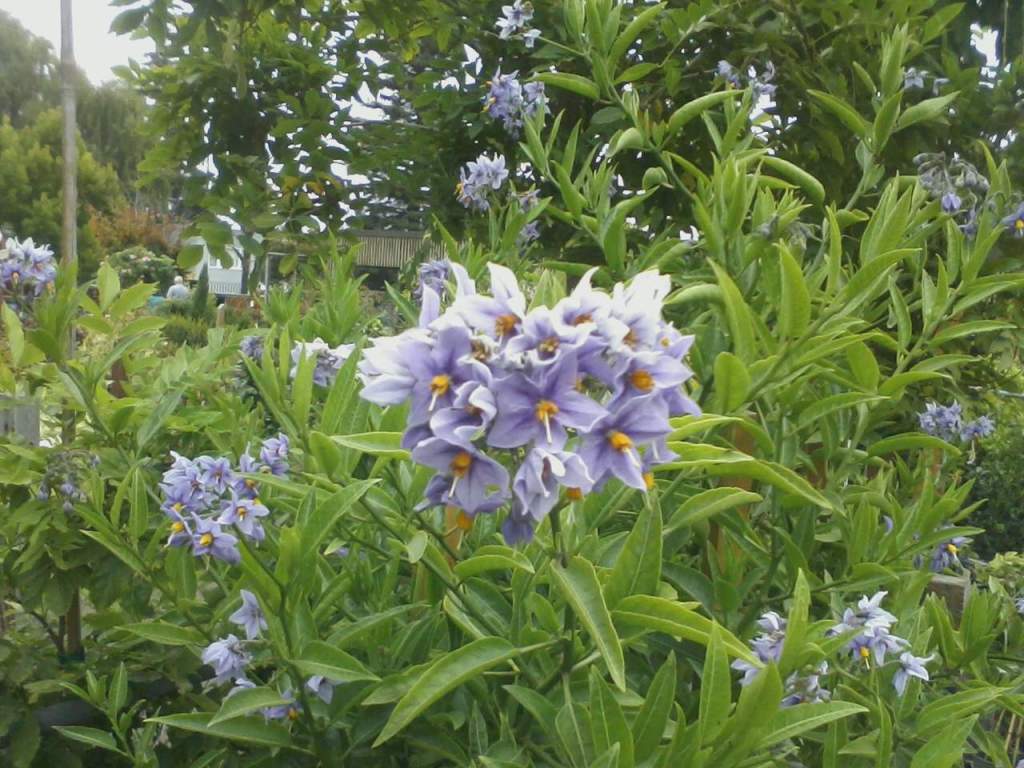
Yellow centered blue flowers like those of the familiar potato bush, on vines almost like those of the comparably familiar potato vine would be like the not so common Chilean nightshade, Solanum crispum. However, Chilean nightshade needs to be trained onto support in order to climb, and only reaches fifteen feet or so. The cultivar (cultivated variety) ‘Album’ is like a shrubbier redundancy to potato vine, since it has white flowers. ‘Glasnevin’ is the most popular cultivar because it flowers freely and is hardier to frost.

The nearly inch wide and slightly fragrant flowers bloom in small clusters from May or June until about now. Small but sometimes prominent green berries that turn yellowish orange and then dark purple are toxic. Partial shade inhibits bloom and vigor.

Red Passion Flower Vine

Red passion flower seems quite exotic.

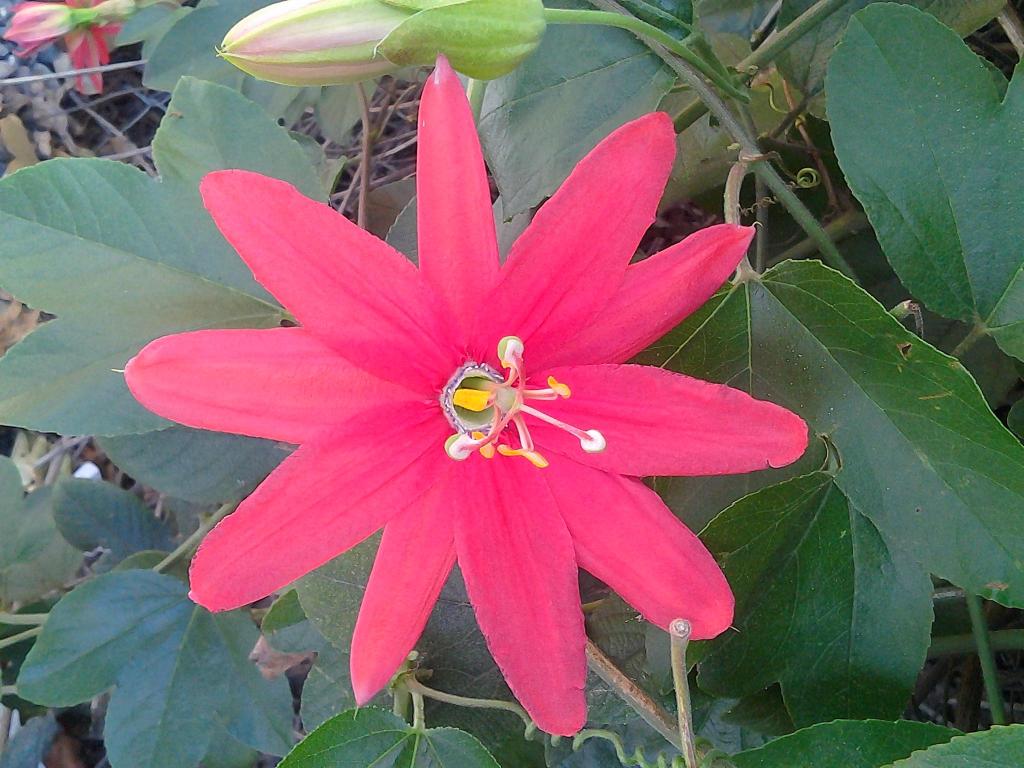
Compared to the common passion flower, the three inch wide red passion flower, Passiflora manicata, is more colorful with cherry red flowers, but does not so prominently display the weirdly distended floral parts that passion flowers are known for. Bloom is not as profuse either, particularly among vigorous vines.

However, red passion flower vine has the advantages of somewhat more resilient and greener foliage, and sturdier vines that can climb almost to thirty feet high. It grows so vigorously that it can be surprisingly overwhelming, even if pruned severely or cut to the ground at the end of each winter. It is not so rampant in light shade.

Copies (new vines) are easy to propagate by layering, which involves merely burying a section of vine while still attached to the parent vine until it develops enough roots to be separated. The buried section should be at least a few inches long. At least a few inches of the tip of the vine should extend beyond the buried section.

The fruit of red passion flower vine is considered to be toxic, but often gets eaten anyway. Fortunately, fruit rarely develops.