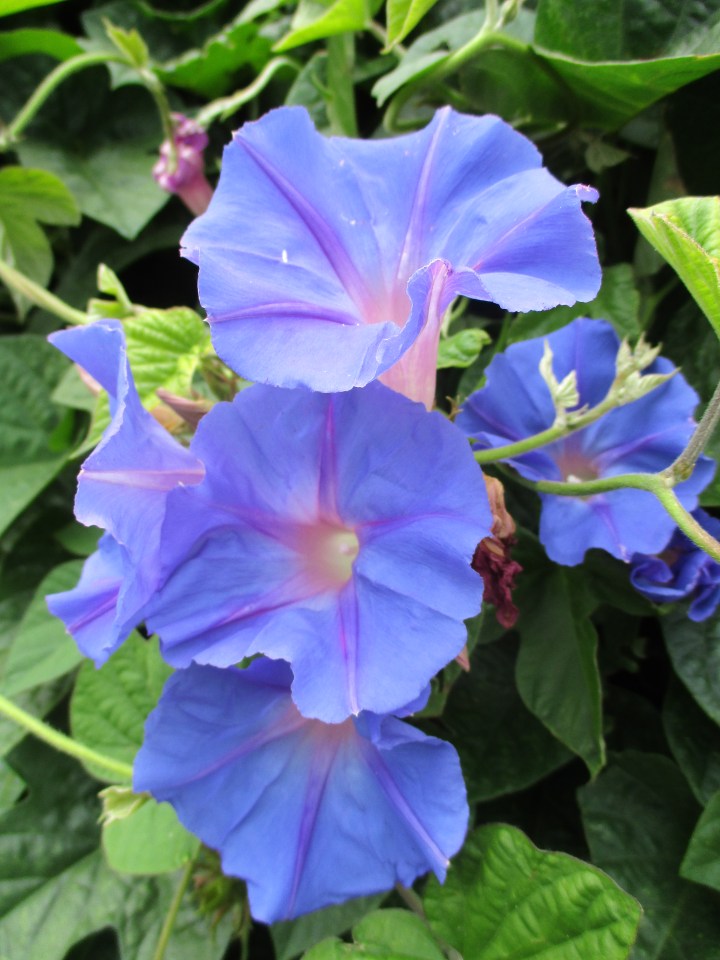
 Even within its native range, blue dawn flower, Ipomoea indica, can be a problem. There are not many other plants in some coastal regions of Peru that can avoid getting overwhelmed by the aggressive wiry vines. These vines grow roots where they touch soil, so can spread indefinitely over the ground. Vines that succumb to frost over winter regenerate as if nothing ever happened.
Three inch wide flowers are rich purplish blue when they open at dawn. They then fade through the day, only to be replaced by fresh new flowers the following morning. Bloom continues from spring until autumn, and can get profuse at times. The lush rich green leaves are cordate (heart-shaped) or lobed (with only three lobes). Too much fertilizer promotes growth but inhibits bloom.
Blue dawn flower’s main weakness is a dependency on water. If it gets too dry briefly in summer, it can die back like it does with frost, and then recover once it gets water, but it will not survive for very long if it stays dry. As aggressive as it is, it should not spread very far from landscaped areas or riparian areas where summers are too warm and dry for it.
 Like Ginger and MaryAnn, choosing between the flashier hybrids of clematis and the anemone clematis, Clematis montana, might not be so easy. The fancier hybrids have the bigger, bolder and richly colored flowers that the genus is known for. Anemone clematis has smaller and more subdued flowers in soft pastel hues, but is more prolific, more vigorous, and blooms for nearly a month.
 There are so many different specie involved with the extensive breeding of the modern cultivars of clematis that they are not even assigned full Latin names. They are simply known as ‘clematis’ (without a specie name), with a respective cultivar name. Clematis X jackmanii is the oldest known hybrid, so the name is often applied to other hybrids, whether or not they are actually related.
 Tony Tomeo