My garden really is not much to talk about. Really. It is just a bunch of redwoods with a bit of other native vegetation dominating the few items that I added into the mix. There are fourteen stock fig trees, but they are very small and mostly obscured by the underbrush. The elderberries, currants and huckleberries are the same as what grows wild, so they do not look like much either. Even the cane berries look very similar to the native blackberries. There is a quince tree, some rhubarb, and some small prickly pear, but they are barely visible amongst the other vegetation. Well, that is enough talk about why my garden is not much to talk about.
These pictures are from one of the gardens that one of my colleagues maintains.
1. Hibiscus is probably the flashiest bloom in this garden now. I have no idea what cultivar this hibiscus is; and I am not even certain about the species. It sure is impressive though. This flower is more than six inches wide!
2. Red honeysuckle is something that I really want to grow, but can not justify it. I mean, it does not exactly ‘do’ anything more than look good. It is not fragrant like Japanese honeysuckle is. This one took a while to bloom.
3. Zonal geranium happens to be one of my favorite perennials, even if others consider it to be too cheap and common. I do not know if this one is pink, peach, salmon . . . or one of those odd colors that only girls can see.
4. Mandevilla is my best guess. Again, I do not know the species. Did I mention that this is not my garden? I do happen to like this one though, because it is so perfectly white. Otherwise, I am none too keen on mandevilla.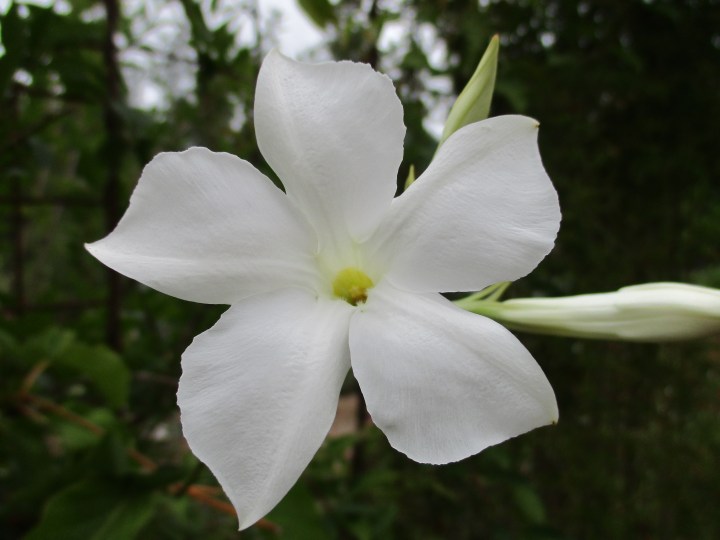
5. Morning glory is quite happy here. This one is annual of course. There was a perennial white morning glory known as a moonflower nearby, but it succumbed to frost last winter. Hope for its recovery ran out months ago.
6. 4:00 (four o’clock) is a prolific naturalized exotic species. I would not say that it is invasive, but merely prolific. I do not know if this one is 4:00 a.m. or 4:00 p.m., but I do know it will not be the last. More on that later.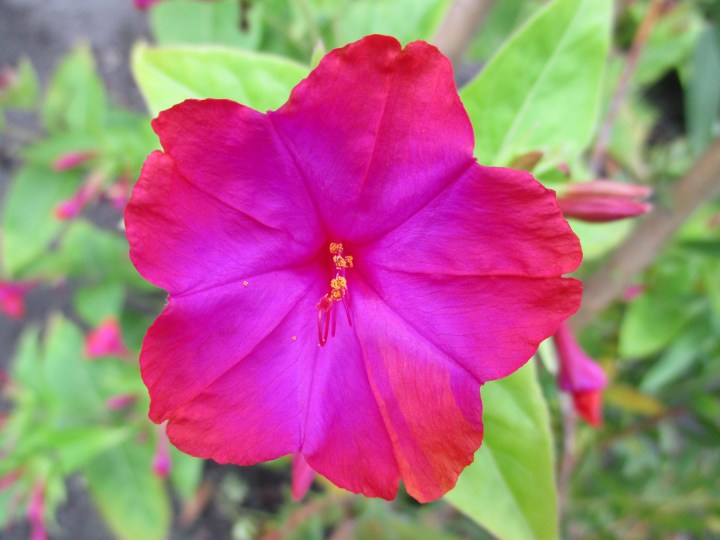
This is the link for Six on Saturday, for anyone else who would like to participate:
https://thepropagatorblog.wordpress.com/2017/09/18/six-on-saturday-a-participant-guide/
 Pink, red or white are the only choices. There happens to be a darker shade of red. Yellow throats are more conspicuous in white flowers. Otherwise, there is not much variation of color amongst the various mandevillas. The flowers are very similar in both color and form to those of related oleander, but are larger. Some are as wide as three inches. Small flowers can have pointed petals.
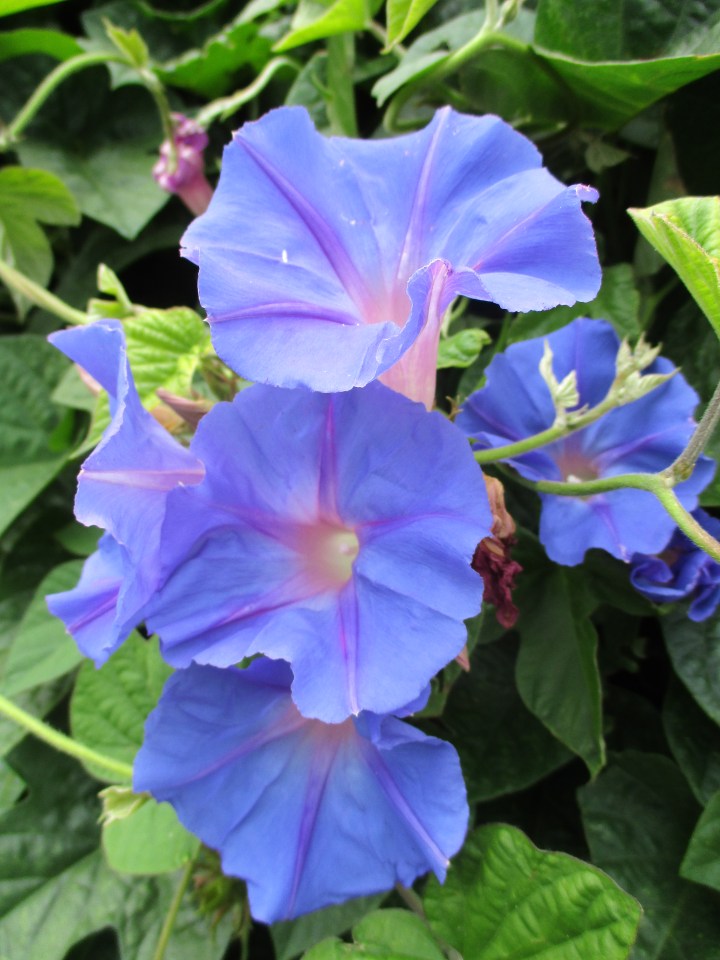 Even within its native range, blue dawn flower, Ipomoea indica, can be a problem. There are not many other plants in some coastal regions of Peru that can avoid getting overwhelmed by the aggressive wiry vines. These vines grow roots where they touch soil, so can spread indefinitely over the ground. Vines that succumb to frost over winter regenerate as if nothing ever happened.
 Like Ginger and MaryAnn, choosing between the flashier hybrids of clematis and the anemone clematis, Clematis montana, might not be so easy. The fancier hybrids have the bigger, bolder and richly colored flowers that the genus is known for. Anemone clematis has smaller and more subdued flowers in soft pastel hues, but is more prolific, more vigorous, and blooms for nearly a month.
 There are so many different specie involved with the extensive breeding of the modern cultivars of clematis that they are not even assigned full Latin names. They are simply known as ‘clematis’ (without a specie name), with a respective cultivar name. Clematis X jackmanii is the oldest known hybrid, so the name is often applied to other hybrids, whether or not they are actually related.
