Six on Saturday: A Saturday Of Flowers

‘A Week Of Flowers’ at ‘Words And Herbs’ finished a week ago, but as I said last week, it reminded me that I should share more floral pictures.

1. Bergenia crassifolia, pigsqueak is as popular as it is because it is so easy to propagate merely by relocating rhizomes that migrate where they are not wanted. These eventually creep onto a low retaining wall around their area, providing more to relocate elsewhere.

2. Rosa spp. ‘Iceberg’ rose should finish bloom anytime. That bud to its upper left is not likely to open now that the weather is cool for winter. ‘Burgundy Ice’, in the background, is grafted onto the same rose tree with this ‘Iceberg’. I think that they look odd together.

3. Pelargonium hortorum, zonal geranium is getting overgrown enough to look shabby, but should not be pruned back until the end of winter. If it gets pruned back now, it will look even shabbier until it resumes growth as weather gets warmer at the end of winter.

4. Erigeron karvinskianus, Santa Barbara daisy flowers seems to be a bit lean in partial shade. Santa Barbara daisy can be an annoying weed, but within our landscapes, is more often an asset, adorning otherwise bare stone walls. I pull it out to refresh it after winter.

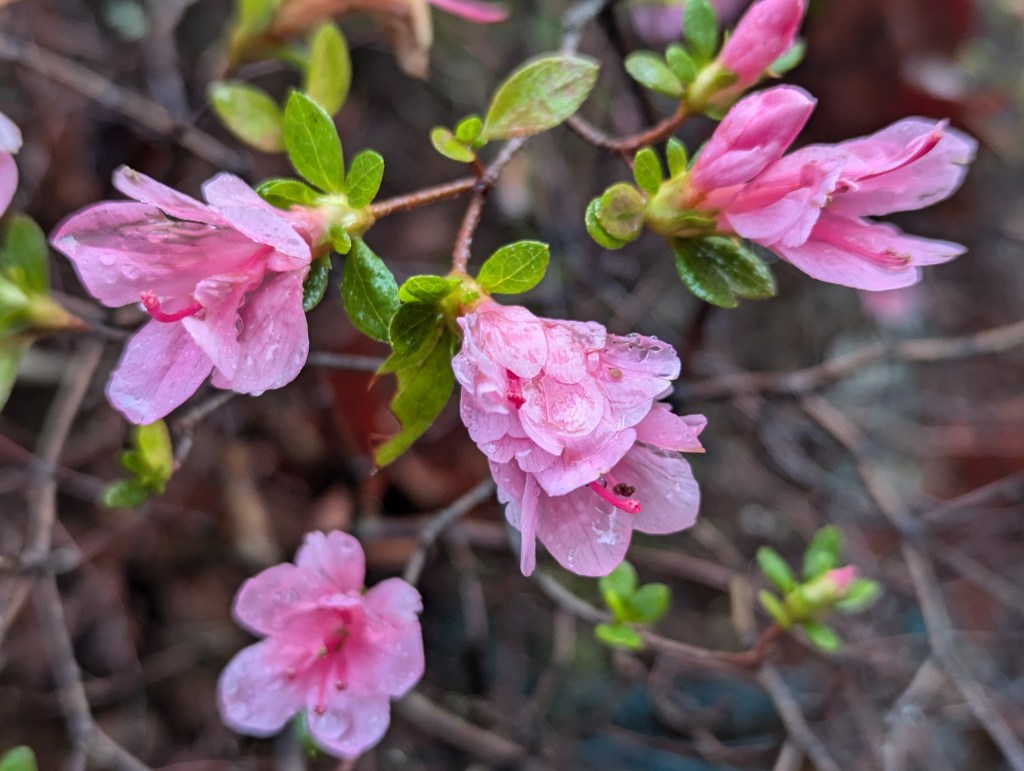
5. Rhododendron spp., azalea blooms lavishly for spring, but this particular unidentified cultivar also tosses out these few premature flowers for winter. Incidentally, it is merely coincidental that most of these Six bloom white. I just got pictures of what is prominent.

6. Helleborus X hybridus, hellebore is happy to self sow, but not as happy to perform. It does not bloom much. When it does, most of its flowers are spotty and grungy. Even the foliage is shabby. This flower, although pallid and weirdly blushed, is a delightful rarity.

This is the link for Six on Saturday, for anyone else who would like to participate: https://thepropagatorblog.wordpress.com/2017/09/18/six-on-saturday-a-participant-guide/

Six on Saturday: a Week of Flowers

‘A Week Of Flowers’ at ‘Words And Herbs’ reminded me that I really should share more floral pictures. These are from yesterday, though, not all year.

1. Salvia chiapensis, Chiapas sage blooms as long as the weather is warm. Then, it takes so long to realize that the weather is no longer warm that, by the time it finishes the last of its bloom, the weather is beginning to get warm enough for it to resume bloom again.

2. Cestrum fasciculatum ‘Newellii’, red cestrum blooms about as continuously. It should have finished blooming about a month ago, but will likely continue until more sustained cool weather just like it did last year. After pausing briefly, bloom resumes before spring.

3. Rosa spp., carpet rose will eventually stop blooming and defoliate just long enough to get pruned back to the ground. It grows back like weeds, but such vigorous growth takes some time to decelerate enough to bloom, which might not be until the middle of spring.

4. Camellia sasanqua, sasanqua camellia has become more of a small tree than a shrub. These flowers are too high up to appreciate individually, but are impressive in profusion. I thought that it is ‘Navajo’, but it now does not seem pink enough, and is a bit too ruffly.

5. Iris X germanica ‘Rosalie Figge’, unlike any other bearded iris here, blooms whenever it wants to, even during the coldest or rainiest weather, with ruins such bloom. I am not certain of its identity. Someone here on Six on Saturday suggested this name, and it fits.

6. Iris unguicularis, Algerian iris from Skooter’s garden, which is perhaps more properly known as Tangly Cottage Gardening, is now blooming to prove that it actually is winter. I am very pleased that it is such perfect blue, without purple, and blooms during winter.

This is the link for Six on Saturday, for anyone else who would like to participate: https://thepropagatorblog.wordpress.com/2017/09/18/six-on-saturday-a-participant-guide/

Six on Saturday: White Saturday

Black Friday was yesterday. White Saturday seems appropriate today. Actually though, I lacked six pictures after a two week commitment from which I returned less than a week ago. These six were cut flowers where I was at. It is a long story. Apologies for this lapse of any personally relevant horticultural topics.

1. Gladiola is one flower that really excels at white! Except for the few at work, I have not grown them in many years. I grew some in yellow and orange in the old neighborhood in 2000 or so. They were fancy hybrids like this, so were not reliably perennial for too long.

2. Peruvian lily was one of the first cut flower crops that I worked with after my first year of college, for the summer of 1986, when they were new and trendy. White had not been developed back then. I am impressed by how white this variety is, with only minor spots.

3. Carnation is one of the most ubiquitous of cut flowers, but is also the only one of these six that I have never grown. I have worked with only bedding types and sweet William in landscapes at work. I did not get close enough to notice how fragrant this carnation was.

4. Rose is the most popular of cut flowers, although it does not seem to be as ubiquitous as carnations do. I can not remember ever not growing them. I acquired some that are in my garden now while I was in high school in about 1984 or 1985 and brought them here.

5. Chrysanthemum that grow in the landscapes at work were formerly potted plants that were left with us to be recycled. We selected none intentionally. They might be more fun like that. Anyway, this particular cut white chrysanthemum is impressively humongous!

6. Lily was a secondary cut flower crop that I worked with for the summer of 1986, along with the primary crop of Peruvian lily, which is not actually a lily. We grew Asiatic lilies, and we grew white lilies, but not white Asiatic lilies such as this. I am happily impressed.

This is the link for Six on Saturday, for anyone else who would like to participate: https://thepropagatorblog.wordpress.com/2017/09/18/six-on-saturday-a-participant-guide/
Strawflower

Strawflower retains its color and form, although not foliage, as it dries.

Just like cosmos, zinnias and other related flowers, strawflower, Helichrysum bracteatum, seems to be at its best as its bloom season ends. Bloom started in summer and should finish now that weather is getting cooler. The two and a half inch wide flowers last in the garden until they get ruined by rain. They are excellent cut flowers, and even better dried flowers.  

Strawflower can be white, pink, red, orange or yellow. Their seed should be sown directly where they are wanted in spring. Mature plants are about two and half feet tall and a foot wide, with three or four inch long and somewhat narrow leaves. Dwarf varieties are not as good for dried flowers, but are fuller and look better in the garden. 

Alternatives For Fresh Flowers

Form develops as color fades.

There are so many choices for flowers to grow for cutting between spring and the end of summer. For autumn and winter though, the choices are somewhat limited. Of the few things that bloom this time of year, there are fewer that are good cut flowers, and even fewer that bloom continually or profusely enough to provide an abundance of flowers until other flowers start to become available again in spring. Besides, who wants to go out to the garden in wintry weather to get flowers to bring into the home?

Many plants have other parts that are showy enough to substitute for cut flowers in the home. Cut foliage, stems, seedpods and even bark can be useful. Some flowers can be dehydrated to last all year, but look nothing like they do while fresh; and the process is somewhat involved. The most convincing alternative to fresh flowers is probably dried flowers.

Not many flowers dry well. Almost all simply turn brown and deteriorate. Only a few remain intact and also keep some of their color. Roses and hydrangeas are commonly dried, although their colors fade and they become shriveled. Yarrow and baby’s breath likewise change their appearance as they dry, but not quite as much. It is not so obvious as their tiny flowers shrivel.

The best dried flowers look somewhat fresh when they are actually dried. Strawflower, statice, globe thistle and globe amaranth are four of the best examples. These flowers are actually rather ‘crispy’ while they are still fresh, and only become crispier as they dry. If left in the garden, the flowers deteriorate only because of exposure to weather, and eventually rot in winter rain.

Simply as fresh cut flowers, strawflower, statice, globe thistle and globe amaranth flowers last longer than just about any other flower. They can even be separated from mixed bouquets and dried as the other flowers deteriorate and get discarded. They only need the lower portions of their stems that were originally soaking in water to be cut off if significantly deteriorated.  

However, most dried flowers probably look best if dried immediately after getting cut, since their foliage yellows more as it dries slowly. Lightweight flowers, like baby’s breath and statice (except bulky perennial statice) can be arranged fresh but without water, and simply allowed to dry as they are arranged. The only potential problem with this technique is that flowers may be difficult to separate and recycle later.

Flowers are more often laid out to dry individually and then arranged afterward. Globe thistle and globe amaranth are rather pliable and can wilt while drying, which can change the shape and consistency of a formerly fresh floral arrangement. Once dried though, their stems remain firm, and they can then be arranged more permanently. Most flowers are adequately dry in about a week indoors (or outdoors in warm dry weather).  

Because strawflowers are rather bulky on soft stems that may wilt, they dry with straighter stems if hung upside down while drying. The biggest flowers should be hung singly. Smaller flowers can be hung in small bunches. This works for heavy flowers like roses, and wide flowers like yarrow as well.

Dried Flowers Were Formerly Fresh

Some faded bloom retains striking form.

All sorts of flowers bloom through autumn as well as winter. Honeysuckle still exudes its richly sweet summery fragrance. Honestly though, most flowers bloom for spring or early summer. They finished a while ago, and are now going to seed. Even flowers that bloom repeatedly do so less now. This is when floral design can get creative with dried flowers.

Straw flower, statice and globe amaranth are among the most familiar of all dried flowers. While still fresh, they already seem to be dry. They do not seem to change much as they dry. They neither fade nor wilt very much. Only their stems sag. If they hang upside down as they dry, their stems remain straight as they stiffen. Their foliage is likely unimportant.

Rose and hydrangea are among less conventional dried flowers that actually look dried. They fade and shrivel, but somehow develop a distinct visual appeal. Amaranth, celosia, lavender and globe thistle fade and wilt only somewhat. Because amaranth stems curve downward anyway, they need not hang to dry. Lavender stems can dry before collection.

Pampas grass and cattails are big and bold dried flowers that were popular in the 1970s. Hairspray should contain dislodged fuzz that otherwise escapes pampas grass bloom. It can also prevent cattail bloom from bursting to disperse its fuzz. Cattails typically grow in marshes, where they are difficult to reach. Pampas grass foliage inflicts nasty paper cuts.

Some dried flowers are better dried than fresh. Some are mere by products of bloom that deteriorated earlier. Dried floral trusses of lily of the Nile, without their seed capsules, are quite striking. So are dried floral spikes of New Zealand flax and some yuccas. They are merely deadheading debris otherwise. Even dried queen Anne’s lace is worth recycling.

Dried flowers do not necessarily need to be of floral origin. Dried bird of Paradise leaves develop weirdly twisty form. Colorful deciduous leaves can be as colorful in the home as in the garden. So can firethorn and cotoneaster berries. Twigs of ‘Sango Kaku’ Japanese maple and red twig dogwood provide color with form. These are only obvious examples. There are many more to experiment with.

Please Do Not Pick the Flowers

Am I that predictable? How did whoever posted this sign know I would be here? I do not want their stupid flowers anyway. Besides, only that dinky twig of some random species that I can not identify is blooming on the far right. Is that all they got? What I really want, or more accurately, what I would want if I did not find them to be either uninteresting or redundant what is already in my garden, is stem bits of the succulents for propagation. I suppose that I am not the only one who might want that, which is why the sign, although slightly irrelevant to such desires, became necessary. Actually, I have direct experience with pilferage of bits of succulents from my small planter box downtown, so I am aware of why such signs might be useful. I would not install any such sign within my planter box because such a sign would be bigger and more prominent than any of the flowers that it would be intended to protect. If I were to grow more flowers, I would prefer those that are so abundant that no one would miss a few that might get pilfered. The most abundant flowers are also smaller than less abundant flowers, so they would not be as tempting to those who might want more impressive flowers. For example, the bearded iris within my downtown planter box blooms with only a few big and bold floral stalks. Not only are the flowers tempting and easily taken, but when they are taken, there are no more to replace them. Anyway, I do not actually mind if those who want copies of my succulent perennials take a few bits if only they do so properly. It may happen more often than I am aware of, but of course, I am not aware of it if otherwise useless bits are taken from below the visible growth, or where they should be pruned away anyway. That is how I justify what you likely know I will mention next. Yes, only about a hundred feet from this urn filled with succulents and the sign that requests that I refrain from doing as such, even if it does not mention the subject matter and procedure directly, I ‘borrowed’ a few bits of stem from the underside of a shabby specimen of what seems to be ‘Roman Red’ Salvia guaranitica that should eventually get pruned back for winter anyway.

Unconventional Dried Flowers

Rose hips are pretty fresh, and can alternatively be dried.

The problem with an abundance of bloom by lily-of-the-Nile over the summer is that all the spent blooms need to be plucked about now. Fortunately though, not all of the spent blooms need to go to compost or greenwaste. The stalks and floral trusses (the clusters of short flower stems on top of the stalks) can actually become interesting ‘dried flowers’, even though the real flowers are long gone.

Many years ago, my neighbor took many of the lily-of-the-Nile stalks that I plucked from my front yard, plucked off the seed capsules, and hung the empty stalks upside down until they dried and turned tan. Being the artistic sort, she added them to other dried flowers and foliage, and arranged them in a large vase (which I think is pronounced as ‘vahz’). Over the years, we found that we can actually let them dry in the garden if we first remove the seed capsules which would otherwise weigh them down and bend the stalks.

Since my artistic neighbor liked these lily-of-the-Nile flower stalks so much, I brought her other dried flower stalks to see how or if they could also be useful. We found that flower stalks from New Zealand flax were just as interesting and even more striking; and some types make rather tall stalks. The large seed capsules from Eucalyptus ficifolia function like modern substitutes for small pine cones. 

There are many other plant parts that can be dried and used with dried flowers as well. Cut bird-of-Paradise leaves become sculpturally twisted as they dry. Petioles (leaf stalks) of windmill palm become simple but striking straight black sticks. While still green, the palm leaves can be cut with scissors into interesting shapes less than six inches wide (larger cutouts disfigure). Some native iris produce large seed capsules that split open as they dry, to reveal bright orange or red seeds within. Money plant is actually grown for its dried seedpods instead of for flowers of foliage.

Even bare stems can be added to dried flower arrangements. Both manzanita and madrone have gnarly stems that turn black or dark brown once cut. Fig has contrastingly thick and curving white or gray stems. Bamboo can be cut into sections of any desired length and stripped of foliage. Heavenly bamboo (Nandina spp.) has shorter canes with a corky texture. Realistically, there are no rules for what works well with dried flowers. Anything that looks good is worth trying once.

Straw flowers, statice (Including sea lavender), lavender, globe thistle and yarrow are some of the more traditional dried flowers. Cat-tails and pampas grass flowers can work as well in large arrangements as they did decades ago, but should be sprayed with hair spray to keep them from shedding. (Cat-tails can actually be very messy if they happen to explode.)

Although spray paint is much too synthetic for those of us who prefer dried flowers to look natural, it also works well to keep pampas grass flowers and cat-tails from shedding while adding serious color. Some people enjoy the potential for unnatural colors enough to spray paint other dried flowers and plant parts that do not need to be sprayed with a fixative.

Bloomless Hydrangea

This hedge of modern Hydrangea is completely devoid of bloom.

Modern cultivars of Hydrangea were not easy to adapt to. I learned how to prune old fashioned cultivars during their winter dormancy. I knew to retain the terminal buds of their retained canes to bloom for their following season. Pruning canes of modern cultivars back shorter and depriving them of their terminal buds in order to promote shrubbier growth seemed to be more like pruning roses. I did not trust them to bloom without their terminal buds. Not only do they bloom, but they do so a bit more abundantly, and with sturdier floral trusses that last and retain their floral color somewhat longer than those of old fashioned cultivars. Old fashioned cultivars have bloomed so reliably for the past few years that I am not so hesitant about pruning them back. However, this year, they inexplicably did not bloom. I do not mean that they bloomed sparsely, or that a few of the total did not bloom. I mean that none of the modern hydrangeas bloomed at all. The only hydrangeas that bloomed within the landscapes at work this year are the few remaining old fashioned sorts. All of the hydrangeas are healthy with vibrantly green foliage. Neither disease nor insect pathogens have been problematic. I can not explain this odd lack of bloom. With such vigorous canes, pruning should be easy this winter. However, I am more likely to leave awkwardly long canes in order to retain their terminal buds. Even if they are not necessary, terminal buds might provide an earlier prebloom prior to the bloom of stems that grow from lateral buds. I can not help but wonder why, while modern cultivars did not bloom, old fashioned cultivars did. A colony of unpruned feral Hydrangea near the bank of Zayante Creek was unusually prolific in bloom.

Unpruned feral Hydrangea bloomed unusually prolifically.

See Anemone

Anemone hupehensis

Japanese anemone, Anemone hupehensis, which is now Eriocapitella hupehensis, is one of several species that I had been wanting to grow for a very long time. Like peony, goldenrod, Joe Pye weed, Indian paintbrush, beautyberry and fancy hybrids of clematis, they are prominent features of fancier gardens in other regions. Some of such species do not perform well here. Others are merely unpopular, but might perform well here if they get the chance. I see them all only in pictures, so can not distinguish what their respective situations are. The only anemones that I had ever encountered while young were sea anemones on nearby beaches. In college, I met poppy anemones, which we know merely as anemone, but found that they are not as reliably perennial as they are purported to be. Japanese anemone had been elusive, until I met a very established and perhaps invasive colony of it in an old landscape near Oakland less than fifteen years ago. I figured that if it can be as happy as it was in a relatively coastal climate, it could be happier here with a bit more chill during winter. Until then, I assumed that minimal chill was a limiting factor to their performance here. ‘Honorine Jobert’ seemed to be the epitome of single white Japanese anemone, but I had not seen any white cultivars, even those with double flowers, that were not alluring. Then, I discovered an unidentified cultivar of Japanese anemone on the edge of a rose garden here. It survives as a remnant of a preceding perennial garden, but does not perform well now that redwood roots have become so aggressive. Furthermore, its floral color is unimpressive. It is not white, but is not quite pink either. Heck, it is not even white blushed with pink. I do not know how to describe it. Initially, it seemed to be only slightly pinkish pale gray. Ick! This year, it seems to be slightly more pinkish than it had been, which makes it slightly less disappointing. However, now that I know it is here, I will not try any other Japanese anemone until I at least try to grow this one well. I am confident that if I relocate bits of it to a garden where it does not need to compete with other vegetation, it will bloom with a more appealing shade of pink. I will not mind that it is not white if it does that much. Then, if it can perform well, I will know that I can grow a white cultivar of anemone also. There is no rush though. Although white happens to be my favorite color, and Japanese anemone happens to excel at white, pink can be appealing also. This is my very first Japanese anemone, and regardless of how unimpressive it is now, I am pleased with it.