Perennial Annuals

New Guinea impatiens (with ivy geranium) from last year.

Annuals complete their entire lifespans within a single year.

Perennials survive for more than a single year.

Biennials grow vegetatively during their first year, and then bloom, disperse seed and die during their second year, but that is another story.

Most species that are appreciated as annuals here actually have potential to be perennials, even if only short term perennials. They are only replaced annually because it is easier than maintaining them through their dormant season.

For example, busy Lizzy is a warm season annual that gets installed for spring and replaced with cool season annuals for autumn. However, if cut back and sheltered from frost, it can survive through winter to perform for the following spring and summer. Actually, it can survive perennially like this for quite a few years, and as it ultimately deteriorates, it can replace itself with its own cuttings or layered stems.

Brent did this with New Guinea impatiens from last year. He neglected to replace them for winter (which is quite brief there), and then noticed that they resumed growth as winter ended. Now, they are huge and even more spectacularly florific than they were last summer.

The picture above shows where I camp out in his backyard when I go to Southern California. Most of the white bloom to the right is actually ivy geranium that cascades below the New Guinea impatiens, but most of the white bloom to the left is New Guinea impatiens above ivy geranium. (White on white was not quite as monotonous when each of the two species maintained its distinct form last year.)

Small terrace at the western margin of the garden.

This other pair of potted dwarf Alberta spruce surrounded with the same New Guinea impatiens above, with a close up below, flanks the steps to a small terrace at far western margin of the garden.

These New Guinea impatiens are huge because they resumed growth from last year.

Six on Saturday: Mostly Flowers

Simply, these are six varieties of flowers. All but one bloomed last week. Half are hybrid cultivars of the same genus with two in the same picture. Six pictures of flowers with two varieties in one picture should include seven varieties of flowers. But of course, “mostly” indicates something that is not exclusive. Anyway, I should have gotten more pictures at work, since it was a rather fun week. Irrigation is getting more demanding, though, now that the weather is getting warmer. Because we need to delay renovation of a prominent landscape, we installed potted Canna onto the site. They are potted to facilitate removal when renovation resumes, but will be rad!

1. Lantana camara, which is known here simply as ‘lantana’, is too colorful to not share. Actually though, it is from three weeks ago, and west of Phoenix. Ours is more yellowish.

2. Rosa ‘Iceberg’ and ‘Burgundy Iceberg’ are grafted together on two old rose trees in the rose garden. I find multiple grafts to be annoying, but guests find them to be intriguing.

3. Rosa of an unidentified cultivar blooms better with better exposure, and also without the other cultivar that it was originally grafted with, but that was crowded out years ago.

4. Alstroemeria peruviana, Peruvian lily will not die. We removed large colonies at least twice from this location, but some always survive. They are yellow, orange, pink and red.

5. Lilium, which seems to be some sort of fancy Asiatic lily, was a gift from a neighbor. I did not expect them to perform so well, but after only four years, they should be divided.

6. Rhody is the only one of these six who is not a flower, although another type of flower is named after him. Morgan, his F250 who identifies as a Mercury, wants to get washed.

This is the link for Six on Saturday, for anyone else who would like to participate: https://thepropagatorblog.wordpress.com/2017/09/18/six-on-saturday-a-participant-guide/

Ranunculus

These grew from formerly small and shriveled clumps of tuberous roots.

It is hard to imagine how the small shriveled clumps of tuberous roots of ranunculus, Ranunculus asiaticus, planted last autumn can produce such bright pink, red, orange, yellow and white flowers between late winter and early spring. The two or three inch wide, semidouble or double flowers stand about a foot high, just above their soft deeply lobed foliage. Those of us who did not get ranunculus in the ground last autumn can find blooming plants now. Ranunculus want to be in full sun, in rich, well draining soil.

Deadheading (removal of fading flowers) promotes subsequent bloom; but the season is rather short. Foliage will soon be turning yellow, and will eventually die back. If not watered too much, dormant ranunculus can survive through summer, but should be dug and stored in a cool dry place until next autumn if they are in pots or areas that will get watered regularly.

Undoing of Fragrance

Extensive breeding can compromise floral fragrance.

As I enjoy good friends and cheap coffee out on the deck, I am also savoring the sweet fragrance of the abundant white bloom of the black locust off in the distance. I know that black locust is a noxious weed that invades riparian environments; but they smell so good on such pleasantly warm spring days. Modern varieties are certainly better behaved and more colorful with their pink to purplish flowers, but their fragrance does not compare so well.

Earlier here on the deck, one of my friends and I discussed how modern Buicks are much safer than old classic Buicks are, but are not quite as elegant and stylish. It made me think of how decades ago, modern roses were developed for flower size, form, color and stem length, but in the process, were deprived of, among other qualities, their fragrance. Perhaps I would have been more attentive to my friend if the coffee were as potent as the fragrance of the black locust.

Modern varieties of many classic flowers are less fragrant than their ancestors were. This is because decades (and centuries) ago, fragrance generally had not been prioritized in breeding as much as were other physical characteristics, such as flower size, form, color and so on. The plants that were consequently used for breeding typically had the most visually appealing flowers, but lacked fragrance. Such disparity is actually quite natural among plants with variable flowers.

For example, most bearded iris that naturally have the biggest, fanciest and most brightly colored flowers are also the least fragrant. Their progeny that have become the modern varieties are just as flashy, and also, just as deficient of fragrance. Conversely, the relatively small and simple pale purple flowers of my favorite ‘Grandma Sheppard’ bearded iris are remarkably fragrant.

To the iris, this is all quite sensible. Their fragrance is not designed to impress us, but is merely intended to attract pollinators. If they are fragrant enough to entice the insects that bring them pollen, they do not need to waste any more effort on visual appeal. Without fragrance though, they can alternatively use color (including infrared and ultraviolet) to direct insect traffic where they need it to go in order to accomplish pollination. Almost all of the many varieties of iris prefer to specialize in one or the other; either fragrance or visual characteristics, but not both.

So many of the old classics seem to have lost some or most of their fragrance as they have ‘improved’ over the years because visual appeal has been prioritized more than fragrance. Besides flowering locusts, roses and iris, some types of honeysuckle, mock orange, sweet pea, violet, hyacinth, lily and even narcissus are less fragrant than their ancestors were. However, traditional as well as modern fragrant roses and iris seem to be gaining popularity. Fortunately, gardenia, lilac, wisteria, stock and the fragrant types of angel’s trumpet and jasmine are probably as potent as they have ever been because they have not been tampered with as much.

Cosmos

Cosmos has potential to almost naturalize.

For the past few years, I have really been overly indulgent with the seed catalogues from Renee’s Garden. I wanted to try more varieties of classic annual cosmos, Cosmos bipinnatus, than I could fit in my garden. I recently grew ‘White Seashells’ with tubular ray flowers, and colorful ‘Double Click’ with ruffled semi-double and double flowers, and even the ‘Dancing Petticoats’ mix, which includes several varieties! By now, I have probably grown all but a few of the many offerings.

After trying so many though, I still can not tell you which are my favorites. It would not matter much anyway, since I did not deadhead them to deprive them of their abundant seeds. Their self sown progeny are now mixed and beginning to bloom in random shades of pink ranging from pale pink to nearly red to nearly purple, with a few white.

Naturalized cosmos eventually reverts to bloom with more genetically basic single flowers in simpler shades of pink and white, on stems about three or four feet tall. They can even get taller than six feet and wider than two feet. Most of the popular garden varieties that I started out with though stay less than three feet tall. ‘Sonata’ is a popular strain that stays even shorter, so is among the most practical and proportionate for refined gardens.

Seed can be sown or new plants can be planted now to bloom through summer. Naturalized plants are already blooming only because they get an earlier start. Regardless of color or form, all cosmos flowers are about three inches wide, with yellow centers. Their finely textured pale green foliage is quite delicate and airy. 

Azalea

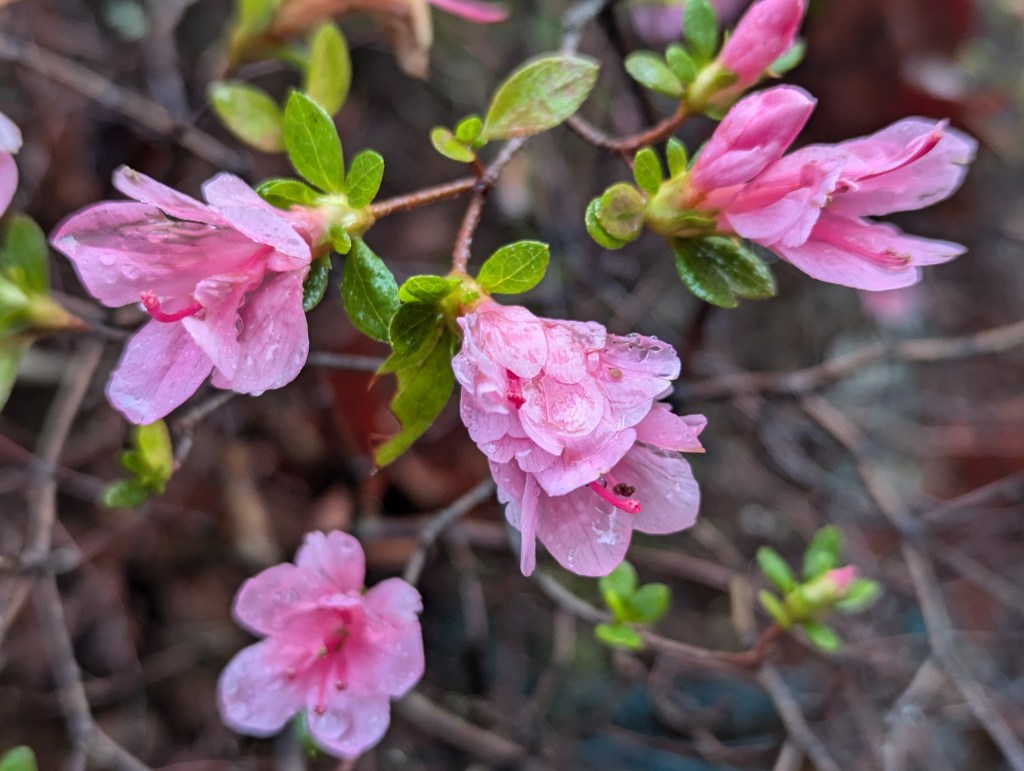
Azalea bloom can almost obscure foliage.

Azaleas, which are species of Rhododendron, have been in cultivation for centuries. At least ten thousand cultivars are documentable. Most are interspecific hybrids. Only a few are selections or breeds of simple species. Most of their ancestral species are native to Asia, Europe or North America. Almost all cultivars that are available here are evergreen.

Azaleas can bloom profusely enough during April or May to almost obscure their foliage. Bloom may last for more than two weeks. Floral color ranges between white and red with many tints of pink, salmon and magenta. The most profuse flowers are as narrow as half an inch. Larger flowers may be three inches wide. Rare deciduous azaleas are fragrant.

Azaleas do not grow fast, but can eventually sprawl more than five feet wide. Some can grow nearly twice as wide. Although most do not grow much taller than three feet, some can grow twice as tall. Azaleas are naturally understory species, so can tolerate a bit of partial shade. They should not crave fertilizer. If they do, they prefer acidifying fertilizer.

Floral Color Communicates To Pollinators

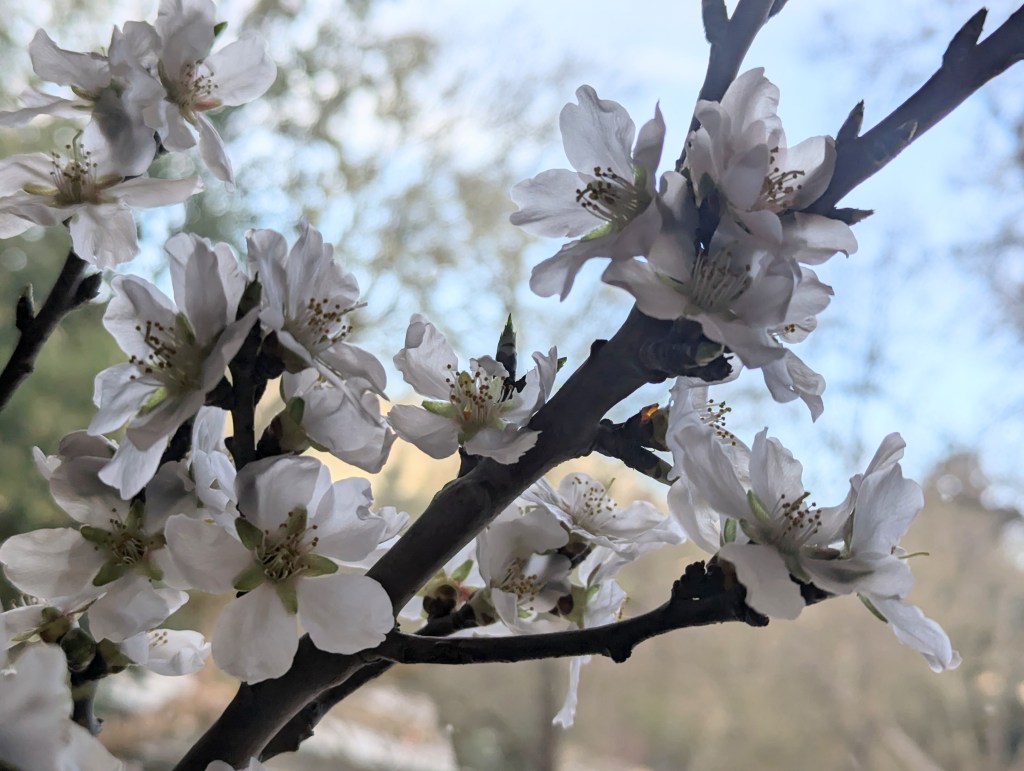
Flowers attract their pollinators with color.

Bloom is bountiful for spring. It is more abundant now than it will be at any other time of year. Early bloom has more time to produce more seed prior to autumn and winter. Also, it can most efficiently exploit its pollinators who are also most active in spring. The most prominent blooms appeal to such pollinators with floral color. Their effort is remarkable.

Most bloom within most natural ecosystems here relies on wind for pollination. Although very efficient, it lacks prominence. Some grasses seem to produce seed without evident bloom. Because such vegetation does not rely on pollinators, it has no need to advertise. Toyon produces tiny but prominently profuse flowers for both wind and insect pollination.

Most species within home gardens rely on pollinators rather than wind for pollination. At least their ancestors did. They originally developed both floral color and floral fragrance to attract pollinators. Extensive breeding enhanced color and fragrance, but also caused sterility for some. Others are not true to type. Their visual appeal became less practical.

Obviously, such visual appeal and associated practicality are subjective. Although less practical for procreation, enhanced bloom is more practical for home gardens. Most who enjoy flowers appreciate enhanced floral color and enhanced floral fragrance. They are unconcerned with how species that provide such bloom procreate. Looks are everything.

Besides, some pollinators can still enjoy most enhanced floral color. A few flowers are so genetically modified that they confuse some pollinators. A few insects die of exhaustion while trying to gain entry. Generally though, most get what they came for or safely leave without it. Many who enjoy gardening also enjoy pollinating insects and hummingbirds.

Ultimately, floral color is personal. Many garden enthusiasts prefer specific color ranges or specific colors. Many prefer an abundance of color. Some prefer more subdued floral color. Some prefer specific types of flowers to provide floral color. Bloom season may be another concern. Some want more winter bloom while nearby gardens lack floral color. Many prefer major spring bloom. Some like random bloom through the year.

Unused Azalea Pictures

Contractions are awkward for me. I certainly could use them if I want to, I just prefer not to. It is a pointless habit that I should be more comfortable with breaking sometimes.

Another habit that I should indulge in less is the use of six different cultivars of the same species for my ‘Six on Saturday’ posts. I have done it for camellias, rhododendrons, roses, flowering cherries, bearded iris, African daisies and a few other species, including various annuals. I refrained from featuring six azaleas simultaneously for yesterday morning, although I did feature three bearded iris, which comprised half of the ‘Six on Saturday’. I should remember to limit azaleas to three pictures, or preferably two or one, if I feature them on ‘Six on Saturday’ later, as they continue to bloom.

These two pictures of azaleas were omitted from my ‘Six on Saturday’ post yesterday because, as the theme implies, such posts are limited to six pictures. Perhaps I should have used one or both of these pictures instead of one or two pictures of bearded iris. It is too late now.

The first azalea above is variegated. Its leaves resemble those of variegated andromeda. I do not remember what cultivar it is, although the label remains attached to at least one specimen. At least three specimens inhabit the same landscape together. They are blooming better this spring than they have in the past, perhaps because, annually, they are bigger and more established than they were for their previous season.

Relative to the many azaleas here, the second azalea below is nothing special. I like this particular picture because it happens to show a bee visiting the bloom. My pictures tend to be more technical than artistic. Perhaps I should try to include a bit of wildlife sometimes.

Six on Saturday: Mix It Up

Six pictures can not represent all that is blooming now. I did not even try. Nor did I post six pictures of six different cultivars of the same species, as I typically do with camellias, azaleas, rhododendrons, flowering cherries, roses, or other flowers that we grow several cultivars of. I posted three pictures of bearded iris, but I could have procured more than six if I wanted to. I likewise could have posted more than six pictures of different African daisy. I tried to mix it up a bit more than I typically do, as I did with the snakeroot here.

1. Persicaria bistorta, snakeroot and (likely) Iris ensata ‘Variegata’, variegated Japanese iris from Tangly Cottage Gardening are happy on the edge of the pond. The Japanese iris is barely visible at the center. The rest of it is on the edge of another stream. Naturalized exotic Nasturtium officinale, watercress to the upper right shows how close the water is. I thought that there were two cultivars of snakeroot, but found three labels for ‘Superba’, ‘Firetail’ and ‘Dimity’. I can segregate their copies later, but will likely leave these mixed.

2. Clivia miniata ‘Variegata’, variegated Natal lily from Brent’s Jungalow tried to bloom, but this happened before I took a picture. Its cultivar is unidentified, but it is variegated.

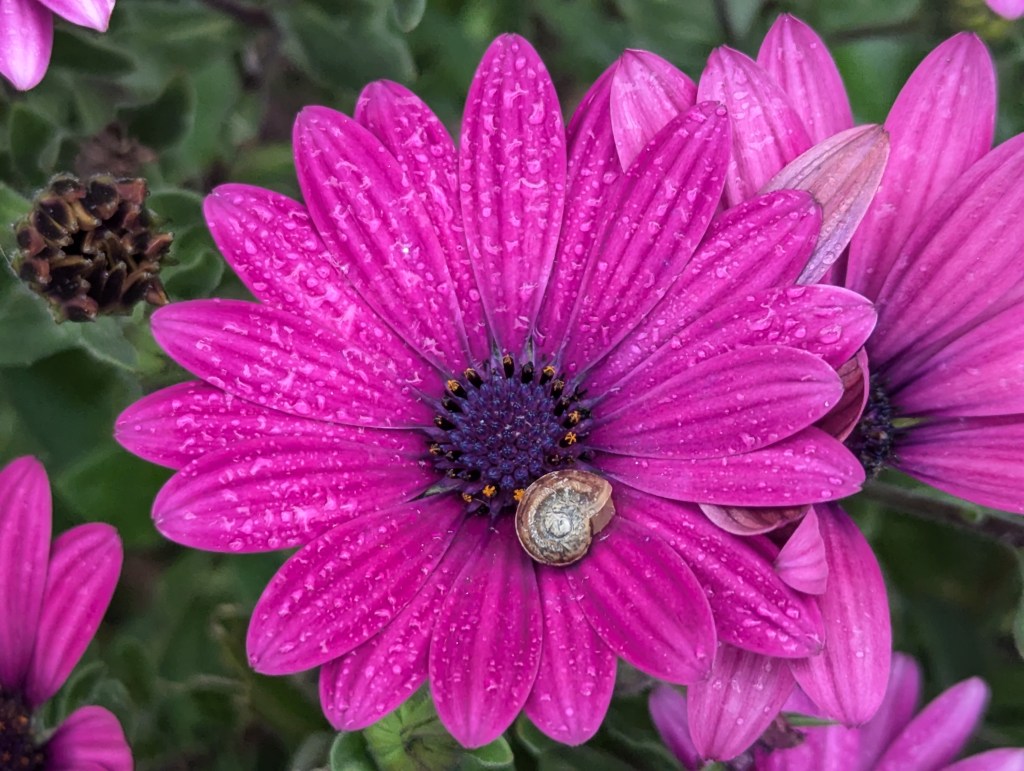
3. Osteospermum ecklonis, African daisy blooms too generously for anyone to take all its flowers. About six cultivars inhabit this particular landscape with a few more in another.

4. Iris X germanica, bearded iris are blooming so tall that some should be staked. There are too many cultivars in the Iris Bed to take pictures of, so I will show only these three.

5. All cultivars of the primary Iris Bed are unidentified. At least three that were relocated from the forest are likely feral. One is pale white. This pale yellow looks like Tweety Bird.

6. All of the iris here, like the iris in my garden, have history. This iris is from the former home of an respected colleague. He brought it to me before the garden was demolished.

This is the link for Six on Saturday, for anyone else who would like to participate: https://thepropagatorblog.wordpress.com/2017/09/18/six-on-saturday-a-participant-guide/

Deadheading Redirects Resources For Growth

Deteriorating flowers lose their appeal fast.

Early spring bulbs that went into their gardens last autumn are now blooming. Some are already done. Some summer bulbs should begin to bloom as the last spring bulbs finish. A few of them might bloom as late as autumn. Ultimately, like the earliest of spring bulbs, all eventually finish. As they do, their deteriorating flowers will necessitate deadheading.

Deadheading is simply the removal of deteriorating blooms. For many species, it diverts resources from fruiting into other growth. Many species can utilize diverted resources for subsequent bloom. Many become more intent on blooming again after deprivation of any prior fruiting. Spring bulbs instead utilize all their diverted resources for new bulb growth.

For spring bulbs, it is the most practical response to deadheading. Most bloom only once annually. Therefore, they can not divert resources directly to subsequent bloom. Instead, they prioritize vegetative growth of bulbs to grow and bloom for the next spring. They are patient. Reproduction remains their priority. They merely regroup before another attempt.

Because of extensive breeding, many spring bulbs can not produce viable seed anyway. Of course, this does not prevent them from trying. Even seeding or fruiting structures that contain no viable seed can be unappealing. For them, deadheading is merely aesthetic. Some complicated hybrids that might produce viable seed are unlikely to be true to type.

Elimination of viable seed that is not true to type is as practical as it is aesthetic. Without deadheading, such seed can grow into feral progeny. Such ferals may be more similar to remote ancestors than to their direct parents. They can be aesthetically inferior, but more prolific. Eventually, less desirable feral bulbs may displace their more desirable parents.

Because they are small but abundant, some freesia avoid deadheading. Resultant ferals are more fragrant but less colorful with pale white bloom. They are more prolific, so might eventually displace their parents. Common grape hyacinth and snowflake are too florific to deadhead, but are true to type. Actually, they can become invasive in some situations. Montbretia are very likely to be invasive.