Proud Land

Proud Land

‘La France’, in 1867, was the first hybrid tea rose to be hybridized. ‘Peace’, in 1945, was the first hybrid tea rose to be classified as a hybrid tea rose. Yes, it took quite a while.

Afterward, hybrid tea roses became very popular both for the cut flower industry and home gardens from the 1950s through the 1980s. Because of their single bold flowers that bloom on tall and sturdy stems from spring until autumn, they are still very popular as florist flowers. However, more florific floribunda roses became more popular for home gardens through the 1990s. Since the turn of the Century, all sorts of simpler shrubby roses, such as carpet roses, became more popular than all of the other types of roses. Hybrid tea roses and other types that produce comparably exemplary cut flowers require more specialized maintenance than most people want to commit to. Sadly, hybrid tea roses are now passe.

‘Proud Land’ was the first of the hybrid tea roses that I installed into my mother’s new rose garden in 1984. It came from Jackson & Perkins while Jackson & Perkins was still based out of Medford in Oregon. Unfortunately, it suckered so profusely during its first season that I wrote a letter to Jackson & Perkins about it. Jackson & Perkins generously replaced it for the following season. Also, my mother, who was unaware of the replacement, purchased another replacement. As if that were not enough, I managed to abscise all sucker and burl growth from the original while it was dormant for the following winter. So, three individual specimens of ‘Proud Land’ bloomed at the center of the small rose garden for 1985, which was the year that I graduated high school.

Technically, hybrid tea roses are at their best after about five years, but should probably be replaced before about ten years. ‘Proud Land’ continued to perform though, with no indication of deterioration, until I finally removed them in 2020. They live here now. I grew a few ungrafted copies from their pruning scraps. I should properly graft a few copies also. Realistically, there is no need to retire the originals.

Some consider hybrid tea roses to be passe. I consider them to be historical.

Garden Phlox

Garden phlox is delightfully fragrant.

In eastern North America where it grows wild as a native, garden phlox, Phlox paniculata, is modest but classic perennial that gets more than four feet tall with pinkish lavender flowers from late summer through early autumn. Modern garden varieties are mostly somewhat more compact with pink, red, light purple or white flowers. Many have fragrant flowers; and some have flowers with lighter or darker centers. Butterflies and hummingbirds dig them all.

Locally, garden phlox probably looks best with slight shade or among other lush plants, only because humidity is so minimal. Otherwise, it would be just as happy out in the open. In well watered gardens with rich soil, it sometimes self sows a bit, but rarely naturalizes continually enough to revert to a more natural (wild) state like it can in gardens on the west coast of Oregon and Washington. Garden phlox can be propagated by division of mature plants either after bloom in autumn or in spring.

Muskogee?

This is not a color I had expected.

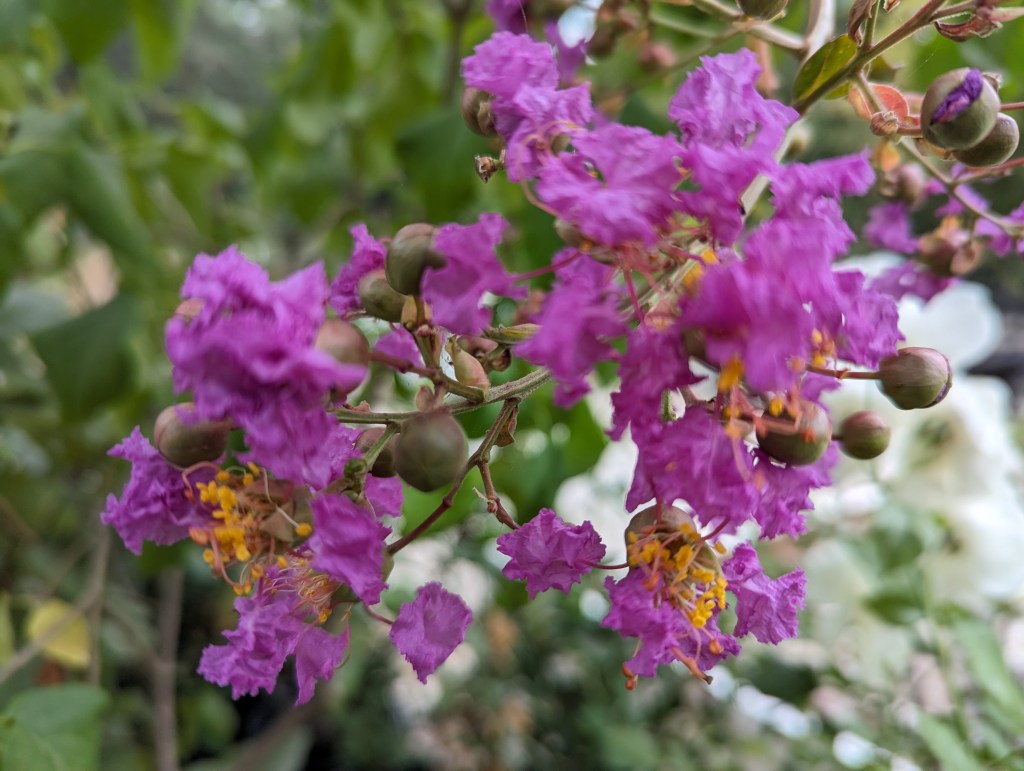
What cultivar of crape myrtle is this?! I realize that this picture is blurred, which is why it was not included within my ‘Six on Saturday’ post this morning, but it is the floral color that is important. Is it purplish pink, or just bright pink? What cultivar does it look like?

I expected this crape myrtle to be one of the old reliable cultivars because it was a gift from the Arbor Day Foundation. The primary old reliable cultivar that blooms with similar floral color is ‘Muskogee’. Yet, even with my limited ability to discern color quality, this floral color seems to be a bit too rich. I sort of expect a milder and scarcely purplish pink from ‘Muskogee’. I suppose that the Arbor Day Foundation can also grow modern cultivars like the rest of us.

Regardless of its identity, it is certainly pretty. The foliar color during autumn is comparable to that of old reliable cultivars. Because neighbors like it, I grew a few copies for them. We would like to incorporate more crape myrtles into the landscapes at work. The abundance of spring color from other species there mostly finishes prior to the summer bloom of crape myrtle. Summer is the busiest season, so justifies flashy color.

Embarrassingly though, I am still none too keen on crape myrtle. If I did not typically spell ‘crape’ as ‘crepe’, I would prefer to spell it without the ‘e’ at the end. I was impressed with it when I first started to notice it through the 1980s, but then realized that it was becoming too common through the 1990s. That was long after Brent told me that it had become too common throughout the Los Angeles region significantly earlier. Decades later, it is still too much of a good thing.

Hydrangea

Hydrangea have certainly evolved.

Things were simpler decades ago when hydrangeas, Hydrangea macrophylla, were either white or not white. Those that were not white were mostly pink locally because of the alkaline soil of the Santa Clara Valley. Blue hydrangeas where seen where the soil is acidic in the Santa Cruz Mountains, or where the soil was amended to be acidic. (Acidity causes flowers to be blue. Alkalinity causes flowers to be pink.)

Now there are more than five hundred cultivars of hydrangea! Although bloom color is really determined by pH, many cultivars make better blue shades, and many others make better pink shades. Purple and red have been added to the mix, while white has become less common. After getting pruned low while dormant through winter, most hydrangeas grow about three or four feet tall and broad through summer. Some can get twice as large, while many stay low and compact.

Most hydrangeas have ‘mophead’ blooms, which are large, round ‘panicles’ (clusters) of smaller sterile flowers. ‘Lacecap’ blooms are flat topped panicles with narrow borders of the same small sterile flowers surrounding lacy centers of minute fertile flowers. Hydrangeas bloom from early spring late into autumn.

Cardinal Flower

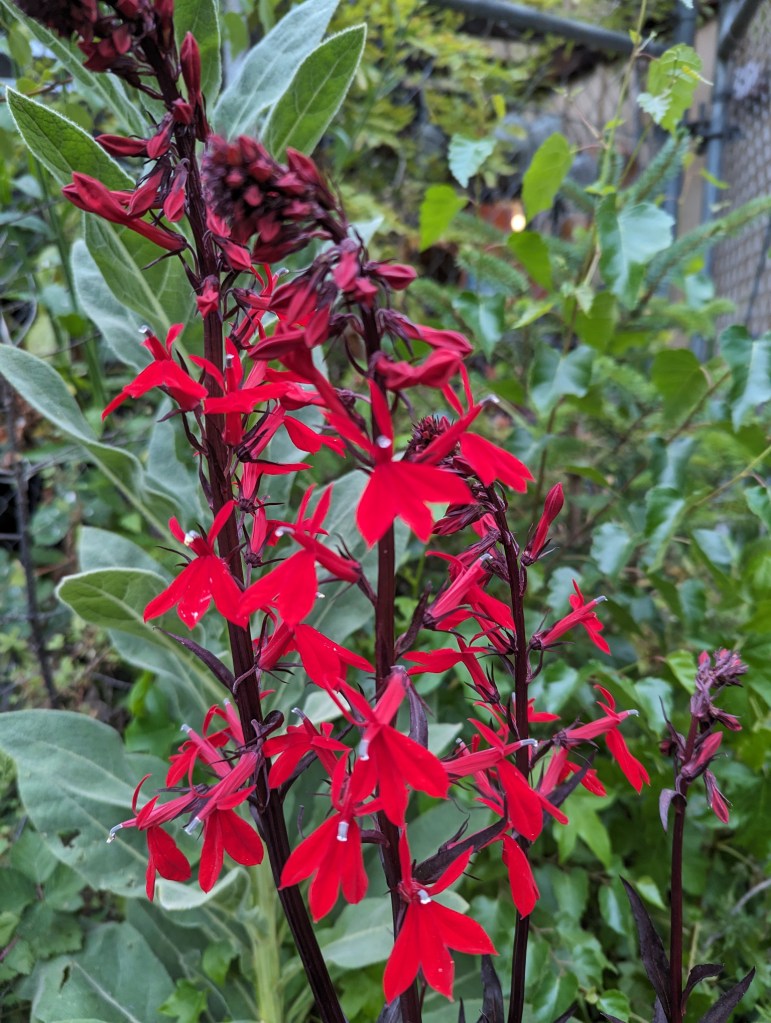
Cardinal flower is traditionally cardinal red.

This warm season annual is actually a biennial. Cardinal flower, Lobelia cardinalis, may stay relatively short for its first summer. It might bloom four feet high for its second or third summer. By then, pups are easy to divide as new plants to replace the old. Most cardinal flower plants from nurseries are rather mature. They might grow tall for their first summer.

Common cardinal flower has rich cardinal red bloom and bright green foliage. ‘Alba’ has white bloom. ‘Rosea’ has pink bloom. ‘Queen Victoria’ has familiar rich red bloom above deeply bronzed foliage. Individual flowers are only an inch and a half from top to bottom, but are numerous. Basal leaves can be almost six inches long. Upper leaves are shorter.

Cardinal flower enjoys richly organic soil with regular irrigation. It dislikes getting too dry. It appreciates a bit of partial shade as the weather gets warmest after noon. Seed is easy to collect. However, seed from fancy cultivars is not necessarily true to type. Subsequent generations eventually revert to familiar rich cardinal red bloom and bright green foliage.

Six on Saturday: Better Late Than Never

As I explained earlier, unusual weather has interfered with the growth and bloom cycles of many species. Winter weather was exceptionally wintry. Spring and summer weather was exceptionally mild until only recently. Many flowers bloom precisely on schedule, as if oblivious to the unusual weather. Many flowers bloom significantly later than normal. Lily of the Nile seems to be about a month late. So does garden phlox, although I do not remember if it bloomed simultaneously with lily of the Nile last year. Nor do I remember when butterfly gladiolus bloomed. Hybrid gladiolus seemed to bloom right on schedule, so are finished.

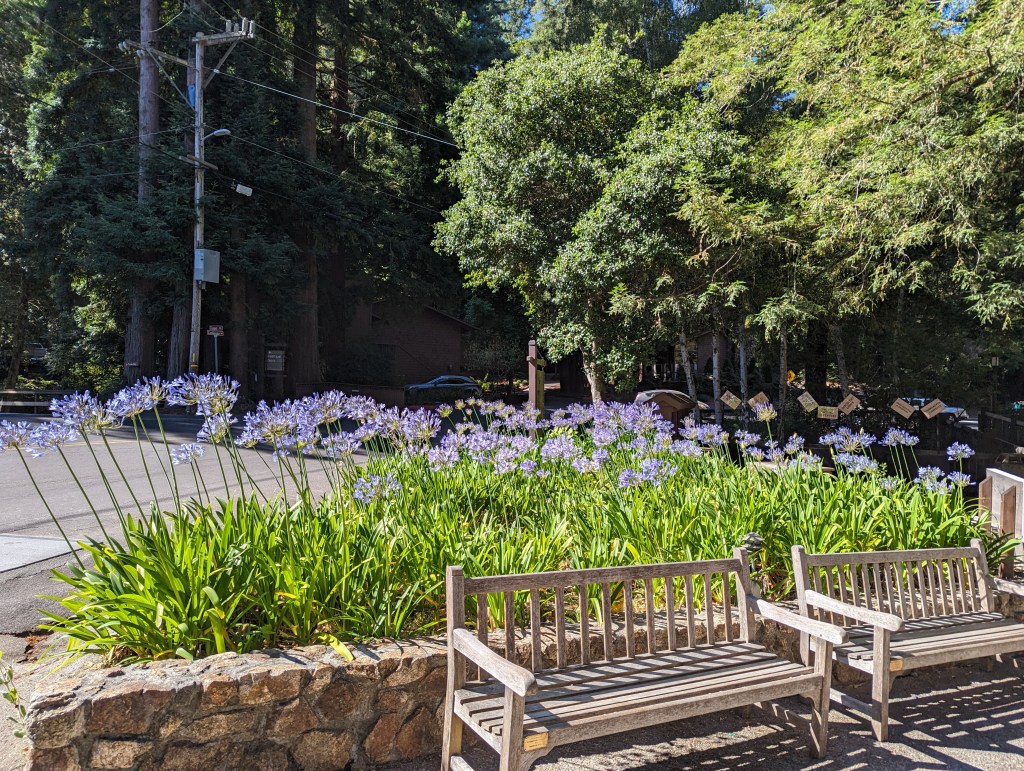
1. Agapanthus orientalis, lily of the Nile should have been blooming like this more than a month ago, and at least for Independence Day. Some buds are only beginning to open.

2. Agapanthus orientalis, lily of the Nile does not bloom abundantly in the shade, but it blooms grandly. This picture can not show that this one floral truss is about a foot wide.

3. Agapanthus orientalis, lily of the Nile, although genetically variable, had always been exclusively blue within all of the landscapes here. This is the first of three white blooms! I grew the originals in the early 1990s, but needed to relocate their herd a few years ago.

4. Phlox paniculata, garden phlox seems to be even more delayed than lily of the Nile is. I can not be certain though, since I got acquainted with its seasons only a few years ago.

5. Gladiolus X hortulanus, hybrid gladiolus was not so delayed, so bloomed precisely on schedule, and now needs deadheading. I am pleased by how many are reliably perennial.

6. Gladiolus papilio, butterfly gladiolus is Skooter approved, and is from Tangly Cottage Gardening! I do not know if it was delayed, because I am still getting acquainted with it.

This is the link for Six on Saturday, for anyone else who would like to participate: https://thepropagatorblog.wordpress.com/2017/09/18/six-on-saturday-a-participant-guide/

Shasta Daisy

Shasta daisy is ideal for cutting.

Mount Shasta very rarely lacks its snow. Its summit is almost always white. Shasta daisy, Leucanthemum X superbum, strives for the same. Bright white bloom starts in spring and continues into autumn. Primary spring bloom is the most profuse. Sporadic bloom lingers between subsequent minor bloom phases. Only cooling autumn weather inhibits bloom.

Shasta daisy is a resilient perennial. It develops dense colonies of tough basal rhizomes to survive winter dormancy. From spring to autumn, upright blooming stems grow almost three feet high. Individual composite flowers are of classic daisy form with cheery yellow centers. They are excellent as cut flowers, with simple green foliage. Leaves are serrate.

Shasta daisy prefers systematic watering, but can survive with less. It tolerates only a bit of partial shade. Removal of floral stems after bloom or cutting should leave no tall stubs. Removal of all upright growth as it deteriorates into winter promotes tidier spring growth. During winter dormancy, Shasta daisy is very easy to propagate by division of rhizomes.

Six on Saturday: Late for Summer

Summer was late this year. This is sounding redundant, so I will not mention last winter again. Nor will I mention last spring or early summer. Now that summer is about a third over, it seems as if it is merely beginning. Lily of the Nile, which never fails to bloom for Independence Day, began to bloom only a few days ago. Bloom is catching up though, or at least trying to. These summer flowers are doing well, and were actually doing well last week, when I was unable to post these pictures because of bad reception. Easter lily was done right after I got these pictures. The preponderance of red here is mere coincidence, but summery.

1. Lilium longiflorum, Easter lily was likely left behind after a wedding in the old Chapel. It lives in a garden across the road now. It is the only of these six that finished blooming.

2. Hydrangea macrophylla, hydrangea is pleasantly pink even without the fertilizer that maintains its pink color. Blue hydrangea faded to lavender without their pH adjustment.

3. Pelargonium hortorum, zonal geranium is quite a bit more prolific in bloom than the old fashioned sorts that I am accustomed to growing. The floral color is impressive also.

4. Gerbera jamesonii, Transvaal daisy is as bright and bold as 1984. However, I still fail to be impressed. It is certainly pretty, but looks like a squirting daisy that a clown wears.

5. Papaver rhoeas, poppy grew from seed that got sown prior to the last torrential storm of last winter. I thought that all the seed got washed away. This was a delightful surprise.

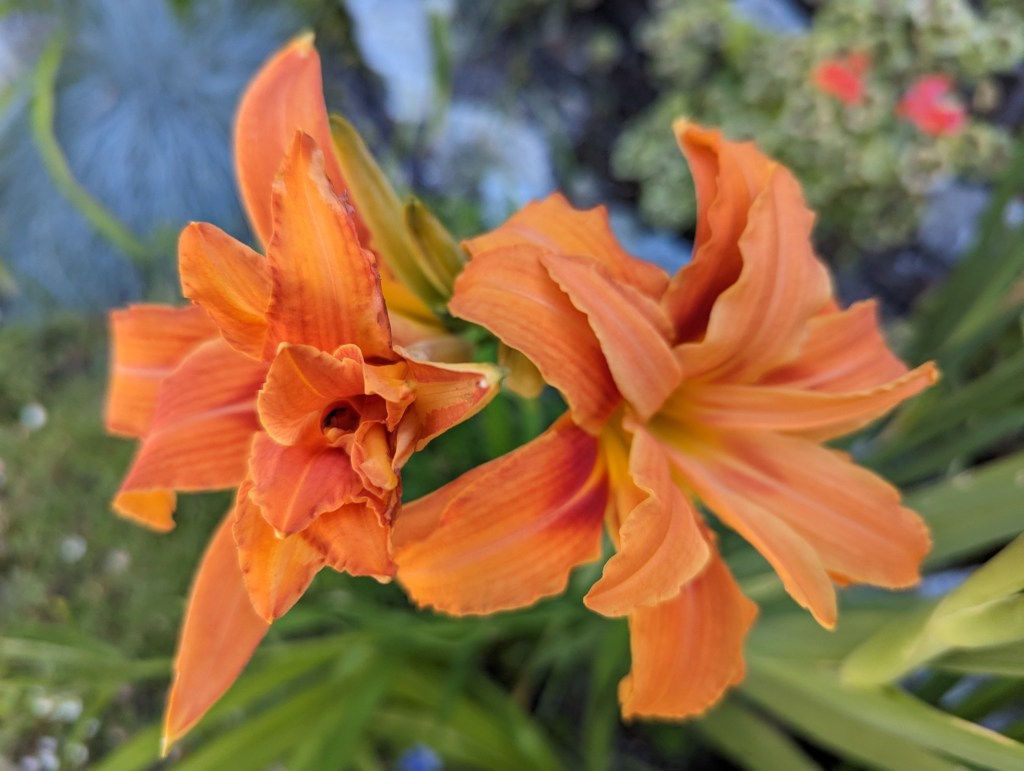
6. Hemerocallis fulva, daylily grows like a weed. We move it from one garden to another as it outgrows its space. This double orange cultivar may be ‘Kwanso’, but I do not know.

This is the link for Six on Saturday, for anyone else who would like to participate: https://thepropagatorblog.wordpress.com/2017/09/18/six-on-saturday-a-participant-guide/

Six on Saturday: Buckeye

Aesculus is not native to Arizona. Buckeye is merely where I vacationed after leaving the Los Angeles region. It is northwest of Phoenix, which is also a genus that is not native to Arizona. It was a hundred degrees daily while I was there, but oddly, never to a hundred and one. My Six are from residential gardens. #2 is of the Plantaginaceae family. #1 and #6 are of the Fabaceae family. The three others are of the Bignoniaceae family. Fabaceae and Bignoniaceae seem to be popular there. #1, #4 and #5 are native species. Carnegiea gigantea, saguaro, which is the State Flower of Arizona, grows wild there. I should have taken pictures of it. The base of a minor specimen is visible to the far right of picture #1.

1. Prosopis glandulosa, honey mesquite was in need of clearance pruning. I brought the bigger stems from the pruning debris back for a colleague who will use it to smoke meat.

2. Russelia equisetiformis, firecracker plant, as the specific epithet describes, resembles equisetum, but with these red and narrowly tubular flowers that exclude interested bees.

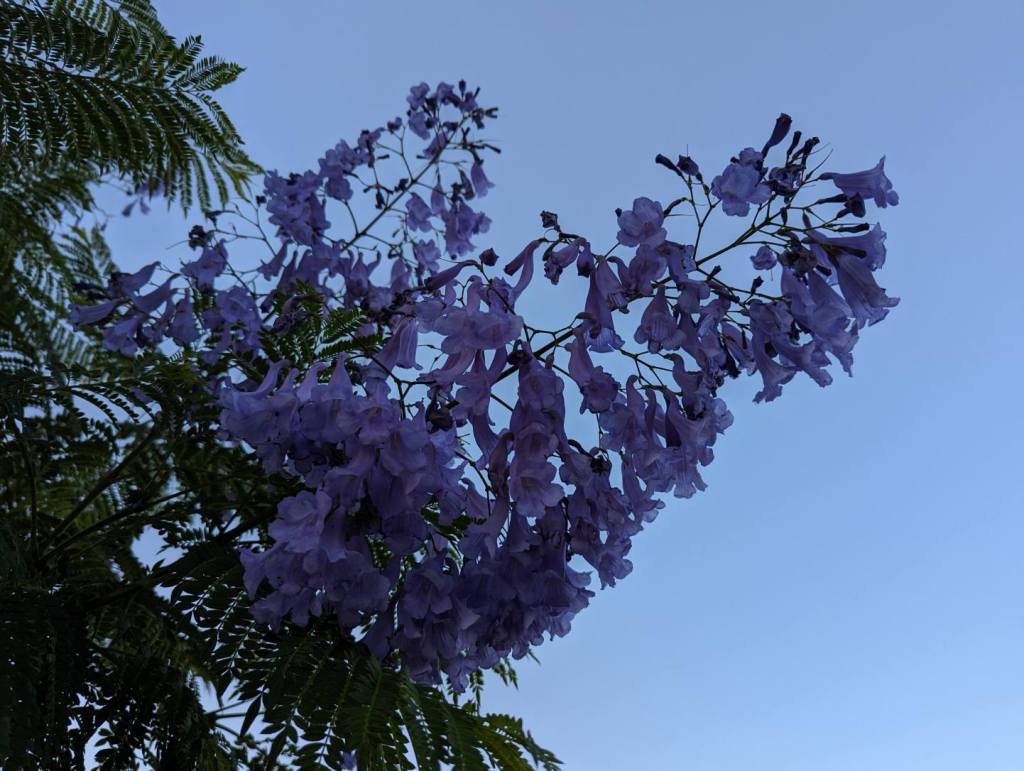
3. Jacaranda mimosifolia, jacaranda is one of a few familiar species that I encountered. I am impressed that it is popular and seems to perform well within such an arid climate.

4. Chilopsis linearis, desert willow got my attention because of this floral color that is so unusual for trees. I had previously only encountered it while it was defoliated for winter.

5. Tecoma stans, esperanza, as well as poinciana #6 below, should bloom like this in my garden. Crazy Green Thumbs sent me seed for both last year. Both were terrible failures.

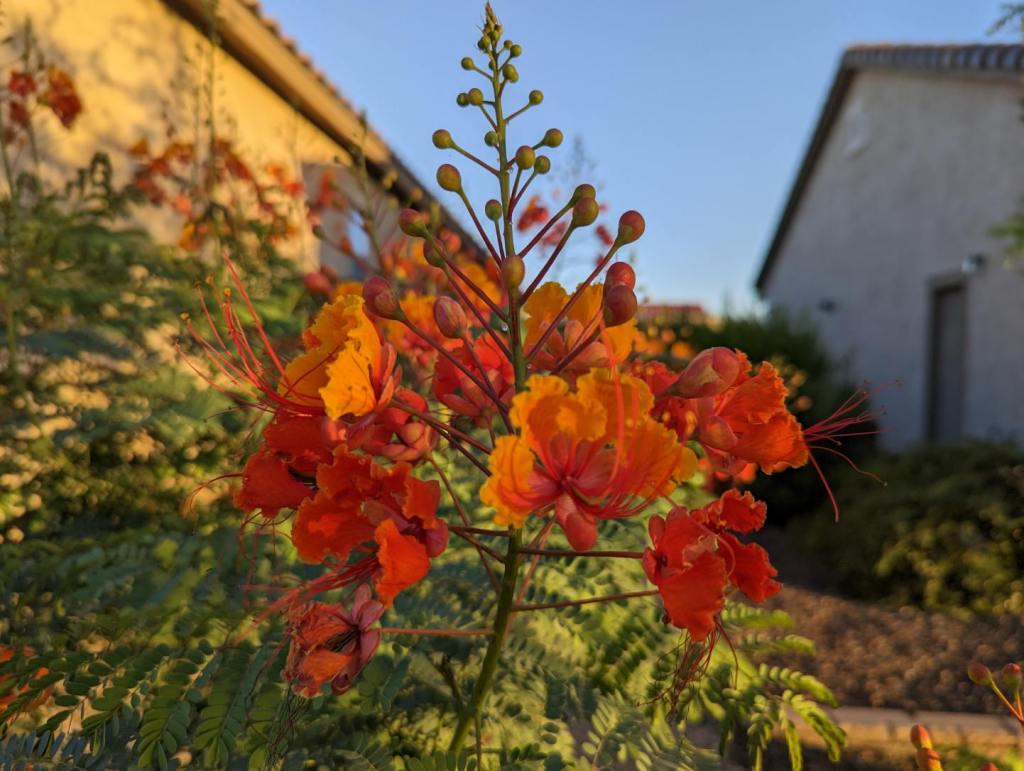
6. Caesalpinia pulcherrima, poinciana, as well as esperanza #5 above, remind me that I should have been more diligent and protective with the seed from Crazy Green Thumbs.

This is the link for Six on Saturday, for anyone else who would like to participate: https://thepropagatorblog.wordpress.com/2017/09/18/six-on-saturday-a-participant-guide/

Six on Saturday: Rhody Obligation

Rhododendrons bloom so spectacularly that I am obligated to share pictures of them for Six on Saturday. I can not share pictures of all of them though. There are too many, and there are also too many pictures of other flowers that bloom at this time of year. As it is, these pictures were delayed because I shared pictures of other flowers earlier. Therefore, these Six will be the first and last pictures of rhododendrons that I will share this season. None of them are of my roommate, Rhody. None of the cultivars are identified. I should share pictures from my vacation next week. I arrived in Los Angeles on Wednesday, and should leave for the Phoenix region on Sunday.

1. Anah Kruschke looks something like this; and this really is more purplish than it looks here. Bloom is so very late that some was still in bud, like those behind these two florets.

2. Floral trusses of this cultivar are huge! The branch structure is also big. The specimen that produced this bloom is more than twenty feet tall. It sags from its own floral weight.

3. Several rhododendrons here are white, but none are pure white. This one is somewhat spotty and blushed with a bit of lavender pink. It brightens its partially shaded situation.

4. Pink is likely the most common color among the rhododendrons here. Rich pink such as this mostly inhabits sunnier situations. Paler pink mostly inhabits shadier situations.

5. White with yellow spots seems to be somewhat whiter than lavender pink blushed and spotty white. A few specimens of this cultivar live here. Its foliage is not very impressive.

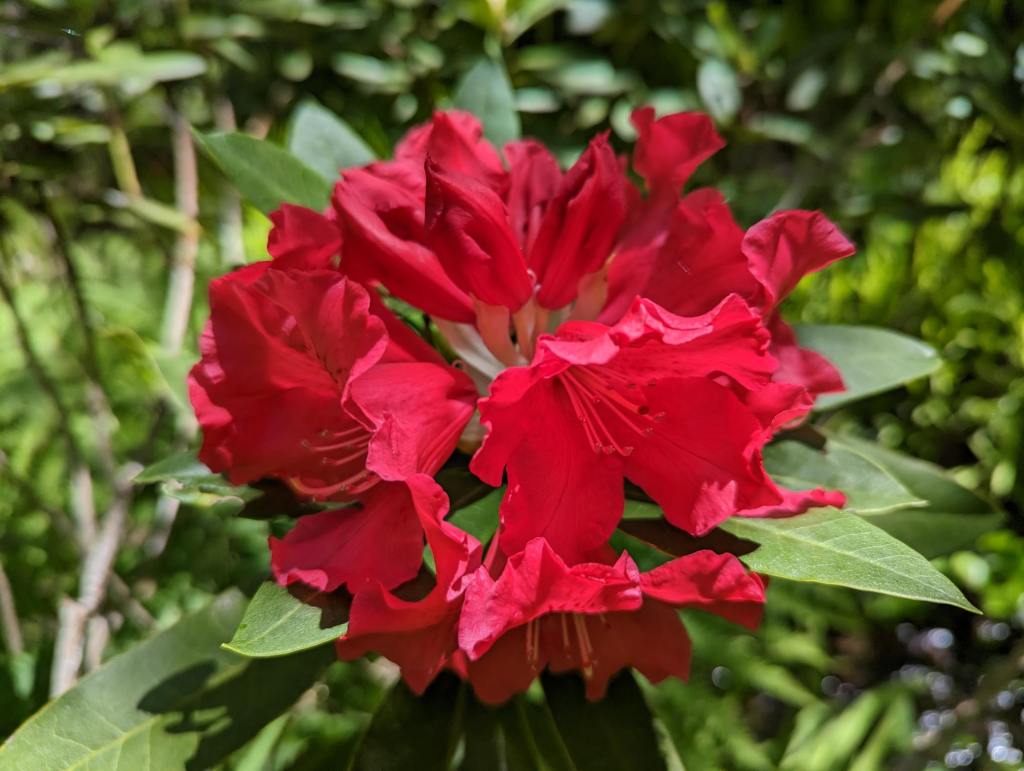
6. Red is a splendid color for rhododendrons. Red is not as splendid as lighter colors for shady situations though. That may be why it is uncommon within our shady landscapes.

This is the link for Six on Saturday, for anyone else who would like to participate: https://thepropagatorblog.wordpress.com/2017/09/18/six-on-saturday-a-participant-guide/