Flowers For Home And Garden

70524thumbThere is a difference. Hybrid tea and grandiflora roses were bred to be excellent cut flowers for the home. They bloom on long stems, and last well once cut. However, the rigid and thorny plants that produce these excellent blooms are realistically not much to look at. Floribunda, polyantha and climbing roses are more of a compromise with less ideal (perhaps) flowers on friendlier plants.

Conversely, bearded iris are spectacular while blooming out in the garden, but do not last so well as cut flowers. As colorful as they are, they perform best while still attached to the plants that produced them. Fading flowers might be groomed away from flowers that continue to bloom later, but are not a serious problem if allowed to linger. The garden is more forgiving than the home.

Where space allows, rose gardens or cutting gardens are areas devoted to the production of flowers for cutting and bringing into the home. Like vegetable gardens, cutting gardens might be hedged, fenced or partly concealed from the rest of the landscape. No one minds if the utilitarian plants within get deprived of their flowers, or need to be staked or caged like big tomato plants.

Taller and bulkier varieties of dahlia, delphinium, lily, Peruvian lily (alstroemeria) or sunflower that might be to big and awkward elsewhere in the garden can be right at home in a cutting garden. Compact and more prolific varieties of the same flowers work better in more prominent parts of the garden, and if prolific enough, can also provide flowers (although less spectacular) for cutting.

There are very few rules in regard to cut flowers. Many of us bring in bearded iris or daylily, even though they may not last more than a day. The buds below the flowers might bloom afterward. Blooming clematis vine, nasturtium (on or off stem), lily-of-the-Nile, zonal geranium, bougainvillea, bottlebrush, crape myrtle and even flower stalks of New Zealand flax, are all worthy cut flowers for anyone wanting to try them, especially if the garden provides enough to spare.70524thumb+

Six on Saturday: Rhody


Not the terrier!

These are six of the many rhododendrons that have been blooming in the landscape for a while now. Some of the pictures are a week or so old. I do not remember when I took them. The rhododendrons did well this year, and their bloom has been lasting quite nicely. I should be pruning them next week, but can not get started until they finish. Some are very big, and some are sloppily overgrown. As much as I enjoy them in this landscape, I miss working with them on the farm. I can remember delivering the smaller rhododendrons in this landscape several years ago. Some of the bigger specimens are about as old as I am. I think I recognize a few of them, but can only positively identify the one in the first picture. ‘Annah Kruschke’ is the most popular cultivar, not only because it is so reliable, but also because it is not too bothered too much by the arid climate of the Santa Clara Valley and other regions that are somewhat farther inland.

1. Annah Kruschke is not the best purple, but is the easiest to grow. The foliage is is very nice dark green and somewhat glossy. It has a nice stout form that does not get too sloppy. Thrip do not bother it too much.P80519
2. This one looks like Taurus, and is just as popular with thrip, but I can not positively identify it. Branch structure is not only open, but has gotten quite sloppy with age. These will be a challenge to prune back.P80519+
3. I will not even guess what this watermelon red rhododendron is. There are several of them here. Although the branch structure is somewhat open, it is not a sloppy mess.P80519++
4. This one looks more like a cultivar that belongs in the Northwest. It has a nice stout branch structure, and nice round trusses of bright pink bloom. Although happy here, these types are not so happy in chaparral climates.P80519+++
5. This is probably my favorite rhododendron here because it looks so much like one of my favorite whites, “Helen Schiffner’. I could do without the yellow blotches. The foliage and branch structure are somewhat shabby.P80519++++
6. Like #3, I will not even guess what this one is. Although I typically prefer plain white, I happen to like these sorts of flowers because the blackberry stains in each floret makes the white look whiter.P90519+++++
This is the link for Six on Saturday, for anyone else who would like to participate:

https://thepropagatorblog.wordpress.com/2017/09/18/six-on-saturday-a-participant-guide/

Snapdragon

80523They are short term annuals in spring or autumn. Where winters are cold, they may last from spring through autumn. Where summers are hot, they may last from autumn through spring. So what are snapdragon, Antirrhinum majus, here? They can be either or both, depending on where and when they get planted. For most of us, they are a cool season annuals that finish before summer.

Although they prefer to be in full sun, the warmth of such exposure is what limits their practicality through summer. They bloom a bit less in partial shade, but are more likely to last through summer if kept cool, particularly in an innately cool microclimate. Like many annuals, they want rich soil, and regular watering. Because they are susceptible to rust and mildew, foliage should be kept dry.

Snapdragon blooms in white and many cheery hues of yellow, orange, red and pink. Some of the older varieties, particularly those developed for the cut flower industry, can get very tall, and might almost reach low eaves! Modern garden varieties are shorter and fluffier. The biggest are less than four feet tall, and less than a foot and a half wide. Deteriorating flowers should be pruned away.

Garden Bloggers’ Bloom Day May 15 – My Second (Yes, Another Sequel)


Just like in April, there is too much blooming here in the Santa Cruz Mountains above Los Gatos to easily select only a few pictures. Again, these pictures are from work instead of my home garden. We are in USDA Zone 9, on the coastal side of the Santa Cruz Mountains, which is significantly less arid than the chaparral climate of the Santa Clara Valley below the inland side.

In the process of selecting pictures, I omitted most of any flowers that I have used or will use for other articles, as well as the new warm season annuals that will be more prolific later in the season. However, I might feature chamomile soon, and will post several pictures of rhododendrons on Saturday morning.

Mock orange, Philadelphus lewisii, is finished blooming. I wanted to get this picture of it before it was completely gone. These flowers were in a shaded spot, so lasted a bit later than the others. They are extremely fragrant, and extremely white. They contrast nicely with their rich green foliage and the surrounding evergreens. This mock orange is the state flower of Idaho.5bd1Mock orange of a different flavor blooms sporadically and later. This one is Pittosporum tobira, or something like it. It happens to be a very old shrub, so might predate the modern garden variety, or might be a slightly different species. It does not look quite right, but I can not explain it in any manner that would interest anyone. It is fragrant too, but with heavier fragrance.5bd2Roses are finishing their first phase, but are already starting their next phase. Most of these are floribundas, which are not my favorite, but work very well here were they are so visible. Quantity is more important than quality here in this prominent spot. We want them to bloom more regularly than to make flowers for cutting, although some do happen to make nice stems.5bd3Clematis is still in the can because it was only recently purchased from a nursery to be added where others are not filling in on their trellis adequately. Vines are such a bother. Most are too aggressive and crush their trellises. Those that are not so aggressive do not fill in well enough. Clematis blooms nicely this time of year, but rarely does much more once summer gets warm.5bd4Peruvian lily or alstoemeria do quite well here, and are certainly happier than in the Santa Clara Valley a few miles away. There are three here. A pink one can be seen in the background. There is also a salmon pink one. All three are the sort that used to be grown for cut flowers, but are difficult to obtain now. Most garden varieties are lower and mounding with shorter stems.5bd5Chamomile can naturalize here, but this garden variety does not seem to seed so profusely. Actually, it does not seem to seed at all. I have not yet seen any feral chamomile. The foliage of this variety was bright yellowish chartreuse when it was new, and is now fading to light green. It blooms most of the time. By the time it gets too green, it can get cut back and start all over.5bd6Rhododendron is blooming all over. I took pictures of only this one flower because, as I mentioned earlier, I will post six more pictures of other rhododendrons on Saturday morning. I chose this particular flower because I also wanted to show how big the plant that produced it is. Other colors can be seen nearby. They are really happy here, even with minimal maintenance.5bd7This picture does not show off flowers as well as the rest of the pictures do, but shows how big the rhododendron tree is. Although it is not as broad as some of the others are, it is likely the tallest here. It is situated at least twelve feet below the bridge, and stands about twelve feet above it, so is at least twenty five feet tall! Even by my standards, it is a big rhododendron!5bd8Garden Bloggers all over America and in other countries can share what is blooming in their gardens on the fifteenth of each month on “Garden Bloggers’ Bloom Day”, hosted by Carol Micheal’s May Dreams Garden at http://www.maydreamsgardens.com

Deciduous Rhododendrons

P80509They are not a myth. They are quite real. So are the related and similar deciduous azaleas. There are certainly not as popular or as diverse as the familiar evergreen cultivars, but they have their place.

Like the popular evergreen cultivars, deciduous rhododendrons and azaleas have been extensively bred so that they are more spectacular than their ancestors in the wild. They lack the purples and blues of the evergreens, but they compensate with bright oranges and yellows that are uncommon among the evergreen cultivars, as well as reds, pinks and whites. Some of their colors are bright and fiery, while some are more relaxed. Compared to evergreen rhododendrons, the flowers of the deciduous rhododendrons are smaller, thinner, and suspended in smaller trusses. However, these smaller trusses are often significantly more abundant, and are flashier as they bloom before new foliage develops in spring.

Deciduous rhododendrons and azaleas are not grown for the foliar color in autumn, but where autumn weather is cold enough, their foliage can color somewhat well. It is mostly clear yellow, but can sometimes turn orange before falling away cleanly, leaving neatly bare stems through winter.

What deciduous rhododendrons and azaleas excel at that their evergreen counterparts can not compete with is their fragrance. Many are moderately fragrant. Some are VERY fragrant. It is rare that such showy flowers are also so fragrant. (Most flowers rely on one technique or another to attract pollinators.)

Now that the evergreen rhododendrons are blooming, our few deciduous rhododendrons are just about finishing. Visitors often ask about the fragrance, since they do not expect fragrance from rhododendron or azalea flowers, even though they can see little else blooming in same area. These flowers are so popular that we would like to plant more near windows of meeting rooms.P80509+(The article from my weekly gardening column that is typically posted on Thursday was posted yesterday, which is why this article, which is more appropriate for Wednesday is posted today.)

Flowering Dogwood

80502Flowering dogwood, Cornus florida, seems like it should be more popular here than it is. It blooms spectacularly in April. The foliage can color nicely in autumn. Mature trees are proportionate to medium sized or smaller suburban gardens. However, the limiting factor to their popularity in the local climate is that they are understory trees that prefer to be in the partial shade of larger trees.

They certainly do not need to be shaded all day. Nearby trees or tall buildings that shelter them during the hottest part of the afternoon might be sufficient. Foliage that is too exposed gets roasted by hot sunshine or drying breezes while the weather is warm, especially if exposure is enhanced by glare from nearby walls or pavement. Otherwise, flowering dogwood is not overly demanding.

The abundant white, pink or rarely brick red bloom is actually comprised of modified colorful leaves known as bracts. Each cluster of tiny green flowers is surrounded by four upward facing bracts. Simple paired deciduous leaves develop after bloom. The leaves of some cultivars are variegated with white or yellow. Mature trees can reach upstairs eaves but typically stay lower and broader.

Garden Bloggers’ Bloom Day April 15 – My First


There is so much blooming or finishing blooming here in the Santa Cruz Mountains above Los Gatos that it is difficult to select only a few pictures. These flowers are not from my home garden, but are from nearby Mount Hermon, which is located on the coastal side of the Santa Cruz Mountains, a few miles north of Santa Cruz. I enjoy the horticulture of the Santa Clara Valley, where San Jose is located, more than anywhere else in the world. However, there are many flowers that perform better in the cooler and moister climate of the Santa Cruz Mountains that separate the Santa Clara Valley from the Pacific Ocean. Mount Hermon is located in USDA Zone 9.

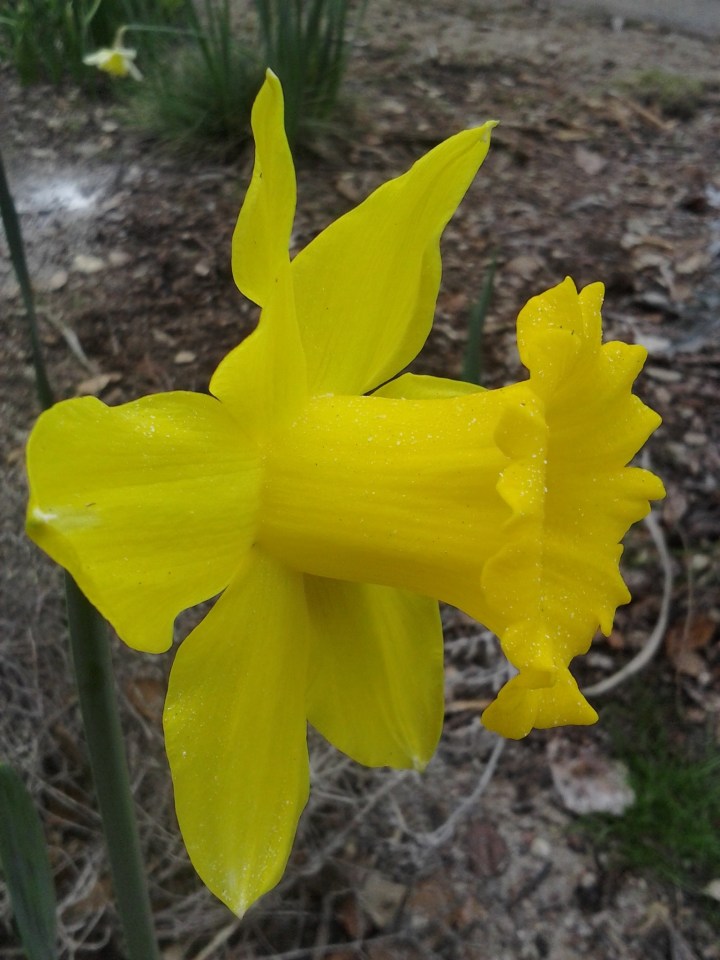
Daffodil are probably all done by now. The last to bloom earlier this week were in somewhat shaded spots. This one was looking a bit tired. Daffodils are one of only a few bulbs that will naturalize in our mild climate.4bd1

Forsythia also finished a while ago. This picture was taken at about the same time earlier in the week as the daffodil above. This tired specimen was not actually in the landscape, but was in a small nursery where gardeners stock recycled plants and recently acquired plants that have not yet been installed into the landscape. Forsythia is rare here. There is only one other in the landscaped area that we are aware of.4bd2

Dutch iris is a surprise every year. As I mentioned with the daffodil, there are not many bulbs that naturalize here. Dutch iris is one of those bulbs that needs more of a chill than it can get here. However, this colony blooms reliably every spring!4bd3

Flowering cherry is spectacular against the dark green backdrop of redwoods. A pair of mature ‘Yoshino’ or ‘Akebono’ flowering cherries in downtown Mount Hermon are the most famous in town. They are very old and sadly, must be removed. A few others have been planted nearby. There are at least three ‘Kwanzan’ flowering cherries in other areas. I do not know what cultivar this one is. It might be my favorite because it is so striking white; my favorite color. This picture was taken at about the same time earlier in the week as the daffodil and forsythia. Only the ‘Kwanzan’ flowering cherries continue to bloom now.4bd4

Camellia bloom for quite a while. A few blooms sneak out in midwinter before the main bloom phase, and a few flowers are still blooming now. There are at least a dozen cultivars here. This elegant white camellia might be my favorite.4bd5

Azalea is even more variable than the camellias. Many are of course finished blooming; but a few still have unopened buds that will bloom this week! This is my favorite, obviously because it is white. I used to grow azaleas in the mid 1990s, as our second major crop. Rhododendrons were our primary major crop. We also grew camellias as our fourth major crop.4bd6

Garden Bloggers all over America and in other countries can share what is blooming in their gardens on the fifteenth of each month on “Garden Bloggers’ Bloom Day”, hosted by Carol Michael’s May Dreams Garden at http://www.maydreamsgardens.com

Onion Weed

70412What an unappealing name! That is probably why so many of us know it simply as ‘wild onion’ or ‘allium’. Few of us bother to get sufficiently acquainted with it to know it by the species name of Allium triquetrum, which is actually not much more appealing than ‘onion weed’. It is not really wild, but has naturalized as an invasive exotic, or in other words, ‘weed’. At least it is a pretty weed.

The foliage might not be much to look at as it emerges from formerly dormant bulbs late in winter. Each bulb produces only two or three leaves that get only about half a foot tall, and are only a bit wider and glossier than grassier weeds. Then the three sided flower stalks grow up as much as a foot above the foliage, and bloom with as many as a dozen small and pendulous white flowers.

The half inch long flowers are individually no more interesting than their foliage; but collectively, they briefly brighten unrefined or neglected areas of the garden with wispy soft white drifts of bloom. They can bloom through shallow weeds or groundcover, and tolerate considerable shade. Yet, as resilient as they are, they are not too drought tolerant. Onion weed is edible, but not very flavorful.

Baby’s Breath

80328You might think that such a popular flower would be easy to get a picture of. Baby’s breath, Gypsophila paniculata, is everywhere, and almost a standard component of the mixed bouquets found in supermarkets. However, the flowers are so small and so sparsely arranged on thin stems, that they do not look like much in pictures. This picture is a closeup of a tightly bound bundle of bloom.

As common is it is with other cut flowers, baby’s breath is quite uncommon in home gardens. It is not often available in nurseries. Seed should have been sown by about now. Baby’s breath grows something like a tumbleweed about three or even four feet high and wide. The stems look too delicate to stand so tall. The minute flowers are usually white but can be pale pink and slightly fluffier.

While blooming in summer, baby’s breath is so handsome that no one wants to cut the flowers. It is difficult to take just a few good stems to add to other cut flowers without ruining the symmetry of a well rounded plant. Some people who grow it prefer to put it out of the way, or grow it amongst other flowers to hide the disfigurement of harvest. Baby’s breath blooms better if crowded anyway.

Poppies . . . again

P80317+This one is different though. It is not the characteristic homogeneous bright orange that California poppies should be. The orange in the middle is what the entire flower should look like. The outer yellow hallow is not typical.

California poppies used to much more common than they are now. Not only did they grow wild, but they grew wild in abundance. Some of the East Hills were blushed orange with them when poppies bloomed this time of year. The lower hills just to the east of Highway 101 to the south of San Jose were more than blushed. There seemed to be almost as much orange as there was green. By the spring of 1985, those same hills were neither south of San Jose, nor quite so orange. They were within the suburban sprawl of San Jose, and were mostly green with invasive exotic grasses. Only wispy swaths of orange bloomed down low and near the top of the western slope. Those same hills are now devoid of orange, and are part of an urban neighborhood.

California poppies just do not grow naturally like they used to. Those who want them must sow seed for them. Their environment is so different from what it once was.

Even the flowers are different. They were naturally the most perfect orange, with perfectly simple petals. When we could find pale yellowish white or lavender poppies (known as purple poppies), they were something very rare and special.

California poppies are now readily available in a variety of colors, including the once very rare pale white and lavender, as well as various hues of yellow and red, some with swirled patterns. Some have fluffier double flowers. It all seems to be so unnatural for a flower that needed no improvement.