 Much of the color in the garden through autumn and winter is provided by foliage. Some foliage turns color as the weather gets cooler. Some had been blue, gray, gold, red, bronze or variegated all year, and just happens to get noticed more now that there is not much other color provided by flowers. There are a few flowers that bloom now or even later in winter, but not nearly as many as there were in spring and summer.
Coral bark Japanese maple and red twig dogwood display colorful defoliated stems as the weather gets cooler. The colorful berries of firethorn (pyracantha), cotoneaster and toyon will ripen about the same time, providing bright red color until the birds get them. Otherwise, there might not seem to be much more to cut and bring into the home to substitute for cut flowers, and add to all the colorful foliage, twigs and berries.
Well, this is where things get less horticultural, and more creative. All those old flowers and flower stalks that should get pruned off, and maybe a few old leaves, might be good for more than compost. Blooms of hydrangea, Queen Anne’s lace and lavender can be cut just as they begin to deteriorate, and hung upside-down to dry. They lose much of their color, and shrivel somewhat, but are nice options to fresh flowers.
Old flower stalks of New Zealand flax and lily-of-the-Nile have striking form once plucked of tattered flower parts and seed capsules. New Zealand flax stalks are tall and straight. Lily-of-the-Nile stalks are like star-bursts on sticks. If the natural color lacks appeal, they can be spray painted! Seed capsules of red flowering gum (eucalyptus) dry in loose clusters with stems that are long enough to arrange like cut flowers.
Pine-cones, magnolia grenades (seedpods) and sweetgum maces (seedpods) that fall from their stems can be drilled, and attached to sticks. There are no substitutes for real flowers, but there are no limits to creative and even weird alternatives.
 Known more as a medicinal herb, and by its Latin name, coneflower or Echinacea, is a delightful prairie wildflower that works just as well in refined home gardens. It blooms in summer and again in autumn, although autumn bloom can be inhibited if plants are not groomed of deteriorating stems from the previous bloom. Like related gaillardia and rudbeckia, coneflower is a nice cut flower.
 Before you send me a comment about it, I am already aware that this is a very bad picture. It was taken with my primitive telephone because it was convenient at the time. This tired looking butterfly might not have waited for me to get the camera. It passed away, seemingly peacefully, right there on the hood of the old Chevrolet. It did not seem to be injured in any way. It probably simply expired like butterflies do after breeding. It is a natural process that the butterfly did not seem to be too distressed about. It gets no obituary because I am not qualified to write one. We are not sufficiently acquainted. I do not even know the specie of this butterfly.
 Long before my white supremacy garden (
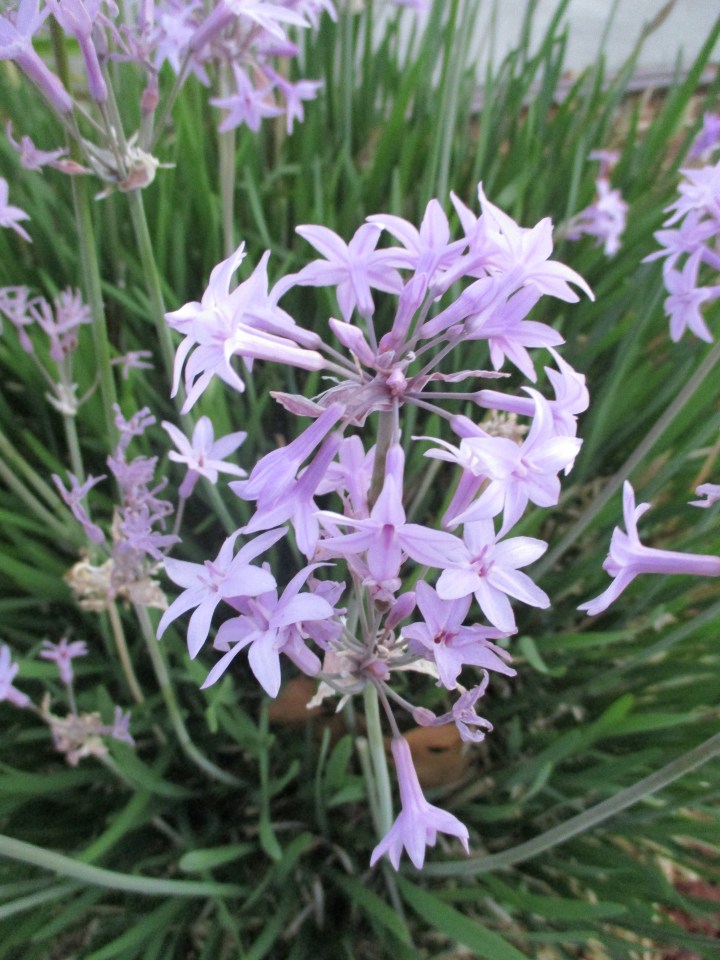 Some flowers are better left in the garden rather than cut and brought in. Society garlic, Tulbaghia violacea, looks like it would be an ideal cut flower, with nice bare stems. The aroma suggests otherwise. It smells something like a strongly aromatic combination of onion and garlic. Even in the garden, it might be a good idea to keep it at a distance. Deer and rabbits do not mess with it.
 You can say what you like about nasturtiums. My landscape designer colleague, Brent Green certainly did when he named them ‘dago pansies’. They are still one of my favorite flowers, and just might be my favorite, even though none are convincingly white. They were my first. I discovered them when I was very young. They were growing near an old English walnut tree in my great grandfather’s garden. He noticed that I liked them, so found some seeds underneath to send home with me.
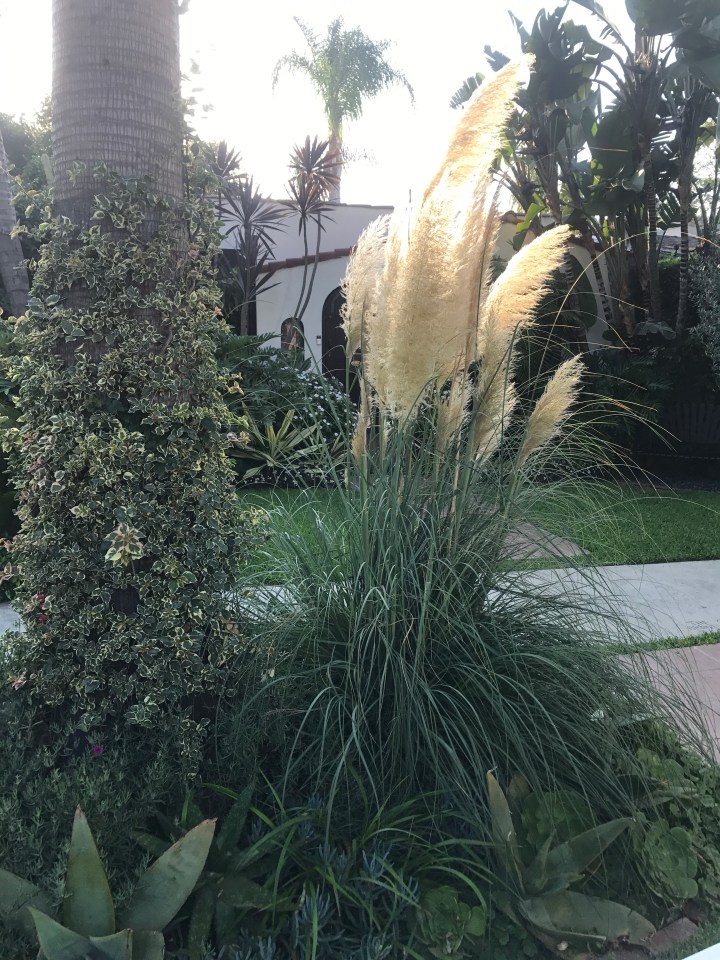 Modern garden varieties of pampas grass found in nurseries are generally non-invasive. Their flowers are described as ‘sterile’, and therefore unable to produce seed. What that really means is that they are exclusively female, and unable to produce seed without male pollinators. However, they have the potential to be pollinated by naturalized pampas grass, and sow a few hybrid seed.
 Many people have a favorite color. I learned how seriously some people can take their preference for a particular color when I was in high school, and taking care of the yardwork for a few homes in the neighborhood. There were three tract homes next to each other. One was grayish blue, with a silvery blue Sedan deVille in the garage, and a garden of blue flowers. The middle house next door was soft amber yellow, with a buttery yellow Oldsmobile 98 in the garage, and a garden of exclusively yellow flowers. The house next door to that was iron oxide red, with an exquisite rich red Electra in the garage, and a garden of, you guessed it, red flowers.
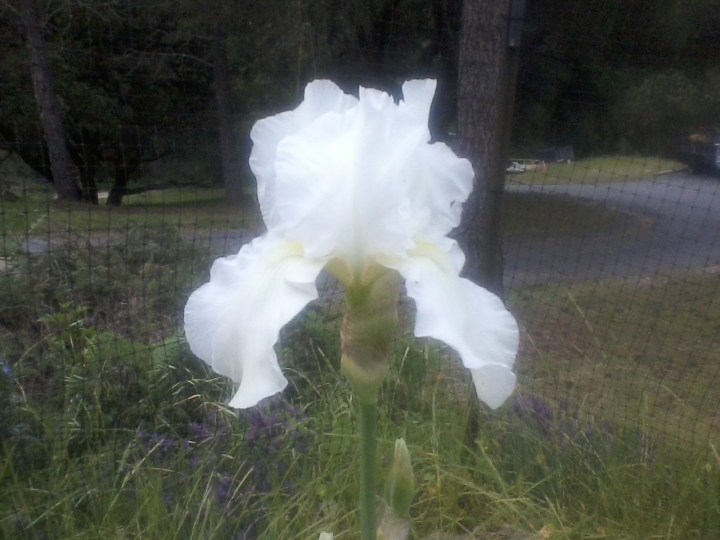 The statute of limitations allows me to discuss this now. It happened thirty years ago, in the spring of 1987. The famous landscape designer, Brent Green, was my roommate in the dorms at Cal Poly, San Luis Obispo. As the bearded iris started to bloom, Brent immediately noticed a bed of uniformly pink bearded iris off the edge of a lawn in the inner campus. He watched it bloom from beginning to end, and occasionally updated me on the progress. During the process, he convinced me that these iris were very rare. Neither of us had ever seen pink bearded iris before. We had no idea that they could easily be purchased from mail order catalogs or nurseries.
