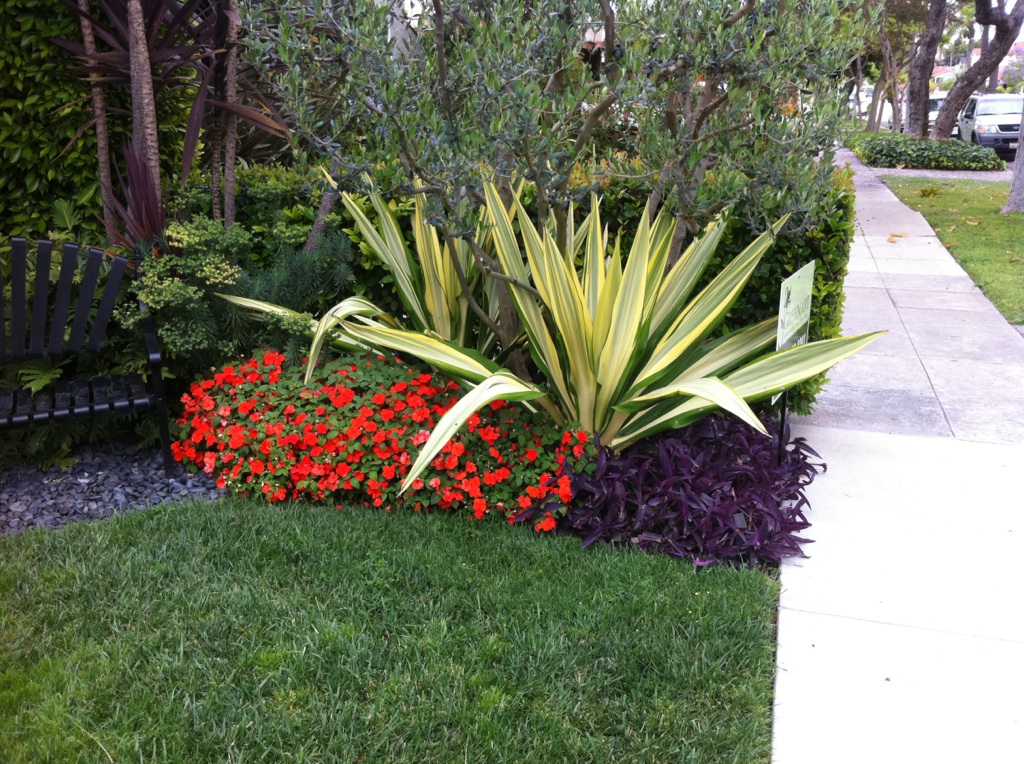
Furcraea foetida ‘Mediopicta’ looks like a big Yucca or a small Agave.
As spectacular as the bloom of Furcraea foetida ‘Mediopicta’ is, it is actually not the most desirable feature. Solitary flower spikes grow intimidatingly fast up past second story windows, and spread out several feet wide with small but abundant pale white flowers. They are certainly impressive, but are also the final act for mature plants just before they die.
Fortunately, they take several years to mature, so provide big bright yellowish green variegated foliage for many years. The other good news is that as they die, herds of pups (known as ‘bulbils’) develop and fall from the huge inflorescences. There are far more than enough pups to replace the original plants and to share with all the concerned neighbors who witnesses the crazy bloom.
Furcraea foetida ‘Mediopicta’ is not quite as tough as unvariegated (green) furcraeas, so it can be damaged both by frost or harsh exposure to sunlight. It is also a bit smaller, staying less than five feet tall (prior to bloom of course) and seven feet wide. Too much watering can cause rot.
Japanese aralia is both prehistoric and futuristic.
The popularity of Japanese aralia, Fatsia japonica, has spanned more than just a few decades. The big, glossy leaves of this lush foliar plant adorned the home of the Flintstones in Bedrock many thousands of years ago, as well as the office of Mr. Spacely of Spacely Sprockets, where George Jetson works, some time in the future! It is just as happy in most types of soil as it was in the front yard at the Flintstone Residence, and is just as happy in large containers as in Mr. Spacely’s office. As long as it is protected from harsh exposure or reflected glare (like it might get from large lightly colored walls or tinted windows), Japanese aralia does well in full sun, or can be just as happy in the shade of larger trees.
Although it does not grow too rapidly, Japanese aralia eventually gets nearly eight feet high and wide, and commands a bold presence. Their deeply and symmetrically lobed leaves can get as broad as a foot and a half, on long petioles (stalks). The foliage of ‘Vairegata’ emerges with a yellow border that turns pale white. ‘Moseri’ stays quite compact.
Plants grown for their foliage can be maintained by cutting oldest stems to the ground as they deteriorate, so that newer stems can replace them. Excessive basal watersprouts can be cut or ‘peeled’ off if they get too crowded. Alternatively, lower growth can be pruned away as it develops to elevate the canopy and expose interior stems. However, individual stems do not last indefinitely, and will eventually need to be replaced by any convenient watersprout. The most deteriorated plants can be rejuvenated by getting cut to the ground just before spring.
Boston fern is merely one of several cultivars of Nephrolepis exaltata. Its cultivar name is ‘Bostoniensis’. Variegated Boston fern, or tiger fern, is reputedly a cultivar of this cultivar. Its cultivar name is either ‘Variegata’ or ‘Tiger’. From a distance, it seems to be a yellower version of the original. Prettily intricate stripes become apparent with closer observation.
Variegated Boston fern is a bit smaller and a bit less vigorous than common Boston fern. Like all variegated cultivars, it works with a bit less chlorophyll. Mature potted specimens might get no wider or higher than three feet. Unvariegated Boston fern can be more than four feet from top to bottom. Both could be larger if their long fronds were less pendulous.
In home gardens, variegated Boston fern can get rather tattered through winter. It is likely to defoliate if exposed to even minor frost. This is why it is more popular as houseplants, usually in hanging pots. Such potted specimens rely on consistent watering. Diffused but bright sunlight is best. Occasional application of fertilizer enhances foliar color and vigor.
‘A’ or ‘co’? What is the better prefix for ‘locasia’? There are certainly differences between the two, but information regarding such differences and characteristics is confusing and potentially misleading. It is amazing how much less information is available now that so much more information is so much more available than it has ever been before.
Alocasia generally develops big leaves that point upward. Colocasia generally develops big leaves that point downward. Alocasia prefers a bit of partial shade. Colocasia prefers more direct sunshine. Alocasia generally has more colorful leaves. Colocasia generally has bigger leaves. Of course, these are generalizations, and some species of each of these two genera seem to be species of the other genus.
Colocasia gigantea supposedly develops the biggest leaves and can get twenty feet tall. Alocasia macrorrhiza supposedly is the biggest of its genus and can get fifteen feet tall. It is difficult to know what to believe.
One the edge of a pond at work, we would like to grow whichever of these massive perennials develops the biggest leaves. If we grow Alocasia, we can put it in a partially shaded situation. If we grow Colocasia, we can put it in a sunnier situation nearby. If we grow Alocasia, we can put it a short distance from the edge of the pond. If we grow Colocasia, we can put it right at the edge of the pond. We only need to know which cultivar of which species of which genus we should grow.
I am inclined to grow Colocasia gigantea. We have a few months to decide, since we do not want to plant it during autumn or winter. We recently acquired this Alocasia odora. Also, another similar but unidentified perennial that seems to be a Colocasia must be relocated from another disproportionately compact landscape.
By the end of the Victorian Period, dracaena palm, Cordyline australis, had become very popular, both as small trees and as foliar plants. The largest specimens were only about twenty feet tall and half as wide. Removal of trunks that grew too tall for short foliar plants induced fresh basal growth. The drab leaves grew three feet long and three inches wide.
Cultivars with bronzed foliage became more popular after the Victorian Period, although not as common as the original. They grew slower and stayed smaller. The many modern cultivars of the past few decades stay even smaller, with even more impressively colorful foliage. Most are purply bronze or variegated with creamy white, pale yellow, pink or tan.
Modern cultivars generally mature efficiently, but then attain height too slowly to function as small trees. Some do not develop substantial trunks. They are therefore more popular for their delightful foliar color and texture. Many generate appealingly pendulous foliage. However, a few eventually develop sculptural form with exposed corky trunks and limbs. Removal of unimpressive floral panicles prior to bloom removes floral frass before it gets messy.
The simple pink or sometimes red or white flowers of angel wing begonia are not as flashy as those of other begonias, and are not abundant enough to provide much color. During warm weather, they are merely a minor bonus to the striking foliage. As the name implies, the big and angularly lobed leaves are shaped like wings of angels. Upper surfaces are glossy and dark green with irregular silvery spots. Undersides are even glossier and reddish bronze. With support, the lanky cane stems can get more than twelve feet tall. However, because older tall canes produce runty foliage, they are often pruned out to promote more vigorous and lushly foliated young canes.
Because they are sensitive to frost, and also because they are ideal houseplants, angel wing begonias are typically grown in containers. They like rather regular but not excessive watering, and rich potting soil. Abundant sunlight enhances foliar color; but harsh exposure roasts foliage. Partial shade is not a problem.
There are all sorts of philodendrons with all sorts of fancy names. Yet, the biggest and boldest lacks a common name (at least one that is actually ‘common’), and is most popularly known by a Latin name that is not even correct. The proper name for Philodendron selloum is really Philodendron bipinnatifidum. It is a big awkward plant with big and deeply lobed leaves on long petioles (leaf stalks), and weirdly thick aerial roots. Well exposed plants can stand on wobbly trunks. Partly shaded plants can creep along the ground, and prefer to grab onto and climb tree trunks, fences or anything that they can get a hold of. The aerial roots are harmless to trees, and generally too slow to catch a healthy cat, but will take paint off of walls. All parts of Philodendron selloum are toxic.
The bold foliage of Japanese aralia is quite striking, whether kept low and dense, or suspended on taller lanky stems.
It may not grow too rapidly, but Japanese aralia eventually gets nearly eight feet high and wide, and commands a bold presence. The deeply and symmetrically lobed leaves can get as broad as a foot and a half, on long petioles (stalks). The foliage of ‘Vairegata’ emerges with a yellow border that turns pale white. ‘Moseri’ stays quite compact.
Plants grown for their foliage can be maintained by cutting the oldest stems to the ground as they begin to deteriorate, so that newer stems can replace them. Alternatively, lower growth can be pruned away as it develops to elevate the canopy and expose interior stems. However, individual stems do not last indefinitely, and will eventually need to be replaced by any convenient watersprouts.
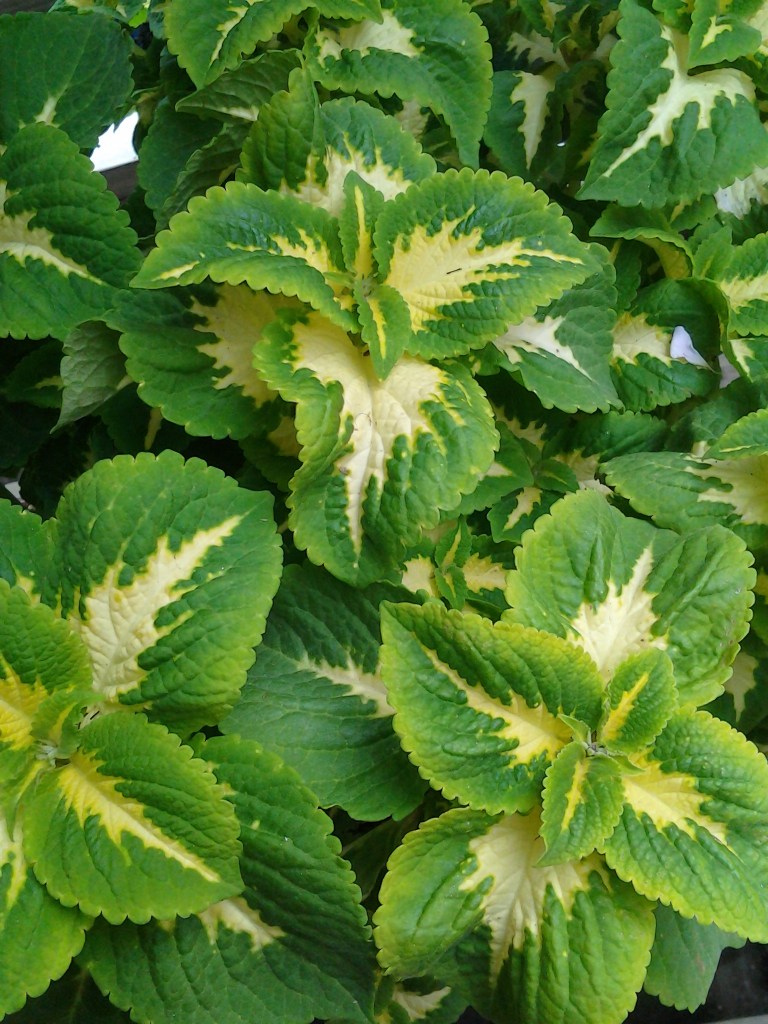
Out in the garden, coleus, Plectranthus scutellarioides, prefers partial shade where the foliage is less likely to get roasted during arid and warm summer weather. It is grown as a warm season annual instead of as a perennial, because it gets so tired through winter, and can be killed by even a very mild frost. Its sensitivity to exposure in the garden is probably why it is more familiar as a houseplant.
The flashy and sometimes deeply lobed foliage is variegated with any combination of green, chartreuse, yellow, orange, red, burgundy, pink, white, brown and almost black. Flower spikes should be snipped as they develop to keep foliage dense. The tiny purple flowers are not much to brag about anyway. Large plants can get to two feet tall and broad. Cuttings root easily in rich and regularly moist potting soil or just plain water. Seeds need sunlight to germinate, so should only be pressed onto the surface of damp potting soil without getting covered, and misted daily.
There is someplace in the world for the brethren of each and every houseplant to grow wild. All houseplants do not originate from the same regions, and many were bred in cultivation, but all originate from somewhere. They are houseplants only because they are plants that can live in a house.
Most houseplants are from tropical regions, and many are understory plants that grow in the partial shade of taller trees. They are naturally tolerant of the mild temperatures and partial shade within the home. Not many deciduous plants will be happy without a winter chill.
Confinement is also a concern, since houseplants need to be potted, and stay below ceilings. Plants that need to disperse their roots will not work. Neither will plants that can not be pruned down as they grow. Some palms that work well in malls have leaves that get longer than the distance between the floor and ceiling in the home!
Most houseplants are grown for foliage instead of flowers, not only because a lack of seasons inhibits bloom, but also because their foliage is naturally so appealing. African violets are one of the more notable exceptions. Amaryllis is all flower with almost no foliage, but typically gets discarded when done blooming.
Coleus and caladiums have such colorful foliage that there is no need for flowers. Bloom actually compromises their foliar quality anyway, which is why flower spikes get snipped from coleus. Mauna loa lily is grown for excellent rich green foliage, but sometimes adds clear white blooms as a bonus.
All sorts of ferns are very good houseplants. However, a few, including the popular Australian tree fern, produce coarse fuzz that can be irritating to the skin. A few others, like sword fern, produce messy spores that can permanently stain fabric and carpet. Just because they can live in the home does not mean that they should.
The various ficus are excellent houseplants because they can grow quite large, but can also be pruned to fit into their particular situations. The popular weeping fig (Ficus benjamina) has an abundance of small glossy leaves. Rubber tree and fiddle leaf fig have big thick leaves. Creeping fig is even more distinct from the others, as a wiry vine that is popularly grown in hanging pots.