Most big China doll trees were formerly docile houseplants.
It is hard to believe that the original variety of the familiar China doll, Radermachera sinica, that grows so slowly to reach an eight foot high ceiling as a houseplant, can actually grow into a substantial fifty foot tall tree with a three foot wide trunk, where protected from frost. Modern varieties with more billowy foliage take even longer to reach the ceiling, and do not go much higher. The finely textured and very glossy foliage is bipinnately compound, which means that each of the half to two foot long leaves are divided into smaller leaflets, which are also divided into even smaller leaflets that are about an inch or so long. Trusses of tubular white flowers that resemble big catalpa flowers are almost never seen among houseplants or modern varieties, but are quite showy on big old trees.
All cacti are succulents. However, not all succulents are cacti. Actually, cacti are a very unique family. Their distinctive spines and thorns are very specialized leaves and stems. Such specialized leaves can not photosynthesize without green chlorophyll. Therefore, cacti rely on their succulent green trunks for photosynthesis. Their trunks work as foliage.
But of course, not all succulents are cacti. Other succulents have succulent leaves. Most also have succulent stems. Some, such as most agaves and some aloes, are spiny, but not like cacti are. They have real leaves that happen to be spiny. Yucca are supposedly succulent, likely because of their relation to agave. However, they lack succulent parts.
Furthermore, not all succulents are drought tolerant. Many are so only because they are naturally native to desert or chaparral climates. Many others are naturally native to less arid climates. Some that are native to tropical rainforests, like epiphyllum, crave regular watering. Many succulents thrive in harsh exposure. Some prefer a bit of cooling shade.
Succulents are generally very adaptable to container gardening. Ironically though, a few of the most familiar sorts are not as complaisant to containment. Several cacti and other desert species need more water while confined. They must compensate for their inability to disperse roots. However, frequent watering or even excessive rain might promote rot.
Agaves, including those of desert climates, happen to perform splendidly within big pots. In fact, some perform too splendidly. If they grow too big and heavy to move, they are as permanent as if in the ground. Their dangerously spiny foliage compounds the problem. Overgrown cacti are both very difficult to move, and likely to break apart in the process.
Fortunately, there are plenty of smaller, tamer and thornless succulents to choose from. They contribute a remarkable range of foliar form, texture and color to the garden. Some contribute colorful bloom. A few, such as aloes and agaves, produce sculptural bloom. Most succulents are naturally resistant to pathogens, and easy to propagate vegetatively. Rooted scraps are less expensive than nursery stock is.
Ferns are foliar perennials. They provide neither floral color nor fragrance. They provide neither fruits nor vegetables. With few exceptions, they provide no shade. The very few that are deciduous are not impressively colorful for autumn here. Ferns can not grow as hedges. Nor can they become lawns. They exclusively provide distinctive fern foliage.
They do so splendidly! Most produce the sort of distinctively lacy fern foliage that ferns are famous for. Some exhibit even more finely textured and airy foliage. A few exhibit a relatively coarse foliar texture. Almost all ferns are rich and deep green. Some are lighter or slightly yellowish green. A rare few are silvery gray, or display an intricate silver lining.
Almost all ferns that are popular within home gardens are evergreen. Most benefit from occasional grooming to remove deteriorating old foliage. Some produce new growth on top as old growth lies down below. Several grow most lushly after removal of all foliage prior to their growing season. A few deciduous types of fern defoliate for their dormancy.
Ferns do not develop stems or trunks like most other vegetation does. They sprawl over the ground with rhizomes, which are fleshy stems. Rhizomes grow only in length, but not in diameter. Tree ferns grow upward as their rhizomes deteriorate below. Roots that grow through the deteriorating rhizomes form what seems to be trunks. Fern roots are fibrous.
Leaves of ferns are fronds. Such fronds of most ferns divide into pinnae, which are like smaller leaflets. Pinnae of some ferns divide into even smaller pinnae. Rachi are central stalks that suspend the pinnae within individual fronds. Ferns reproduce by spores, so lack flowers. Most ferns propagate efficiently by division of preferably dormant rhizomes.
Because of their fibrous root systems, ferns are complaisant to confinement within pots. Most ferns are naturally understory vegetation, so are innately tolerant of partial shade. Ferns that tolerate aridity as well as shade and confinement are delightful houseplants. Most ferns are very tolerant of relocation, although some must replace foliage to adapt.
Val culture developed within the Santa Clara Valley prior to its assimilation into the San Fernando Valley. I totally know how to use “like” in a sentence, and can do so repeatedly if I like. These Six are not about Val culture during the 1980s though. They are just a few items that are sort of like each other, and five items that I like. Eventually, I will like the item that I do not yet like. Totally!
1. Sambucus nigra ‘Black Lace’ is an ornamental cultivar of European elderberry. As the name implies, it has darkly bronzed and intricately lobed foliage. All but two of the herd of cuttings that I plugged rooted. I wanted a few, but got forty-eight. I was not at all fond of this cultivar or even this species when I met it a few years ago, but I now sort of like it.
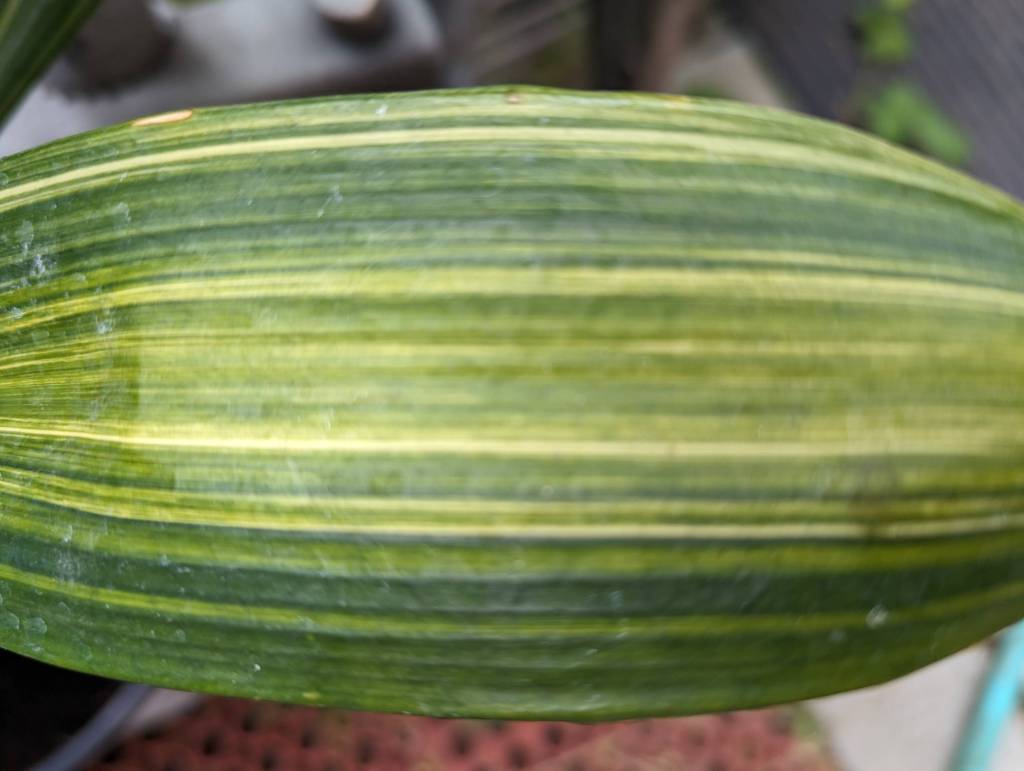
2. Clivia miniata, Kaffir lily lacks bloom now, but like ‘Black Lace’ European elderberry, provides colorfully ornamental foliage. It is variegated with these narrow yellow stripes. I believe it blooms orange. I do not know what cultivar it is. It came from Brent’s garden.
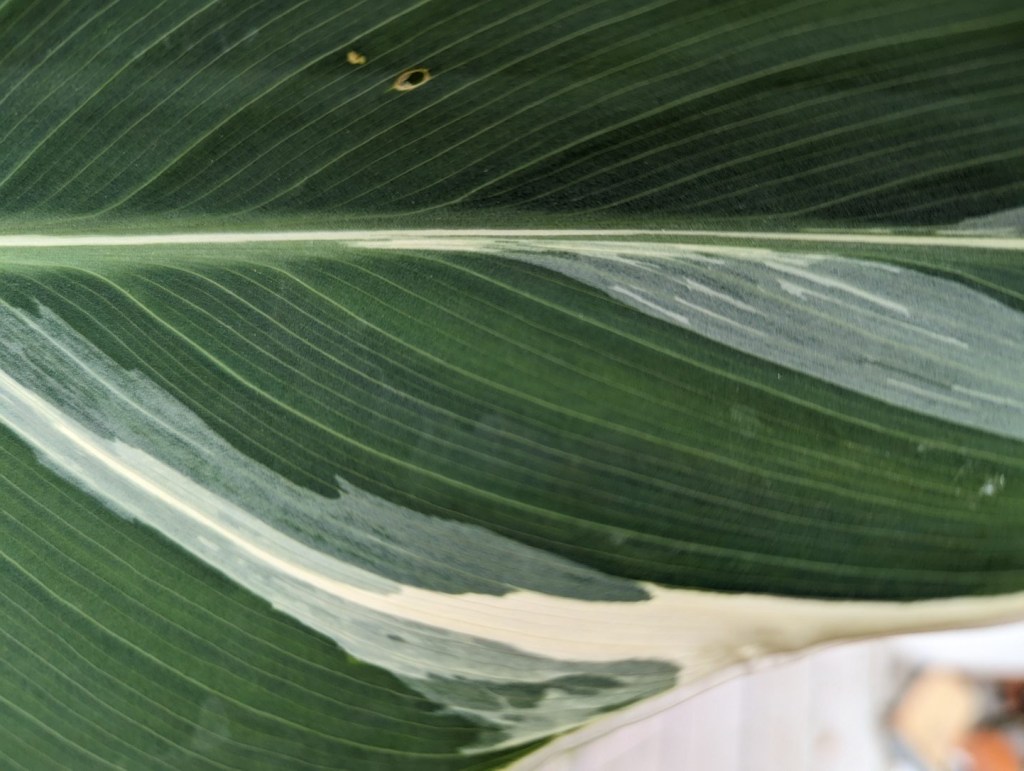
3. Canna ‘Stuttgart’, like the Cymbidium and the other two Canna, lacks a species name. Like 1, 2 and 4, it provides colorful foliage. Like 4 and 5, it is a Canna. It has a lot to like. Most importantly, it came from Tangly Cottage Gardening, and is approved by Skooter!!
4. Canna ‘Australia’ might be described like ‘Stuttgart’ Canna above, but is not approved by Skooter. Its colorful foliage is darkly bronzed, but this specimen is striped with green.
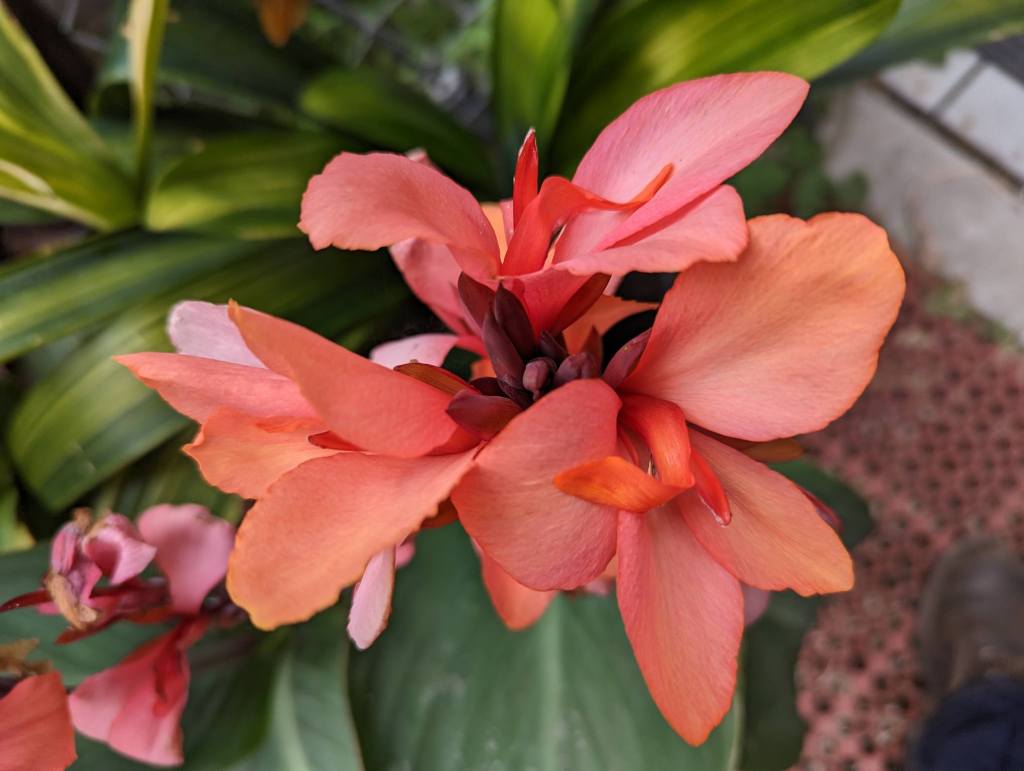
5. Canna ‘Cannova Mango’, like 3 and 4, is a Canna, but that is about its only similarity. I do not like it much because it is a modern cultivar, and it blooms with this weird color.
6. Cymbidium orchid, like 3, 4 and 5, lacks a species name. I like it because I have grown it since the early 1990s. Bloom began in March, but is only now beginning to deteriorate.
Spring bloom is the most colorful color in the garden here. It is not the only color though. Some deciduous foliage will provide color at the opposite end of the year. Bark can add a bit of color, particularly while deciduous trees defoliate for winter. So can colorful fruit. Furthermore, ornamental foliage, both deciduous and evergreen, can contribute color.
Ornamental foliage is not the same as deciduous foliage that is colorful only for autumn. The distinction is that it is colorful from the beginning. Generally, it is most colorful while fresh during spring. If both deciduous and colorful for autumn, it changes from one color scheme to another. If evergreen, it may remain more or less colorful throughout the year.
Ornamental foliage of this sort displays various colors and patterns. Variant colors might be yellow, orange, red, purple, blue, pink, bronze, white or gray. They can be variegation such as stripes, margins, blotches, spots, patterns or blushes. Alternatively, they can be monochromatic. Most fade to some degree during the warm and dry weather of summer.
The colors of ornamental foliage are not as vibrant as floral color. They are not intended to attract pollinators. In fact, most of such color serves no practical purpose. Blue, gray or white foliage mostly originates from high altitudes or harsh desert climates. It reflects a bit of excessive sunlight to avert scorch. Most other ornamental foliage is mere mutation.
In the wild, such mutant foliage is generally a disadvantage. White portions of variegated leaves contain less chlorophyll. Consequently, they can not photosynthesize as much as green portions. Such foliage only perpetuates unnaturally within cultivation because it is appealing. Some mutant ornamental foliage can revert to more vigorous greener growth.
Ornamental foliage can be annual, perennial or woody. New Zealand flax, canna, coleus and caladium are the most variably colorful. Coprosma and various pittosporum are a bit more limited. Euonymus, hosta and ivy display white or yellow variegation. Smoke tree, redbud and some maples are surprisingly diverse. Agave blue spruce and some junipers can contribute gray and blue. There are too many options to mention.
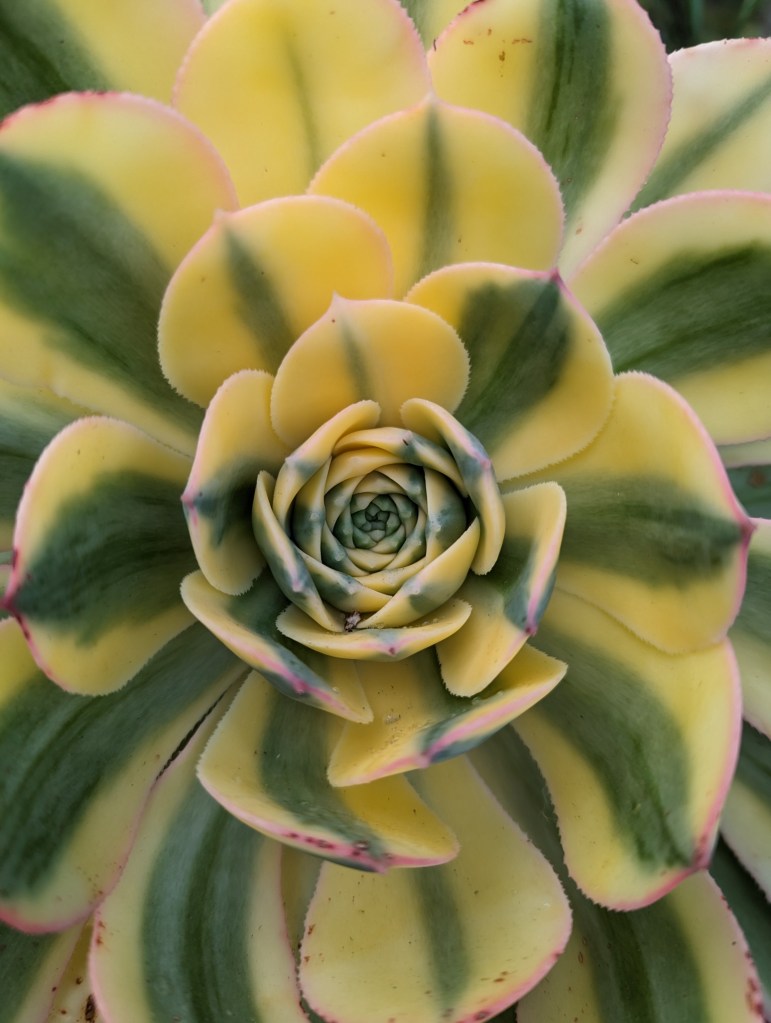
Variegation can be neatly symmetrical, or strikingly irregular like this.
With spider plant, croton, pothos, dracaena and the various ficus, variegated foliage seems to be very popular among house plants. Remember the wildly colorful variegations of coleus when it was a popular houseplant in the 1970’s? Variegation is most commonly white or some sort of yellow; yet can be just about any color.
In the landscape, variegated shade tolerant plants brighten shady spots even without bloom. Variegated acanthus, Japanese aralia, andromeda, hydrangea, aucuba and angels’ trumpet show up nicely, especially when they can contrast with the darker green of other plants; although andromeda and hydrangea do not bloom as well in darker shade. Variegated periwinkle and English ivy are nice ground covers, (but potentially invasive).
Variegated trees, like tulip tree and certain maples, stay smaller than their unvariegated relatives, so can be proportionate to large atriums that could use their brighter foliage. Some of the variegated pittosporums likewise function like the unvariegated forms used for informal hedges, but work better in tighter spots.
Even if there is no need to brighten areas that are already sunny, variegated holly, lily-of-the-Nile, bougainvillea, pampas grass and silverberry add nice contrast where there is an abundance of rich green foliage. (However, some people who grow variegated pampas grass are not too impressed by it.) New Zealand flax presently happens to be one of the most popular variegated perennials, with many different personalities of color to choose from. Variegated varieties of several specie of agave and yucca are striking big perennials for the sunniest and even inhospitably hot spots, as long as they are kept at a safe distance. (Many have dangerous spines and teeth!)
Some variegated plants, particularly New Zealand flax, andromeda, Pittosporum tobira and the various maples, try to produce unvariegated mutant growth that grows faster and bigger, and overwhelms the desirable variegated parts. It is therefore important to watch for and prune out unvariegated growth as it appears. For New Zealand flax, this involves diligent digging and splitting to removed unvariegated shoots from the variegated parent plants.
Coffee was more popular as a houseplant decades ago.
The White Raven Coffee Shop, the best little pourhouse in Felton, has an interesting but old fashioned houseplant on the counter. This group of four small but rapidly growing coffee trees, Coffea arabica, was a gift from a loyal customer.
Mature plants can get to thirty feet tall in the wild. Fortunately, coffee trees are easy to prune to fit interior spaces. Pruning for confinement is actually better than relocating big plants outside, since they do not like cold weather and are sensitive to frost.
Like various species of Ficus, coffee is appreciated more for lush foliage that happens to grow on a tree that can be trained by pruning to stay out of the way, overhead or in other unused spaces or corners. The simple remarkably glossy leaves are about two and half inches long or a bit longer. The very fragrant small white flowers are almost never seen among well groomed houseplants, and only rarely and sporadically bloom among less frequently pruned larger trees in greenhouses and conservatories.
The half inch wide coffee fruit, which is known as a ‘cherry’, is even more rare than flowers among houseplants because of the scarcity of both pollinators and pollen (from so few flowers). Those fortunate enough to get flowers sometimes pollinate them with tiny paintbrushes or clean make-up brushes to compensate for a lack of insects about the house. The resulting bright red or somewhat purplish cherries barely taste like cherries and only make two coffee ‘beans’ each; not enough to bother roasting and grinding for coffee, but great for bragging rights.
This weird Euphorbia is one of the few small evergreen trees that drops no foliage.
Contrary to popular belief, most deciduous trees, those that drop all their leaves in autumn, are not as messy as most evergreen trees. There are of course a few exception; such as cacti that lack foliage completely, or Italian cypress that drop their finely textured foliage straight down within a very narrow drip-zone, where it decomposes and disappears unnoticed. Very few leaves fall from a big silver maple through winter, spring and summer, so that almost all of the raking is done when almost all the leaves get shed in autumn. However, a big Southern magnolia generally drops leaves throughout the year, so that raking is always necessary.
The problem is that when deciduous trees get to be messy, they are very messy. Also, they get to be messy at the worst time of year, when their leaves mix with rain to clog drains and gutters. Unraked leaves become hazardously slippery when they get wet and start to decompose. It is amazing how something that can be so appealingly colorful through autumn can so quickly become such a nuisance.
Leaves of deciduous trees somehow seem to be better for composting than those of some of the evergreen trees. Anyone with a Southern magnolia knows how slow the foliage is to decompose. Foliage of camphor, bay, carob and various eucalyptus certainly decompose slower than various maple, ash, poplar and birch. Many of us outfitted with green waste bins or curbside collection of green waste prefer to recycle the less desirable evergreen foliage, and compost primarily deciduous foliage. Those of us who do not compost but need to rake under large or many deciduous trees may fill bins for several weeks, or leave very big piles of leaves at the curb.
Small leaves, such as those of most elms, or finely textured compound leaves, such as those of silk tree, jacaranda or locust, may not need to be raked if they fall onto lower shrubbery or ground cover. Small leaves or the small leaflets of disintegrating compound leaves simply sift through the lower plant material to decompose below. However, large elms may produce such an abundance of foliage that some may need to be removed. Maple and other large leaves are not so easy to ignore. They can shade lawns, ground cover or bedding plants, so need to be raked as they fall.
Where winter weather is cooler, honeybush, Melianthus major, is likely to be deciduous. If so, it annually sheds all growth that is above ground. It can not bloom where deciduous because only growth of a previous season can bloom. That is no problem here. Dark red floral spikes bloom boldly about two feet above jungly evergreen foliage for early spring.
This silvery gray foliage can grow taller and wider than six feet, even if deciduous during winter. Foliar texture is both luxuriant and elegant. Pinnately compound leaves are more than a foot long with serrate leaflets. Evergreen plants are tidier with grooming to remove deteriorating older foliage as new foliage replaces it. Deciduous plants are always fresh.
‘Antonow’s Blue’ is a bit bluer than the straight species. ‘Purple Haze’ is slightly purplish, with a slightly finer foliar texture. Some notice that the rich fragrance of honeybush bloom resembles that of honey. Also, some notice that the foliar aroma can be rather grungy. All parts of honeybush are toxic. Honeybush wants regular watering and abundant sunlight.
Exotic plants are not native. They are from someplace else. Yet, most plants within most home gardens are exotic. Most are capable of tolerating the more extreme climates from which they originated. Some tropical or subtropical plants actually prefer milder climates. After the recent cool weather, some vulnerable plants exhibit symptoms of frost damage.
Vulnerability is relative though. Honeybush and elderberry can be mostly evergreen with minimal chill, or deciduous with more pronounced chill. Both tolerate more chill than they can experience here. What may seem to be frost damage of specimens that are normally evergreen could be a normal deciduous response to slightly abnormally cooler weather.
Frost damage is also relative. Partial defoliation of Mexican lime might happen annually after minor frost, so may not be alarming. However, such seemingly minor damage could involve stems or entire trees. Luxuriant canna foliage that so instantly becomes unsightly after minor frost can be more alarming. However, dormant rhizomes are safe until spring.
The simplest means to avoid frost damage is to not grow plants that are susceptible to it. Obviously, that is quite limiting. Besides, plants that were not susceptible last winter may be susceptible this winter or sometime in the future. Weather is annually variable. Some susceptible plants can grow in pots that are portable enough to relocate to winter shelter.
Small but immobile plants that are vulnerable to frost damage may appreciate temporary shelter during frosty weather. Any sort of sheeting or cardboard suspended by any sort of stakes and strings should be adequate. Ideally, the sheeting should not touch the foliage below. Incandescent Christmas lights under such sheeting radiate a slight bit of warmth. Frost occurs only at nighttime locally.
Frost protection can be unsightly, but it is less unsightly than frost damage. Fortunately, it is temporary during frost. If not too unsightly, most frost damage should remain until after the last frost date. It insulates other vulnerable vegetation within. Furthermore, premature grooming or pruning stimulates new growth that is more vulnerable to subsequent frosts.