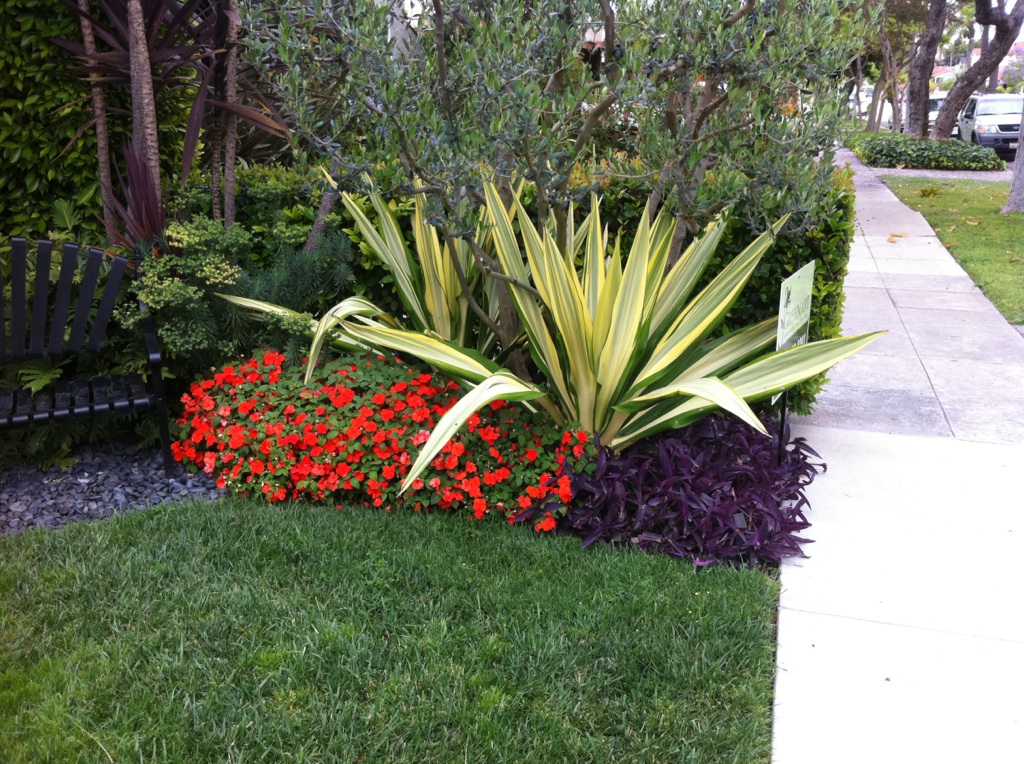
Furcraea foetida ‘Mediopicta’ looks like a big Yucca or a small Agave.
As spectacular as the bloom of Furcraea foetida ‘Mediopicta’ is, it is actually not the most desirable feature. Solitary flower spikes grow intimidatingly fast up past second story windows, and spread out several feet wide with small but abundant pale white flowers. They are certainly impressive, but are also the final act for mature plants just before they die.
Fortunately, they take several years to mature, so provide big bright yellowish green variegated foliage for many years. The other good news is that as they die, herds of pups (known as ‘bulbils’) develop and fall from the huge inflorescences. There are far more than enough pups to replace the original plants and to share with all the concerned neighbors who witnesses the crazy bloom.
Furcraea foetida ‘Mediopicta’ is not quite as tough as unvariegated (green) furcraeas, so it can be damaged both by frost or harsh exposure to sunlight. It is also a bit smaller, staying less than five feet tall (prior to bloom of course) and seven feet wide. Too much watering can cause rot.
Artemisia ‘Powis Castle’ is more foliar than floral.
The pleasantly aromatic and lacy silvery gray foliage of Artemisia ‘Powis Castle’ can either mix well with pink, lavender or light blue flowers, or contrast against bright red or orange. The dark angular leaves of bronze New Zealand flax or bronze cannas are striking against its low and softly mounding form, which stays less than two feet tall and not much more than twice as wide. Contrary to how Artemisia ‘Powis Castle’ enhances the color of other flowers and foliage, its own flowers are not much to look at, if they get noticed at all.
Foliage is fluffiest if mature plants get pruned down at the end of winter. New plants can be propagated by division in spring or autumn. As plants get established, good drainage becomes more important than frequent watering.
Aspidistra elatior, cast iron plant, is a foliar perennial. In other words, it is grown more for its lush and famously resilient evergreen foliage than for its bloom. The resiliency of its foliage accounts for its common name. Its bloom does not account for much. In fact, it is rarely seen. This is not because it is rare, but because it is not much to see. Such bloom is typically obscured by the lush evergreen foliage. Even if exposed, as in these pictures, it is not prominent. Individual flowers are tiny and dark, and do not extend much above grade. They seem to be designed for pollination by ants or other insects that might walk over them on the ground. In the picture above, one flower is blooming to the far left, another is beginning to bloom to the far right, and a third floral bud seems to be developing below that which is is beginning to bloom to the far right. Even the closeup of the far left bloom below is more weird than visually appealing. The floral form, texture and color suggest that they are intended to attract flies. I did not notice if the floral fragrance was consistent with that assumption, nor do I want to. I know what sort of fragrances flowers disperse to attract flies. However, I suspect that if such floral fragrance were notably objectionable, cast iron plant would be known for sometimes producing it, or not be quite as popular as it is.
Coral bell foliage is as pretty as its delicate flowers for which it is named.
Even though their delicate trusses of tiny hanging flowers on one or two foot tall wiry stems make good cut flowers and attract hummingbirds in spring and early summer, coral bells, Heuchera micrantha, is more often grown for its colorful foliage. Contrary to their common name, the flowers (of this species) are more often pale or greenish white anyway. Their foliage can be all sorts of shades of green, gold, tan, brown, bronze, and purplish. The rounded and lobed leaves have somewhat raspy tomentum (hairs) and can be about two and a half inches wide. ‘Ruffles’ has more ruffled and deeply lobed leaves. ‘Palace Purple’ is a very popular cultivar with distinctive deep bronze or purplish foliage.
Mature plants can be divided in spring to make more plants every few years or so. Where protected from frost, division can be done in late autumn. Coral bells can also be propagated by cuttings. Rich soil and good exposure are preferred; but partial shade is best in warm spots.
Of the few unrelated species of dusty miller, the most common here is Senecio cineraria. Like other dusty miller species, its foliage is remarkably silvery white. Its foliar tomentum can be so thick that it resembles fine felt. Individual leaves exhibit intricately deep lobes. They are about two to five inches long, but are smaller and simpler on upper floral stems.
Dusty miller blooms with floppy clusters of tiny but bright yellow daisy flowers. However, because the colorful foliage is more appealing, bloom might not be a priority. Removal of floral stems prior to bloom promotes denser and neater foliar texture. Within more severe climates, dusty miller is a warm season annual. It is a resilient shrubby perennial locally.
Mature specimens of dusty miller can get a bit taller than three feet with bloom. They are shorter with grooming and pruning to maintain compact form without bloom. If necessary, they are conducive to pruning to limit their height to about a foot and a half. This species tolerates a bit more partial shade than other dusty miller. Ideally, it prefers sunny warmth.
Floral color gets most of the attention within home gardens through spring. It should. It is the most copious and most colorful of color. Though, it is not the only color. A few species that provide floral color, and more that do not, provide colorful foliage. Similar to Olympic Medals, this foliage can be bronze, silver or gold, or variants of such. Some rivals bloom.
Colorful foliage is not the same as foliar color of deciduous foliage as it sheds in autumn. Much is evergreen. Most is most colorful while it grows through warming spring weather. Actually, most fades through summer, and some becomes simpler dark green by autumn. Afterward though, some deciduous colorful foliage also develops foliar color for autumn.
The most popular colorful foliage is variegated. This means it is partly green with stripes, margins, blotches, spots, patterns or blushes. The color range of such variegations is as variable as its pattern range. Some foliage is variegated with a few vividly distinct colors. New Zealand flax, coleus, croton and caladium are some of the more familiar examples.
Of all unvariegated colorful foliage, bronze foliage is the most variable. It includes foliage that is brown as well as reddish, purplish or perhaps dark orangish. Some emerges pink before developing a darker shade. New photinia foliage is reddish bronze only briefly as it matures as dark green. Purple leaf plum and smoke tree are famously purplish bronze.
Silver foliage is the most useful colorful foliage in the wild. At high elevations, where sun exposure is harshly intense, it is selectively reflective. It absorbs sufficient sunlight for its photosynthesis, but not enough to succumb to scald. It is how Arizona cypress and some agaves survive in the high desert. Such foliage may be gray, pallid blue or almost white.
Many species with gold foliage are the same as those with bronze foliage. New Zealand flax, smoke tree, barberry and elderberry can be either bronze or gold. Since gold foliage contains less chlorophyll than green foliage, it is a bit less vigorous. Unlike silver foliage, it serves no natural practical purpose. It survives in landscapes for visual appeal.
Mexican weeping bamboo is more appealing in abundance.
Like junipers, bamboos have gotten a bad reputation from only a few of their problematic specie. Many of the traditional running bamboos really are too aggressively invasive. However, there are many clumping bamboos that are much more adaptable to confined and refined garden areas. Even these complaisant bamboos remain uncommon though, both because of the unpopularity of bamboos, and because they are not so easily produced.
Mexican weeping bamboo, Otatea acuminata aztecorum, is certainly one of the more interesting of these clumping bamboos. Their limber inch and half wide stems are not nearly as rigid as those of most other bamboos are, and may bend down to the ground under the weight of their abundant and remarkably finely textured foliage. The four or five inch long leaves may be only an eighth of an inch wide. Both the stems and foliage move nicely in even slight breezes.
Established plants are somewhat resilient to neglect, but can get rather yellowish and will likely stay less than ten feet tall without regular watering. With regular watering and monthly application of nitrogen fertilizer, such as lawn fertilizer, during warm weather, they can get twice as tall. Old canes should be pruned to the ground as they begin to deteriorate. There should be plenty of fresh new stems to replace them.
Coniferous evergreens are popular Christmas decor.
Christmas trees are extreme cut foliage. They grow on farms like cut foliage that florists use, but are entire trees! Although most fit under household ceilings, some within public venues are famously grand. Nonetheless, they are ultimately as disposable as any other cut foliage. Eventually, after their Christmas season, they become common greenwaste.
Other cut foliage is also popular as home decor through the Christmas season. Much of it is from the same sorts of coniferous trees that become Christmas trees. Almost all of it is evergreen, since deciduous vegetation is already defoliating. A few deciduous stems with colorful bark, such as red twig dogwood, are nice too. So are colorful winter berries.
Cut foliage is more practical as wintry decor within climates with cooler winter weather. Not much blooms during such weather. However, because of this same wintry weather, people prefer to be inside. While inside, they appreciate the color, texture, and perhaps aroma of cut foliage. Locally, such foliar decor for winter is more traditional than practical.
Actually, the most traditional cut foliage of Christmas is uncommon within local gardens. Scraps from the lowest branches of Christmas trees are a good source of minor bits of it. Premade wreaths and garland include a few types that are otherwise unobtainable here. Improvisation is necessary to create wreaths and garlands from locally available foliage.
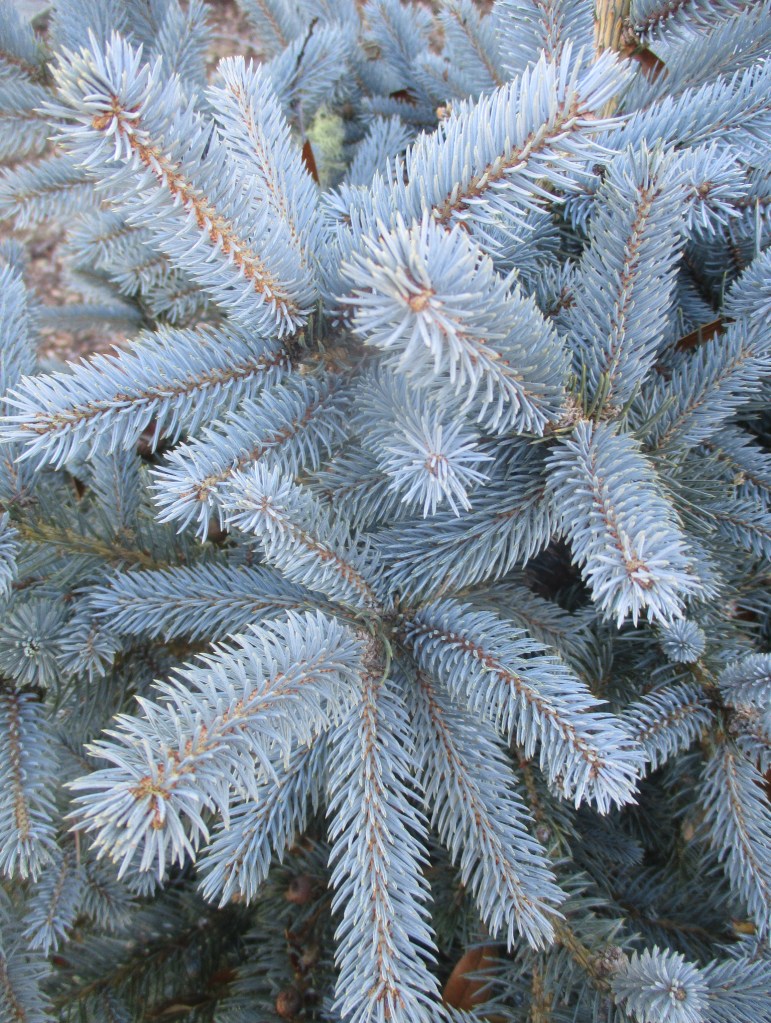
Only a few of the few blue spruce that live here grow large enough to share many stems. Their best foliar growth is also their most important structural growth. Removal of it might cause minor disfigurement. Other spruce, as well as various fir, are very rare within home gardens. So is Eastern white pine, although a few other pines are notably common here.
Atlas cedar, Deodar cedar, various cypress and various juniper are also rather common. A few sorts of holly are uncommon but not rare, but they produce only a few berries here. Holly olive may be more common, and resembles English holly, but produces no berries. Southern magnolia is a strikingly untraditional cut foliage, but becomes fragile as it dries.
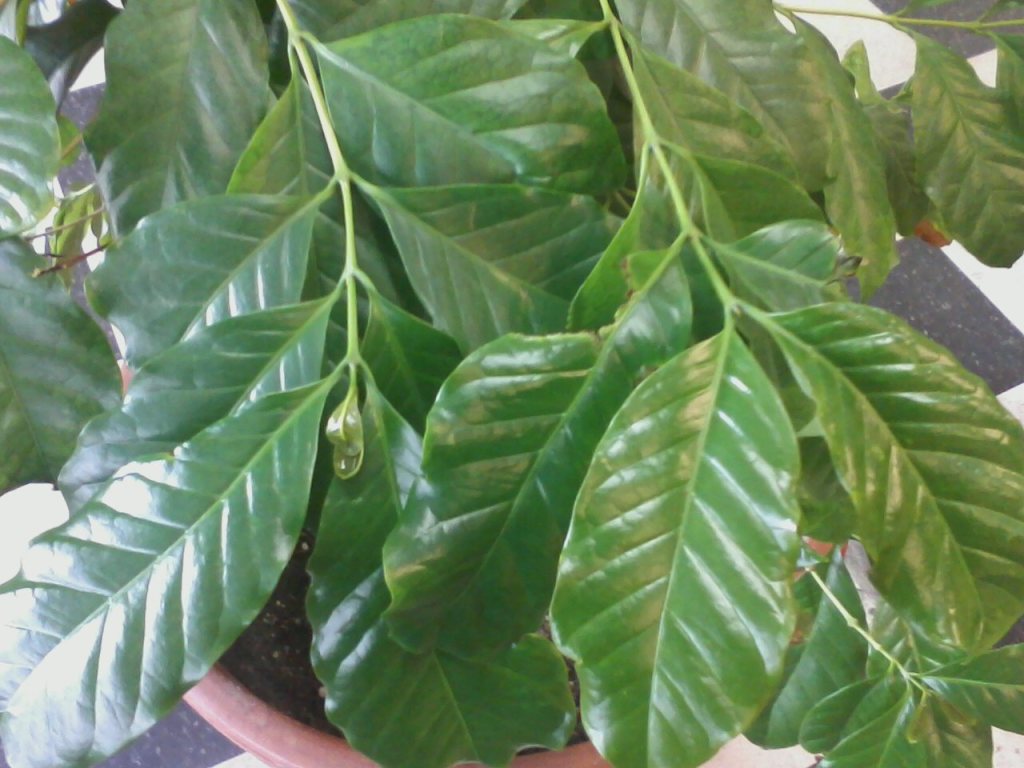
It looks more like a houseplant than the source of coffee.
The White Raven Coffee Shop, the best little pourhouse in Felton, has an interesting but old fashioned houseplant on the counter. This group of four small but rapidly growing coffee trees, Coffea arabica, was a gift from a loyal customer.
Mature plants can get to thirty feet tall in the wild. Fortunately, coffee trees are easy to prune to fit interior spaces. Pruning for confinement is actually better than relocating big plants outside, since they do not like cold weather and are sensitive to frost.
Like various species of Ficus, coffee is appreciated more for lush foliage that happens to grow on a tree that can be trained by pruning to stay out of the way, overhead or in other unused spaces or corners. The simple remarkably glossy leaves are about two and half inches long or a bit longer. The very fragrant small white flowers are almost never seen among well groomed houseplants, and only rarely and sporadically bloom among less frequently pruned larger trees in greenhouses and conservatories.
The half inch wide coffee fruit, which is known as a ‘cherry’, is even more rare than flowers among houseplants because of the scarcity of both pollinators and pollen (from so few flowers). Those fortunate enough to get flowers sometimes pollinate them with tiny paintbrushes or clean make-up brushes to compensate for a lack of insects about the house. The resulting bright red or somewhat purplish cherries barely taste like cherries and only make two coffee ‘beans’ each; not enough to bother roasting and grinding for coffee, but great for bragging rights.


 Tony Tomeo