Flowering cherries are not necessarily the first of the flowering trees to bloom. Flowering apricot, Prunus mume, is even earlier than all but the winter flowering cherry. Many have bloomed already, and as early as a month ago. The latest will bloom soon. Their flowers are more resilient to weather than those of flowering cherry. However, they bloom briefly.
Although generally fruitless, a few cultivars produce fruit for pickling, as umeboshi. Such fruit, without pickling, is rather unpalatable. Some cultivars of flowering apricot are useful as understock for related trees. Actually, some local flowering apricot trees grew from the roots of other flowering plums. New trees are very rarely available from nurseries locally.
Mature flowering apricot trees are ten to nearly twenty feet tall and almost as broad. They bloom before they foliate. Abundant bloom on big trees can be mildly fragrant. Individual flowers are about an inch wide. They are pastel pink, but can be white or deep rosy pink. Blooming stems can be exquisite as cut flowers, although they may not last for very long. Such stems are a traditional component of ikebana.
Spring bulbs, with prechilling, were conducive to the technique of forcing bloom earlier. A few summer bulbs might still be responsive to it, although it is getting late for most. Now, it is about time for forcing bloom with certain dormant deciduous stems. Most are already beginning to bloom. Forcing bloom merely accelerates this process for cut flower stems.
Forcing bloom for dormant deciduous stems is actually simpler than for bulbs. It involves merely cutting stems that are about to bloom and bringing them indoors. The warmth of a home interior is what accelerates profuse bloom. Aridity of home interiors may accelerate the deterioration of this bloom. However, homes also provide shelter from wind and rain.
Witch hazel, flowering quince and forsythia are mostly done blooming locally. Otherwise, they are conducive to forcing bloom, and will be available next winter. Several flowering cherries and flowering plums are now about ready for forcing bloom. Redbuds are ready also, though some will be later. Flowering crabapples should bloom later in their season.
Several fruit trees are as conducive to forcing bloom as their fruitless flowering relatives. Their floral color and profusion are less extravagant only because of their breeding. Fruit is, after all, the priority. With planning, dormant pruning can involve leaving a few surplus stems to cut later. Then, cutting them about now should not compromise fruit production.
With precise timing, wisteria and lilac are conducive to forcing bloom. Technically, so are dogwood and several deciduous magnolias. They bloom relatively slowly though. A few flowers should therefore be blooming before collection of their stems. Evergreen species are less striking in bloom. Fringe flower and Oregon grape can perform elegantly though.
Forcing bloom is more popular where winters are cooler. This is partly because gardens lack floral color for so long through winter. Those who enjoy flowers are in more of a rush to bring some into their homes. Also, dormant vegetation is more reactive to warmth after colder winters. Warmth might not stimulate bloom as effectively after locally mild winters.
Winter flowering cherry, flowering quince, witch hazel and forsythia are finishing bloom. Later types of flowering cherry and flowering quince bloom immediately afterward. Lilac, redbud and weigela bloom only slightly later. Flowering crabapple extends the season of such flashy early bloom. It is relatively easy to force any of these for even earlier bloom.
Forcing is more popular where cool weather inhibits bloom through winter. It accelerates bloom simply by exposing it to home interior warmth. Bulbs that remain dormant in cold gardens bloom sooner in warm homes. Winter is the most popular time for forcing bulbs. It is now time to force formerly dormant deciduous stems to bloom a bit earlier for spring.
It is less wasteful to force deciduous stems to bloom than to force bulbs to bloom. Bulbs rarely survive because they exhaust their resources without replenishment. Those that do survive and have potential to bloom again may take a year to recover. Bulbs are not cheap. Deciduous stems are free, and are as disposable as other popular cut flowers.
The most popular stems to force are the fruitless counterparts of fruit trees. This includes flowering cherry, flowering crabapple and flowering quince. Flowering quince is actually not closely related to fruiting quince though. It also includes flowering apricot, flowering plum, flowering peach and flowering pear. Flowering pear is likely to smell badly though.
Stems from deciduous trees that actually produce fruit are just as easy to force. They are only less popular because they are not bred to be as pretty. Also, removal of their stems compromises fruit production. Those who plan to force such stems can leave a few extra during dormant pruning. Collection of stems should not damage or disfigure the source.
Stems are ready to force when their floral buds are just about to pop. Ideally, some buds should be slightly exposing their floral color within. A few flowers could be blooming. At that stage, bloom accelerates significantly in response to home interior warmth. Aridity can desiccate larger blooms. Otherwise, wisteria, dogwood, deciduous magnolias and perhaps azaleas are conducive to forcing.
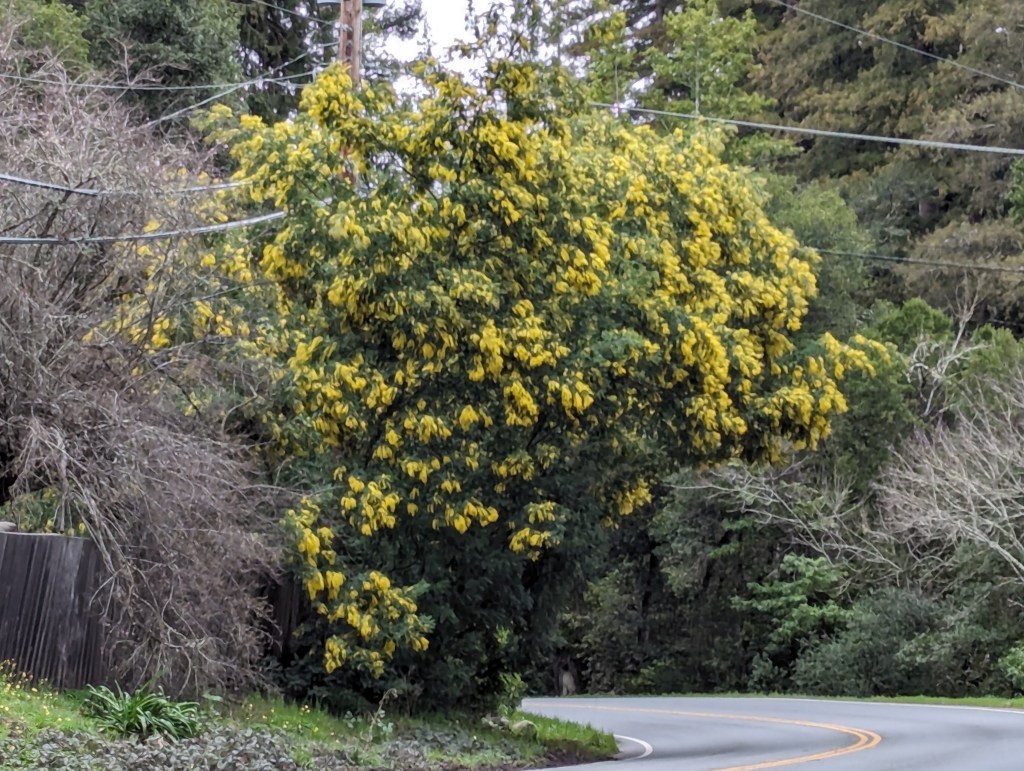
Silver wattle is an aggressively invasive exotic species, but certainly is pretty in bloom!
From my window, I can see across the way to one of my all time favorite weeds in my neighbor’s garden. A healthy acacia tree is nearly in full bloom! Throughout the year, I occasionally remind my neighbor that we really should cut the tree down before its seedlings overwhelm the neighborhood. This time of year though, I am secretly glad that we have not gotten around to it yet.
Even though most people find the fragrance objectionable, I actually find it appealing. It reminds me of Southern California, perhaps because, even on a cool wintry day, it smells like a sun roasted freeway on a hot smoggy day. I suppose that its pollen is a problem for anyone with even mild allergies; and after all, it is still a major weed.
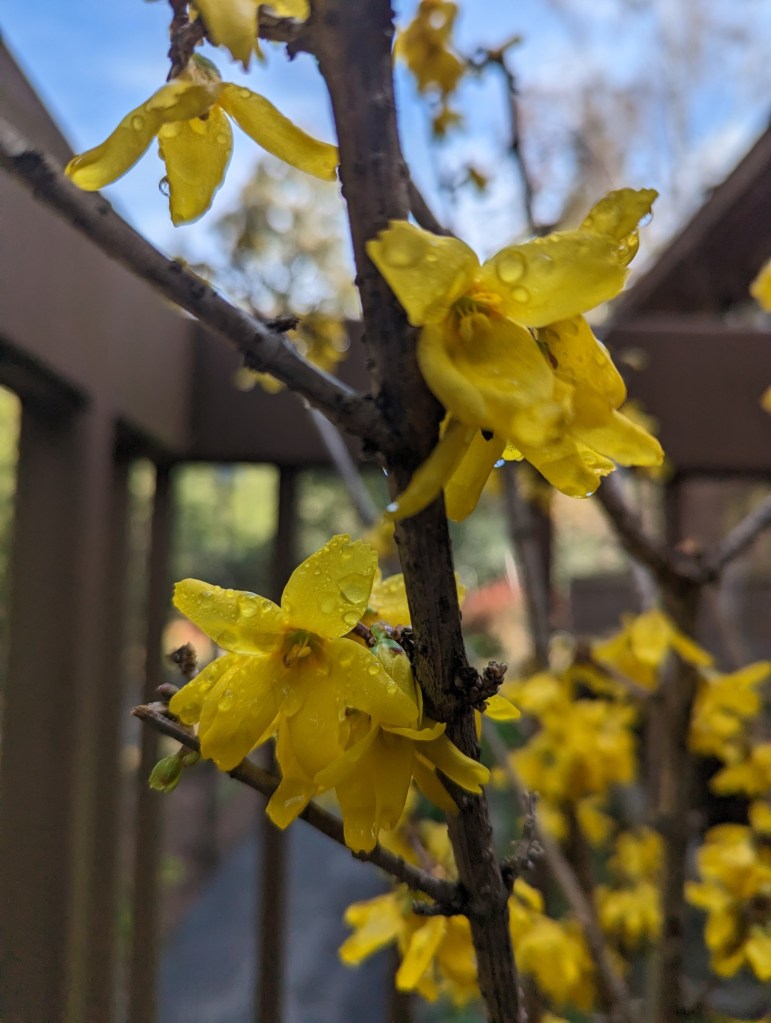
Other trees that are now blooming are not so problematic, or equipped with a petroleum based fragrance. Shrubby forsythia and flowering quince were the first to bloom. Forsythia is the best bright yellow besides acacia. The most popular flowering quince are rich pinkish orange. Apricot, cherry, peach, plum, prune, nectarine, almond and a few other fruit trees, as well as their fruitless ‘flowering’ counterparts, including purple leaf plum, are blooming about now. (Flowering apricot, peach, nectarine and almond are rare.) Fruiting pear and apple trees typically bloom a bit later; but flowering pear and some flowering crabapple are already blooming. Later, redbuds bloom bright purplish pink.
When pruning fruit trees during winter, I sometimes leave a few branches to cut and bring inside while in bloom. Fruitless flowering trees do not need to be pruned like fruiting trees, so can provide even more flowering stems with more flower variation. Stems of forsythia, flowering quince and flowering cherry are often ‘forced’ into bloom by getting cut and brought in just as flower color start to become visible, so that they can finish their bloom inside. Except for redbud, any of the other spring bloomers can also be forced, but are more likely to get desiccated by the dry air inside.
As red maple and red oak begin to break dormancy, they develop delicate pendulous ‘blooms’ that are not very colorful, but might be interesting enough to add to more colorful cut flowers. Of course, pussy willows are always traditional.
Unusually wintry weather did not seem to delay star magnolia, Magnolia stellata, bloom. Such bloom can begin immediately prior to March, or finish immediately afterward. Yet, it typically occurs at about the same time annually within any particular situation. Few here were notably later than they were last year. Bloom lasts only for about two weeks though.
Nonetheless, bright white bloom is spectacular prior to foliation of otherwise bare stems. Formerly rare cultivars with blushed or pastel pink bloom are becoming popular. Delicate floral fragrance is proportionate to profusion of bloom. Individual flowers are about three inches wide with many narrow tepals. Deciduous foliage appears as bloom deteriorates.
Star magnolia may be more comparable to large shrubbery than small trees. Most do not grow much taller than six feet. Some of the largest may be twice as tall and broad, with a few trunks. Old trunks and branches can be somewhat sculptural. Bark is pallid, like that of fig trees. As their plump floral buds begin to burst, bare stems are conducive to forcing.
Flowering crabapples are the same genus as fruiting crabapples. Flowering cherries are the same genus as fruiting cherries. Flowering quince, Chaenomeles spp., though, is not the same genus as fruiting quince. Available cultivars are generally floriferous but sterile hybrids. Only four basic species produce small fruit that are good for little more than jelly.
They bloom magnificently though, on bare stems, prior to foliation. Profusion of bloom is comparable to that of flowering crabapple and flowering cherry. It begins early enough to finish before some flowering cherries begin. Flowering crabapples start even later. Floral color ranges from bright white to deep red. This includes orangish pink and orangish red.
Unlike flowering cherry trees and flowering crabapple trees, flowering quince is shrubby. The largest might grow no higher than ten feet, with irregular branch structure. Some old cultivars are thorny. Modern cultivars are more compact, shaplier and thornless. Younger trunks should methodically replace older trunks. Pruning can happen after spring bloom.
Some of the earliest of spring flowers are done blooming. More are just beginning. Then, a few early spring flowers barely qualify as early. Their fresh color is especially pleasing after such an atypically wintry winter. Many are delightful cut flowers. A few that bloom on bare deciduous stems are conducive to forcing. Even the earliest bloom could be earlier.
Bare stems are simpler and less wasteful to force to bloom than bulbs and potted plants. Most bulbs and some potted plants do not survive long after forcing. Dormant deciduous plants easily replace a few forceable stems. Forcing such stems is as simple as bringing cut flowers into a home. The difference is that it is premature, immediately prior to bloom.
Flower buds on dormant deciduous stems begin to swell during warming spring weather. Such stems are ready for forcing when these floral buds are about to pop open. Ideally, a bit of floral color should be visible through some of the bud scales. A few flowers may be blooming. Collective bloom accelerates within the warmth of a home interior after cutting.
Flowering but fruitless counterparts of popular fruit trees are some of the best for forcing. These include but are not limited to flowering cherry, plum, apricot and other stone fruits. Flowering pomme fruit trees, such as quince, crabapple and pear are almost as popular. Related fruiting stone and pome fruit trees are as conducive to forcing, but not as garish.
Of course, there is nothing wrong with simpler bloom. Some fancy flowering cherry trees bloom with single white flowers like fruiting cherries. However, cutting stems from fruiting trees decreases fruit production. With a bit of planning, dormant pruning can allow a few undesirable stems to remain. These stems are then available for cutting and forcing later.
Witch hazel cultivars are exemplary for forcing, but are done blooming. Flowering quince and forsythia are now finishing within most climates. Redbud, lilac, wisteria and perhaps weigela are still conducive to forcing. Dogwood and deciduous magnolia can perform as well if humidity is not too minimal. So should some acacias, although their fragrance and pollen may be distasteful.
Poinsettias are very popular blooming potted plants for about a month prior to Christmas. Then, most quietly disappear prior to spring. A few become foliar houseplants. Fewer go into home gardens to likely succumb to frost or neglect. Very few survive for more than a few years. It is not easy to recover from the procedures that forced them to bloom so well.
Forcing bloom is stressful. It provides unnaturally indulgent doses of stimuli that optimize floral performance. It involves any combination of deceptive environmental and chemical manipulation. Optimal bloom is the primary objective. Sustainability or even survivability after bloom is irrelevant. Forced plants are barely more than cut flowers with potted roots.
For example, poinsettias receive much more than the nutrition they require for exemplary growth and bloom. The greenhouses that they grow in maintain optimal temperature and humidity for them. Shading shortens their daylength to deceive them into believing that it is the season for bloom. Transition from such decadence to natural conditions is difficult.
Almost all fancy blooming potted plants that are available from supermarkets and florists, and several from nurseries, are forced to some degree. These include poinsettia, orchid, chrysanthemum, hydrangea, azalea, a few types of roses and various bulbs. Such bulbs include lily, narcissi, crocus, hyacinth and tulip. Some exhaust their resources by bloom.
Many forced plants are cultivars that are distinct from more common landscape cultivars. For example, many florist hydrangeas bloom with huge and very abundant floral trusses on short stems. They are spectacular in pots, but might not be so practical for landscape situations. Landscape hydrangeas support bloom higher over the ground on taller stems.
Their potential for inferior performance after their potentially difficult recovery from forcing should not necessarily disqualify forced plants from salvage. Short florist hydrangea can be delightful accessories to bigger landscape hydrangea. Moth orchids are impressively adaptable. Premature doubting of possible ultimate results can be more effort than trying.
Properly pruned deciduous fruit trees probably do not have too many extra stems to spare now. Neglected trees would have more to offer. Believe it or not, a few of us who prune deciduous fruit trees diligently and meticulously in winter sometimes leave a few unwanted stems to prune out and take into the home now that the flower buds are beginning to swell and are about to bloom.
Bloom accelerates once the bare twigs are inside where the nights are warmer than outside. If the buds are plump enough, they can bloom in a day or a few. (If not plump enough, the buds may desiccate before they bloom.) Twigs that are already blooming can be brought in as well, but do not last quite as long. Blossoms are a bit messy as they later drop petals, but are worth the bother.
The technique is simply known as ‘forcing’, which works something like forcing bulbs to bloom prematurely. Timing is critical. If a few blossoms are already blooming elsewhere on the tree, the fattest unblooming buds that are already showing color are ready to be cut and brought in. They only need to be put in a vase with water like any other cut flower, and can mix with other flowers.
Stone fruits (of the genus Prunus) like almond, apricot, plum, prune, peach, nectarine and cherry, start to bloom about now, although not in this order. Apple and pear bloom later. All their fruitless counterparts, known simply as flowering plum, flowering cherry, flowering crabapple and so on, are even more colorful, and some types bloom with ruffled double flowers. All bloom without foliage.
Flowering quince and forsythia have already bloomed, but would have been the most spectacular bare twigs to force into bloom. Pussywillow is probably the most familiar forced bloom twig. Hawthorn (Crataegus spp.) blooms something like pear, but the aroma may be objectionable to some. More adventurous garden enthusiasts force witch hazel (winter), redbud and star magnolia.




 Properly pruned deciduous fruit trees probably do not have too many extra stems to spare now. Neglected trees would have more to offer. Believe it or not, a few of us who prune deciduous fruit trees diligently and meticulously in winter sometimes leave a few unwanted stems to prune out and take into the home now that the flower buds are beginning to swell and are about to bloom.
 Tony Tomeo