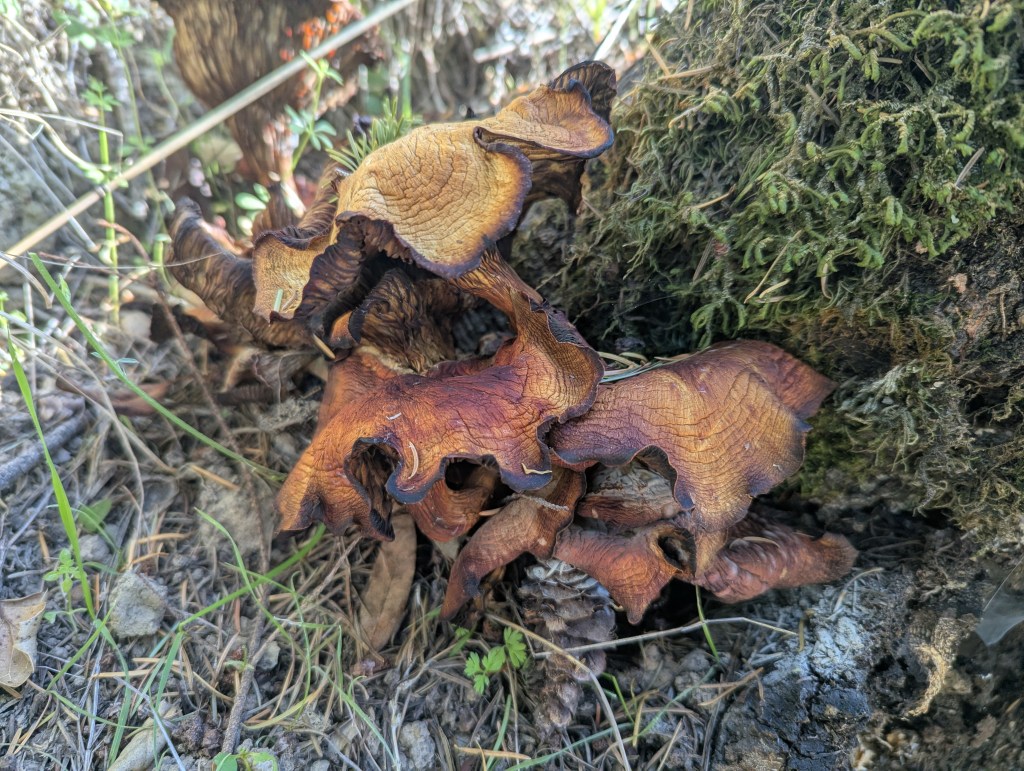
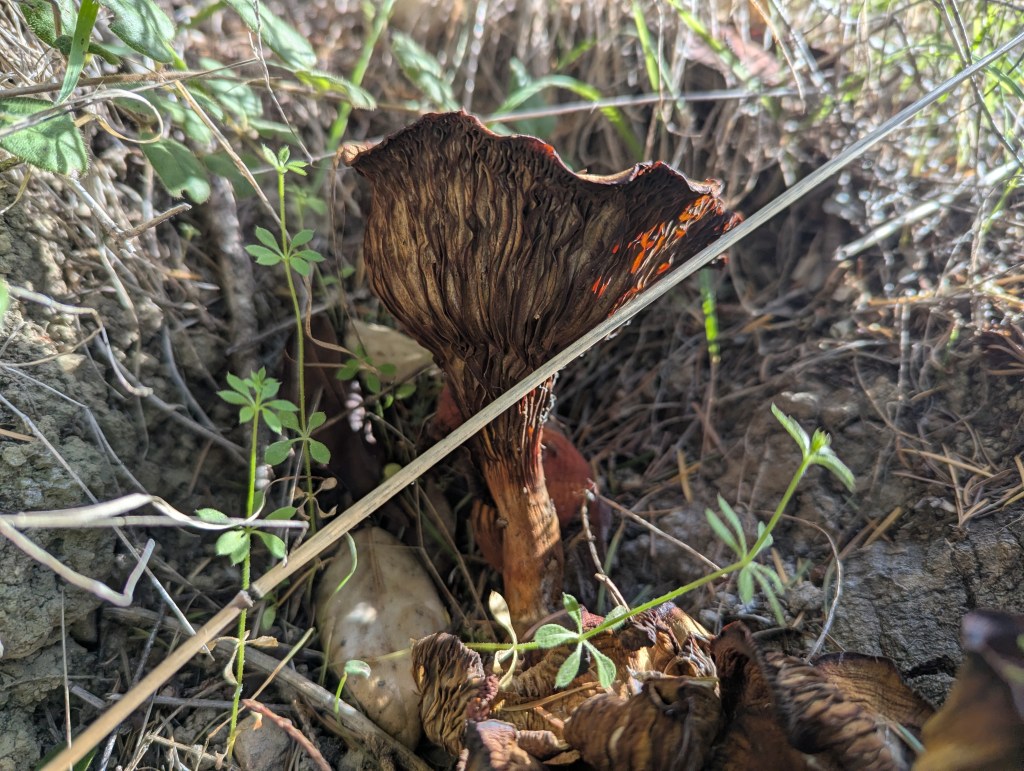
Are these chanterelles? I found them at the base of a dead and rotting coast live oak on the Upper East Side. I took their picture because friends had been asking me if there are any chanterelles to collect there. Apparently, chanterelles can be sold for quite a sum to restaurants. I really should have been more observant when I took these pictures, to see how many more of the same, if any, were in the area. I will not return to the area anytime soon, unless I need to show someone else where it is. It is quite a hike to get there, with a very steep incline. It is likely too late to collect chanterelles anyway. They supposedly emerge after the first autumn rain, but finish through November, which is likely why these look so deteriorated and dried. However, locally, they can continue to appear throughout winter if weather conditions are favorable. I am certainly no expert. After all, even if these are chanterelles, this is my first experience with them. We are barely acquainted. I do not trust them enough to taste them. Nonetheless, I would be pleased if friends could collect real chanterelles for a profit.
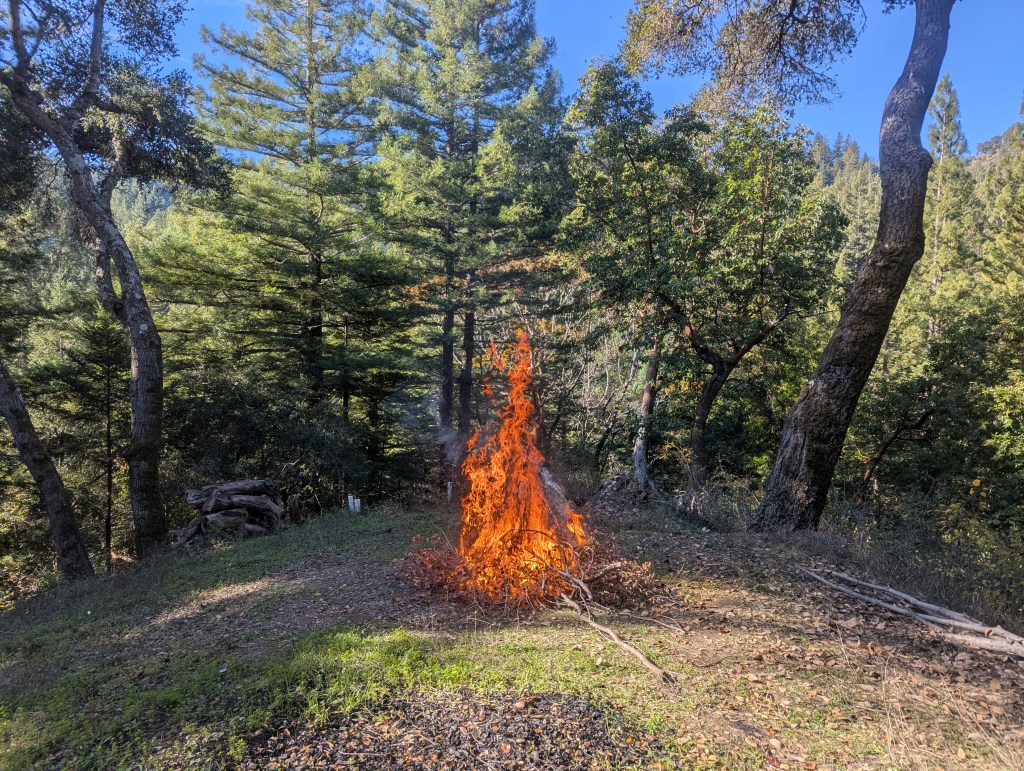
Monday was the first day of burn season, which continues from December 1 until April 30. On designated burn days within burn season, we can burn green waste that would otherwise make our properties more combustible during fire season, which is generally the opposite of burn season. The designation of burn days is determined by multiple meteorological factors, such as temperature, humidity, wind, atmospheric pressure and air quality. It is also limited by the moisture content of the forest, so can be delayed until after the first soaking rain storms. So, not only was Monday the first day of burn season, it was also the first designated burn day within burn season. I took the opportunity to burn some of the green waste that has been accumulating since the previous burn season. It was tedious but gratifying. A chipper would have been faster, but that is something that I lack here. Besides, a chipper can not go where some of the green waste remains. It is so far down steep hillsides that I may try to burn it where it is, rather than drag it up to where this primary burn pile was. There is a lot of green waste!
It may not look like much, but it gets annoying, especially at night.
The industrial shop buildings at work are not exactly visually appealing. Fortunately, they are partially obscured from the roads outside by wild forest trees within the adjacent Zayante Creek and a roadside ditch. One road is on the opposite side of Zayante Creek. The other is on the opposite side of the roadside ditch that is perpendicular to Zayante Creek. Their intersection with associated traffic signals is therefore right outside. I added five Arizona cypress trees to the forested area of the roadside ditch, and three Monterey cypress to the forested area of Zayante Creek, to obscure the buildings more in the future. Unfortunately, though, some of the trees beyond needed to be removed for renovations of a major water main for Santa Cruz. One was a mature Monterey cypress between one of the shop buildings and the intersection of the two roads outside. Not only did this reveal the view of the backside of the building from the roads and intersection, but it revealed the view of the intersection from the few windows of the building. Now, from where I do much of my writing, I can see this traffic signal monotonously change from green to yellow to red.
“This” is the first word of each of these six entries for Six on Saturday this week. There is not much variation among the coast live oak, coastal redwood, California bay, California black oak, big leaf maple and whatever else might be visible in these pictures. Half these pictures happen to feature specific coast live oaks. Therefore, I omitted botanical names. I wanted to show some of what is happening at the new home site, but there is not much to show, and there may not be much to show for a while, except for Rhody.
1. This is where the old home was. The forest wasted no time reclaiming its space. I miss the old home very much, but it was too deteriorated to salvage. I knew it was temporary.
2. This is where the new home will be built. It is less than fifty feet to the west, and faces more to the west instead of south. The upstairs office studio will face into the redwoods.
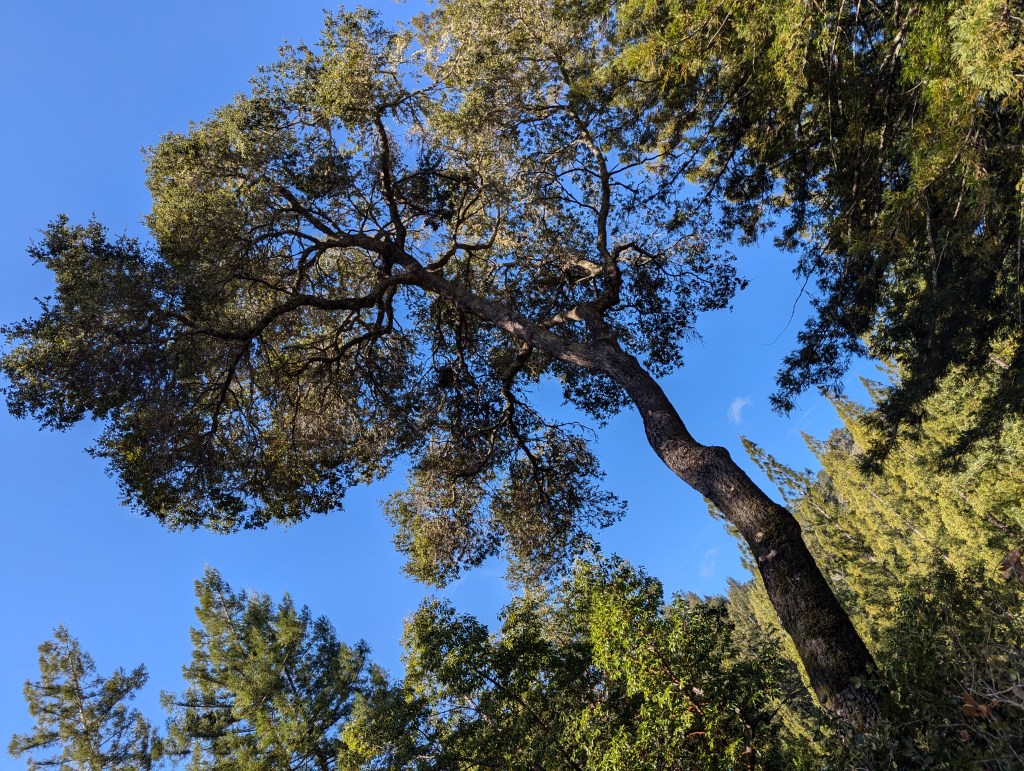
3. This lofty coast live oak stands high over the new home site, but leans to the north and away from where the house will be. It is the biggest of several big oaks in the grove here.
4. This silly coast live oak leans parallel to the driveway. The contrastingly vertical trunk to its right is the same that is on the right border of the first picture of the old home site.
5. This grand coast live oak arches elegantly over the driveway. It can be seen across the upper left corner of the previous picture. It is about perpendicular to the horizontal oak.
6. This is how I manage the overgrown and overly combustible vegetation here. It needs to be planned in accordance with the weather that has been too dry for much too long.
Desert ecosystems are fascinating, but so are local ecosystems.
Vacation was excellent! I do not get out much, but when I do, I feel as if I enjoy it more than those who travel regularly. The simplicity of my travel allows me to enjoy it more intimately than those who travel more elaborately and put more effort into enjoying what they should probably just enjoy more effortlessly. Anyway, I went to the Pacific Northwest for two weeks, returned for two weeks, and went to the Southwest for two weeks. Actually though, my trip to the Pacific Northwest was limited to Western Oregon and Western Washington, and my trip to the Southwest was limited to the area between Los Angeles and Phoenix. Regardless, it was excellent, and I encountered several climates and ecosystems that are very different from what I am accustomed to. I drove through dense rainforests dominated by massive Douglas firs as well as sparsely forested deserts dominated by sporadic saguaro cacti. Winters are much cooler in some regions than here. Summers are much warmer in some regions than here. It was all so fascinating. I encountered so much vegetation that I would like to grow here, and brought a bit of it back, but can not grow everything that I find intriguing within other regions. However, as excellent as it all was, it also reminds me that I prefer to be here, within the climates and ecosystems that I am most comfortable with. Winters do not get too cool. Summers do not get too warm. I may not be able to grow all the cultivars of apples that prefer a bit more chill in Washington, or all the cacti that prefer more arid warmth in Arizona, but realistically, even if I could work in the garden constantly, I could not possibly grow everything that performs well here.
These coastal redwoods are very distinct from giant redwoods.
“Hidden giants: how the UK’s 500,000 redwoods put California in the shade” was published in the Guardian more than a month ago. It was amended to specify that it is about giant redwoods rather than all redwoods, as if that is a distinction that is easily omitted. Incidentally, it later mentions that, “For millions of years, the world’s tallest trees have graced California peaks and coastlines,” which is a reference to coastal redwoods, which are a different genus from giant redwoods.
What is worse is the claim that, “Researchers found that the Victorians brought so many seeds and saplings to Britain that experts say the giant redwoods now outnumber those in their US homeland.” More specifically, it continues to explain that, “The Victorians were so impressed that they brought seeds and seedlings from the US in such large numbers that there are now approximately 500,000 in Britain, according to a Forestry Commission estimate that includes coastal redwoods and dawn redwoods (a separate Chinese species) as well as the giant redwoods. Experts at Kew think most of the UK trees are giant sequoias, the official name for giant redwoods. California has about 80,000 giant redwoods, as well as also having coastal redwoods and a few ornamental dawn redwoods imported from China.”
Essentially, the article claims that this data demonstrates that there are more redwoods in the United Kingdom than there are here. Apparently, approximately half a million redwoods live there, and “experts” “think” that most are giant redwoods. Also apparently, only about eighty thousand giant redwoods live here.
Response to this is no easy task. It is a comparison of all redwoods in the United Kingdom to a very slim minority of redwoods here. About eighty thousand mature specimens of giant redwood live in the wild alone. Countless more immature specimens, including abundant seedlings that are only a few years old, live with them. Countless more giant redwoods have been installed into landscapes throughout areas of California that are collectively almost as large as all of Britain. Such trees have been getting planted here at least as long as they have been getting planted there. It is impossible to estimate how many giant redwoods are here, but there are many more than merely half a million. Furthermore, regardless of how the article was revised, the half a million redwoods of the United Kingdom includes coastal redwoods and dawn redwoods. There may be as many dawn redwoods here as there are there. More importantly, there are more than two million acres of wild coastal redwood forest here. In other words, for every redwood of any species there, there are at least four acres of wild coastal redwoods here. Many redwoods inhabit each acre of redwood forest. Also, many millions of coastal redwoods are planted into landscapes here.
Incidentally, the three species of redwood are actually three distinct genera, and the official name of giant redwood really is giant redwood. It is Sequoidendron, not Sequoia.
The article continues to say with complicated grammar, “Spurred by the climate crisis, devastating droughts and scorching temperatures have added new stressors for the redwood, particularly the famous giant sequoias, which now struggle to bounce back after big wildfires.” However, there is no climate crisis with devastating droughts or scorching temperatures here. Summers here are naturally dry and warm. That is simply how the climate here is. Most forests here burn at least every century or so. Therefore, redwoods that are thousands of years old have survived many fires. Now that some forests are allowed to burn as they naturally should, fires will not likely be so unusually lethal to younger redwoods in the future. Another claim that, “Vulnerable trees are also increasingly under attack from native bark beetles, insects that feed on their spongy red trunks until they topple.” is likewise inaccurate. Bark beetles rarely damage redwoods, and are no more likely to damage them now that they ever had been.
No, not ‘the’ Palm Springs. It is merely a concept for a new garden. It may not begin to develop for quite a while, and certainly will not begin prior to when the rainy season begins this autumn.
Palms and redwoods do not mix. Technically, they can, but they look silly together. However, there are a few young palms here, and there will be more in the future. Some are very important to me. The pair of Mexican fan palm seedlings came from the mature specimen that Brent scattered some of his brother’s ashes under in front of his home at the Jungalow. The windmill palm came from the childhood home of two of my best friends from the fourth grade. The rare hesper palm was a gift from a now deceased friend. It was stolen and then recovered.
Palm Springs may be developed to accommodate the various palms within their own space, away from the redwoods. The preferred location is a small and relatively mildly sloped plateau on an otherwise steep hillside, where oaks and chaparral species grow wild. A natural spring, if tapped, may be able to provide adequate irrigation. Otherwise, water is available reasonably nearby. Other lush or jungly species can also inhabit this garden. This includes heliconia, giant bird of Paradise, canna, calla, blue ginger, cup of gold vine, Philodendron selloum, four cultivars of angel’s trumpet and three distinct species of bamboo palm that are already here. The garden would not be visible from either of the nearby roads until some of the palms get very tall a few decades later. I doubt that anyone would mind if they could see such odd vegetation anyway.
Ultimately, Palm Springs could be like a bit of Southern California within its own confined oasis almost hidden above the redwoods.
Before: There was not much hope for the Chinese maple underneath this mess.
It will be just fine. The Chinese maple that I mentioned earlier this morning sustained surprisingly minimal damage when part of a bay tree fell onto it. The situation initially seemed hopeless prior to the removal the heavy debris that was pressing the diminutive Chinese maple downward. Yet, the little tree somehow regained its composure, and is expected to recover.
The little Chinese maple was always rather sparse in the shade of the surrounding forest. Also, it exhibited an asymmetrically sculptural form. That is likely normal for the species within its natural environment, where it lives as an understory tree (within the shade or partial shade of larger forest trees). The distinctive form and open canopy were part of its allure.
As the debris was removed, most of the stems of the Chinese maple sprang back into their original positions. Only two major limbs were fractured and needed to be pruned away. Some of the minor twiggy growth was groomed in the process. The main trunk was somewhat destabilized, but not too detrimentally so.
It probably should be no surprise that the little tree was so resilient to the altercation. It is, after all, an understory tree. Within its natural environment, it likely contends with the same sort of abuse. Chinese forests are likely just as messy as forests here are. Gravity pulls all that mess in the same direction.
The little Chines maple may not look like much now that it has been groomed and pruned to be even more sparse than it originally was, but it should be fine. By this time next year, foliar density should be comparable to what it was prior to the incident. The form will remain sculptural, as it grows away from the shade of the forest, and out over the stream below.
After: After a bit of grooming, this little Chinese maple is not so badly disfigured.






 Tony Tomeo