 There happen to be quite a few campgrounds in the region, with one about a quarter of a mile upstream from where this picture was taken, and another less than three miles past that. Both are primarily used by school age children. The vast redwood forests with creeks flowing through are ideal for such campgrounds.
This is a campground too. I know it does not look like it. It is located between a creek and an industrial building, the eave of which is visible in the top right corner of the picture. The herd of dumpsters that is barely visible at the bottom of the picture might include a dozen dumpsters at at time. (I tried to get both the eave and the dumpsters in one picture.) There really are two rows of barbed wire on top of that fence behind the dumpsters.
Nonetheless, it is a campground. You see, individuals who lack adequate shelter occasionally camp on a flat spot next to the creek, right below the big cottonwood tree in the middle of the picture. It is not a big space, so can only accommodate one or maybe two people at a time. No one has been there for quite a while. Yet, on rainy days like today, it is saddening to imagine someone camping there, so close to inaccessible buildings.
Because the area is outside of landscaped areas, I do nothing to make it any more comfortable as a campground. I only cut away the limbs that fall onto the fence.
The trees are a mix of mostly box elders, with a few cottonwoods and willows, and even fewer alders, with one deteriorating old bigleaf maple. They concern me. Box elders, cottonwoods and willows are innately unstable. All but bigleaf maple are innately structurally deficient. Although bigleaf maple should innately be both stable and structurally sound, the particular specimen in this situation is in the process of rotting and collapsing.
I really do not mind if limbs or entire trees fall into the forested riparian zone. If they fall outward, they do not damage the dumpsters. Only the fence needs to be repaired. What worries me are the potential residents of the campground. Part of my work is to inspect trees for health, stability and structural integrity, and if necessary, prescribe arboricultural procedures to make them safe. I just can not do that here.
UPDATE: Just after this article posted at midnight, a very big box elder off to the right of those in the picture fell with a loud but quick crash. It was probably the biggest and most deteriorated of the box elders in this area, and pulled completely out of the ground to reveal that the roots were so decayed, that none stayed attached to the stump. Seriously, you should see the pictures when they get posted next Sunday.
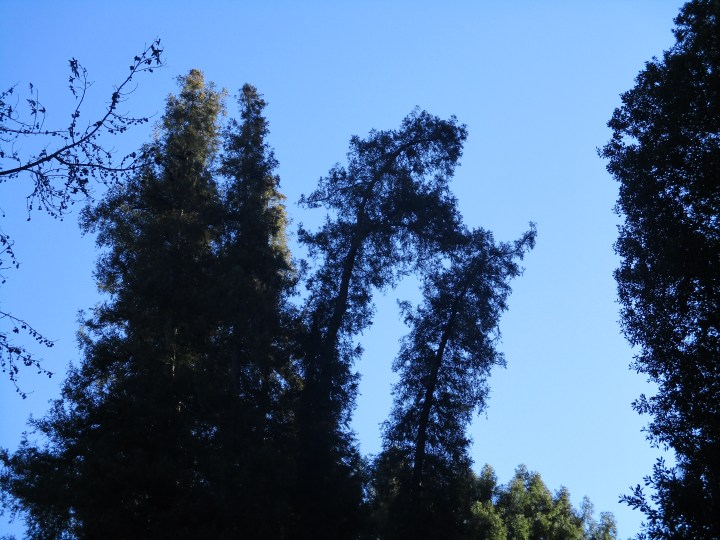 Coastal redwood, Sequoia sempervirens, are remarkable stable trees. They rarely fall, which is how they get to be thousands of years old. They prefer to live in groups, where they mesh their roots together, and shelter each other from wind. Those that live outside of a group stay shorter than forest trees, and typically develop multiple trunks that function as a group.
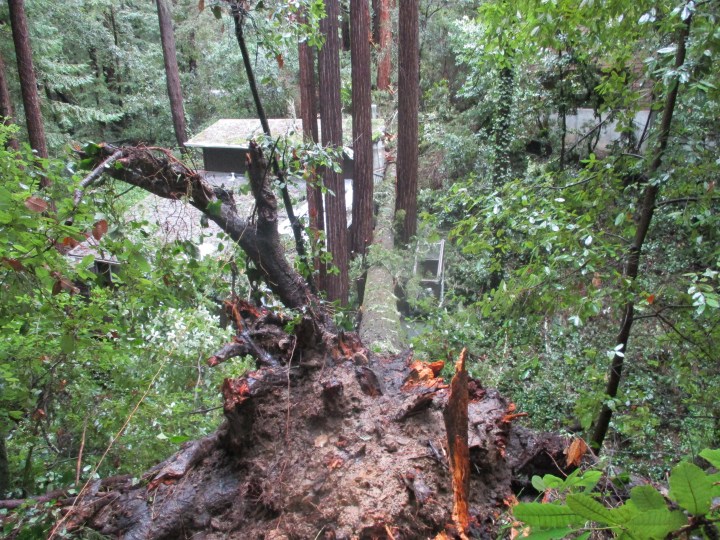 If there were lawns and fences in this neighborhood, the grass would likely seem to be greener on the other side of the fence. In this situation, the greenhouse probably seemed to be more comfortable than being left out in the storm. This tall Douglas fir tree dropped in to find out. It did not go well. What remains can be seen in the middle of the picture above, just to the right of the fallen fir, and in the close up of the picture below.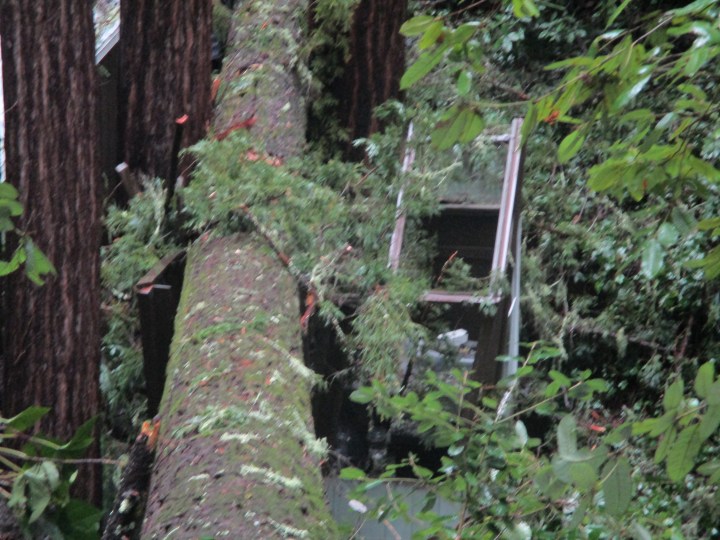

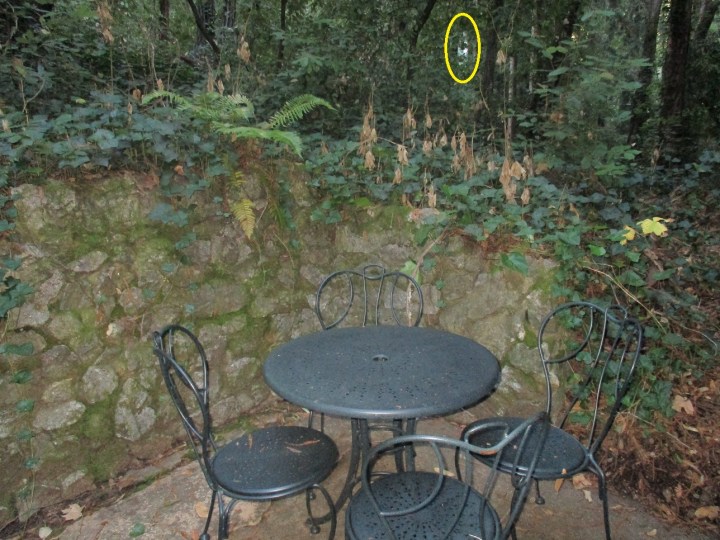
 Fire has always been a part of life in most of California. That is why almost all native flora benefits from it, and has developed an efficient system and schedule for not only living with it, but exploiting it.

 Tony Tomeo