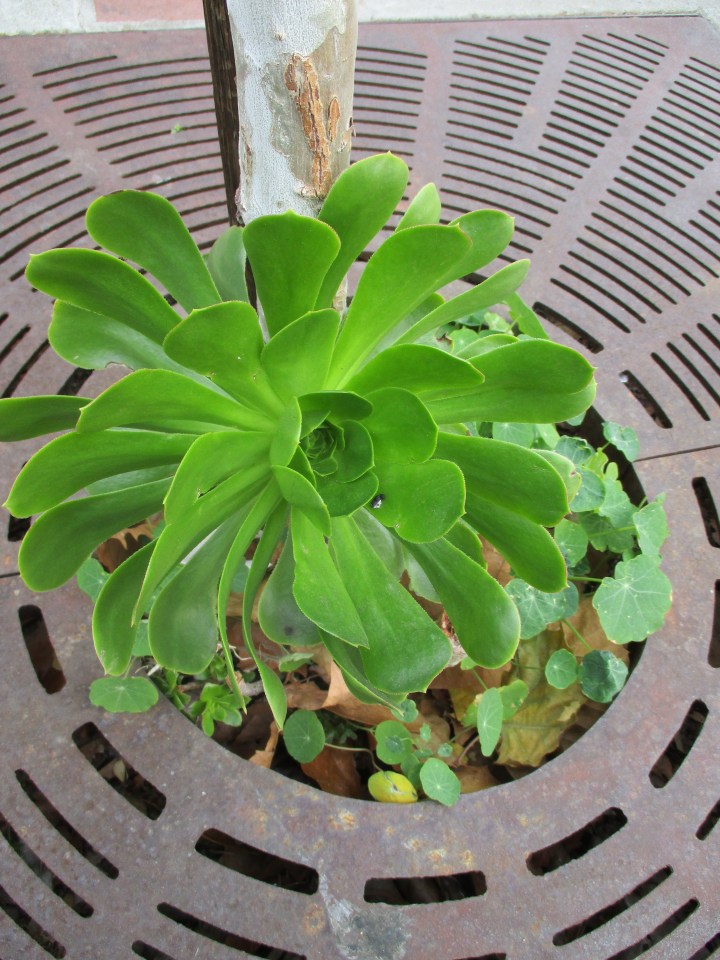
The once traditional Aeonium arboreum, with round, dense rosettes of slightly serrate, olive green leaves has become less popular than its more colorful varieties that have become more available over the years. ‘Atropurpureum’ has rich purplish brown foliage. ‘Zwartkop’ is even darker and stays more compact. Long and sometimes unkempt clusters of tiny yellow flowers that bloom in spring or summer are not much to look at against green foliage, but contrast nicely against dark foliage. Larger plants can get to three feet tall and wide, with foliar rosettes wider than six inches.
Like many succulents, Aeonium arboreum is so easy to propagate from cuttings, that small pieces that need to be pruned from established plants can be plugged into the garden wherever more of the same plants are desired. New cuttings like to be watered until they develop roots. Established plants are a bit happier with occasional watering, but can survive neglect just fine. After all, they are native to similar climates in the Mediterranean and northern Africa.
Bloom is probably the favorite component of home gardens. Foliage is likely the second favorite component. Japanese maples are popular as much for their form as for any other characteristic. The intricate textures and autumn color of their foliage is likely secondary. Coral bark Japanese maple, Acer palmatum ‘Sango Kaku’, is even a bit more distinctive.
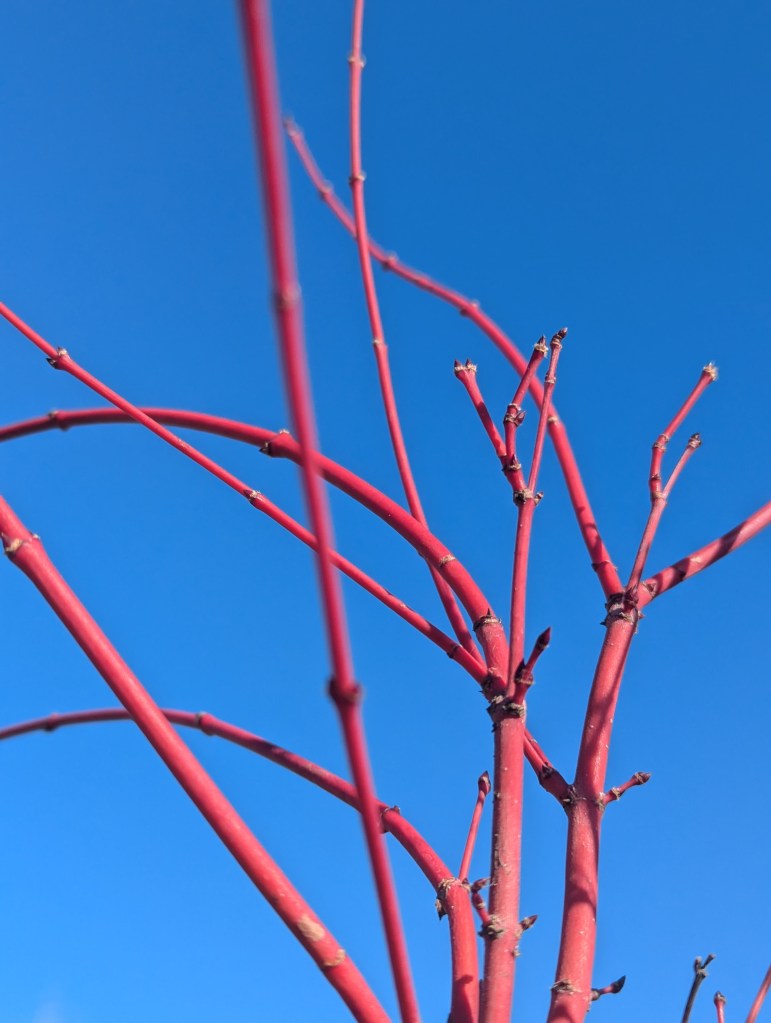
Relative to other cultivars of Japanese maples, its foliage is not remarkable. Actually, it is more vulnerable to foliar scorch with arid warmth. Its form is not overly remarkable either. For coral bark Japanese maple, the bright red bark of its young twigs is its primary allure. It is obscured by foliage for most of the year, to be revealed by defoliation through winter.
Coral bark Japanese maple is an understory tree, so can tolerate partial shade. With full sun exposure, it particularly dislikes arid wind. It can grow as tall as twenty feet, or might stay as short as ten feet. It naturally produces many long and limber stems with shiny red bark. Severe pruning to promote growth of such stems is likely to ruin its sculptural form.
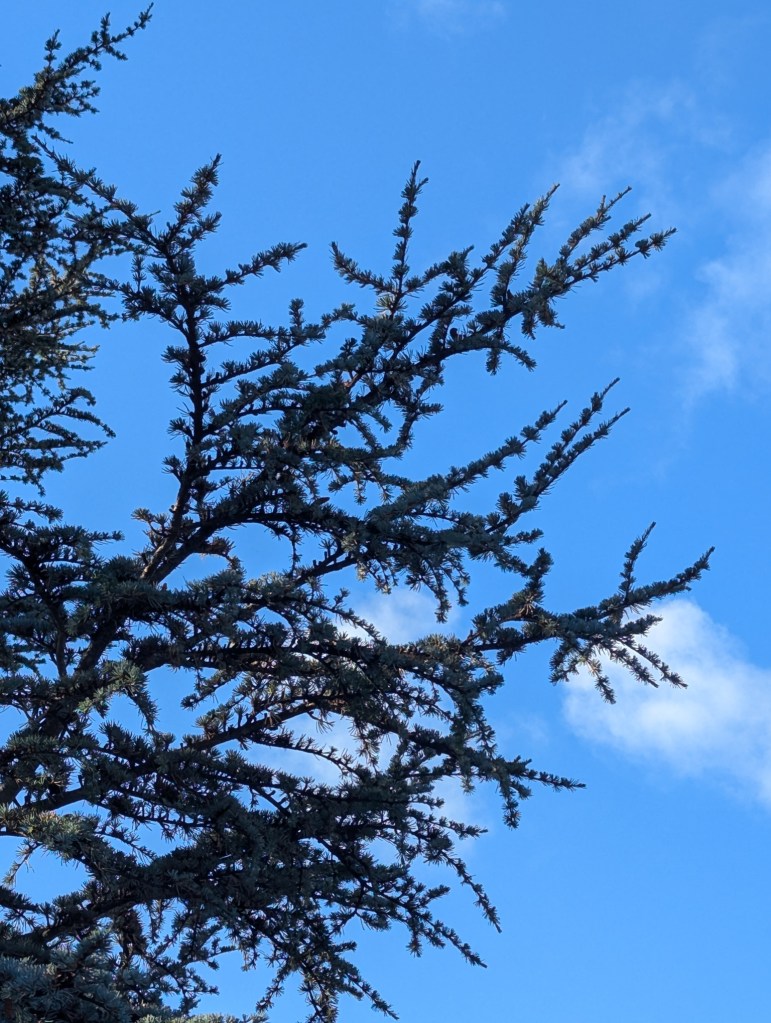
No other coniferous tree develops such distinctively irregular form. Very few exhibit such distinctively steely grayish blue foliar color. Blue Atlas cedar, Cedrus atlantica ‘Glauca’ is no simple shade tree. It is a striking trophy tree that is worthy of prominent display within grand landscapes. It is ideal for traffic circles, without other trees to obscure its boldness.
Blue Atlas cedar is also sufficiently resilient for traffic circles and other difficult situations. Arid warmth, even if enhanced by pavement, roofs or walls, should be no problem. Once established, blue Atlas cedar does not crave much irrigation. It should be able to survive with none. Excessively frequent or copious irrigation is more likely to become a problem.
Blue Atlas cedar can grow a hundred feet tall in the wild within its native range. It should not grow much more than half as tall with good exposure within landscapes. Trunks may slowly grow to almost six feet wide. Canopies can eventually grow wider than thirty feet. ‘Glauca Pendula’ is weeping blue Atlas cedar, which is smaller but even more exquisite. ‘Aurea’ with gold tips, is very rare.
Eucalyptus citriodora, lemon gum, is one of several species that I miss from the more southern portion of the Central Coast and Southern California. San Luis Obispo, where Brent and I studied horticulture at Cal Poly, and where I learned to appreciate this particular species, is technically within the same climate zone as Los Gatos. Nonetheless, many species that are popular in Southern California are more popular there than here, perhaps because of the proximity to Southern California. I got this picture on the inland edge of Highway 101 in Carpinteria on the return trip from Los Angeles. It demonstrates how sculptural the elegantly slender, smooth and pallid trunks and limbs of lemon gum are. The airy foliage is delightfully aromatic, but is too high to reach among trees that are sufficiently mature to be so sculptural. A few other eucalypti are similarly but distinctly sculptural. Some develop heftier trunks and limbs. Some develop blotched or uniformly coarse bark. Also, several other genera, such as coast live oak, camphor and ‘Marina’ madrone, develop sculptural form. Such form should be more of a consideration for modern landscape design, as it was until about the late 1970s, when trees like European white birch and the last of the complaisant eucalypti slowly became passe. It is actually gratifying to notice that a few daring horticulturists are experimenting with some of the smaller species of eucalypti that could have become popular years ago, as well as a few that had not yet been introduced. Where lemon gum might eventually grow too large, smaller species, such as Eucalyptus caesia, gungurru, might be more proportionate. Of the more than seven hundred species of Eucalyptus available, more than a few must be appropriate to refined home gardens, and more than a few of such are likely sculptural.
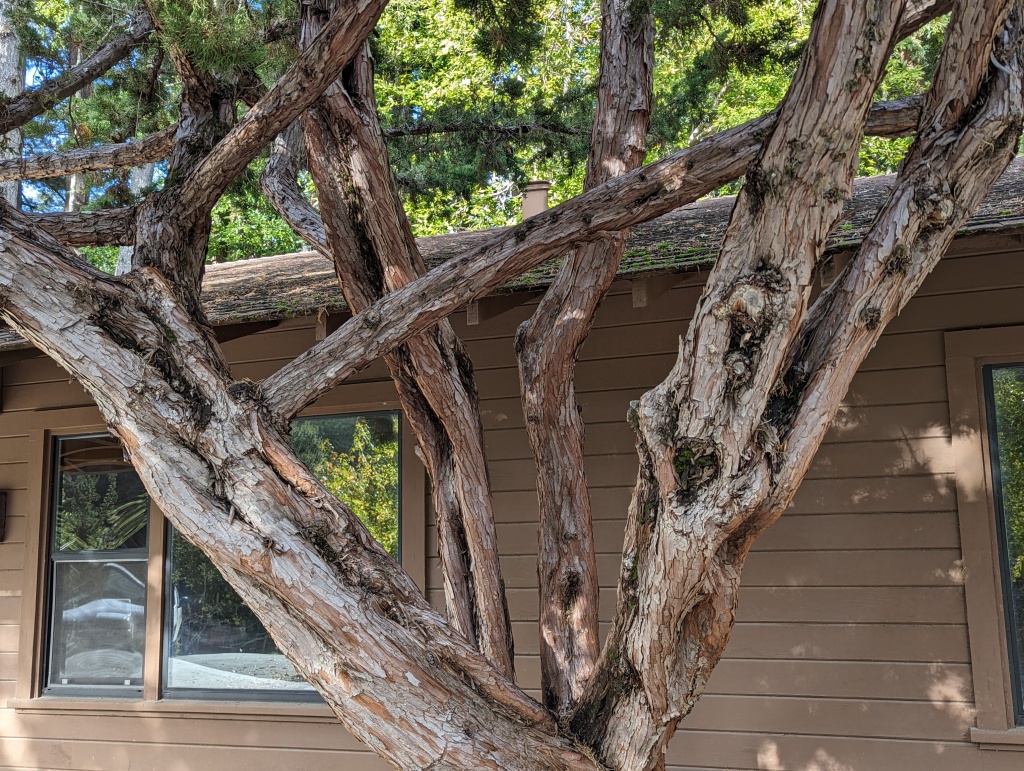
This is an exemplary specimen of Juniperus chinensis ‘Kaizuka’, Hollywood juniper
Juniperus chinensis ‘Kaizuka’, Hollywood juniper is one of my favorite junipers. The few North American junipers that I prefer more are not as appealing for prominent positions within refined landscapes. Hollywood juniper is distinctly sculptural with its strikingly gnarly form. The dense, finely textured and deep green foliage contrasts stylishly with the more coarsely textured and rusty reddish brown bark. Whether a large shrub or a small tree, properly groomed Hollywood juniper can be an elegant trophy tree.
The illustration above is from my ‘Six on Saturday’ post from two weeks ago. It shows one of the largest specimens of Hollywood juniper that I have ever worked with. Initially, I pruned it for clearance from the roof and parking spaces that it extends its canopy over. I also thinned it somewhat. I intended to elevate and thin it a bit more this year or next.
Instead, it became firewood. Sadly, it grew too big and obtrusive for its situation. One of its large roots was displacing the asphalt pavement of the parking spaces in front of it. Another was beginning to do the same. It was very saddening to see it dismembered and processed, as the foliar canopy was discarded to compost into the forest, and the trunk and limbs were taken to a woodpile.
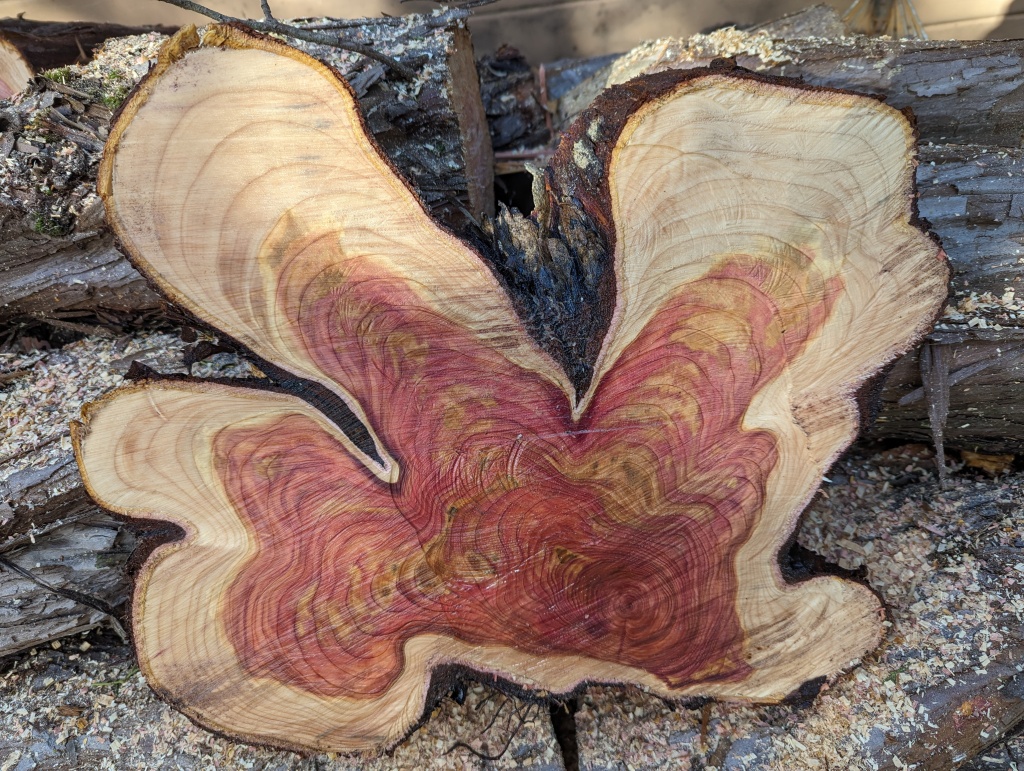
Even as firewood, it retained unique beauty. The illustration below shows the contrast of the red heartwood and blond younger wood within the interior of the gnarly trunk. If it resembles the interior of a cedar chest, it is because it is related to the Juniperus virginiana, Eastern redcedar, which is the cedar within cedar chests (but is not actually a real cedar). Although not visible within the illustration, the woodsy aroma of the exposed wood is very similar to that of a cedar chest.
It is no wonder that the many specie of horsetail have been around since the Carboniferous Age. They seem to be impossible to kill! Because they can be so invasive and persistent, they should be confined to planters or areas of the garden where they can be controlled. They should probably be kept away from thickly foliated areas where they can spread and mix with other plants unnoticed.
Even though they are among the oldest plant specie, they seem well suited to modern architecture. Besides, the narrow areas between modern residences, walkways and driveways are confining by nature. Many modern buildings are even outfitted with awkwardly narrow planter areas that could use plants that get three or four feet tall without spreading out laterally, just as Equisetum hyemale, the most common species of horsetail does. The partial shade and potentially bad drainage in these confined spaces is not a problem.
The hollow segmented stems are rich green with black or dark brown joints. Some specie of horsetail have symmetrical whorls of wiry stems radiating from their joints. Otherwise, no other foliage is evident. Small knobs on top of the stems produce rusty brown spores. The larger types of horsetail are more likely to become invasive. Equisetum scirpoides stays about half a foot tall and is relatively complaisant. I do not know the identity of the horsetail that I got this picture of; but it has unusually large spore ‘blooms’ and a more relaxed texture.
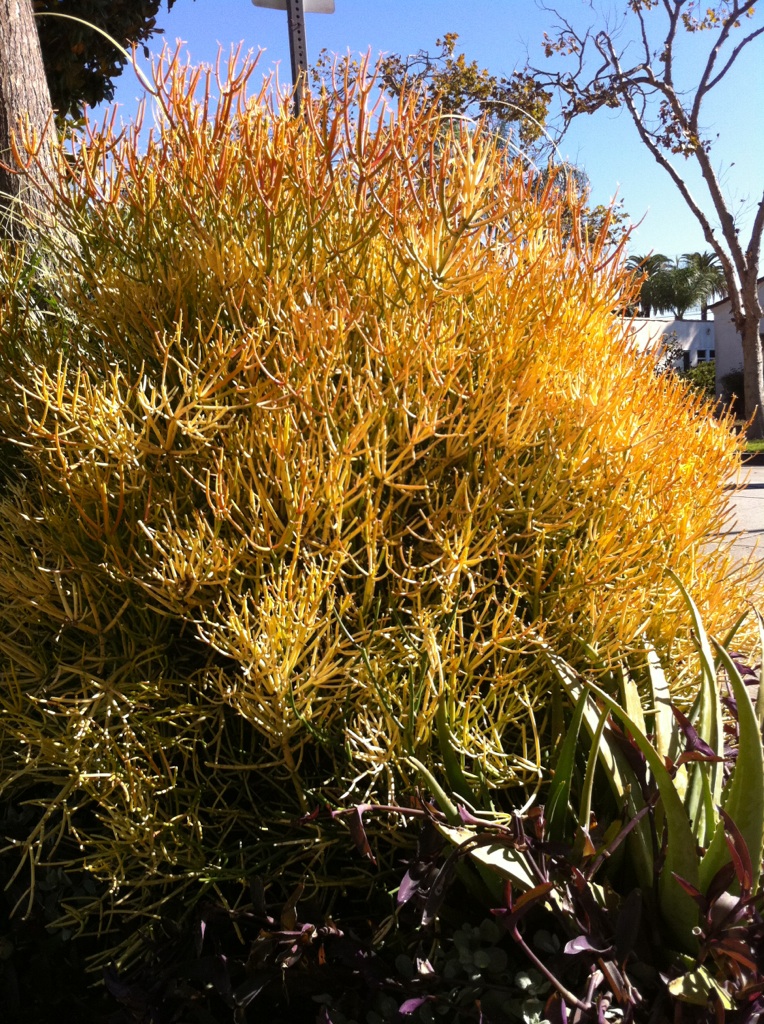
Sticks on fire is a more colorful version of pencil tree.
The old fashioned pencil tree, with leafless, succulent stems is a strikingly strange plant already. In mild climates of coastal Southern California, it can get quite large, nearly ten feet broad and twice as high. Sticks on Fire, Euphorbia tirucalli ‘Sticks on Fire’, stays less than half as large, but is even weirder because the stems are so oddly colored.
The inconspicuous leaves drop almost as soon as they develop, leaving distended fleshy stems that are either reddish or yellowish orange. Stems fade to softer yellow through summer, and then turn red in winter. Size and growth rate are limited by a lack of chlorophyll. Although related to poinsettia, the flowers of sticks on fire are not significant.
Sticks on fire prefers full sun exposure and warmth, but unfortunately needs protection from frost during winter. It can be happy under an eave on a south or west facing wall, or in a large tub that can be moved to shelter during winter. Plants in tubs are a bit more sensitive to rot if watered too frequently. The sap of sticks on fire is very caustic to skin and can be dangerous if it gets in the eyes.
Home gardens are components of the homes that they serve. They are the exterior of the interior. They are the environments in which homes exist. Some provide vegetables and fruits. Many provide flowers. Ideally, gardens enhance domestic experiences. Therefore, their design is as relevant as architecture. Accordingly, horticultural form follows function.
Gardens can be single open spaces or, like their associated homes, a few spaces. They benefit from features that function like those that define interior spaces. Lawns are floors. Trees are ceilings. Hedges and shrubbery are walls. Patios, decks and fences are static features. Vegetation, though, requires more discriminating selection for appropriate form.
Lawns seem to be the simplest of such functional vegetation to select. Form is not overly variable. Nevertheless, turf grass must be appropriate to its particular exposure. Some is more tolerant of partial shade than others. Some requires less water than others. Ground cover vegetation is more appropriate for many situations. Artificial turf might be an option.
Trees and shrubbery are much more diverse. Although they are the largest vegetation of a garden, some are quite small. They are evergreen or deciduous, and both have distinct advantages. While palms lack branches, other trees and shrubs develop sculptural form. Consequences for inappropriate selection of such significant vegetation can be serious.
Furthermore, different varieties of the same species can behave very differently. Junipers are practical shrubbery for some situations. However, some are prostrate ground covers. A few grow as small trees. Also, while some rosemaries are shrubbery, some are trailing. Selection of an inappropriate cultivar of an appropriate species is a rather common error.
A few species change form as they mature. With confinement, the trailing juvenile form of English ivy is a practical ground cover. However, as it encounters support, it becomes its vining adult form. This clinging growth ruins paint, and overwhelms trees and shrubbery. Star jasmine evolves from ground cover to twining vines even without changing its form.
This big perennial ‘sticks of fire’ produces a thicket of bright yellowish orange stems that changes shades through the seasons.
Everyone knows that flowers provide color in the garden, particularly through spring and summer. As blooms become less abundant in autumn, fall color of deciduous plants and trees becomes more prominent. After most plants are finished blooming, and most of the fall color is gone, the garden may seem relatively bleak for winter. Only evergreen foliage remains. This is when plants that exhibit colorful bark or bare twigs really get noticed.
Various types of birch trees exhibit striking white bark all year. While the trees are bare in winter, the bark becomes even more prominent, particularly against a backdrop of evergreen trees. English walnut trees are not as striking, but are more sculptural. Fig trees (fruiting types) are more gray than white, so are more reliant on a backdrop of rich evergreen foliage or a darkly painted wall for contrast; but they grow fast enough to become interesting sculptural specimens within a few years.
Bright white or light gray bark are certainly no substitute for the colors of flowers or foliage, but are striking nonetheless. They exploit the starkness of winter, and the sculptural nature of bare trunks and limbs.
Even without the sculptural structure of birch, walnut or fig trees, the more colorful twiggy growth of coral bark Japanese maple and osier dogwood trees can be quite an advantage in a stark winter landscape. As the name implies, coral bark Japanese maple has pinkish orange twigs. Osier dogwood can be ruddy brown, brownish orange or pale yellow. Frost improves color.
Unlike other Japanese maples that get pruned only lightly to enhance their form, coral bark Japanese maple can get pruned rather harshly just prior to spring growth in order to promote an abundance of the twiggy growth that is so colorful in winter. Osier dogwoods can get pruned down almost to the ground at the end of winter to eliminate tired older stems and promote colorful new stems for the following winter. They lack the colorful bloom that flowering dogwoods provide; so it is no bother that such harsh pruning prevents them from blooming.
Like trees with white or gray stems, coral bark Japanese maples and osier dogwoods are more striking against a backdrop of rich green foliage. Because winters are so mild here, they should be located where they will be most exposed to chill.
Flowers provide color and texture. So does foliage. What is less often considered is that the bark of many trees and large shrubbery can be aesthetically appealing as well. Bark is usually thought of merely as something to cover up the trunks and limbs of the plants that provide all the colorful and textural flowers and foliage.
Coral bark Japanese maple and red twig dogwood (and yellow cultivars, which are selectively bred varieties) turn color as they defoliate for winter. However, the color is limited to the twigs and smaller stems. Red twig dogwood often gets cut back at the end of winter so that it will produce more twigs for the following winter. Mature stems and trunks are not as interesting.
Palms and yuccas do not actually have bark, but are still texturally interesting. Giant yucca trunks are weirdly sculptural. Mexican fan palm can be ‘shaven’ to expose lean trunks with a finely textured exterior, but are more often adorned with the intricately patterned thatch of old petiole bases (leaf stalks). Windmill palm is uniquely shaggy with coarse fiber.
Arbutus ‘Marina’ is a madrone that was developed for home gardens. It is compact and symmetrical, with finely textured flaking bark that reveals strikingly smooth cinnamon-colored bark beneath. Larger manzanitas can be pruned up to expose similar bark on a smaller scale. Smooth Arizona cypress looks much like other cypresses, but with strangely smooth bark on vigorous stems.
The bark of almost all eucalypti is interesting for one reason or another. Even the notorious blue gum, which gives other eucalypti a bad reputation, peels away in very long strips to reveal smooth bark that fades from green to pink to tan to gray before peeling away to start the process over again. Some eucalypti have blotched bark. Red ironbark has rich brown bark that is uniformly furrowed.
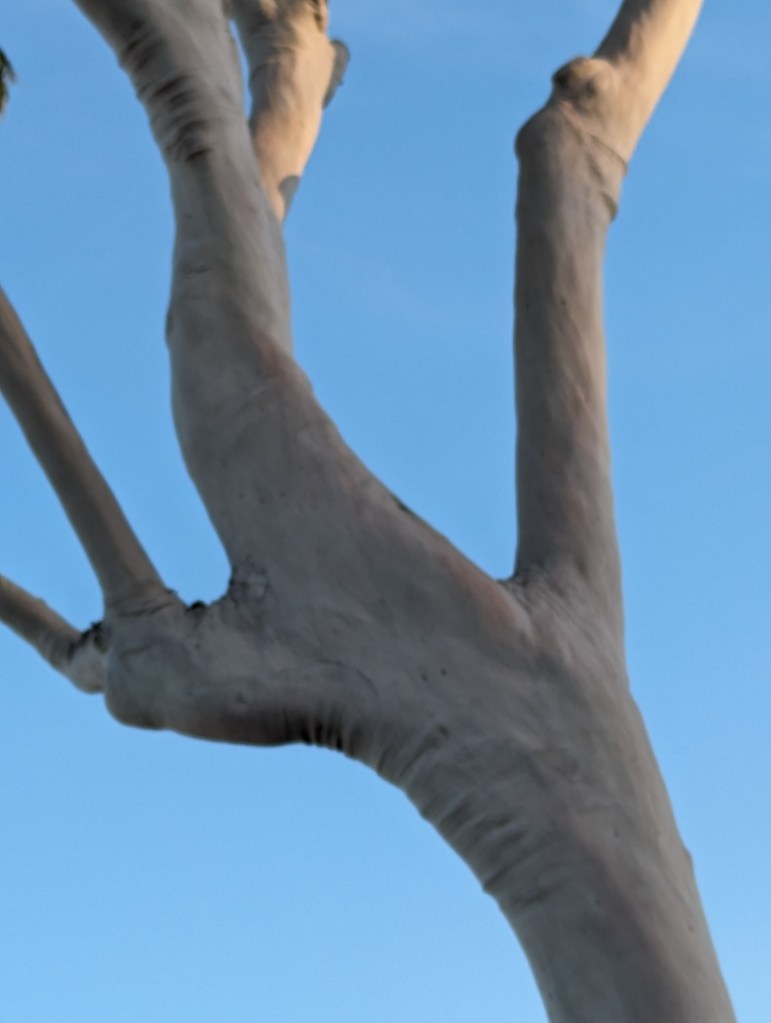
Lemon gum (eucalyptus) and various birches have strikingly white bark. Lemon gum bark is smooth. Birch bark peels away like paper. Because the trees are so slender, they can be planted in groups so that there are more trunks to display the distinctive bark. These are only a few of the many trees that can impress with mere bark.



 Tony Tomeo