Victorian Box

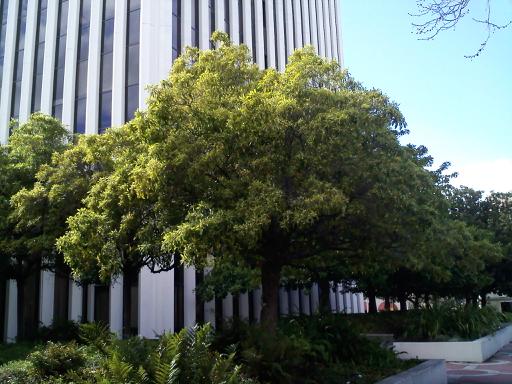
Victorian box does not get too big.

In the right situation, Victorian box, Pittosporum undulatum, is a nice small to mid-sized shade tree with dense foliage, sculptural branch structure and pleasantly fragrant spring bloom. In the wrong situation, it drops enough leaves, flowers and sticky seeds and bits of seed capsules to make quite a mess. This finely textured and sometimes sticky debris is easily absorbed into thick, shade tolerant ground cover like Algerian ivy, but is difficult to rake from pavement and to clean from roof gutters. Besides, even though Victorian box is not a large tree, the roots can eventually become aggressive enough to displace pavement.  

Young trees grow rather vigorously to about ten feet tall and wide, and then slow down somewhat as they continue to grow to as much as three times as tall and wide. They are easily contained with occasional selective pruning. The small, clustered flowers are not as impressive as their fragrance, adding only a bit of pale yellowish white color over the exterior of the rounded canopy. Some people, as well as birds, like the greenish olive-sized fruit that turns orange and eventually splits open to reveal sticky orange seeds within. (‘Pittosporum’ translates into ‘sticky seed’.) Leaves are about two or three inches long, or longer, with ‘undulating’ margins.  

Fragrant Flowers Have Ulterior Motives

00311
Demure daphne bloom is richly fragrant.

Many who enjoy gardening appreciate fragrant flowers. Many grow particular flowers specifically for their fragrance. Yet, not many consider why so many flowers are fragrant. Plants can not enjoy their own alluring floral fragrances any more than they can enjoy their own delightful floral colors and forms. They do not expect people to enjoy their bloom either. Human appreciation is incidental.

Floral fragrance is merely intended to attract pollinators. Flowers are inanimate, so rely on either wind or animate pollinators to exchange their pollen among other flowers. Animate pollinators are mostly insects, but may be birds, bats or other animals. Flowers do what they must to attract their preferred pollinators. Many use color and floral form. Many use fragrance. Some use both tactics.

Flowers that use both color and fragrance to attract pollinators are mostly endemic to densely forested ecosystems. There is more competition for pollinators within such ecosystems than there is within ecosystems of sparser vegetation. Otherwise, fragrant flowers are generally not as colorful as those that are not as fragrant. Likewise, the most colorful flowers are generally not so fragrant.

Angel’s trumpet is striking in bloom because the flowers are so large. Wisteria and lilac that bloomed last spring were spectacular because they were so profuse. The pastel hues of their blooms are no problem that their fragrance does not compensate for. Pink jasmine and mock orange are about as fragrant, even if their color range is more limited. Star jasmine is not always so profuse.

Pittosporum tobira and Pittosporum undulatum are even less visually impressive in bloom, but can be surprisingly fragrant. The tiny but richly fragrant flowers of sweet osmanthus, sweet box and night blooming jasmine are so obscure that other bloom is often credited with their fragrance. As the name implies, night blooming jasmine is powerfully fragrant after sunset during warm weather.

Freesia, hyacinth, narcissus, lily and some bearded iris are both colorful and very fragrant.