Frost Protection

For many species, frost damage is not as bad as it looks.

            My colleague in the Los Angeles area still sends me seeds for all sorts of strange plants that I probably should not be growing in my less climactically temperate garden, making it difficult to conform to the primary rule of frost protection: ‘Select plants that are appropriate to the particular climate.’ No matter how often I remind my clients of this rule, I really do not want to abide by it. There are just too many interesting but inappropriate plants.

            So the next option is to grow frost sensitive plants in containers that can be moved to sheltered areas prior to frost. That worked while I had an extra parking space in the carport and some room under the porch for giant bird-of-Paradise, plumeria, philodendrons and such. Eventually though, some of these plants get too large to be contained; and I really do not want to keep pruning them back. Besides, I prefer to grow things in the ground.

            The third option is to put sensitive plants in spots that are naturally warmer, or where they are sheltered below the canopies of large evergreen trees, lath or wide eaves. Just remember that plants under eaves are also sheltered from rain, so may need to be watered occasionally through winter. Steep slopes are not quite as cold because cold air drains off. However, flat areas below slopes get colder as they catch cold air that drains from uphill. South facing exposures are of course warmer than northern exposures.

            I know probably better than most that there are always some plants that are not ‘appropriate to the particular climate’, that I do not want to grow in pots, and that prefer to be out in exposed parts of the garden. For example, bougainvilleas are somewhat tender, have sensitive roots that do not like to be confined, and really want to be out in the open to take advantage of warming sunshine during summer. Such plants in colder areas will either need to be protected, or will get damaged by frost.

            Burlap suspended above the foliage by stakes is typically enough to protect sensitive plants from frost. I have used old towels and linens where my neighbors can not see. Plastic sheeting is also effective, but should be removed before sunlight warms the air too much underneath. Paper grocery bags or cardboard boxes are enough for small plants.

            I actually allow some of my larger plants that would be difficult to cover to get damaged by frost, and then prune out the damage later. If they are too big to cover easily, they are probably big enough to survive frost. Damaged stems should be left until the end of winter both to insulate stems below, and also because early pruning stimulates new growth that is even more sensitive to frost. 
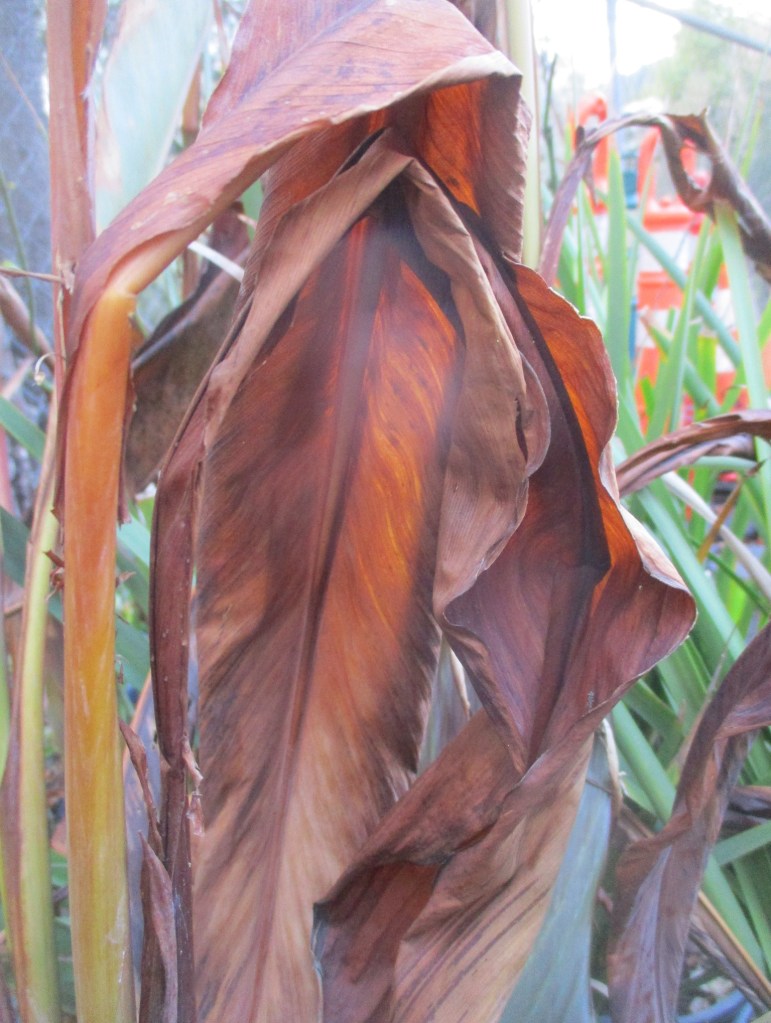
Frost Is Not An Enemy

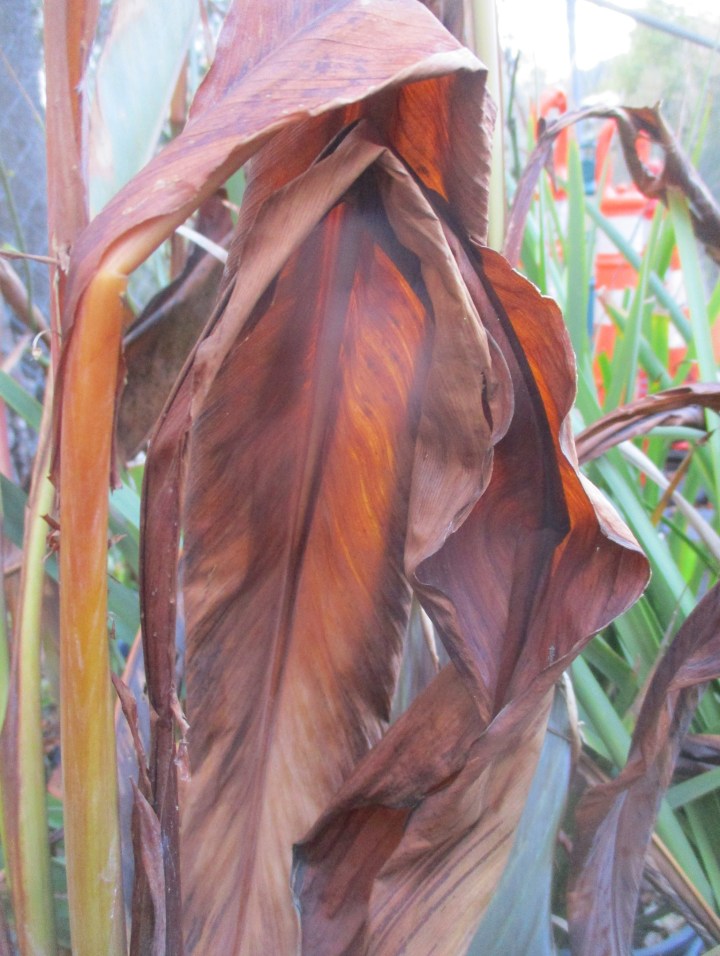
Among canna, frost damage is harmless.

Rain was one clue. Cooler weather is another. It is now so late into autumn that it will be winter soon. Every regional climate experiences some degree of chill. Some, particularly to the north, experience frost. This limits gardening in two ways. Several species prefer a bit less cool weather. Several prefer a bit more. Every species prefers a particular range.

Apple trees, for example, require vernalization, which is a specific duration of chill. Some cultivars require more than others. Without it, they can not distinguish seasons, so do not know when to bloom for spring. Consequently, few cultivars of apple perform adequately within Los Angeles. However, many perform very well in the cooler climates of San Jose.

Banana trees, conversely, need no chill, and are instead set back by frost. Some tolerate a bit more chill than others; but ultimately, they are all tropical species. They produce fruit only within the months between frosts. Consequently, not many banana trees are notably productive within San Jose. However, they perform better in the climates of Los Angeles.

Banana trees stop growing when the weather is cooler than fifty degrees or so. That is a bit too much chill for them. However, frost does not occur until the weather is cooler than thirty-two degrees. Banana foliage can therefore be safely dormant during chilly weather. That is a range of twenty-two degrees. Different tropical species survive different ranges.

The simplest form of frost protection is to not cultivate species that are vulnerable to frost. This is, of course, a bit too restrictive for many who enjoy gardening. Instead, some grow vulnerable species in pots to move to shelter prior to frost. Some simply grow vulnerable species below the shelter of eaves or big trees. Tenting may also be effective protection.

Alternatively, some species can endure frost damage to recover during warmer weather. If possible, outer foliage that succumbs to frost should remain through winter. It insulates inner growth from subsequent damage. Besides, premature grooming can stimulate new growth that is more vulnerable. Many perennials prefer cutting back after winter anyway.

Nurseries Sell Some Marginal Species.

Heliotrope is available from nurseries in climates that get too frosty for it.

            Limiting selection of plants to those that are appropriate to the local climate is not as easy as it seems. Even in mild climates, plants that should be grown in even milder climates are just too tempting, and have sneaky ways of getting from nurseries into the garden. Consequently, when the weather gets cold, at least a few plants get damaged by frost.

            Geraniums, angel’s trumpet, daisies and many other perennials that are so reliable throughout the rest of the year were likely damaged when the weather recently got harshly cold so suddenly after being so mild. Sensitive plants that got some protection prior to the frost may have avoided damage this time, but will likely need protection again before the end of winter. The only sensitive plants that are reasonably safe are those that are located in sheltered spots or in pots that got moved to shelter.

            Now that the damage has been done, it is important to not rush corrective procedures. Even though frost damaged foliage is unsightly as it deteriorates, it insulates undamaged tissue below. Early removal of the damaged foliage exposes interior stems to frost later in the season. On rare occasion, exposed stems of some plants can be damaged by desiccating cold wind or sun scald. (Sun scald typically happens during summer, while sunlight is most intense.)        

            Early pruning of frost damage can also stimulate premature development of new growth, which is much more sensitive to later frost. Most moderately sensitive plants have no problem recovering from minor frost damage once annually. However, recovery is so stressful and takes so much effort that secondary frost damage to new growth can be much more damaging and even fatal to some plants.

            It is best to delay removal of frost damage until late winter when subsequent frost is unlikely. Large plants that are too unsightly to wait that long should be pruned as minimally as possible, and then pruned as necessary later. Minor distal damage known as ‘tip burn’ of avocado and lemon trees may not need to be pruned out at all if it first gets obscured by new growth that develops after winter.

            This may seem contrary to the importance of pruning most other plants while they are dormant during winter. The difference is that, unlike most plants that stay dormant while the weather is cold, plants that get damaged by frost are not so well adapted to cold winter weather, so do not know that they need to stay dormant until the weather is safe for new growth.      

            Burlap, plastic sheeting or any other coverings used to protect sensitive plants from frost should be removed when it is not needed. These protective coverings hold warmth within, which can stimulate premature development of sensitive new growth. Opaque materials shade the plants below and can eventually cause etiolation (stretching of the stems), which likewise makes plants even more susceptible to frost damage.

Frosty Weather Can Limit Gardening

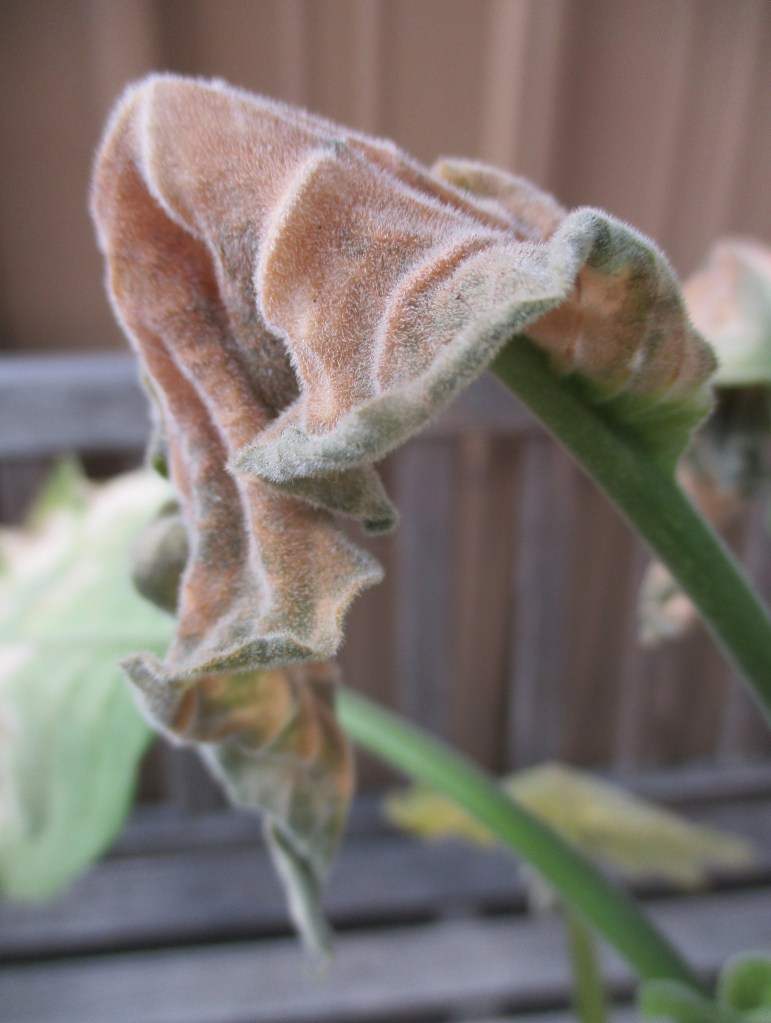
Foliar frost damage can be unsightly.

Even here, climate is not perfect. It may sometimes seem to be too warm during summer. However, it might not be consistently warm and humid enough for some tropical species. Winter chill may be inadequate to vernalize some species or certain cultivars of species. However, recently frosty weather has already damaged some vegetation in some areas.

Frost limits what performs well in home gardens in two extremes. Some species prefer a bit more than they experience here. Others prefer less. For example, peony prefers more, while vanilla orchid prefers none. Peony is only marginal where weather is exceptionally frosty by local standards. Vanilla orchid can be offended by minor chill even without frost.

Climates and microclimates limit frost just as frost limits what performs in home gardens. Some coastal climates here only very rarely or perhaps never experience frosty weather. Other climates farther inland or at higher elevations experience frost almost every winter. Within such climates, eaves or canopies of big trees can provide shelter from minor frost.

Vegetation within home gardens should be appropriate to its particular climate. Varieties that are vulnerable to frosty weather are likely safe where frost never occurs. Conversely, they will obviously be susceptible to damage where frost does occur. The best means to avoid such damage is appropriate selection. Climate will not accommodate bad choices.

Gardening could be slightly less interesting without a few bad choices, though. Besides, some of such choices are justifiable with the right perspective. Canna, for example, dies back harmlessly to dormant rhizomes after frosty weather. It wastes no time regenerating as weather warms. Some tropical species may grow in pots to move to shelter from frost.

Tenting can shelter some specimens that are too big to move, or are in the ground. Outer foliage that already succumbed to frosty weather can shelter inner growth. Therefore, if it is not too unsightly, it should remain through winter. Besides, premature pruning is likely to stimulate new growth. Such growth would innately be vulnerable to subsequent frosts.

Donation

Heather thinks that she just found a new house with a view.

Donations can be annoying. At the farm, neighbors sometimes left random pots and cans from their home gardening at the gate on the road. Sometimes, they left other bits of gardening supplies, such as short pieces of PVC pipe, a pound or so of lawn fertilizer, or perhaps a broken rake. Only very few of the standardized cans could be added to the huge pile of recycled black vinyl cans that the horticultural commodities were grown in. The majority of what was left was merely more junk that we then needed to dispose of. If I found such items while driving a sedan, I needed to move them out of the way of the gate and return with a pickup to retrieve them. The gate is directly in front of the very well kept home of a nextdoor neighbor, which made such piles of junk even more inappropriate. The same happens here. Neighbors leave all sorts of useless random gardening paraphernalia and deteriorating houseplants. Because we do not grow acres of horticultural commodities in thousands of cans, the few random cans that I get here can actually be useful. Some of the houseplants recover in the nursery, and get recycled into landscapes or shared with neighbors. Perhaps such donations are not so annoying. I did happen to find this small home garden ‘greenhouse’ contraption to be quite annoying though. It was left in my parking space as if it were important. I would never actually purchase such an item. I am accustomed to working in real greenhouses. This thing is for those who enjoy gardening in small urban gardens, not professionals. I wanted to find who left it so that I could return it. Then, it occurred to me that the small banana plugs might appreciate it this winter. Oops.

Sweet Spot

Saccharum officinarum ‘Pele’s Smoke’ sugarcane

‘Pele’s Smoke’ sugarcane has grown enough for installation into the landscapes. I am not certain how happy they will be here through winter, but we will find out. Frost is mild here, but is supposedly enough to kill them to the ground. I expect that. Even if they do not die to the ground, I would prefer to cut them down by the end of winter regardless. Survival of their basal growth is more of a concern. I want them to regenerate next spring. It is difficult to imagine a species as vigorous as this being so vulnerable to the locally mild frost, but all the information that I find about it insists that it is marginal here. There are so many canned specimens that it would be no problem to shelter some through winter to replace any that do not survive in the landscapes. Later, if they get depleted, it would be no problem to take cuttings from those in the landscapes in autumn, and shelter them through winter to put back into the landscapes in spring. However, that is just too much unnatural intervention for me. If they are not happy here, they I do not want to force them. I enjoyed growing them while I did. I got the cuttings from grooming a specimen in Brent’s garden. I was not very careful with them, and did not process them very efficiently because I knew that I would get more than I could accommodate. Ultimately, after sharing a few with friends and neighbors who are aware of the risks, thirty new specimens remain here. Fifteen are in #1 can, including the first three that were just installed into the landscapes. Another fifteen are in four inch pots, which is annoying one less than a full flat of sixteen.

Going Bananas!

‘Double Mahoi’ is not even a fraction of a single yet, but can grow fast.

This is not banana territory. The soil is good, and water is readily available; but the climate is a limiting factor. The weather does not get very warm for very long. When it rarely gets almost unpleasantly warm during the day, it generally gets tolerably cooler overnight. Bananas are none too keen on such comfortable weather. They want sustained warmth, with less fluctuation of temperature between night and day.

This is precisely why I should not have acquired as many as fourteen cultivars of banana. Some may never do more than generate appealingly lush foliage here. Those that produce fruit will unlikely produce fruit that is much more than marginally palatable. One of the cultivars is the oem, which is the largest banana ‘tree’ in the World. I have NO idea of how to manage it. ‘Mekong Giant’ also grows quite large and heavy. Two cultivars are unidentified, so could possibly be copies of others. ‘Kokopo Patupi’ may not have survived last winter, as it has not begun to regenerate yet. Four other cultivars were given away, but then generated pups that are now returning! I do not remember how many cultivars are here now, but I know that there are too many.

Oem is resuming growth faster than the others, but with small leaves from within pseudostems that produced larger leaves last year. ‘Double Mahoi’ is likewise regenerating dinky and pale leaves that are actually dinkier than those that emerged earlier from a shriveled carcass of a dinky pup that got frosted last winter.

I want all of the cultivars of banana to survive and thrive, but I should have planned for them better. Now, I should plan to find homes for most of them instead. Even if I could manage them all, I can not justify doing so.

Oem is the biggest banana ‘tree’ in the World!

Ginger Ail

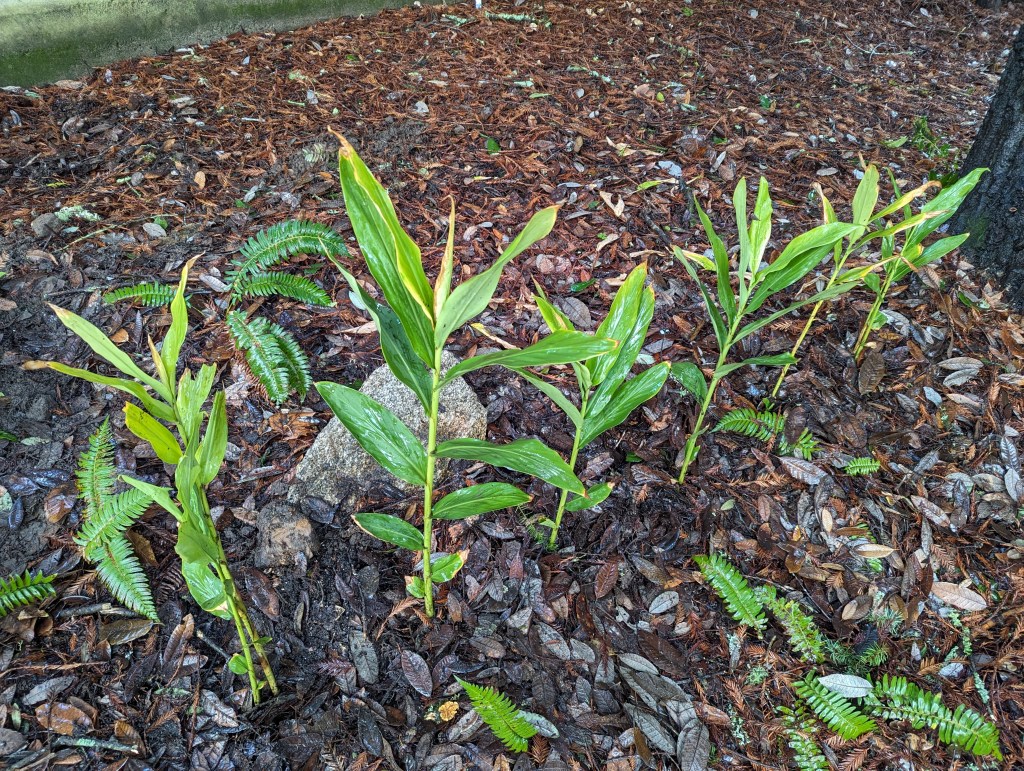
White butterfly ginger is still green.

At least seven gingers live here. Five are ornamental. Two are culinary. None have yet died back as they should for winter.

Now that it is time to divide them, I do not know what to do with their intact foliage. For this white butterfly ginger from Forest Garden, I divided the rhizomes and installed them into the landscape with their healthy foliage still attached. I do not want to cut it back until it succumbs to frost. I suppose that it can remain as long as it is healthy. It is likely promoting healthier secondary growth. Because none of the gingers are crowded yet, it should not be difficult to selectively groom out older growth as new growth develops. I doubt that older foliage absolutely must be pruned away during winter. If it were that important, the rhizomes would shed it naturally, with or without frost.

This is a mild climate, with very mild frost; but gingers should still die back for winter regardless. Cannas certainly do, even without significant frost. Even some of the banana trees were somewhat unhappy about the chill.

Actually, the banana trees seem to be bothered more by chill than the gingers. Is this normal? Angel’s trumpet, cup of gold vine and blue ginger (which is not related to ginger) also expressed more displeasure than the gingers.

I really should have sheltered some of these species better. Actually, I probably should not be growing so many species that are so sensitive to chill and frost. I will be going to Southern California again in about April, so could bring back even more tropical species. It is a bad habit.

Technically, the average last frost date is about a month and a half from now. Technically, a bit of frost is possible even after that.

Summer Bulbs Begin In Winter

Summer bulbs bloom after spring bulbs.

Spring bulbs begin to go into the garden during autumn to benefit from the chill of winter. Summer bulbs begin to go into the garden during late winter to avoid the chill of winter. Spring bulbs know to remain dormant through winter. Some summer bulbs do not. If they grow prematurely, they can be vulnerable to cool wintry weather. Late is better than early.

Frost is still possible within some climates. However, summer bulbs are now in season. That is because, like spring bulbs, they disperse roots prior to developing foliage. By the time they extend foliage in a month or so, the weather will not be so cool. Later phases of a few sorts bloom later to prolong bloom for the first season. They synchronize afterward.

That is because they establish themselves within the garden. Once they do, some types of summer bulbs become hardy perennials. Some might try to grow prematurely during subsequent winters. If they incur frost damage as established perennials, they can easily replace the damage. Ornamental gingers and cannas do so regularly in inland climates.

Ornamental gingers and cannas may eventually benefit from division. Even if they do not become too crowded, they can migrate where they are not wanted. Their surplus is easy to relocate or share while dormant for winter. Their foliage becomes shabby or dies back during dormancy anyway. Even if mostly green, its removal stimulates healthy refoliation.

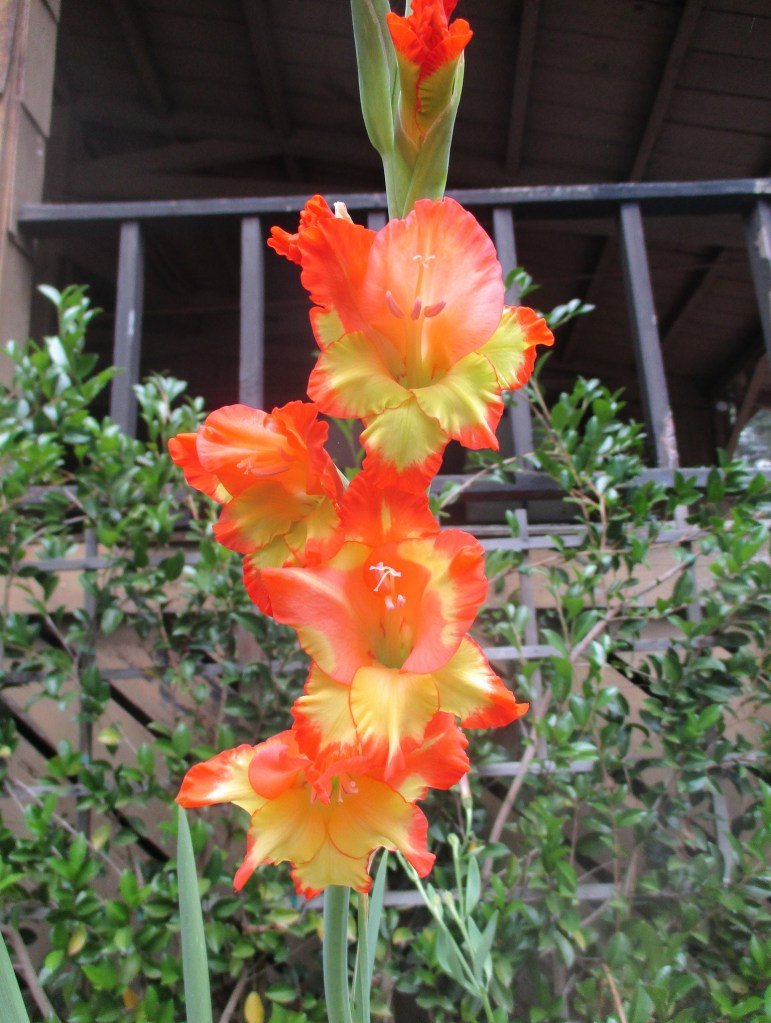
Ornamental gingers and cannas also are oblivious to phasing. Gingers bloom only once for late summer or autumn. Cannas bloom randomly from spring until autumn. Gladiolus bloom only once like gingers, but are more conducive to phasing. Early planting allows early bloom. Late planting delays bloom. Unfortunately, they are much less sustainable.

If summer bulbs do not look like bulbs, it is because few actually are. Most are rhizomes. Dahlias, which, like cannas, bloom from spring until autumn, grow from tuberous roots. As the name implies, tuberous begonias grow from tubers. Crocosmias grow from corms. So do taros, which are large foliar perennials. Gingers and cannas are familiar rhizomes. Although alliums bloom as summer bulbs, they go into the garden along with earlier spring bulbs.

Frost Is Simply Too Chill

Some minor frost damage is acceptable.

Chill can be good. Frost can be bad. The difference is thirteen degrees Fahrenheit. Chill is at or less than forty-five degrees. Frost is at or less than thirty-two degrees. Chill helps some flora to maintain its seasonal schedule. Frost causes some flora to freeze. Both are limiting factors of home gardening. Both are weather patterns that are limited by climate.

Many species from climates with more pronounced seasons rely on chill. They know that it occurs only during winter, and that they should bloom afterwards. Duration of such chill is more important than temperature. Any temperature at or less than forty-five degrees is equally sufficient. Within that, different species require different durations, or ‘chill hours’.

This limits the selection of many species, like various fruit trees. Citrus orchards formerly grew within the San Fernando Valley. They require no chill. Stone fruit orchards formerly grew within the Santa Clara Valley. They require a bit of chill. Pomme fruit orchards grow in the Willamette Valley. Many cultivars of pomme fruit perform best with significant chill.

Frost also limits the selection of many species. Pomme fruits do not mind it. However, if it happens late, it can ruin stone fruit bloom or developing fruit. It might damage citrus trees whenever it happens. Some climates here experience frost annually. Some experience it only rarely or mildly. Several coastal climates experience merely minor chill without frost.

Many garden enthusiasts grow a few species that are vulnerable to frost. Of course, such species are safe within frostless climates. Elsewhere, they may need shelter during cold weather. Potted vegetation may benefit from seasonal relocation. Temporary tenting can shelter imobile vegetation in the ground. Some vegetation is too large to shelter, though.

Vegetation that sustains frost damage is unsightly. However, it is best to delay pruning or grooming until subsequent frost is unlikely. Damaged outer growth insulates undamaged inner growth. Besides, pruning stimulates new and more vulnerable growth. Some types of vegetation should want only superficial grooming. Others might require major pruning.