
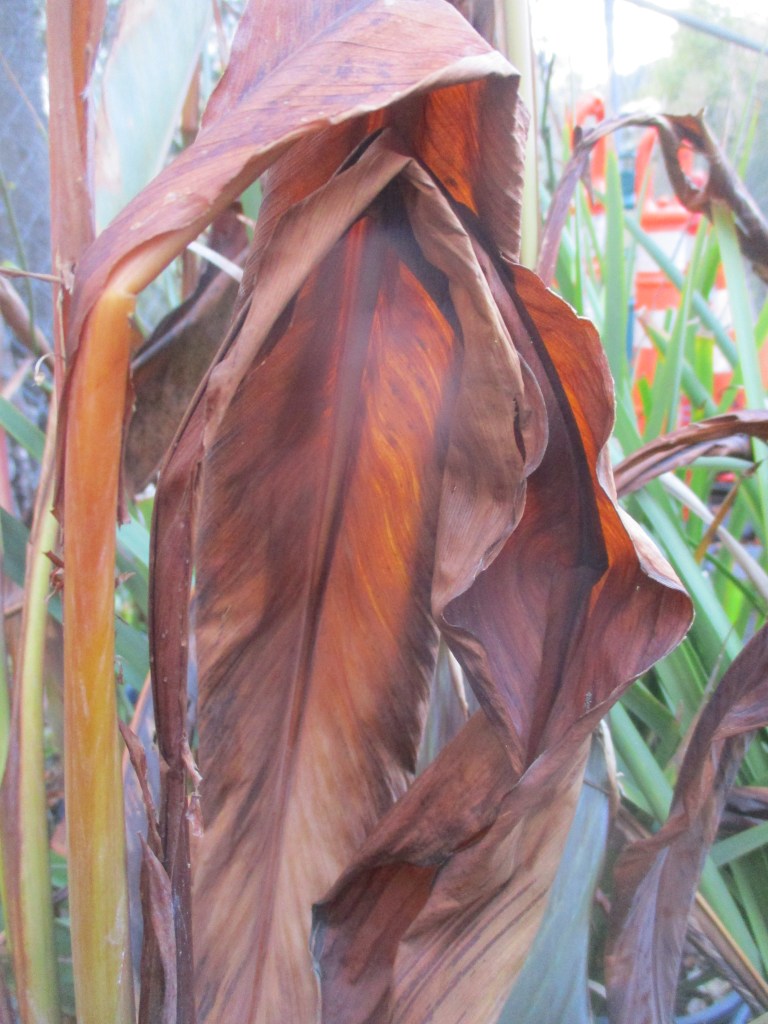
This elephant ear was happy and healthy as the sun set last night. As the sun rose this morning, it was sagging from frost damage. The picture that was taken prior to damage posted here (at my previous ‘Six on Saturday’ post) at midnight. Frost likely occurred shortly afterward. The picture that was taken after damage was taken only a few hours later.
Frost does not happen frequently enough to get much consideration here. When it does happen, it is not severe. This particular frost was only thirty- two degrees. Nonetheless, I should have sheltered the elephant ear. It would not have taken much effort to do so. I could have simply moved it over a few feet, so that it would have been under an eave. A few other species were likewise worthy of shelter. A few, though, should not even be grown here. The most practical means with which to avoid frost damage is to refrain from growing species that are vulnerable to it.
Fortunately, the elephant ear and all other species that were slightly damaged by frost early this morning should recover efficiently. Elephant ear typically loses its foliage through winter, and regenerates foliage for spring anyway. No more frost is predicted for the next week.
I am glad that I do not need to contend with the sort of frost that kills vulnerable species completely. The possibility of such weather would be much more limiting.
A pair of bougainvillea that I planted last autumn actually succumbed to frost last winter. Although bougainvillea commonly loses foliage and perhaps a few small stems to frost, basal stems should not have succumbed. I wanted to get them into their landscape during autumn, so that they could benefit from cool rain through winter, and be ready to grow in spring. Their replacements will get planted in spring.






 Tony Tomeo