Get Perennials Ready For Winter

81212thumbDilemmas are common in gardening. Should summer vegetables that are still producing be removed so that winter vegetables can get started on time? What about replacing summer annuals that are still blooming with winter annuals, and then replacing winter annuals with summer annuals half a year later? Should tender perennials be regarded as annuals, or get a second chance?

Right now, some perennials are looking tired. Many will be going dormant for winter. Many do not get much down time, and will start to develop new growth faster than old growth deteriorates. Not many make their intentions obvious. Deciding how to work with them can be confusing at times. It might take a few years and a few mistakes to get familiar with the habits and lifestyles of some.

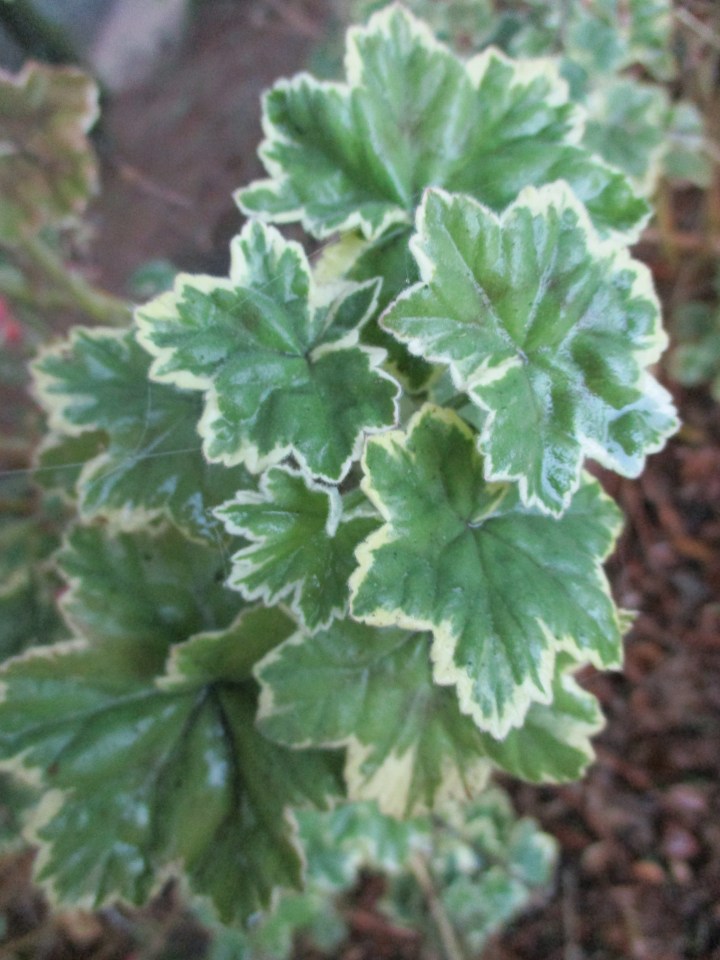
If cut back too early, hardy zonal geraniums will not regenerate much until the weather gets warmer at the end of winter. In the interim, they are more likely to be killed by frost without the protection provided by old growth However, some varieties start to grow in winter. If not cut back soon enough, new growth mingles with old, so that they are difficult to separate when they do get cut back.

It is best to observe what hardy geraniums are up to before deciding on when to prune. If they start to develop vigorous new growth down near the ground, the old growth should probably be cut down as far as the new growth. It is likely better to take a chance that they might be damaged by frost. Those that do not start to grow right away can enjoy the insulation of old foliage for a while.

Thoroughly deciduous perennials, like deciduous daylilies, dahlias and some ferns, can be groomed of their deteriorated old growth without risk that they will start to regenerate new growth prematurely. However, cutting back some specie of salvia might actually stimulate development of exposed and frost sensitive new growth. Perennials that get damaged by frost later In winter should not be groomed of damaged growth right away. The damaged material provides a bit of insulation for lower growth, particularly if new growth was stimulated by the damage.

Being Cool Might Be Overrated

31218thumbThis really is the best climate for gardening. Even though summers are mild, there are not many plants that want for more warmth. Even though winters are mild, it gets just cool enough for many plants that require winter chilling. Yet, there are a few plants, particularly plants from tropical climates, that can be damaged by frost. The best way to protect such plants from frost is to not grow them.

Of course, this oversimplified technique would prevent the cultivation of familiar plants like banana, angel wing begonia and angel’s trumpet. In cooler regions, it might involve bougainvillea, philodendron and some types of citrus. Most of us would prefer to take some degree of risk to grow marginal plants. Some may get damaged by frost and then recover. Others may be killed by frost.

Potted plants can be moved to sheltered spots when threatened by frost. Some can be brought into the home or garage temporarily. For some, the simple shelter of a porch or a dense evergreen tree might be sufficient. Bougainvillea and other plants that do not like to be potted might prefer to be planted under the eaves against a warm south-facing wall. A bit of warmth radiates from walls at night.

During the coldest nights, some of the most sensitive plants that can not be moved to shelter may need shelter brought to them. Burlap, plastic, paper or any sort of sheeting that can be temporarily suspended on stakes above the foliage should be sufficient. Leaves that touch the sheeting can potentially get frozen. The sheeting should be removed during the day so that it does not get too warm in the sunlight.

Foliage that does get damaged by frost should not be pruned away immediately. It may be unsightly, but if left for later, it helps to insulate inner foliage and stems from subsequent damage from later frost. Besides, immediate pruning stimulates new growth that will be even more sensitive to frost than was the foliage and stems that had already been damaged.

Frost

P81125We do not get much frost here. This picture of the view through the windshield of one of the work vehicles was taken more than a week ago, while the humidity and the temperatures were still quite low. The sparse and angular pattern of the frost on the windshield is a result of the minimal humidity. There will be more frost later in winter, although there will not be nearly as much as most other climates get.
After a cool Monday morning last week, the weather got a bit warmer, or really just less cool. Rain started about midnight between Tuesday and Wednesday, and continued through the day and into the night. More rain is predicted to start after noon next Tuesday, and continue through Thursday. There will be no frost during this weather pattern. Frost happens here only between rainy weather. One might think that since we do not get much rain, there would be plenty of time in between for frost. Really though, much of our winter weather is simply quite pleasant, neither rainy nor frosty.
As appealing as this might be to those in harsher climates, it has certain disadvantages.
So far, there was just enough chill to start defoliation of the black locusts and box elders in the background of the picture, and just enough rain to almost finish it. Trees that need more of a chill to start this process are not so impressed with the weather. Many of the crape myrtles have not even started to color yet. Cottonwoods are starting to defoliate, but are doing so while still only dingy greenish yellow because they did not get enough chill for better color.
Spring bulbs that got planted earlier or are being planted about now will bloom next spring because they were so optimal and primed to do so before they were planted. However, many will not get enough chill in their second winter to bloom again. Consequently, many of the bulbs that would be perennial in other climates are grown as expensive annuals here. Likewise, seed of certain specie that self sow may not get enough chill through winter to germinate next spring.
So again, what is comfortable for us is not so ideal for everything in the garden.

Frost Is History For Now

80328thumbThere is no doubt that frost will return next autumn. It does that every year. Right now, we are more concerned that is should not return prior to that. It is now safe to plant plants that are sensitive to frost. Even if the weather were to somehow get cold enough to necessitate protection of frost sensitive plants, it will not be severely cold, and it will not last long. It is best to start now than to delay.

It is also safe to prune away foliage and stems that were damaged by frost through winter. It was best to leave it in place through winter, both to provide a bit of insulation for undamaged stems below, and to not promote new growth. Pruning it away allows warming sunlight to the undamaged stems, and stimulates generation of new growth. A bit of new growth might already be apparent.

Many leafy perennials can be cut to the ground, or at least just above their rhizomes. The tall vertical canes of cannas can be cut back to the low horizontal rhizomes that creep along the ground. The canes are not really stems anyway, but are merely upright foliar shoots. Any shorter new shoots that are beginning to develop can remain, even if a few outer leaves happen to be damaged.

Zonal geraniums can likewise be pruned almost to the ground, leaving only stubs of lower stems, even if only upper and outer foliage was damaged by frost. Although they do not need to be cut back so severely, they respond to such pruning splendidly, with vigorous new stems and foliage. The fungal foliar disease known as ‘rust’ overwinters in old leaves that get removed in the process.

Lemons, limes and any other citrus that were damaged by frost only need to have their damaged stems removed as far back as viable growth, where new buds might already be visible. However, if more pruning is necessary, this would be a good time to do it. Major pruning should not be done later in summer because the sensitive bark of inner stems can be scalded by sudden exposure to too much sunlight. Small trees that are sensitive to frost become more resilient as the grow larger.

The Weather Outside Is Frightful

P80110It is certainly not as cold as it is in other regions at or north of this latitude. Nor is it unusually cold for this time of year. It is not stormy. We got only a few heavy but brief rain showers with a bit of small hail. A slight bit of snow fell only on the Summit of the Santa Cruz Mountains
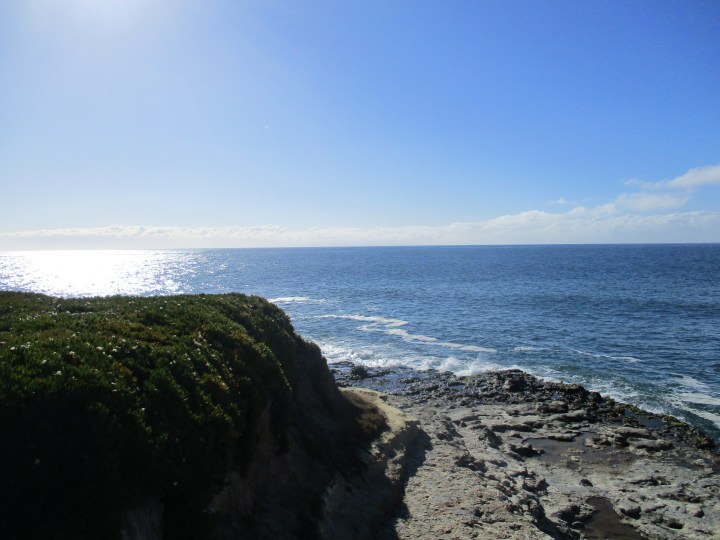
The problem is that the weather had been so mild earlier, and at times, downright warm. Many plants were coerced into premature bloom. Some started to generate new spring growth. When the weather suddenly became more seasonably cool, many of the flowers and new growth got frosted and ruined.

Fortunately, most of the deciduous fruiting trees seemed to know what they were being set up for, and abstained from bloom. So far, even the early blooming apricots, cherries, almonds prunes and plums are safe. The wild American plums bloomed, but not many of us use their fruit anyway. (I want some – both amber and red – for jelly, but there will be plenty of other fruit.)

Saucer magnolias were just beginning to bloom when the cool weather moved in. Now, some of the big pink flowers are spotting and melting before they open completely. Many of the camellias are succumbing to blight, and falling to the ground shortly after they open.

Weather is always risky, even in mild climates. Actually, our mild climate allows us to grow more of the plants that are sensitive to anomalies of the weather. Perhaps such anomalies would be less of a problem in harsher climates where the weather is naturally more variable. If so, it is probably a fair compromise. The problems with such a mild climate are still less significantly less than the advantages.

The Coast Is Clear

P80218Between here and Hawaii, there is a whole lot of water. Between Hawaii and Australia, there is a whole lot more. Everywhere to the west and southwest of California, there is a lot of water. Unfortunately, none of this huge volume of water is useful for gardening. It is saline. It would kill plants.
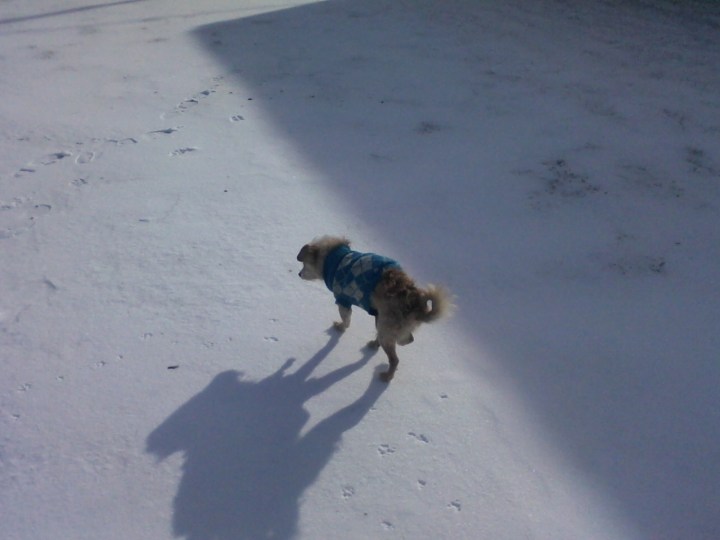
Of course this is not just any water. It is the Pacific Ocean. Although the water within it is useless directly, it is what feeds the weather that provides the precipitation that becomes the water that makes gardening and everything else possible. Rain fills local aquifers. Snow in the Sierra Nevada fills reservoirs as it melts.

The weather that the Pacific Ocean feeds gets shared over a very large area. Weather that does not make rain here might make rain or snow in Nevada, or Oklahoma, or really anywhere the weather wants to go to. In fact all the oceans all over the world cooperate to make climate and weather what it is.

What is so special about the Pacific Ocean being right here off the coast is that it moderates our climate and weather. Places like Nevada and Oklahoma that are not on the coast get water from the Pacific Ocean because weather is mobilized. The moderating effect of all that saline water is not. It stays right here in coastal regions.

Water has a high specific heat. That means that it takes a lot of energy to change the temperature of water. Saline water has an even higher specific heat. The temperature of the Pacific Ocean therefore changes very slowly and very minimally.

This inhibits extremes of temperature in the air above all that saline water. Small batches of extremely cold weather tends to collect a bit of heat energy as they pass over the Pacific Ocean. Weather coming in over so much saline water can not get extremely hot without the water absorbing at least some of all that heat energy. Therefore, coastal weather is rarely extremely cold or extremely hot. Temperatures can be more pronounced a few miles inland from the Pacific Ocean, especially when the weather comes from inland. Farther inland cold and heat can get significantly more extreme.

A lack of cold weather in winter limits what can be grown here. Plants that require a good chill are not satisfied with our pathetic winters. That is why some bulbs that do well as perennials farther inland bloom only once here, and why some varieties of apple that perform well in central Washington are not grown here.

However, a lack of hard frost allows us to grow many plants that can not be grown where winters are more severe. Even if bougainvillea gets frosted every few years or so, it typically recovers. Avocados and lemons are likewise quite happy here. The weather may seem to be boring, but it certainly has its advantages.

Snow

P80110It seems that almost all of us in the Northern Hemisphere are talking about it. Those of us who lack it can get to feeling somewhat deprived. It looks so pretty in pictures. It seems like such a natural part of winter. To many of us, it is a good excuse to take a break from gardening, stay inside, and write more compelling articles than the more technical sorts written when there is more activity in the garden.

In California, we get almost everything. Although most of the most densely populated ares lack snow, parts of the Sierra Nevada get more snow than anywhere else in the world. Californians can go to the snow to ski, hike, take pictures and do whatever people want to do in the snow; but we do not need to live with it at home like most people in other states do.

I grew up without snow. It snowed only once in 1976. It was only half an inch deep. The snow fell overnight while everyone slept, and it melted by early afternoon. Because the turf in the schoolyard was not resilient to snow, we were not allowed out there until the snow was gone. I later saw snow only when we went to where the snow was, in the Sierra Nevada. Snow only rarely fell at my home near the summit of the Santa Cruz Mountains above town, and it stayed for only a few hours.

I never had to live with snow until I went to Oklahoma at the end of 2012. Even then, it was minimal. The first snow fell only about three weeks before we left, and it never accumulated more than two inches or so. The difference from what I had experienced prior to that was that it lingered. It took a few days to melt. As minimal as it was, I could totally understand why people who live with snow dislike it so. I really can not imagine living with more accumulation of snow for months at a time.

First of all, snow is cold. It is very cold. It is, after all, frozen. That would not seem like much of a problem when the air is already cold, but snow is different. It sticks to the sides of boot and makes them cold inside. It seems to hold the cold on whatever it covers, including parked cars.

Also, snow is wet. Yes, as I already mentioned, it is is frozen, but it is frozen ‘water’, and it does not stay frozen when one is trying to get warm after being out in it. It gets clothing and everything else wet, just like a light rain. Frozen snow gets tracked in on boots and then melts just inside the doorway.

To go along with that, snow is messy. As cars drive through it, it becomes muddy, but does not necessarily melt right away. It becomes slushy mud that splatters onto otherwise clean cars.

There is actually quite a list of things to dislike about snow. It is dangerous on roadways. When it gets pushed off of roadways, it piles up around parked cars and on top of plants that happen to be in the way. I think that I prefer to see it in pictures of Switzerland, Minnesota, Ontario and Mount Hood as it looks from Portland.

Sometimes I think that it would be nice if we got a bit more of a chill here. We would be able to grow more varieties of apples, pears and other fruits. Perhaps peonies would do better, and autumn foliar color would be more spectacular. There are so many things that we can not grow or that do not perform as well as they want to in such a mild climate. However, all those frost sensitive plants that we can grow that others can not grow are nice too. Either way, I will pass on the snow.

Bill was mostly blind by the time we went to Oklahoma, but he could feel the snow on the ground well enough to determine that he did not like it either.P80110+.jpg

Unseasonable Weather Can Confuse Plants

70920thumbEven without any of the five senses that we are outfitted with, plants are remarkably perceptive of the weather and the changing seasons. They know precisely what time of year it is because they know how long the sun is up. Their calendar is just as accurate as ours is. They also know that the weather has been getting progressively cooler through autumn, and that it rained a bit earlier.

New Zealand tea tree, torch lily, euryops daisy and many other plants from other temperate climates do not seem to care that they should not be blooming at this time of the year, if the weather is telling them otherwise. If the weather is warm enough during the day, even if it gets cool at night, these plants will bloom right up until things get really cold, even if some of their bloom gets frosted.

Saucer magnolia, lilac, apple and the many other plants from climates with cooler winters should know better than to bloom this time of year. Many bloom only once annually, so whatever blooms now will not bloom when it should next spring. Besides, the flowers that try to bloom now will bloom slowly, and probably be ruined by cool or rainy weather before they can develop completely.

Roses had a particularly weird year. They bloomed well and on schedule last spring, but then idled through much of summer, only to express a new interest in blooming now that they should be going dormant for winter! No one wants to prune them while they have more buds than they did in August. Fortunately for them, they bloom more than once annually, so should recover by spring.

The colorful foliage of sweetgum and Chinese pistache, as well as the observable weather, indicate that everything is more or less in order for this time of year. Autumn might have started out mild, but it had been even warmer in past years. It is impossible to say why some magnolia, lilac and apple are trying to bloom already. They each have such distinct personalities, and respond to so many different variables besides the obvious; daylength, temperature and humidity.

Jack Frost Was Sneaky Again

71227thumbTiming is very important in gardening. Even when the weather in autumn still seems like summer, spring blooming bulbs must be planted on time. Bare root fruit trees will become available while they are dormant, and will need to be planted before they wake up. Roses need to be pruned before buds for new canes swell later in winter, even if their old canes are still awake and blooming.
Some procedures are influenced more by environmental factors than timing. Planting bare root fruit trees and pruning roses must be done sooner if the weather gets warm sooner than expected. Irrigation must be increased in summer, but only as warm and dry weather necessitates such increase. It gets decreased in winter, but only as weather gets cooler and rainier. Then there is frost.

Frost arrives differently every year, and is of course worse some years than others. It is only a minimal threat in some regions, but limits what can be grown in others. It happened to be sneaky this year, by hiding in between remarkably pleasant days. While the daytime weather is so mild and even unseasonally warm, a weather forecast may provide the only early warning of overnight frost.

By now, sensitive plants were either protected successfully, or possibly damaged by earlier frosts. Potted plants got moved to shelter under porch roofs, or maybe dense evergreen trees near the home. Those in the ground might have been tented with plastic or sheeting suspended above the foliage by sticks and maybe string. Old fashioned Christmas lights might have softened the chill.

Many perennials and annuals are just left out to succumb to the cold. Any remaining warm season vegetable plants are not worth protecting. They will not produce anything this late anyway. Canna and ginger can likewise be left out in the cold for their foliage to freeze and collapse to the ground. If protected, they can stay green through winter, but will replace their foliage in spring anyway.

Foliage of hosta and dahlia can be removed because the dormant parts of the plants are safe below the surface of the soil. Canna and ginger rhizomes on the surface of the soil might appreciate a bit of mulch if their foliage gets removed. Frost damaged stems of woody plants should not be pruned out too early. Premature pruning stimulates new growth that will be sensitive to later frosts.

Frost!

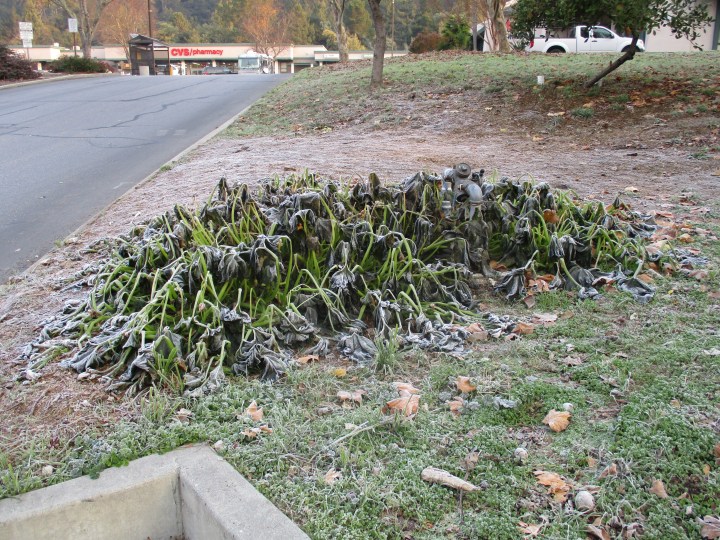
P71208+K1Yes, we get it too. It took a while, but we finally got it just like most of everyone else in North America and the Northern part of the Norther Hemisphere. It is not much to brag about, but it is enough to melt the big feral pumpkin vine that I wrote about earlier ( https://tonytomeo.wordpress.com/2017/12/03/too-late-for-pie/ ). It has actually been frosting for a few nights. I just got around to getting this picture this morning.

Now that the foliage is melting and collapsing, a leak is now visible in the exposed valve manifold that was obscured in the previous picture. It did not get cold enough to freeze the pipe, so the water was dripping freely. This confirms the earlier theory about where the pumpkin vine was getting water from.

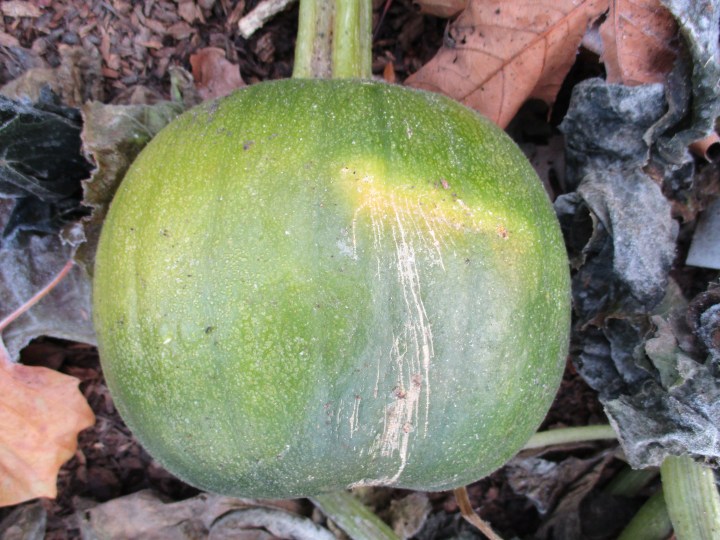
Two pumpkins are also exposed by the collapsing foliage. They were not visible earlier. Unfortunately, they are too under-developed to mature and ripen. A neighbor will likely take them and set them aside on the porch, just in case they are able to finish ripening. It would be nice if they did. The vine certainly put a lot of work into them!P71208+K2P71208+K3

While taking this picture, I was reminded why people who live with cooler weather dislike it so. First of all, and most obviously, it kills things. The season is over for pumpkin vines, which is not a problem. The problem is that so many of the citrus, avocados and other plants from mild climates that we grow so easily here get damaged or killed by frost in other climates.

The second reason to dislike cool weather is that it is too cool, maybe even cold. It is uncomfortable to be out in long enough to walk over and get these pictures of the pumpkin vine and pumpkins. I am glad that it does not get much colder here.