Six on Saturday: Suburbia

The Santa Clara Valley is the best place in the entire Universe for horticulture. Yet, few of the nearly two million people who live there now appreciate it, or realize that some of the area was still occupied by orchards only half a century ago. These pictures are from the garden where I lived before graduating from high school, and subsequently planting the peach tree #5 in 1985. Apricots and cherries were finishes quite a while ago. Peaches will be ready soon. These are not orchard trees, but they are happy to be here.

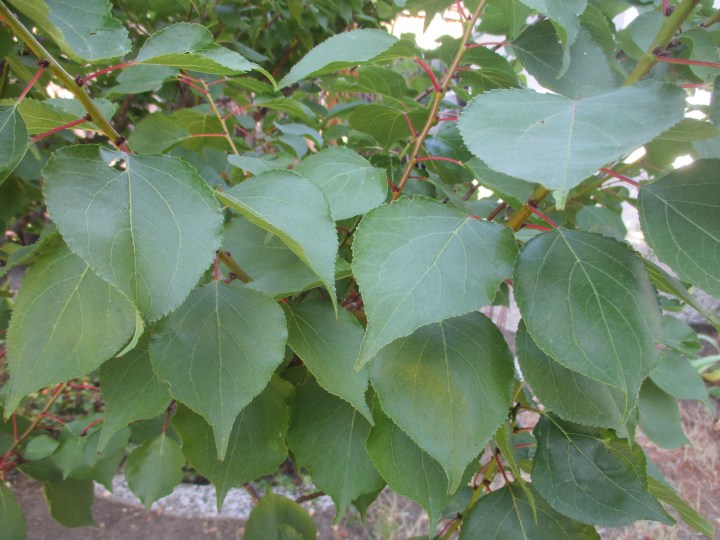
1. Garden Annie apricot – is, as the name implies, a garden variety rather than an orchard variety. With surprisingly minimal pruning, it stays compact and proportionate to a home garden.P00801-1

2. Stella cherry – is likewise a garden variety. It was selected because it is self fruitful, so does not need a pollinator. It also has stayed relatively compact and proportionate to limited space.P00801-2

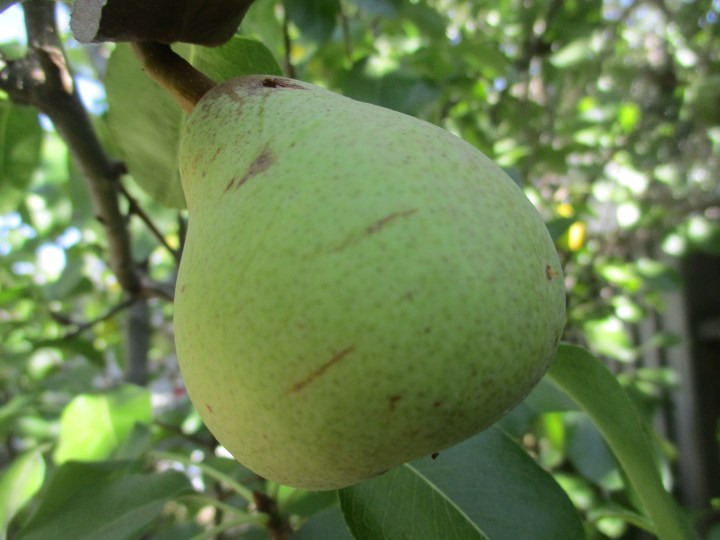
3. Anjou pear – is also known as D’Anjou or Beurre D’Anjou pear. Pears and apples were not common in the orchards of the Santa Clara Valley, but were grown in the Santa Cruz Mountains.P00801-3

4. Golden Delicious apple – is more commonly and more appropriately known as Yellow Delicious apple. It was selected as an all purpose ‘only child’ apple for baking, cooking or eating fresh.P00801-4

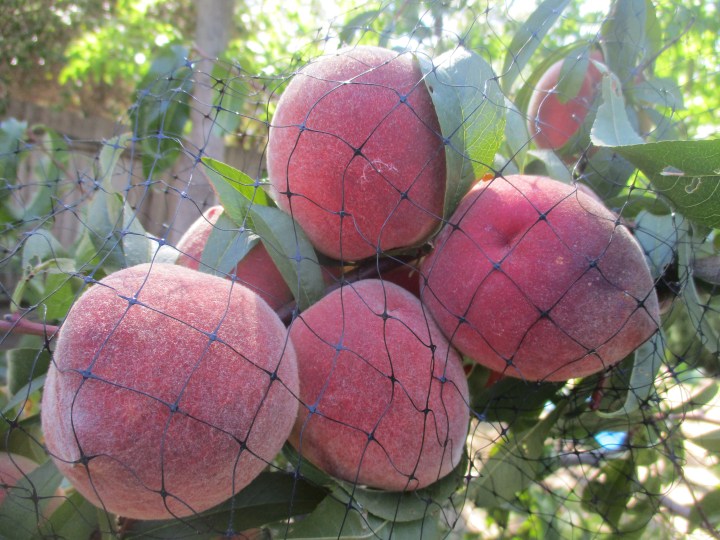
5. seed grown peach – came here from a compost pile in Santa Clara in about December of 1985. The fruit is excellent. However, after all these years, I have never been able to propagate it.P00801-5

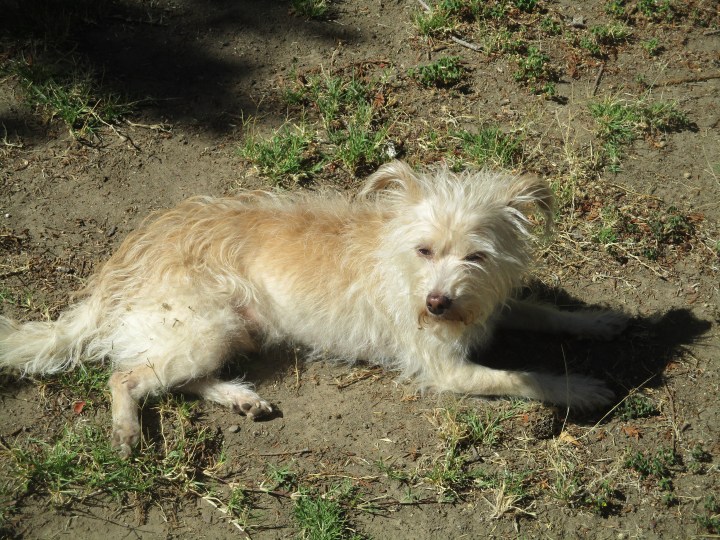
6. Rhody – performs pre-emergent weed abatement by collecting large quantities of burclover seed. He does not enjoy getting them removed from his finely textured fur afterward though.P00801-6

This is the link for Six on Saturday, for anyone else who would like to participate:

https://thepropagatorblog.wordpress.com/2017/09/18/six-on-saturday-a-participant-guide/

Mild Weather Is Still Problematic

50527thumb
Minimal frost delayed certain spring blooms.

It is amazing that so many orchards are so productive in California, and that so many similar orchards had formerly been productive in the urban areas in which so many of us now live. Nowadays, it takes so much work to care for just a few fruit trees in home gardens. Horticulture is not what it used to be.

Diseases and pests get transmitted all over the world at a rate unlike at any other time in history. It is just too easy to buy and sell infected plants online, and get them delivered without adequate inspection. Many varieties of plants that are so easily imported may not perform as reliably as the more traditional varieties.

Modern landscaping does not make fruit production any easier. Most deciduous fruit trees do not get pruned adequately or properly. Many get too much water. Almost all must live in crowded landscape conditions where diseases and pest proliferate. Sanitation (removal of infected plant parts) is rarely as efficient as it should be.

Then there is all this crazy weather! First, the winter does not get as cool as it should. Then, it does not get warm enough in spring. It is all so difficult to keep track of. Many plants do not know how to respond. Those that stay dormant through cool weather got an early start. Those that like warmth in spring started late.

The unfortunate deciduous fruit trees that need both a good chill through winter and nice warm spring weather are really confused. Early blooms were ruined by brief late frosts or brief rain showers. Some delayed blooms were not synchronized with pollinators. Some of the minimal fruit is developing slowly.

Even the fruitless or ‘flowering’ relatives of the deciduous fruit trees are annoyed by the weather. Many flowering cherry trees that should have bloomed profusely prior to foliation delayed bloom until lower foliage started to appear. However, both bloom and foliation are so slow and sporadic that upper stems stayed bare quite late.

Flowering crabapple trees, which generally bloom after flowering cherries, actually bloomed more reliably, and were not delayed as much. Hopefully, fruiting apple and pear trees, although late, will be more productive than so many of the cherry, apricot, plum, peach and nectarine trees will be this year.

Six on Saturday: TWIGS!


The Belmont Rooster posted pictures of red mulberry that really got my attention back on February 15. The trees are native on his farm, but not here. I only remember them as decoy trees that provided berries to distract birds from other fruit as it ripened in the orchards. Of course, those that I remember were planted. I neglected to get seed or cuttings from them while in Oklahoma. I have been craving them since.

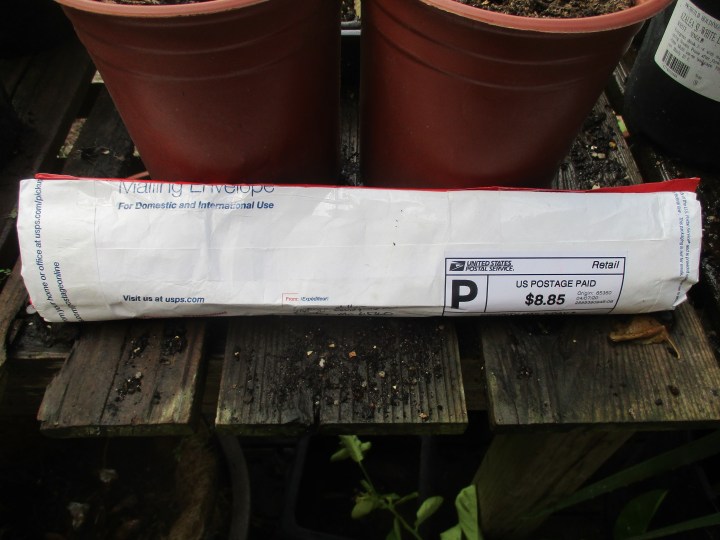
1. $8.85! The Belmont Rooster spent some major funds to get this package to me. It must be important. I already know it is very important to me! I have been wanting this for seven years. P00411-1

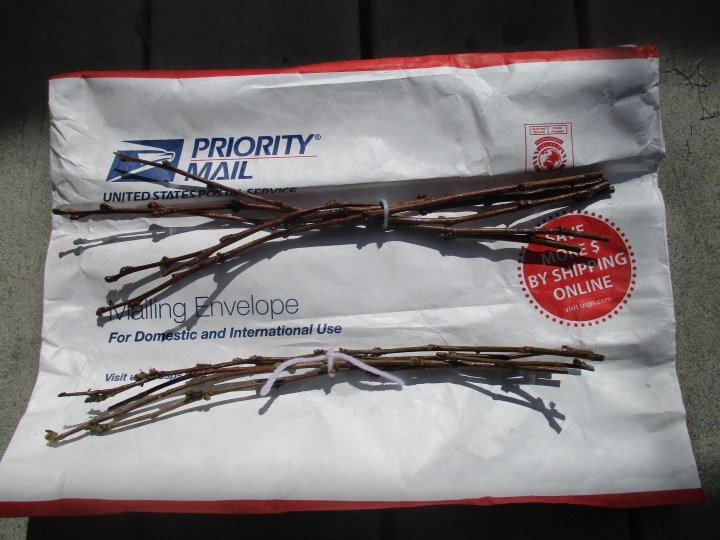
2. TWIGS! I got two bundles of twigs! These are not just any twigs though. They are from red mulberry, Morus rubra. One bundle is from a female tree. The other is from a male pollinator.P00411-2

3. Cuttings were processed from the twigs. There are a dozen female cuttings, and sixteen male cuttings. These are male. I was informed earlier that the female twigs were starting to foliate.P00411-3

4. Plugged cuttings are not much to look at. Rooting hormone was applied, but is not visible on the bottom ends. Only a few popping buds are barely visible in the female cuttings to the right.P00411-4

5. White mulberry was the only mulberry that I was growing here. I got the cuttings for it from a client’s tree. I do not know what cultivar it is. I have not been very impressed with it so far.P00411-5

6. The Belmont Rooster sent these cuttings from Missouri, just to the left of the center of this picture. All of Missouri is within the native range of red mulberry, which is designated by green.P00411-6

This is the link for Six on Saturday, for anyone else who would like to participate:

https://thepropagatorblog.wordpress.com/2017/09/18/six-on-saturday-a-participant-guide/


‘Eureka’ Lemon

50318

‘Lisbon’ lemon actually came first. It is still grown in orchards for lemon juice and other lemon products. The glossy evergreen foliage is a nice bright green. The late winter bloom is nicely fragrant. Mature trees can be kept about twelve feet tall, or allowed to get much taller. Besides the nasty thorns, the only other problem is that all the fruit ripens within a limited season.

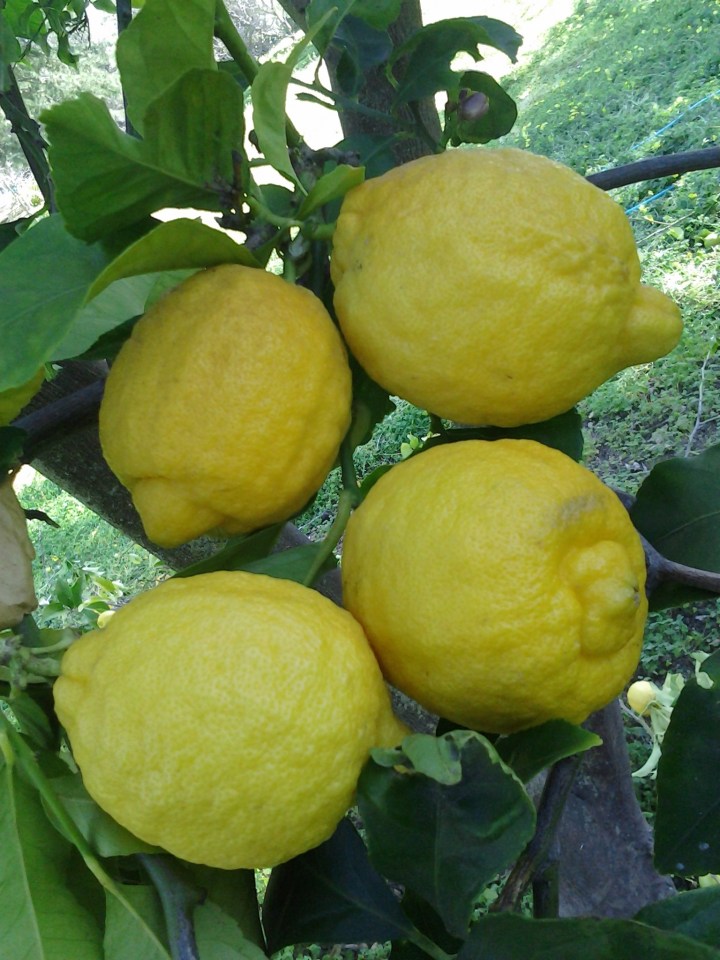
‘Eureka’ lemon, Citrus limon ‘Eureka’, is a mutation of ‘Lisbon’ that is more casual about its schedule. It produces a good quantity of fruit in season through the end of winter, and also produces lesser quantities throughout the year. Because it is so productive, the lesser quantities should be more than sufficient whenever lemons are needed.

The ‘Variegated Pink’ lemon is a mutation of ‘Eureka’, so is a mutation of a mutation. The foliage is nicely variegated with white. The green fruit is striped with yellow until it ripens to yellow. The pulp and juice are pink of course. Like many variegated plants, the ‘Variegated Pink’ lemon stays much smaller than ‘Eureka’ lemon, and is more sensitive to frost.

Horridculture – When Life Gives You Lemons, USE THEM!

P00311-1
“Hello – my name is LEMON.”

Almost all of the fruit trees that I encounter are or were neglected to some degree.

Many were planted a long time ago by someone who was able to maintain them at the time, and perhaps for many years, but then relocated, passed away, or just got too elderly as the trees grew and required more work.

Many were planted by those who simply enjoy gardening around their homes, and wanted to grow some fresh fruit, but were not aware of how intensive the maintenance of most of the fruit trees is, or how to execute such maintenance properly.

Many were planted by so-called ‘gardeners’ or so-called ‘landscapers’ who had no intention of actually ‘maintaining’ them, or believed that they could ‘maintain’ them with motorized hedge shears and a blower . . . just like they ‘maintain’ everything else.

There is a young but nicely productive ‘Eureka’ lemon tree at work. I would not say that it is neglected. Someone has been maintaining it well since it was installed. However, I remind others at work to take some of the lemons because the tree gets overloaded with otherwise unappreciated and unused fruit.

The tree is strategically located right outside of one of the big cafeteria kitchens, so that those who work in the kitchen could use the fruit. The kitchen probably uses more lemons that the still young tree could produce, but does not seem to use any from the tree.

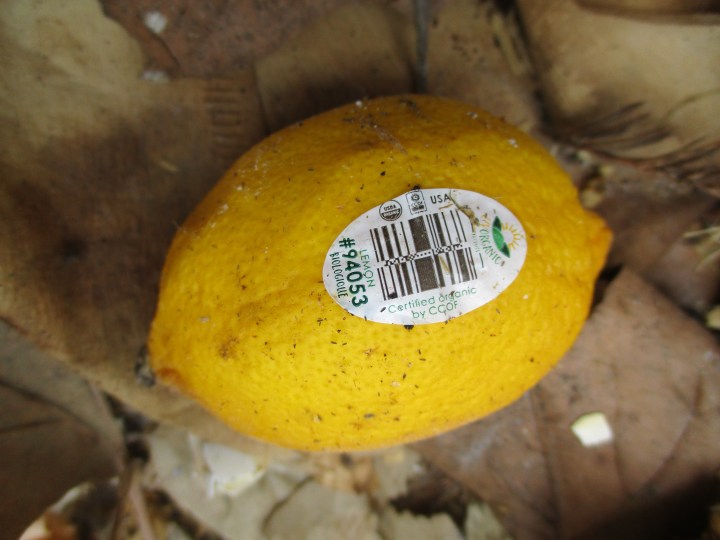
While dumping greenwaste from the kitchen onto the big compost piles, I noticed this labeled but unused lemon. I can not help but wonder why lemons from my tree aren’t good enough, and why this particular lemon wasn’t good enough either. How many of us nowadays would even recognize a lemon tree, or appreciate the fruit that it produces?

P00311-2
This lemon tree right outside of one of the kitchens is loaded with fruit.

Feral Plum

P00301-1
Feral plum naturalized from understock cultivars.

Springtime in the Santa Clara Valley was famously spectacular decades ago, when vast orchards occupied what is now only urban sprawl. Tourists came to see it like some still go to see foliar color of autumn in New England. Most of the orchards were for stone fruits. Only a few in cooler spots were for apples and pears. Only orchards of English walnuts did not bloom colorfully.

Cherry and almond trees typically bloomed first. Prune trees bloomed immediately afterward. Apricot trees were only a few days later. Of course, the schedule of bloom was variable. Prune trees often bloomed just after apricot trees. Various cultivars of cherry started to bloom at slightly different times, even though those that needed to pollinate each other managed to do so.

After the main bloom of all the stone fruits, and after the tourists were gone, the few apple and pear orchards in cooler spots and surrounding hillsides continued the process. Mulberry trees that grew sporadically on roadsides around the orchards bloomed no more colorfully than English walnuts, but somehow produced enough fruit to distract birds from developing stone fruits.

Feral plum trees are a group that was not easy to categorize even before the demise of the orchards. They were not intentionally grown in orchards, or even in home gardens. They just sort of grew wild along creeks or from the roots of grafted stone fruit trees that had been cut down. They were originally grown as understock cultivars, but had naturalized to become truly feral.

Because their fruit was not used for much, they did not get much consideration. We tend to forget that some types bloomed before any of the other stone fruits. To those who do not expect fruit, feral plum trees are as spectacular as productive stone fruit trees.

P00301-2
Feral plum bloom is now finishing. Foliage will replace blossoms.

Deciduous Fruit Trees Need Pruning

00122thumb
Dormant fruit trees will bloom soon.

Deciduous fruit trees have no business in a low maintenance landscape. They need as much specialized pruning while dormant in winter as roses need, and on a much larger scale. Neglected trees get disfigured by the weight of their own fruit. Disease proliferates in their thicket growth that develops without pruning. Overgrown trees produce most of their fruit where no one can easily reach it. Fruit that can not be harvested attracts rodents.

Of course, deciduous fruit trees are certainly worth growing if they get the specialized pruning that they need. Pruning concentrates resources so fewer but better fruits develop. Fruit bearing stems are better structured to support the weight of their fruit, and lower so that the fruit is easier to reach. Pruning also promotes more vigorous growth, which is less susceptible to disease and insects.

Now that it is February, and the weather has been unusually warm, deciduous fruit trees that have not yet been pruned will need to be pruned very soon. They will be sensitive to such major pruning once they start to bloom. The pruning is too specialized to explain here in just a few sentences. Fortunately, Sunset publishes an very detailed book about “Fruit Tree Pruning” that explains how to prune each of the different fruit trees. Pruning will be more extensive each year as trees grow, but also becomes more familiar.

Stone fruits like apricots, plums, prunes, nectarines and peaches (that have hard seeds known as stones), need the most severe pruning. Their fruit develops on stems that grew last year. These stems should get cut short enough to support the weight of the fruit expected to develop next year. The ‘four Ds’, which are dead, dying, damaged and diseased stems, should get pruned out as well. Cherries and almonds do not get pruned as much because their fruit is so lightweight; and out-of-reach almonds simply get shaken down anyway.

Apples and pears are pomme fruits that need similar pruning, but also produce on stunted ‘spur’ stems that should not be pruned away. Spurs may continue to be productive for many years. Figs, persimmons, pomegranates, mulberries and grapevines all need their own specialized styles of pruning.

Horridculture – NO TRESSPASSING

P00115
NO TRESPASSING? . . . No respect!

Growing fruit takes a bit of effort. Trees that produce the fruit must be planted and maintained for all the many years that they produce. They might need to be irrigated through summer. Most need specialized pruning every winter.

Canning surplus fruit takes a bit of effort too. All the jars must be cleaned. All the fruit must be collected, processed and cooked. The jars must be packed and boiled and so on.

Drying fruit is less work than canning, but takes a bit of effort nonetheless.

Where I lived in town, I grew a peach tree closer to the apartment building to the north, and a fig tree closer to the apartment building to the south. I maintained both trees meticulously. Many of the neighbors appreciated the fresh fruit. At the end of their season, there was (almost) always surplus peaches for canning. Sometimes, there were surplus figs for drying.

I really would not have minded if there had not been surplus fruit. It would have been better to have it consumed by the neighbors while fresh, than after it had been canned. Besides, it would have been less work for me.

One summer, there was a major surplus of peaches. We wanted to can them as efficiently as possible because we know how perishable they are. We planned to do all the canning on a Saturday, so got all the jars from the attic and washed them on Friday afternoon. The canning pots and utensils were ready to go. We had purchased lids and several pounds of sugar.

Also on Friday afternoon, the so-called ‘gardeners’ came to the apartment building next door to the north.

The major surplus of peaches, every last peach, was completely gone when we went to collect early Saturday morning.

Now, really, I don’t mind sharing. That is what the tree is there for. I really don’t even mind if a few people want to take all the surplus fruit. I just want to be told about it before I make plans and prepare to do something else with it. What really angered me was the complete disregard for those of us who put the effort into growing all those excellent peaches.

The fig tree to the south produced an early crop of figs before the peaches, and a late crop of figs after the peaches. Each crop lasted a long time, so there were not often too many figs at any one time that needed to be dried. Most were eaten fresh.

I often noticed an annoying absence of figs each day after the so-called ‘gardeners’ came to the apartment building next door to the south. It was not as bothersome as the missing peaches, since I got quite a bit of figs in between. What angered me was that every fig that could be harvested at the appointed time was taken, leaving none for anyone else.

Pear

00122
Properly pruned peartrees produce pears prolifically.

Ancestral species of modern pears grow wild from western Europe and northern Africa to eastern Asia. Long before they were domesticated and developed in China about three thousand years ago, their fruit was eaten by indigenous people. Farther west, dozens of cultivars were developed and popularized in ancient Roman societies. There are now more than three thousand cultivars.

Most pears that are popular in America are descendants of European pear, Pyrus communis. Asian pears, which are mostly descendants of Pyrus X bretschneideri and Pyrus pyrifolia, became a fad in the 1980s, and are still somewhat popular, particularly in California. Asian pears are generally rounder and firmer than the familiar ‘pear shaped’ European pears that soften as they ripen.

There are too many cultivars of pear for all to conform to similar characteristics. All that are grown for fruit are deciduous, and almost all have potential to exhibit remarkable foliar color in autumn. Abundant clusters of small white flowers bloom in spring. Floral fragrance of some cultivars might be unappealing. Semi-dwarf trees can get more than fifteen feet tall, so should be pruned lower.

Pears can be shades of yellow, green, red or brown, and might be blushed or russeted. They can be canned, dried, juiced, or eaten fresh.