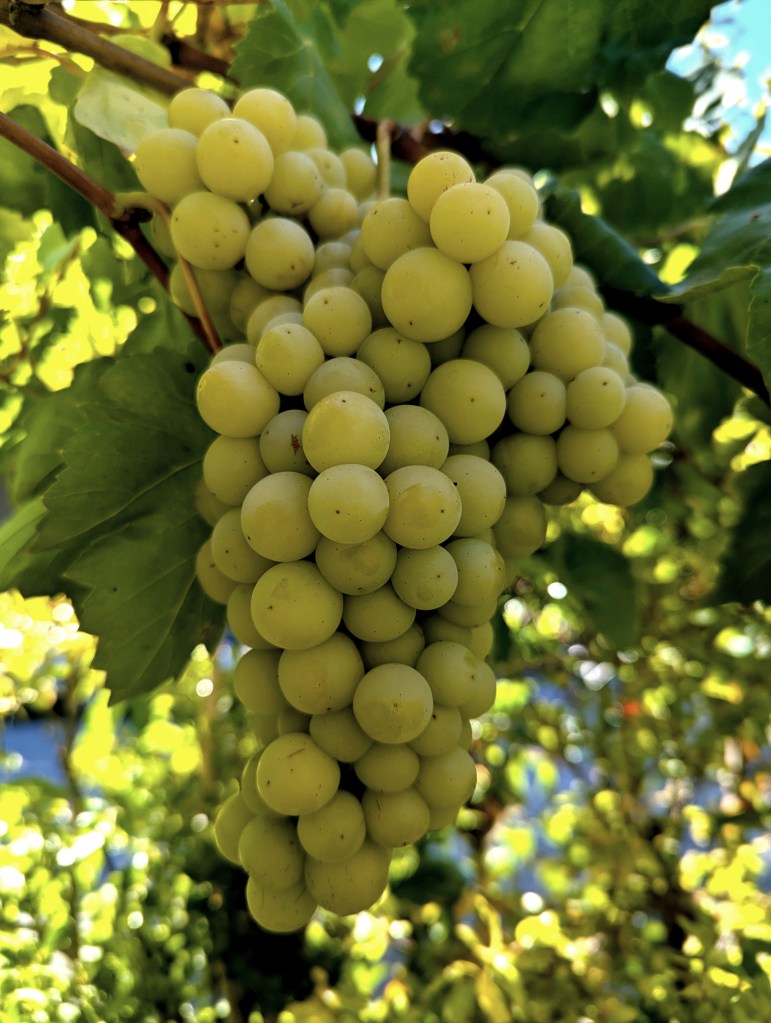
Grape, Vitis spp., has been in cultivation for approximately eight thousand years! That is a very long time for many diverse varieties to develop. Most are cultivars of Vitis vinifera, but other species and hybrids are in cultivation also. Grapes are useful for juice, vinegar, wine, jelly, fresh eating and dried as raisins. Each application utilizes particular cultivars.
Grapevines are very vigorous. Without pruning, some can climb more than fifty feet high. Within home gardens, specialized dormant pruning limits most to less than ten feet high. On larger vines, fruit is awkward to reach. Vines climb with tendrils, but are conducive to redirection on trellises, fences or arbors. They are deciduous, so are bare through winter.
Grapes grow in clusters of all sizes, from only a few grapes to two hundred or more. Fruit can be green, yellow, orange, red, pink, purple, dark blue or black. Table grapes are the most familiar seedless type for fresh eating. Wine grapes are smaller and contain seeds. Established vines do not need much water. Excessive irrigation can compromise flavor. Bare root vines become available for winter.
Why are more urban shade trees not fruit trees? Urban landscapes could produce much more food than they already do. It could be so nice to be able to pick fresh fruit from trees in parks or flanking streets. After all, this region formerly sustained orchards of fruit trees. It could certainly sustain more fruit trees again. Why waste space on mere shade trees?
Many cities in California sustain more trees than they naturally did prior to urbanization. Both San Jose and Los Angeles were chaparral grassland with only isolated woodlands. Their urban trees are now more numerous than native trees were only two centuries ago. The same applies to several urban areas, including San Diego, Bakersfield and Fresno.
Trees are not only more abundant than they naturally were. They are also more practical. They perform specific functions. Those that are street trees must develop high canopies, and need minimal maintenance. Those in parks must be broad enough to create shade. For many reasons, fruit trees are impractical for such applications in public landscapes.
Fruit trees generally require significantly more maintenance than typical shade trees do. Deciduous fruit trees require specialized dormant pruning each winter. Without adequate pruning, their limbs become overburdened with fruit and break. Such pruning is very time consuming. It also necessitates cordoning off space below trees during the procedures.
Also, fruit trees are significantly lower than shade trees. This facilitates both specialized pruning, as well as collection of fruit. Street trees and most shade trees are much higher for clearance below. With the same clearance, particularly over roadways, fruit would be out of reach. Limbs that are low enough to produce fruit within reach would be obtrusive.
Fruit that is out of reach becomes messy below. For street trees, it becomes a slip hazard on paved surfaces. Furthermore, fruit attracts unwanted wildlife, including rats, raccoons and opossums. Ultimately, trees selection should be appropriate to specific applications. Fruit trees are better within private home gardens. Shade trees should not produce fruit.
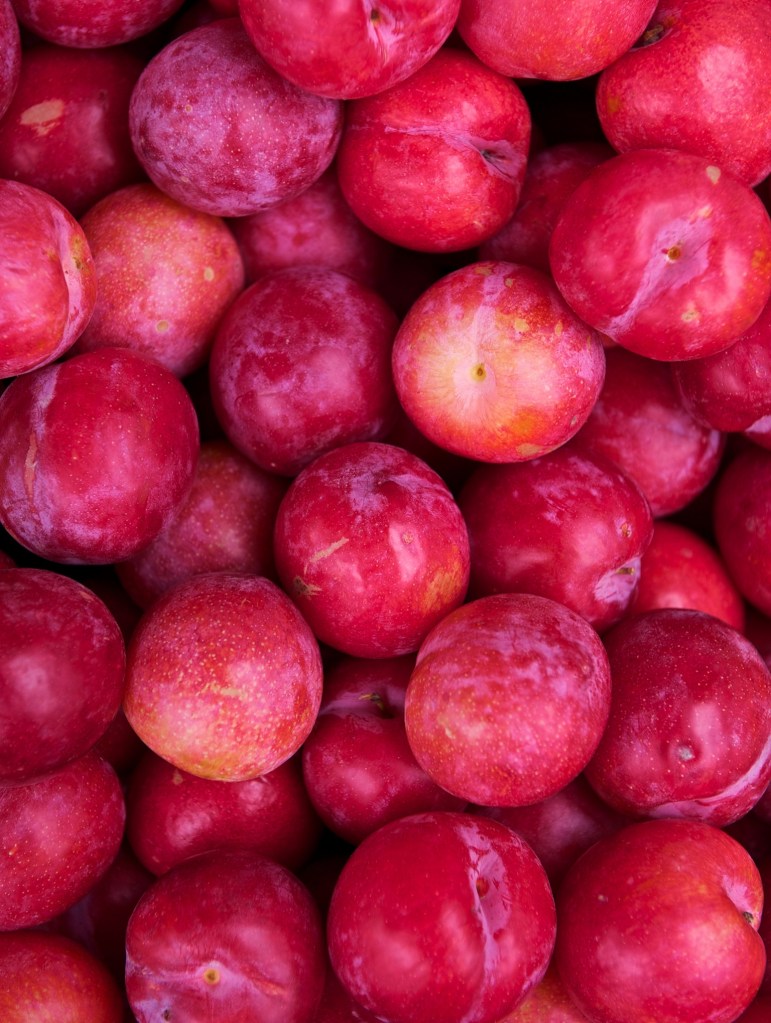
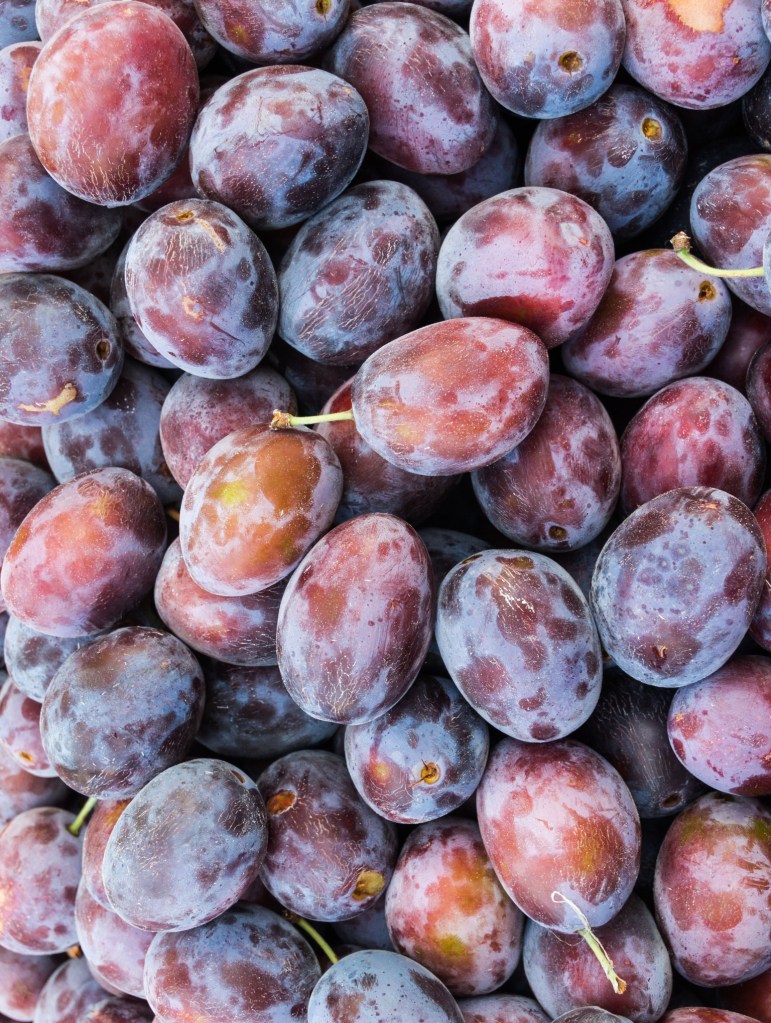
A prune is not merely a dried plum. Plums and prunes are really two distinct types of fruit. Plums are Japanese cling fruits, with their ripe flesh firmly adhered to their pits. They are rounder, softer, juicier, more colorful and best for fresh eating. Prunes, Prunus domestica, are European freestone fruits. They are slightly oblong, firmer, sweeter and dark purple.
Because of their higher sugar content, prunes are more popular dried than fresh. Plums are likely to mold during the drying process because they contain less sugar. Prunes are also better for canning and juicing than plums. However, for marketing purposes, modern prunes now qualify as plums. Plum juice is apparently more appealing than prune juice.
Regardless of their differences, plums and prunes are of the same genus. They grow on similar trees that require the same dormant pruning through winter. Dwarf trees are about ten feet tall. Semi-dwarf trees, which are the most popular, can get almost fifteen feet tall. Efficient pruning keeps them shorter so that more of their fruit grows within reach.
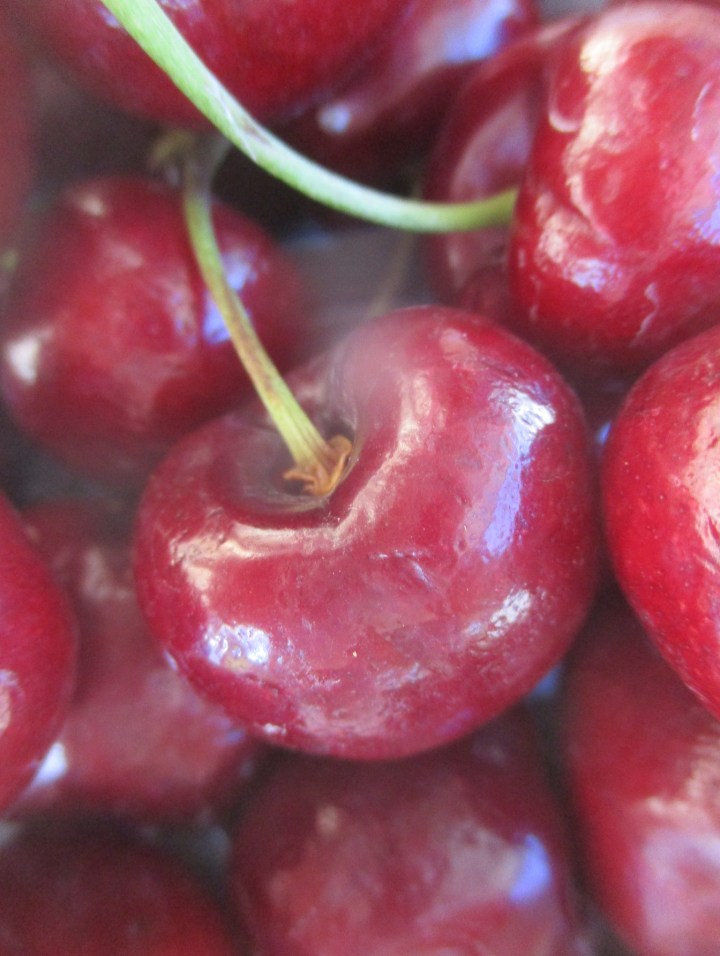
So much summer fruit is now in season. Most cherries have finished, but apricots, plums and prunes are still ripening. Nectarines and peaches will ripen immediately after them. Almonds will be the earliest nuts to ripen later in August or so. Birds, squirrels and other wildlife are eagerly watching and waiting. If they have not stolen fruit yet, they likely will.
Fruit appeals to wildlife like flowers do. Flowers employ attractive colors and fragrances to appeal to wildlife that pollinates them. Many reward such pollinators, which are mostly insects and hummingbirds, with nectar. Similarly, fruit uses attractive colors and aromas to lure wildlife that disperses its seed. Such fruit is compensation for this important work.
It is therefore only natural for wildlife to damage or abscond with fruit from home gardens. Such wildlife includes squirrels or various birds, or perhaps rats, opossums or raccoons. Protecting ripening fruit from them can be daunting. For some situations, it may not even be possible. Typically, wildlife takes only some fruit. However, sometimes, it ruins all of it.
Protection of fruit requires some familiarity with whomever exploits it. Squirrels and birds are visible as they are active during the day. Opossums, raccoons and rats are nocturnal, so are not visible during the day. Opossums and rats tend to nibble fruit but leave it on its stems. Raccoons tend to take fruit off trees to eat on the ground, leaving bits and pieces.
Bird netting can exclude birds, but is difficult to install, and almost impossible to remove. If effective for the particular birds, flash tape is an easier and more practical option. Fake owls or snakes deter both birds and squirrels. Relocation every few days improves their credibility. Because they are unfamiliar, plush toys may be as effective to deter squirrels.
Tree trunk baffles can protect fruit from opossums and raccoons. However, they are only effective if there is no other access from adjacent trees or fences. Rosemary, lavender or mint around fruit trees can supposedly be a minor deterrent. Not much deters a raccoon, though, once fruit starts to ripen. Electric fencing can be effective, but is not so practical.
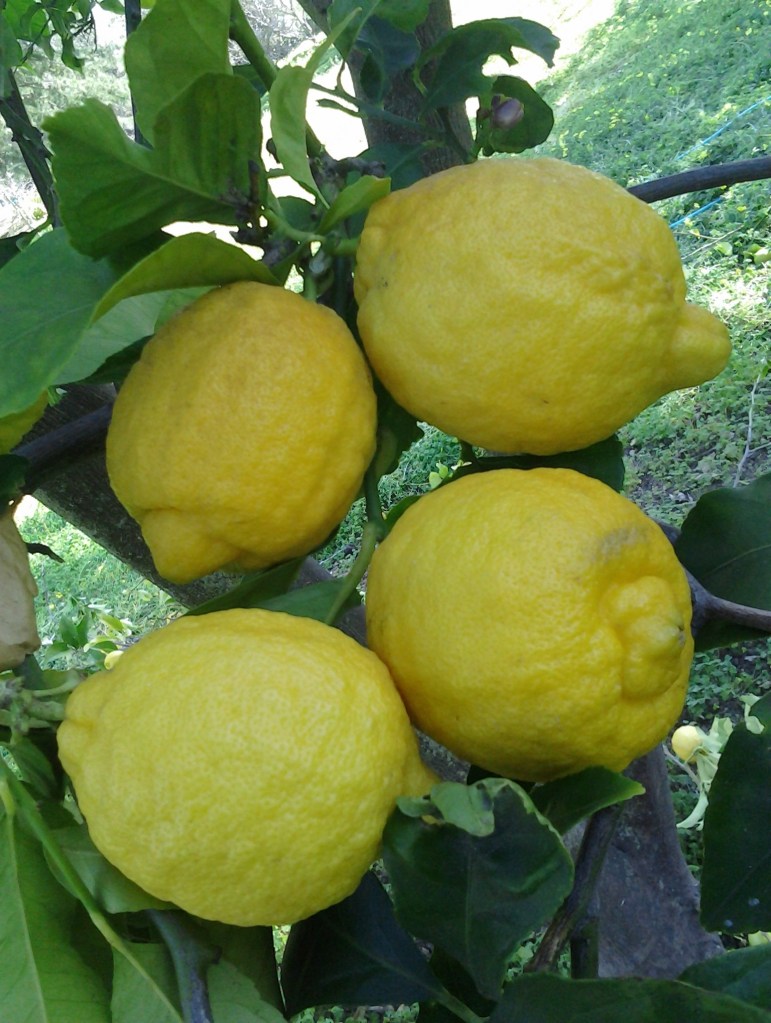
Planting and pruning of deciduous fruit trees are priorities for winter. Evergreen fruit trees are not as much of a concern. For them, planting and pruning should happen after winter. However, most citrus trees are most productive with their summerish fruit through winter. Oranges, lemons, limes, Mandarin oranges, grapefruit and more are ripening about now.
With the exception of Mandarin oranges, most citrus fruits are impressively durable. Most can last for months on their trees, which is likely why they seem so summerish. Mandarin oranges have loose skin, which causes them to oxidize faster than the others. ‘Valencia’ oranges, though, can linger for a year after ripening. They actually sweeten as they age.
Also, some cultivars of citrus extend their production with sporadic fruiting. While ‘Lisbon’ lemon fruits only for winter, ‘Eureka’ lemon fruits more sporadically. ‘Eureka’ is actually a cultivar or cultivated variety of ‘Lisbon’. Although a bit less productive in season, ‘Eureka’ produces several fruits out of season. It rarely disappoints by failing to provide a few fruit.
Oranges and lemons are the most familiar of citrus. They are surprisingly diverse though. ‘Meyer’ lemon is almost as acidic as other lemons, but with a richer flavor like an orange. Most oranges are dessert oranges for eating out of hand, but ‘Valencia’ is for juice. Blood oranges are for juicing, but ‘Moro’ is a dessert orange. Sour oranges are for marmalades.
Mandarin oranges that developed in the Americas formerly classified as tangerines. Now they seem to qualify as Mandarin oranges, like more traditional Mandarin oranges. They collectively might be the most diverse class of popular citrus. More cultivars of Mandarin orange are available than the others. ‘Rangpur’ lime is actually a sour Mandarin orange.
There is so much variety among citrus. Besides oranges, lemons and Mandarin oranges, there are too many to list. Grapefruit, limes kumquats, pomelos, calamondins and citrons are a few examples. Limequats are hybrids of limes and kumquats. Tangelos are hybrids of grapefruit and Mandarin oranges. Orangequats are hybrids of oranges and kumquats.
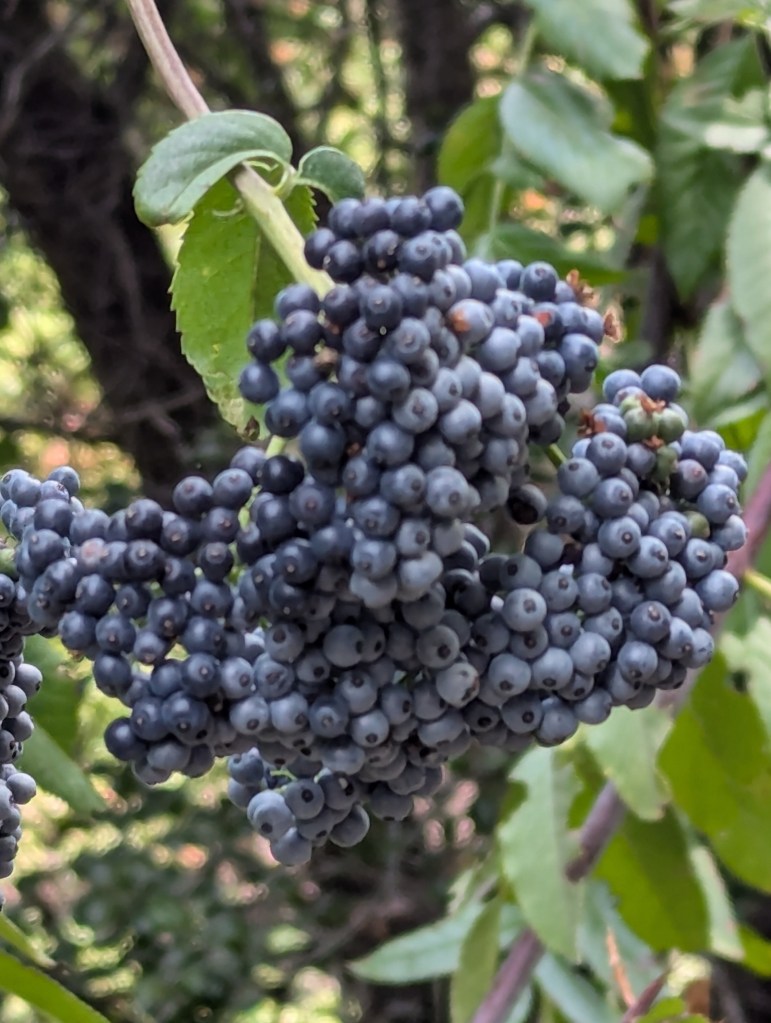
Native blue elderberry, Sambucus cerulea, can grow twenty feet tall and wide in the wild. It is rare among compact home gardens. Domestic specimens are fortunately conducive to various pruning techniques, though. They regenerate very efficiently from coppicing or pollarding. Alternating canes pruning involves more effort but promotes berry production.
Blue elderberries are toxic while fresh, but make good jelly or syrup when cooked. They are also edible dried. Although quite tiny, they grow in large clusters that are three or four inches wide or wider. They ripen through late summer. Flowers, which bloom during late spring, are useful for teas or cordials. Some find their floral fragrance to be unappealing.
Because it grows so large, blue elderberry can be a large shrub or a small tree. It usually develops several trunks. Aggressive dormant pruning enhances foliar lushness. Without much pruning, old trees can develop dense thicket growth with sparse foliage. Individual leaves are pinnately compound, with five to nine leaflets. They are as long as six inches.
Not many fruit trees have been in cultivation for as long. After several thousands of years of breeding, there are quite too many cultivars to count. Pomegranate, Punica granatum, is now common in many regions throughout the World. It is particularly productive within Mediterranean climates, including locally. Bare root trees are now available in nurseries.
Without pruning, old trees can grow fifteen feet tall, with dense and thorny thicket growth. Fruit is easier to collect from tamer trees that are subject to regular thinning and pruning. Individual trees typically develop a few trunks, but can have only one. They may survive for centuries. Ruddy orange flowers bloom for spring. Foliage yellows prior to defoliation.
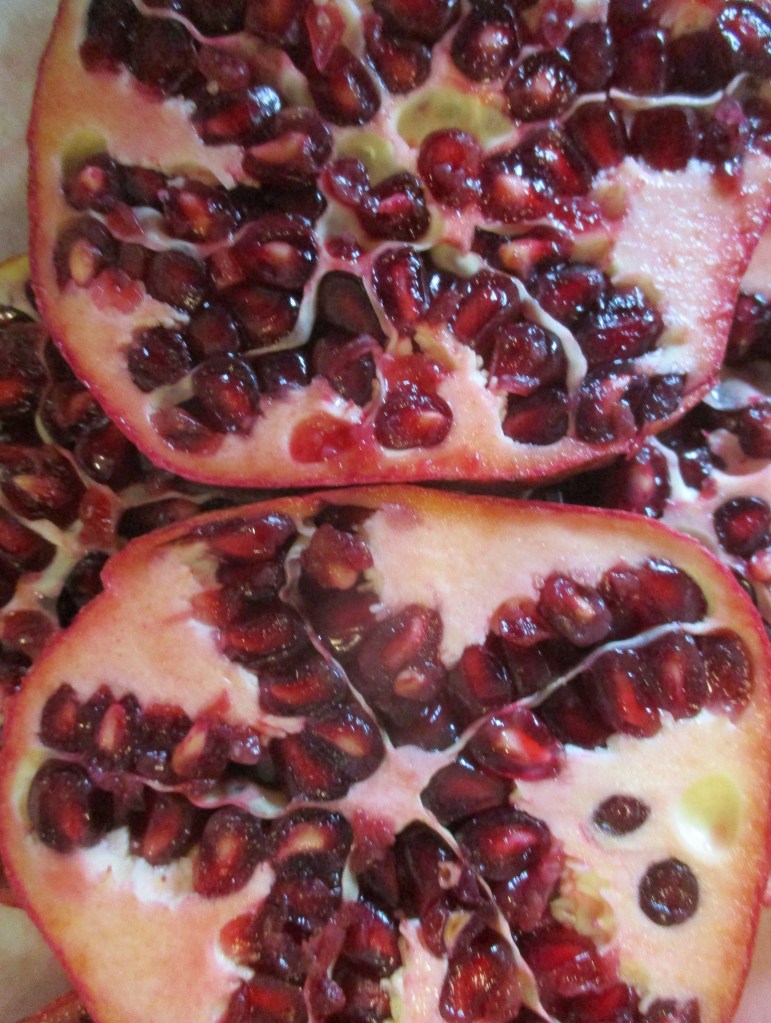
Pomegranate fruit ripens so late during autumn that it can linger after autumn defoliation. It is generally brownish red. Individual fruits are about three or four inches wide, but may be wider. They contain hundreds of seeds, which are surrounded by juicy and succulent flesh. Such flesh is generally garnet red, but might be purplish, pinkish or even colorless. Flowers are edible too.
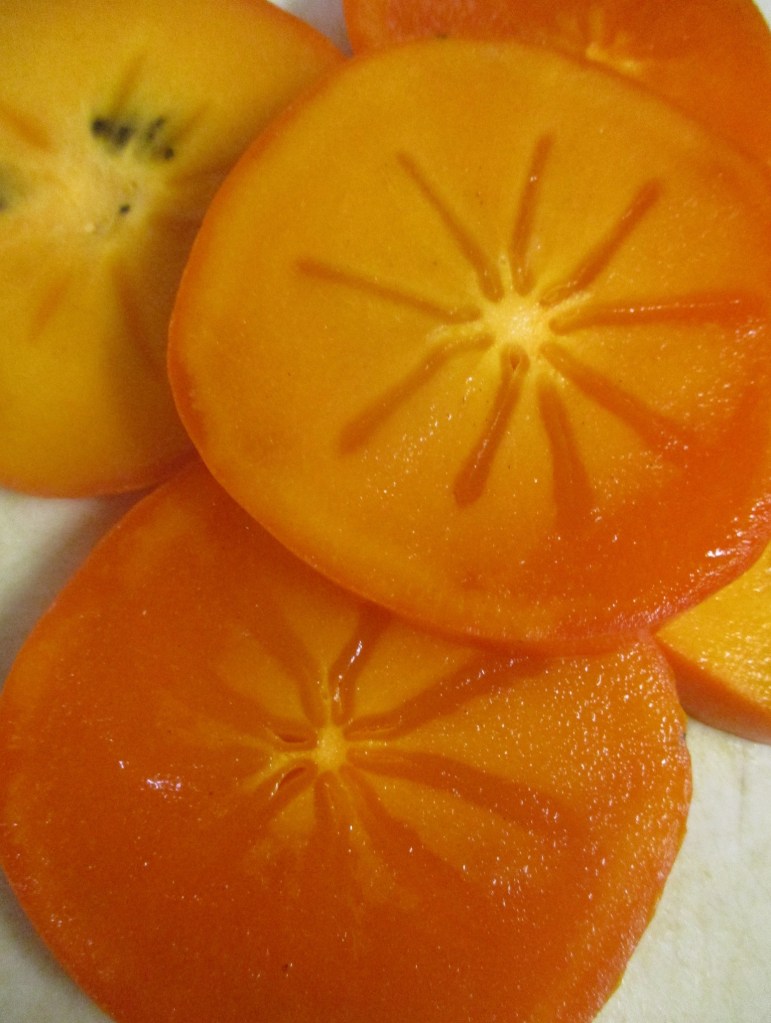
It lacks the spectacular spring bloom of the other deciduous fruit trees, but compensates. Persimmon, Diospyros kaki, performs double duty with fall color. Its autumn foliar color is impressively fiery orange. Then, it defoliates to reveal plump, abundant and comparably fiery orange fruit. So, it is spectacular with both autumn foliar color and autumn fruit color.
Persimmon trees are tempting. Some cultivars can grow twenty feet tall to become small or even mid sized shade trees. However, if they do so, much of their overly abundant fruit is unreachable. Aggressive and strategic pruning limits their production with most of their fruit in reach. Although undemanding otherwise, this major dormant pruning is important.
Persimmons are self fruitful without a pollinator. However, they supposedly provide more fruit of better quality with another cultivar. Fruit is unfortunately inedible before thoroughly ripe, but then all ripens simultaneously. That is an incentive to share with neighbors and friends. With a bit of effort, fruit is conducive to drying and freezing, although not canning. Ripe fruit is very perishable.
The Santa Clara Valley was formerly famous for fruit and nut production.
(This article is recycled from several years ago, so contains outdated information.)
The vast orchards that formerly inhabited the Santa Clara Valley were here because this is among the best places on Earth to grow apricots, cherries, prunes, almonds and walnuts. Actually, there are not many fruit trees that would prefer to be somewhere else. Home gardens continue to produce the many traditional fruits, as well as many other types of fruit that were not so common in the orchards; such as citrus, figs, apples, pears, persimmons, avocados, peaches, nectarines and too many more to fit into a brief list.
Those of us who enjoy growing fruit trees do not need to be reminded of how well they do here. Some trees produce too much and can become overwhelming. It is not always possible to can, dry, freeze or share with friends and neighbors all the fruit from the more productive trees. Leaving the fruit out in the garden is not only wasteful, but also bad for the garden, attractive to vermin, very messy and smelly.
Besides, there are other people in the community who could use it. During this past year, Village Harvest has harvested from local gardens, and distributed to those who can use the produce, approximately 156,000 pounds of fruit. The record for distribution of produce may be exceeded this year after apples, persimmons and citrus are harvested.
Volunteers make Village Harvest possible, by collecting excessive fruit from home gardens. Some of the people with productive trees like to retain some of the fruit. Volunteers are also welcome to take some of the fruit. The vast majority of fruit gets dispersed to others in the community who can use it.
(Most of the following information is outdated.)
The next apple harvest event in the Cupertino orchard on October 22 may no longer be able to accommodate additional volunteers; but the next major apple harvest in the Woodside Orchard on October 29 may still be in need of volunteers. Harvests take about three and a half to four hours, between 9:00 a.m. and 12:30 p.m.. Volunteers must be at least sixteen years old.
Volunteers can register for harvest events, or get more information at villageharvest.org. Early registration is recommended since space is limited. Volunteer instructions, including meeting location addresses will be e-mailed to volunteers a few days prior to each event. Those of us with excessively productive fruit trees who happen to be within range of harvest events can possibly make arrangements to get fruit harvested.
The next few neighborhood harvests will be on October 25 in Central San Jose, October 31 in Sunnyvale, November 1 in Central San Jose, November 6 in Mountain View, November 8 in Central San Jose, and November 14 in Sunnyvale. Sunnyvale harvests begin at 8:00 a.m.. Some harvests are repeated. For example, the Central San Jose harvests are weekly on Tuesday.
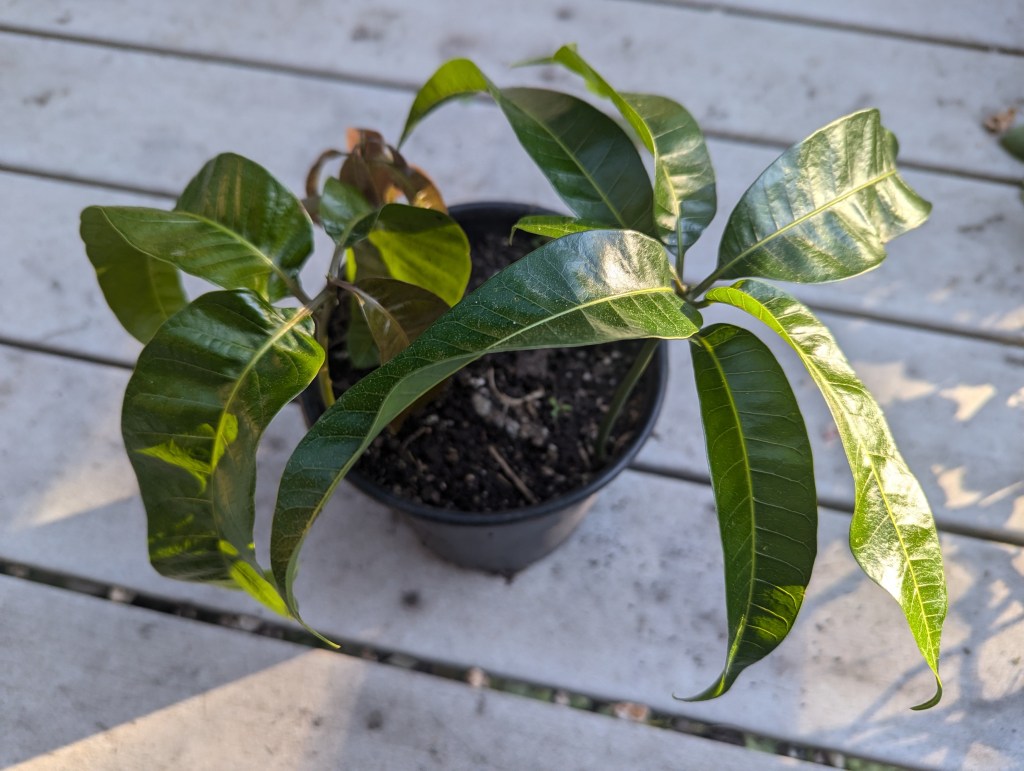
There are a few reasons to not grow avocado trees from seed. Such trees take a few years to produce fruit. Then, their fruit may be very different from the fruit that provided the seed. It is therefore better to purchase a grafted tree, or at least to graft a seedling. However, some of the best and most productive avocado trees have grown from seed. I have been acquainted with many such trees, and have never met even one that produced inferior fruit. (The primary problem that I notice with seed grown avocado trees is that they grow so tall while young that most of their fruit is out of reach, but that is another topic for later.) Anyway, this is my justification for growing mango trees from seed. I am told that they are much more likely than seed grown avocado trees to produce inferior fruit. I suppose that I will find out now. I am willing to try grafting them if their fruit is not good. They can at least become good understock. Yet, I am also wondering why I get into these situations. I should have known better than to grow something that I know nothing about.