Flowering cherries are a complicated group of many distinct hybrids, of several species. Japanese cherry, Prunus serrulata, is the most common ancestor of almost all of them. It is a relatively small deciduous tree that does not get much more than twenty five feet tall. The wild species produces unpalatable fruit, but its many hybrids are generally fruitless.
Most flowering cherries exhibit splendid autumn foliar color, with yellow, orange and red. Weeping cultivars develop strikingly pendulous form. Birch bark cherry exhibits distinctly smooth and chestnut brown bark, with broad lenticels. Weeping cultivars are sometimes grafted onto birch bark cherry trunks. This combines pendulous form with smooth trunks.
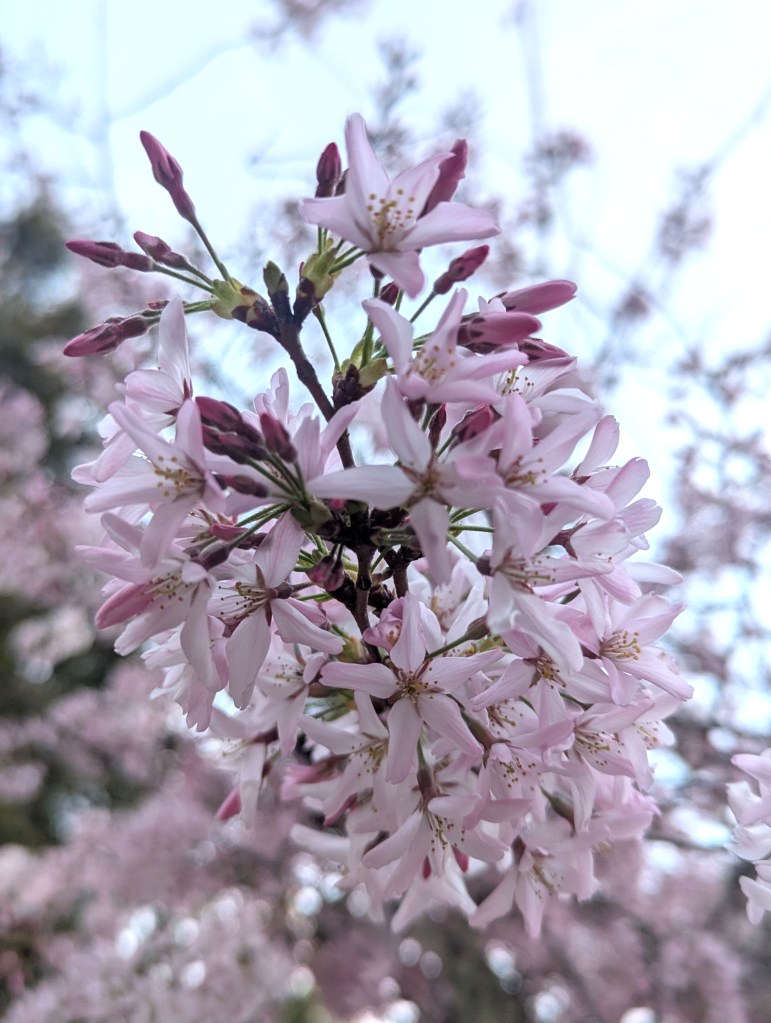
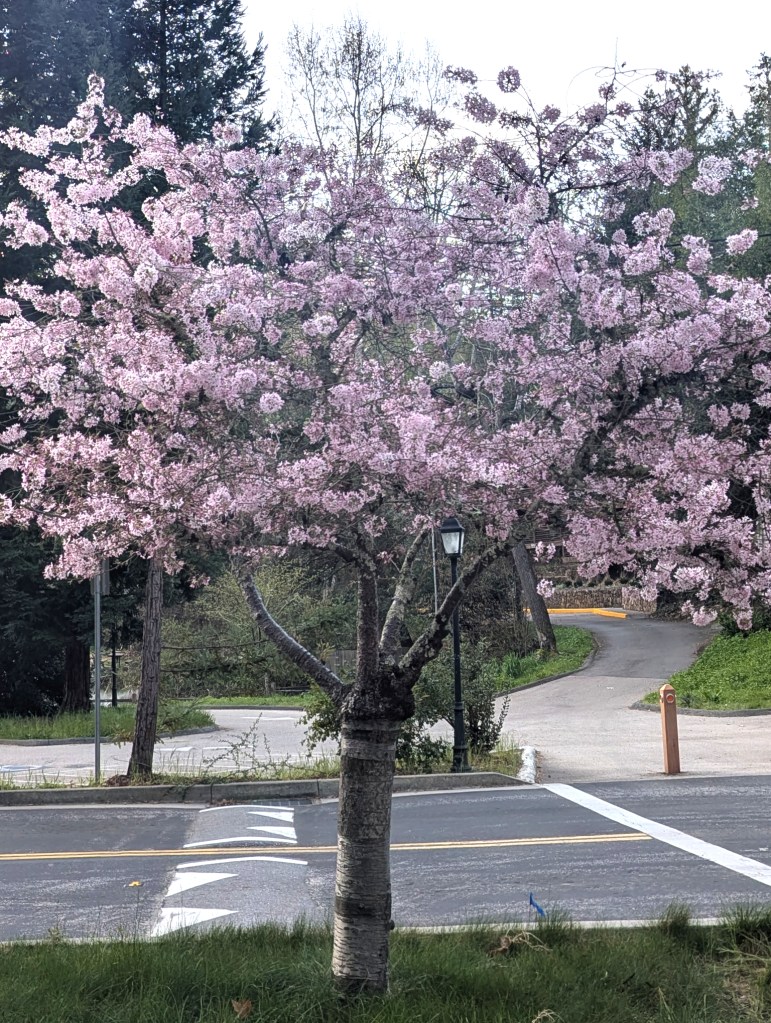
The primary allure of flowering cherries, though, is their profusions of early spring bloom. Floral color ranges from bright white to rosy pink, although most cultivars are pastel pink. Flowers can be delicately single or billowy double. Some cultivars bloom slightly earlier or later than others, but all bloom quite early. Their blooming stems are pretty cut flowers.
Fruit trees such as apricot, cherry, peach and plum, bloom about now. Some are already finished, while a few are just beginning. Apple and pear trees will bloom somewhat later. More colorfully, flowering or fruitless counterparts of such trees are on similar schedules. Flowering apricot has already finished bloom. Flowering crabapple will likely bloom last.
The difference between fruit trees and their flowering counterparts is not their bloom. It is their fruit or lack thereof. “Flowering” has become a euphemism for “fruitless”. Trees with such designation produce either no fruit or fruit of relatively inferior quality. Wildlife might enjoy some of any inferior fruit. Although, even inferior crabapples might make good jelly.
Purple leaf plums are probably the most popular of this type of flowering or fruitless tree. Flowering cherry is less common. Flowering peach is somewhat rare. Fruitless pear is a popular street tree, but may not bloom as profusely as the others. Also, it does not bloom quite as early. Flowering quince grows as shrubbery rather than trees with upright trunks.
While very closely related, fruiting trees and their fruitless counterparts are very different. Fruiting trees should obviously produce fruit. That is their primary purpose. Their fruitless counterparts are merely ornamental. The truly fruitless types grow and bloom where fruit would be a messy nuisance. For example, some perform well as small scale street trees.
Because they are fruitless, such trees do not require specialized dormant pruning. There is no need to prune to concentrate resources into developing fruit. Nor is there any need to prune to accommodate the weight of fruit. Fruitless trees can assume their natural form and scale instead. Although none are large trees, they can grow taller than fruiting trees.
Also because they are fruitless, their bloom is their priority. They bloom more abundantly than fruiting trees, and some bloom with double flowers. Floral color is more diverse too, ranging from bright white to rich rosy pink. Some flowering crabapple trees bloom nearly red. Since dormant pruning is unnecessary, blooming stems are splendid as cut flowers.
The Shrub Queen sent me seed for sea grape, Coccoloba uvifera. Naturally, it is now very important to me. I wanted to grow it before obtaining the seed. Now, I am obligated to grow it well! Some of the seed germinated readily. The problem is that slugs promptly ate the tops of the seedlings. Only one seedling survived without damage. It now has its first pair of leaves, and looks like a green butterfly. A second seedling that germinated shortly afterward retains one of its first pair of leaves, so could possibly survive. Hopefully, more seed will germinate later. Sea grape is dioecious; so the primary seedling is either male or female, and therefore unable to produce fruit without a mate of the opposite gender. Most sea grape are female; so even if the secondary seedling survives, there is more than a fifty percent probability that both the primary and secondary seedlings are female. If more seedlings germinate in the future, they will increase the probability that at least one will be a gender that is different from the others. Actually though, I would be pleased with only a single fruitless sea grape. The seed was such a generous gift.
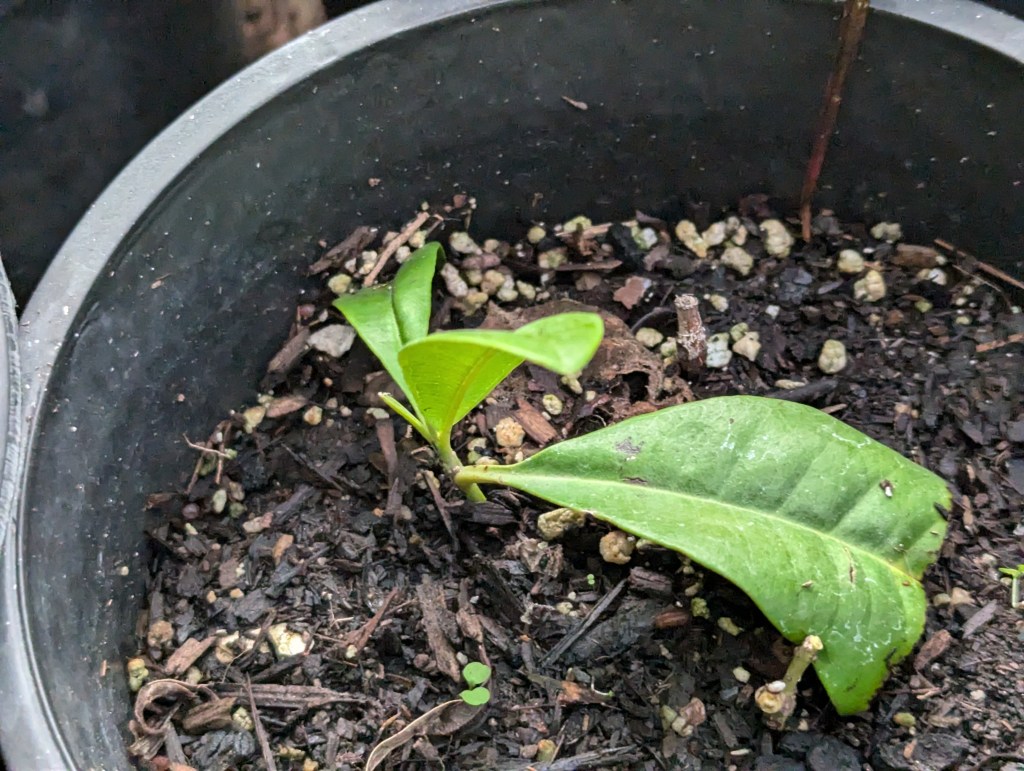
Jamaican allspice, Pimenta dioica, is rare here. I am beginning to learn why. Because it is tropical, it is vulnerable to even very minor frost. Actually, it is not so keen on chill either. It is rated for climates that are no cooler in winter than Zone 10. This is Zone 9. It seems to grow reasonably well in the Los Angeles region, where I collected my cuttings from Brent’s Jungalow Garden, but it is rare there also. That could be because it is not much to look at. Its foliage is no more interesting visually than that of common privet. Although the foliage is splendidly aromatic, only those who are familiar with the species, or become acquainted with its aroma while pruning it, would know. Its bloom is neither prominently colorful nor fragrant. What is worse is that the bloom is dioecious, with male or female flowers on different specimens. Single specimens have no problem blooming, but can not produce allspice fruits without a mate. Single male specimens are fruitless for obvious reasons. Single female specimens are fruitless without pollination. Not many people who grow the very rare single specimens are aware of this, although most are satisfied with the delightfully aromatic foliage. New specimens only very rarely become available in nurseries, and when they do, all of them were likely grown from the same stock specimen, so are genetically identical and of the same gender. Only seed grown specimens are random in regard to their respective genders, and even among them, their genders are unknown until they eventually bloom. The potential for growing both genders is proportionate to the number of seedlings. For example, one seedling will be of one gender. Two seedlings are as likely to be of the same gender as they are to be of different genders. Three are more likely to include one of another gender. Several or many are proportionately less likely to be of the same gender. All of my several cuttings were from the same specimen, so would have been genetically identical. It does not matter much now anyway, since only one survived, and even it is still rather wimpy. It has developed only two new leaves, and retains a trimmed portion of one of its original leaves. I am pleased with it regardless of its gender, and will be satisfied with only its aromatic foliage.

 Tony Tomeo