The San Francisco Flower and Garden Show (2010)

(This article is from 2010, so contains irrelevantly outdated information, but the link to the website below is accurate.)

The big Pacific maples outside my window never seem to get enough rest through the brief winters. Not too long ago, their leaves turned yellow and fell during autumn. Their branches were bare for only a short time through the middle of winter. Now their buds are popping open to remind me that it is now early spring. Gardening can no longer be put off because the weather is too cool and rainy to go outside, or for that matter, because it is too cool for the various plants to be actively growing and in need of much attention. Gardening now becomes a rush just to keep up with all that is going on, and to not miss out on the many excellent gardening events this time of year.  

The San Francisco Flower and Garden Show, the grandest of these events, has already begun and will continue though March 28 at the San Mateo Event Center. More than 70 seminars feature topics such as sustainability in the garden, edible gardening, new plants, garden design, container gardens and water conservation. Guests can also learn how to create bonsai, build trellises, grow orchids, prune properly and how to determine what plants are best for each garden. Sproutopia has fun and educational activities and entertainment for young children.

There are also many displays exhibiting everything from garden sculpture to victory gardens. The pocket parks and container garden display shows the potential of gardening with limited space, or with little time to devote to gardening. The Bonsai Society of San Francisco is exhibiting impressively mature bonsai specimens, and demonstrating bonsai techniques. Flower Lane exhibits floral design by California Garden Clubs. Hot Plant Picks displays some of the most recently introduced or developed plants. Some are still too new to be available in nurseries yet.  

Gardens for the Future, the twenty display gardens that are the most prominent component of the San Francisco Flower and Garden Show, illustrate themes ranging from simple and refined to opulent and lush. ‘Velvet Daggers3’ may be my favorite because it “suggests that we seek out new applications of simple technology” and “demonstrates the beautiful qualities of xeric plants” (yuccas perhaps!?). ‘Pulling Up Daisies’ defies conventional thirsty lawns and consumptive landscaping, suggesting evolution of environmental compatible landscaping with natives. “The use of native plants makes ‘Native Garden 3.0’ a model of sustainability.” These are merely three of my favorite gardens. There are seventeen others that are worthy of more theatrical descriptions! 

The San Francisco Flower and Garden Show will be open from 10:00 a.m. to 8:00 p.m., except on Sunday, March 28, when it will close two hours earlier at 6:00 p.m.. It is at The San Mateo Event Center, which is located at 2495 South Delaware Street in San Mateo. Admission is $20 for all five days, or $4 for youths sixteen years old and younger. Children four years old and younger are free. Student admission is $15 with valid student identification. After 3:00 p.m., or 2:00 p.m. on the last day, half day admission is $12. More information can be found at www.sfgardenshow.com

Safety First

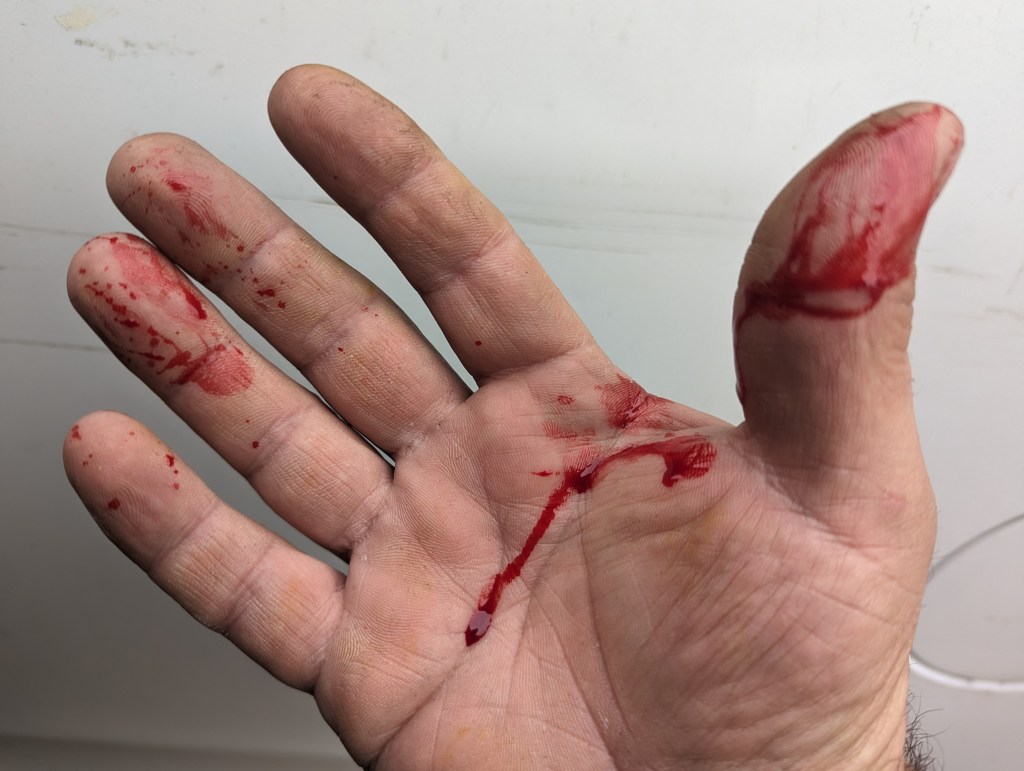
OUCH!

You should have seen the other guy.

Actually, this blood was not contributed by someone else. No one else was involved. Perhaps that was the problem.

I can not sharpen blades. I tried for a long time years ago, before eventually realizing that it would be best to rely on someone else to sharpen my blades. Those who know how to do it make it seem so easy. I have no idea how they do it so well, but I know that they do because it is how my blades get sharpened. It is an enviable ability.

Well, I neglected to get someone to sharpen my blades for a very long time. Naturally, my overused and worn pruning shears are beyond mildly dull. As most of us know, “A dull blade is more dangerous than a sharp blade.”.

The blade did not cause this damage directly. As I wrestled with the dull shears, they unexpectedly slipped past the stem that I was cutting so suddenly that I bashed my thumb against the accordingly damaged latch on the opposing handle. The injury was not bad; but I was too annoyed by it to stop what I was doing, which is why the blood continued to get messy.

I only took this picture so that I could later brag about rescuing a school bus full of Girl Scouts from an attacking polar bear, or something like that. I just have not gotten around to doing so yet. It might have been a grizzly bear.

Because these particular pruning shears are so worn, with a broken latch and a chipped blade, they really should be replaced rather than sharpened. They are the cheapie sort that can not be repaired. The blade can not be replaced. They performed exemplarily longer than they should have.

Horridculture – Weed Eaters

P90410The most destructive tools that so-called ‘gardeners’ have access to are hedge shears. They use them on just about anything within their reach. If a tree is not beyond their reach, they are likely to shear it into a nondescript glob of a shrub, complete with lodgepole stakes and straps that never get removed. Yet, in all their enthusiasm, they will not properly shear hedges that are actually intended to be shorn. Well, I have ranted on that enough.

The second most destructive tools that so-called ‘gardeners’ have access to are weed eaters, which are also known as weed whackers or edgers. Although not actually related to real edgers, they are known as such just because they are so commonly used for the same purpose. Weed eaters are designed to cut weeds indiscriminately, and are quite efficient at doing so. The problem is that they cut or try to cut anything else they encounter.
So-called ‘gardeners’ often gouge the paint off of the bottoms of walls and fences, just because it is easier to cut the weeds there with a weed eater than it is to pull them. What is worse is that they also often cut off the tops of perennials that are trying to regenerate in spring after winter dormancy. Spring or summer bulbs might never get a chance to bloom. Perennials, groundcover plants and shrubbery are not safe from the blatant indiscretion.
The sad little Memorial Tree in Felton Covered Bridge Park gets gouged more than annually by a weed eater. Every time it happens, I am assured that it will not happen again; but if the weeds get cut before I pull them from around the trunk, it does . . . very regularly. I was also assured that the tree would be outfitted with a tree-guard, but as you can see, it has not yet happened. I am told that I can not put my own guard on the trunk.
Those causing this damage are non-horticulturally oriented people who are assigned community service for some sort of infraction, so should not really be expected to know how to use weed eaters properly; not that this is any consolation for the damage. What is worse is that such damage is so commonly caused by so-called ‘gardeners’ who really should know better, and charge good money to take care of the trees they damage and kill
The most recent article about the Memorial Tree, with a link to a previous article that links to previous articles . . . and so on, can be found at: https://tonytomeo.com/2018/10/14/memorial-memorial/

Merry Christmas!

P71225Does anyone else think that it is odd that Baby Jesus got only some frankincense, myrrh and gold for His first Christmas? I mean, it was the first Christmas ever, and that was the best that anyone could do? Well, maybe those gifts were something important back then. Maybe it was a good heap of gold. It just seems to me that three ‘wise’ men could have procured better gifts. More than two thousand years later, some of us are disappointed if we do not get a new Lexus on Jesus’ birthday, after He got only frankincense, myrrh and gold. (Get your own birthday!)
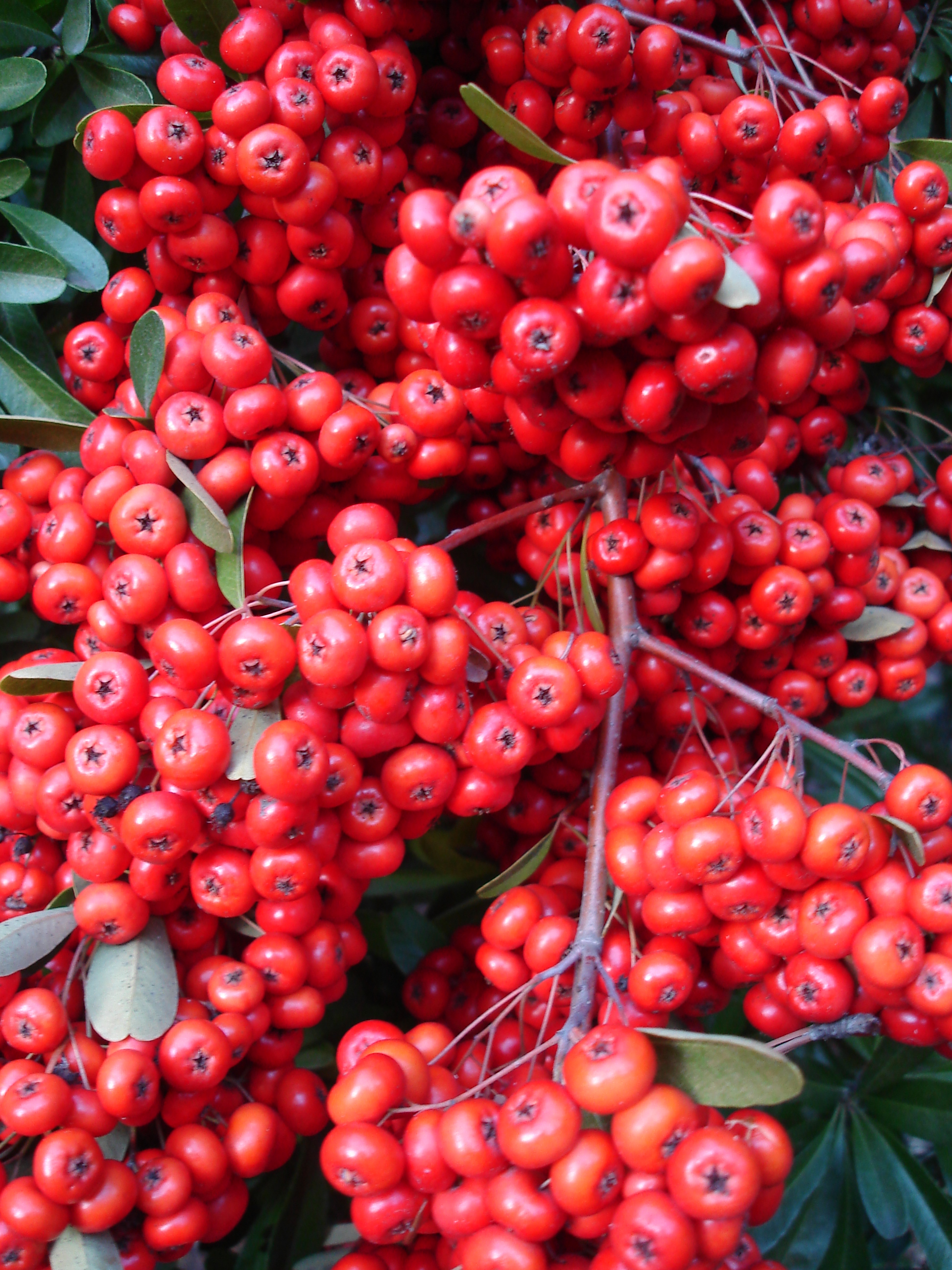
Although I do not remember my first Christmas, I know that my parents and others got excellent Christmas gifts for us kids when we were young. Our stocking that hung over the fireplace were filled with a mix of nuts, mandarin oranges, cellophane wrapped hard candies and small wooden toys. This is a tradition that dates back to a time when citrus fruits and certain nuts were something fancy that needed to be imported to Northern Europe from Mediterranean regions.

Of course, citrus grows quite well in our region, and almonds and walnuts still grew in the last remnants of local orchards. Our great grandparents had two mature English walnut trees in their gardens. Only pecans and hazelnuts were exotic. I happened to like pecans because they are from Oklahoma. (I did not know where or what Oklahoma was back then, but I knew it was an excellent place.) Hazelnuts were from Vermont, which is twice as far away as Oklahoma is, if you can believe that!

The gifts under the Christmas trees were even more excellent! One year, I got packets of seed for a warm season vegetable garden the following spring. There were seed for pole beans, corn, pumpkins, cucumbers and zucchini. (The cabbage incident that I will write about later happened in the cool season garden the following autumn.) Under the Christmas tree at my grandparents house, I got all the gardening tools that I would need in my garden, including a small shovel, garden rake, leaf rake and hoe. But wait, there’s more! Under the Christmas tree at my great grandparent’s house, I got flower seed for bachelor button, alyssum and a few others, as well as bare root rhubarb plants (from my great grandfather’s rhubarb that he had been growing longer than anyone can remember). I had already learned about seed from my first nasturtiums (https://tonytomeo.wordpress.com/2017/10/07/dago-pansies/), so I could not have been more pleased with my cache of gifts.

For later Christmases, and also birthdays, I got all sort of other things that were much more excellent than frankincense, myrrh and gold, including an incense cedar (how appropriate) that my grandparents brought back from the summer house near Pioneer, and a young ‘Meyer’ lemon tree. My Radio Flyer wagon was the biggest and most excellent in the neighborhood, and was more than sufficient to haul all my gear around the garden with. My big watering can was a bit too big, and was too heavy for me to move when it was full of water.

I would not say that these gifts were extravagant. They were just . . . okay, so they were extravagant. It was a long time ago. Unfortunately, my parents figured out that their gifts were somewhat excessive just prior to buying me the Buick I wanted. The wagon is still around. My mother uses it to bring in firewood. She also uses the little shovel to clean ash from the stove.

(The gardening article that is regularly scheduled for Mondays is scheduled for tomorrow. The featured species that is regularly scheduled for Tuesdays is scheduled for Wednesday.)P71225+