Horridculture – Queen Nefertiti

Ancient Egyptian influence within a modern landscape

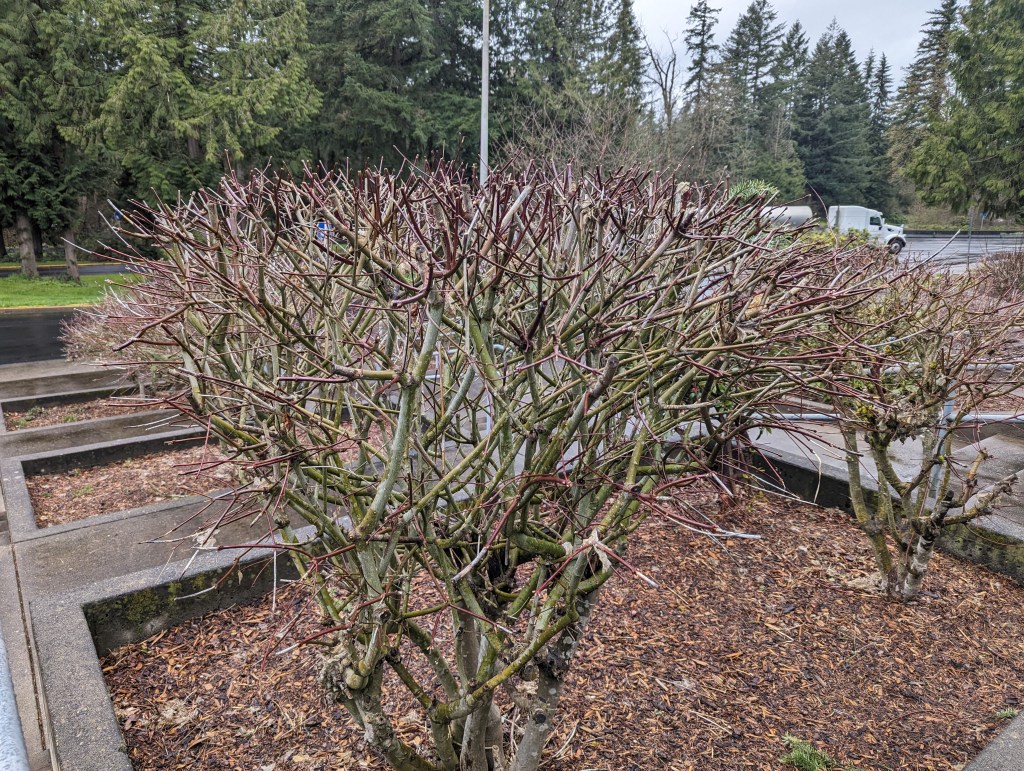
Queen Nefertiti, during the fourteenth century BC, was the most famous and most influential Queen of Ancient Egypt. She wore a cool hat too. It was sort of cylindrical shaped, but also tapered so that it was wider on top, sort of like a funnel. So, not only was Queen Nefertiti very influential during her time, but she remains influential in modern mow, blow and go gardening. So-called ‘gardeners’ everywhere still shear shrubbery into the shape of Queen Nefertiti’s cool hat! Not many species of shrubbery are exempt. Just about any get shorn into a sort of cylinder shape that is wider on top, sort of like a funnel, but also tilted in one direction or another, just like Queen Nefertiti’s hat tilts toward the back. Such shearing typically deprives blooming shrubbery of its bloom, but bloom is apparently not a priority, as long as the ancient Egyptian form is maintained. The picture above includes four oleanders, a Texas sage and what seems to be two trailing lantana. The Texas sage and trailing lantana are more cylindrical than hat shaped, but the hat shape of the three oleanders is impossible to deny. It is such a universal technique that is performed so precisely wherever vegetation is maintained by mow, blow and go gardeners that it seems to be taught in classes as standard procedure. I am significantly more educated in horticulture than most mow, blow and go ‘gardeners’, but I somehow missed this in my curriculum. Instead, I learned that vegetation should be allowed to exhibit its natural attributes, such as form, texture, bloom and so on. If I wanted a herd of ancient Egyptian hats in my garden, I would probably construct something that resembled ancient Egyptian hats from an inert material that never needs shearing or irrigation.

the Original
a modern version of an ancient Egyptian fashion show

Improper Pruning Is More Work Than Proper Pruning

Vine maples should be small trees, not . . . this.

In the short time it took me to run to the back yard to get some big stakes and something to pound them into the ground with, the unfortunate deed had been done. I had come home to find that one of my neighbor’s new Canary Island pine trees had blown down. I also noticed that the gardeners were there; so I wanted to get the tree staked properly before the gardeners got to it. Sadly, as I returned with stakes, ties and a mallet, I found that the gardeners were faster. Instead of standing the small tree up and staking it, they had already shorn the formerly well structured canopy into a globular mound that was about the same size and shape as most other items throughout the landscape, for no other reason than it was within their reach.

This same landscape had egg shaped African iris ‘bushes’ that only rarely bloomed if they happened to get an errant flower stalk out between shearings, and short, round trumpet vine ‘bushes’ in front of hefty  but bare trellises that they were never allowed to climb. Everything that was within reach was shorn, even the underside of an elegant Chinese elm that really should have been pruned properly by an arborist. The landscape was actually well designed, but could not perform as planned because of the shear abuse.

I really do not mind proper shearing of particular shrubbery that is intended to be shorn. I actually like old fashioned privet or boxwood hedges. However, even hedges need to be shorn properly; and realistically, not much else should be shorn as often. If it needs to be shorn regularly, but is not a hedge, it is probably not the right plant material for the job.

Properly selected plant material is proportionate to its particular application. This certainly does not mean that it does not need to be pruned. Most deciduous fruit trees and roses need to be pruned aggressively every winter, and almost all plant material needs to be pruned in some manner at one time or another. The difference is that shearing is indiscriminate pruning of outer growth without regard for foliage, bloom or branch structure. This is fine for hedges, but disfigures many other plants, and deprives them of their blooms and natural foliar textures that they were planted for.

For example, wisteria is an abundantly blooming robust vine that becomes a gnarled shrub that cannot bloom if shorn. Heavenly bamboo (nandina) is grown for its graceful and colorful foliage, but becomes a grungy rigid thicket of tattered leaves and stems with shearing. Although some shrubby junipers can make nice low hedges, frequent shearing deprives them of their feathery texture.   

This is why it is so important to know what the various plants in the garden need. They can only perform as intended with the proper care and maintenance, which includes proper pruning. Hedges may only need to be properly shorn, but almost everything else needs to be selectively pruned, thinned, elevated (raised), divided, groomed, trimmed, trained or even cut back. 

Design and Implementation

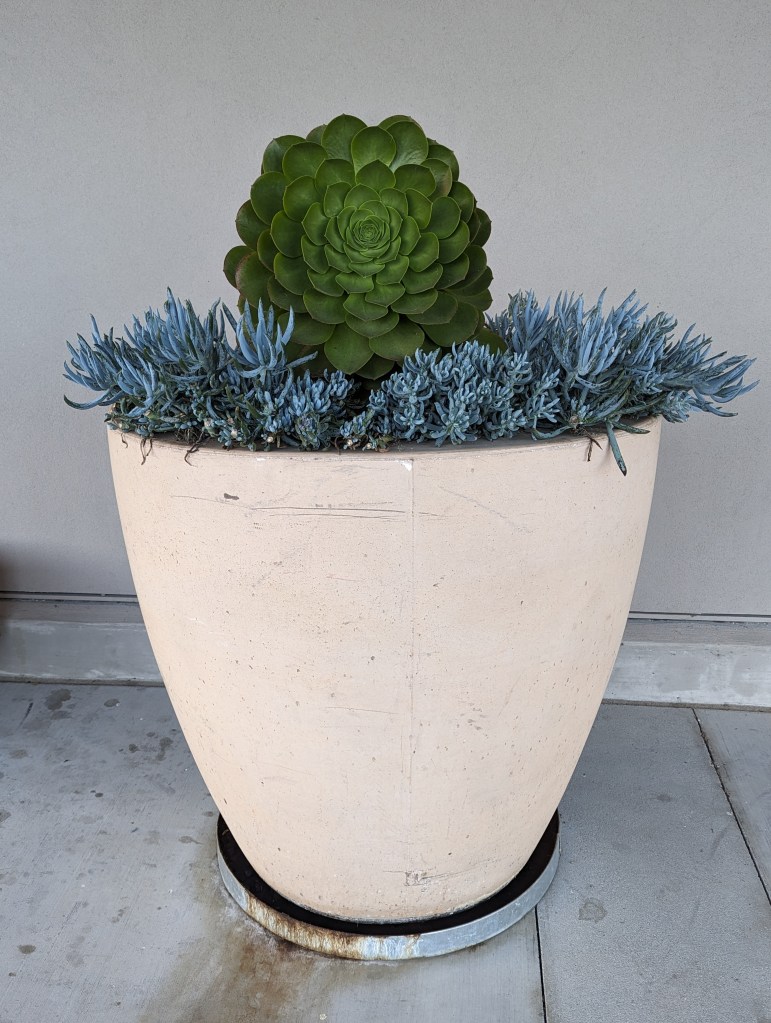
This exposed urn looks like a koala tummy.

This is so silly that I sort of like it. I mean, I found it to be sufficiently amusing to get a picture of it to send to Brent. It is a nice large urn, with an Aeonium arboreum that is a bit bolder than any of mine, and delightfully blue Senecio mandraliscae. It has nothing else going for it, but perhaps its simplicity is an asset. It might look junky if it contained any other well planned but comparably maintained material.

My only personal criticism of its design is that it is located on otherwise useful pavement, where pedestrian traffic must divert around it; but I am merely a horticulturist, not a landscape designer. For all I know, it could be there to intentionally soften the expansiveness of all that useful pavement, without occupying too much of it. I would also say that the urn should be outfitted with species that are more tolerant of the partial shade of its particular exposure, but obviously, these two simple species are reasonably happy there.

My more realistic criticism is of its implementation. Is it really too difficult for so-called maintenance ‘gardeners’ to maintain this as the landscape designer who designed it thought they should be able to? Must landscape designers design their landscapes with the expectation that their work will not be maintained as expected? Although it is delightfully silly, it might be more visually appealing if the Senecio mandraliscae cascaded a bit more over the edge. Alternatively, it could be confined to the upper surface of the urn if a third perennial were allowed to cascade somewhat over the edge; but again, I am no landscape designer. The urn is nice, but might be nicer with a bit of foliar color, form and texture over some of its exterior.

Horridculture – “Help! I’ve fallen and I can’t get up!”

The landscape maintenance industry attracts apathetic idiots. There is no nice way of saying it. Those who have flunked out of everything else and simply do not care can push a mower. I can not imagine how infuriating this must be for gardeners who take their work seriously. It must be more difficult for them to observe than it is for me.

More to the point, the jacaranda tree in the median pictured above fell down and stayed that way long enough for the canopy to try to grow into a normal tree. It likely got run over by a car. No one bothered to try to stand it up and stake it, or more simply remove it, and maybe replace it. It just stayed there, for YEARS. So-called maintenance ‘gardeners’ just mow around it, and weed whack the grass that they can not mow below the horizontal trunk. Arborists might eventually groom the canopy. Apparently, they all find this to be acceptable horticultural procedure.

The Brazilian pepper tree pictured below is almost as weird. It is slightly more tolerable only because it has not been in this position as long. Perhaps SOMEONE or ANYONE will realize how inappropriate its horizontal orientation is for the parking lot that it inhabits, and remove it. It had been falling over slowly, which is why the exposed roots are already weathered. No one bothered to prune it for weight reduction or to improve the clearance on the side that it was falling toward. Otherwise, it might have been able to support itself, even with a bit an irregular but tolerable lean. Now that it is on the ground, some so-called ‘gardener’ pruned it around the parking spaces that it fell between. Seriously! The bumper of the pickup is against a now hedged portion of the canopy of the fallen tree. The branches to the left in the picture were pruned between adjacent parking spaces so that they can actually accommodate parked cars as they were intended to. Seriously, rather than simply cut the tree ‘down’ and remove it, someone devoted that much effort into something as crazily dysfunctional as this. IT WOULD HAVE BEEN MUCH EASIER TO DO THIS PROPERLY!

Maintenance Gardeners Often Need Help

Gardeners can rake leaves and mow lawns, but may not be qualified for some of the more specialized horticultural techniques.

Even some of the most avid of garden enthusiasts get some of the work in the garden done by maintenance gardeners. In many regards, even the common ‘mow-blow-&-go’ gardeners can be very helpful. As long as they are not expected to work with trees or shear anything (or everything), they can be remarkably efficient at the tedious and most demanding of tasks that are not much fun. For example, and as the job description implies, they can mow boring lawns and blow inert pavement. We can tend to our own meticulous chores, such as pruning roses and burying bulbs.

However, as professionals, gardeners must be as efficient with their time as possible, so rarely have the luxury of devoting the sort of attention to our gardens as those of us who enjoy gardening as a leisure activity. Consequently, they tend to be more generous with automated irrigation than they need to be. The immediate symptoms of insufficiency are more apparent than the symptoms of excess; so too much seems to be better than not enough. To make matters worse, the driest area of a lawn or bed is the limiting factor for automated irrigation, since everything else that gets watered along with the particular dry spot gets the same frequency and duration (volume) of irrigation.

At a time when many of us are already trying to use significantly less water, it is frustrating to notice any waste. In most gardens, lawn uses more water than everything else combined, but is also the part of the garden that many of us relinquish to maintenance gardeners who are not always there to notice waste. Regardless of any drought or water conservation, excessive irrigation is expensive and unhealthy to trees and many other plants.

Unfortunately, irrigation schedules can not be prescribed, but must be determined by direct experience with the lawn or landscape being irrigated. Even without rain, lawns and landscaped areas require less water through the (normally) cooler and shorter days of winter. The trick to rationing is to give the garden only as much as it needs to survive without allowing it to get too dry, which will undoubtedly cause some friction with any gardeners who may work with it.

Horridculture – Dust Bowl

P00520
Cimarron County in 1940 or the road out back last Wednesday?


In a commotion that an Okie would flee from, the road out back got blown last week. What a mess! Dust was everywhere, and I mean, except for the road from which it was blown, it went ‘everywhere’. The engines of the two blowers at full throttle echoed loudly against pavement, the cinder block and metallic walls of the industrial buildings, and under the broad eaves above.

Fortunately, no one else was here to be bothered by it. Actually, no one would have been as bothered by it as we were by the crud that was on the road prior to getting blown. We know that blowing is sometimes necessary. There are only a few windows on the industrial buildings, and they were all closed. The few vehicles that happened to be parked nearby were already dirty.

Where I lived in town many years ago, the apartment buildings to the north and south were ‘maintained’ by so-called mow-blow-and-go ‘gardeners’. The building to the south lacked a lawn, but there was plenty of shrubbery there to be destroyed, even though the name of the technique does not rhyme with the rest of the routine. For both buildings, blowing dust was extreme.

There was no attempt to be tactful about it. The so-called ‘gardeners’ operated their blowers very loudly at full throttle, with no regard for where all the crud went from the pavement. Much of it went onto cars in the carports. Much went into the washrooms. Almost monthly, I needed to ignite the blown out pilot for the water heater in the washroom of the building to the north.

Both back corners of my garden were paved. There was a small paved laundry yard to the north, and a small paved trash yard to the south. The so-called ‘gardeners’ on both sides removed the kickboards from below the rear panels of those dreadful fences that I disliked so much, and blew the detritus from the neighboring properties into may back yard as if I would not notice.

When I replaced the kickboards, the so-called ‘gardeners’ broke pieces of them out, and continued with their technique. There was not much detritus from pavement that got blown weekly, but it was enough for me to collect and show to the property management of the adjacent apartments. It put the ‘go’ in ‘mow-blow-and-go’. It was the same technique only a few years apart.

As necessary as they are, and even though they can be used properly and tactfully, blowers still annoy me. The noise, the dust, and the seemingly innate disregard for others are not justified by their efficiency. I have used them, so I know that a practical degree of tact does not compromise efficiency. They exemplify the worst of what a formerly respectable industry has become.

Horridculture – Major Improvement

P00401-1
A bit of Boston ivy adds a bit of texture and color to the stone wall.

My rant for this week is that I was deprived of my rant. I went to a nearby landscape that had been trashed by the so-called ‘gardeners’ for many years, only to find some unexpected and major improvements. I do not know what happened. Although it will take some time for the landscape to recover from the prior damage, it is already starting to function as intended.

It is obvious that the landscape was very well designed. Although I know very little about design, I know what is horticulturally correct. The designer selected species that are very appropriate for every application, even though none were particularly trendy at the time. Those who were hired to maintain the landscape only interfered with its intended development.

I noticed several improvements, but got pictures of only two features that bothered me the most prior to this season.

Obviously, the landscape designer intended the trailing rosemary in the picture above to cascade over the stone retaining wall, not so much to obscure the appealing stonework, but to break up its expansiveness. Obviously, the Boston ivy was intended to climb up from below to do a bit more of the same, and provide a bit of color in autumn, without overwhelming the rosemary.

Until recently, the so-called ‘gardeners’ had shorn the Boston ivy into useless little globs at the base of the wall. If it crept onto the wall, they were sure to remove it just as it was starting to exhibit color for autumn. The rosemary was never allowed to hang over the edge, and typically got shorn just as it was beginning a bloom phase.

Now, the Boston ivy is allowed to climb the wall somewhat. I suspect that it will be partly removed through the year, just so that it can provide a bit of color by autumn, but without getting too overgrown. Also, the formerly shorn edge of the rosemary is beginning to take on a natural form, and will likely start to cascade through summer, hopefully with occasional thinning.

What bothered me even more than the glaringly bare wall was how this pair of flowering crabapples in the picture below got hacked back annually just as the flower buds were beginning to show the slightest bit of color. Seriously! Every little twig that could have bloomed was removed. The so-called ‘gardeners’ were weirdly punctual about this.

Well, the trees got pruned a bit earlier last winter. What I did not bother to notice earlier was that much of the unsightly stems that had been disfigured by what the so-called ‘gardeners’ did to them were pruned back to healthier growth, while much of the blooming stems were left intact to bloom now! All the damage can not be repaired in one season, but this a great start.

P00401-2
Someone is putting serious effort into renovating these flowering crabbaple trees.


Horridculture – NO TRESSPASSING

P00115
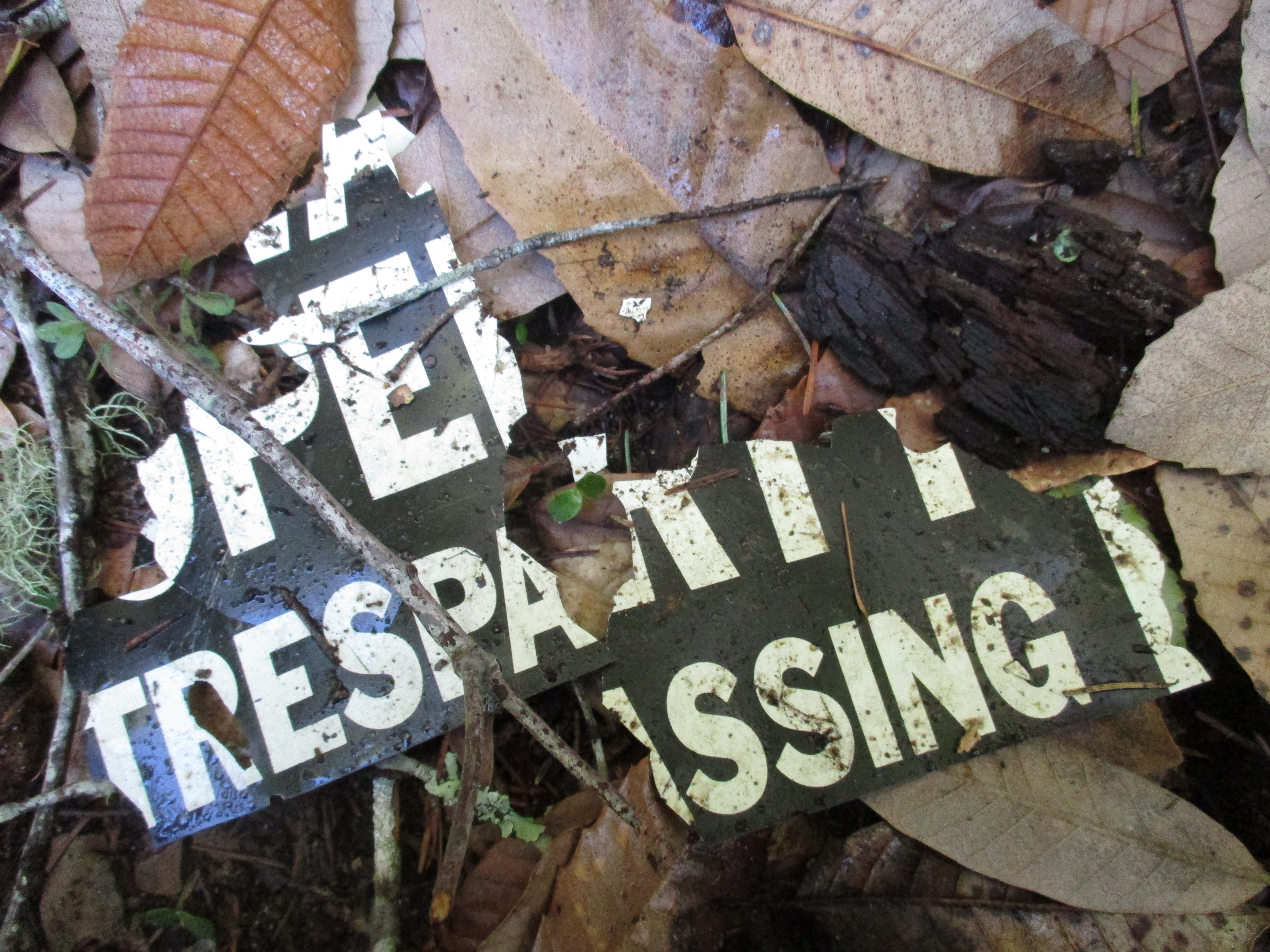
NO TRESPASSING? . . . No respect!

Growing fruit takes a bit of effort. Trees that produce the fruit must be planted and maintained for all the many years that they produce. They might need to be irrigated through summer. Most need specialized pruning every winter.

Canning surplus fruit takes a bit of effort too. All the jars must be cleaned. All the fruit must be collected, processed and cooked. The jars must be packed and boiled and so on.

Drying fruit is less work than canning, but takes a bit of effort nonetheless.

Where I lived in town, I grew a peach tree closer to the apartment building to the north, and a fig tree closer to the apartment building to the south. I maintained both trees meticulously. Many of the neighbors appreciated the fresh fruit. At the end of their season, there was (almost) always surplus peaches for canning. Sometimes, there were surplus figs for drying.

I really would not have minded if there had not been surplus fruit. It would have been better to have it consumed by the neighbors while fresh, than after it had been canned. Besides, it would have been less work for me.

One summer, there was a major surplus of peaches. We wanted to can them as efficiently as possible because we know how perishable they are. We planned to do all the canning on a Saturday, so got all the jars from the attic and washed them on Friday afternoon. The canning pots and utensils were ready to go. We had purchased lids and several pounds of sugar.

Also on Friday afternoon, the so-called ‘gardeners’ came to the apartment building next door to the north.

The major surplus of peaches, every last peach, was completely gone when we went to collect early Saturday morning.

Now, really, I don’t mind sharing. That is what the tree is there for. I really don’t even mind if a few people want to take all the surplus fruit. I just want to be told about it before I make plans and prepare to do something else with it. What really angered me was the complete disregard for those of us who put the effort into growing all those excellent peaches.

The fig tree to the south produced an early crop of figs before the peaches, and a late crop of figs after the peaches. Each crop lasted a long time, so there were not often too many figs at any one time that needed to be dried. Most were eaten fresh.

I often noticed an annoying absence of figs each day after the so-called ‘gardeners’ came to the apartment building next door to the south. It was not as bothersome as the missing peaches, since I got quite a bit of figs in between. What angered me was that every fig that could be harvested at the appointed time was taken, leaving none for anyone else.

Horridculture – That Blows!

P91218-1Blowers put the ‘blow’ in ‘mow, blow and go’. They really blow! The only power tool used by so-called ‘gardeners’ that is more detestable to the rest of us is the power hedge shears, and that claim is contestable. Some consider blowers to be worse because they are so obnoxiously noisy, and generate so much dust. Some municipalities have outlawed the use of the noisiest sorts.
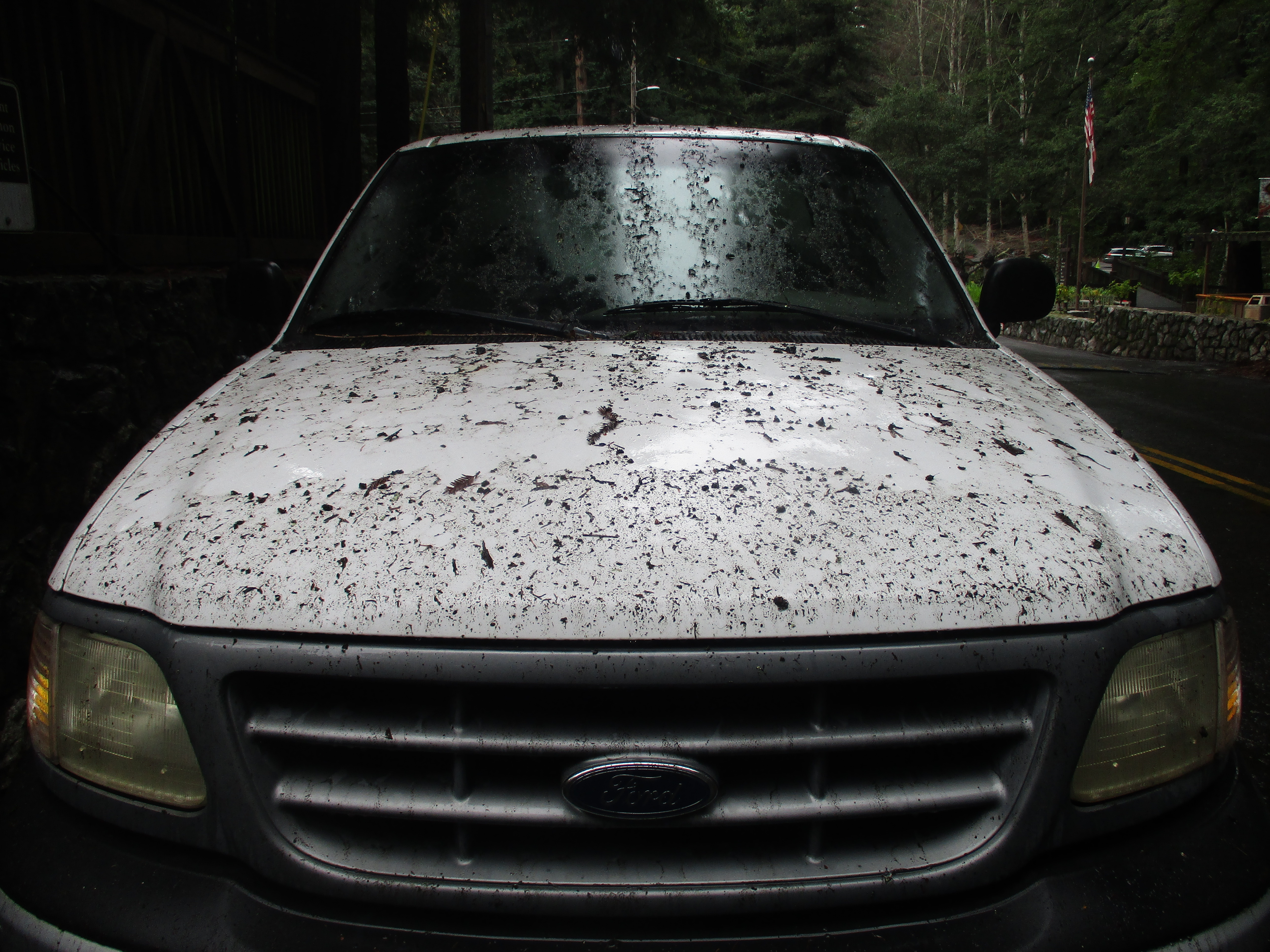
The mess on the hood and windshield in the picture above was not actually caused by blowers. The picture below shows the bridge that was power washed above. Oops. I should have been suspicious that no one wanted that parking space. Anyway, this picture was just too funny to not share; . . . and I happen to lack pictures of the sorts of dusty messes that blowers can stir up.

Where I lived in town, the so-called ‘gardeners’ who ‘maintained’ the apartment buildings on either side used blowers. There is a noise ordinance there, but we never bothered to enforce it. We did not want to interfere with what needed to be done. There was a lot of pavement, and we wanted it to be kept clean. We could not expect it all to be quietly swept like I swept mine.

To the north, the blowers were either off or on full-throttle. There was nothing in between. The cars in the carport collected all the dust that was stirred up. If the door to the washroom was left open, debris got blown in, and the pilot light for the only water heater in the building got blown out. Most of the debris got blown to the southeast corner, and under a fence into my yard.

The same happened to the south, but the water heater was less exposed, and there was much more debris. The largest valley oak around lived there, and dropped leaves for several months. I replaced the kickboard at the base of the fence in their northeast corner a few times, but it was just as regularly kicked out and removed so that debris could continue to be blown under!

In other neighborhoods, so-called ‘gardeners’ are notorious for blowing debris out into roads, where it gets dispersed by traffic. Even if they do not blow it away just to become a problem somewhere else, they are likely to blow too much of it into shrubbery, along with any mixed litter. It accumulates faster than it decomposes to benefit the soil and roots below. What a mess!P91218-2

Horridculture – Parking Lot Islands

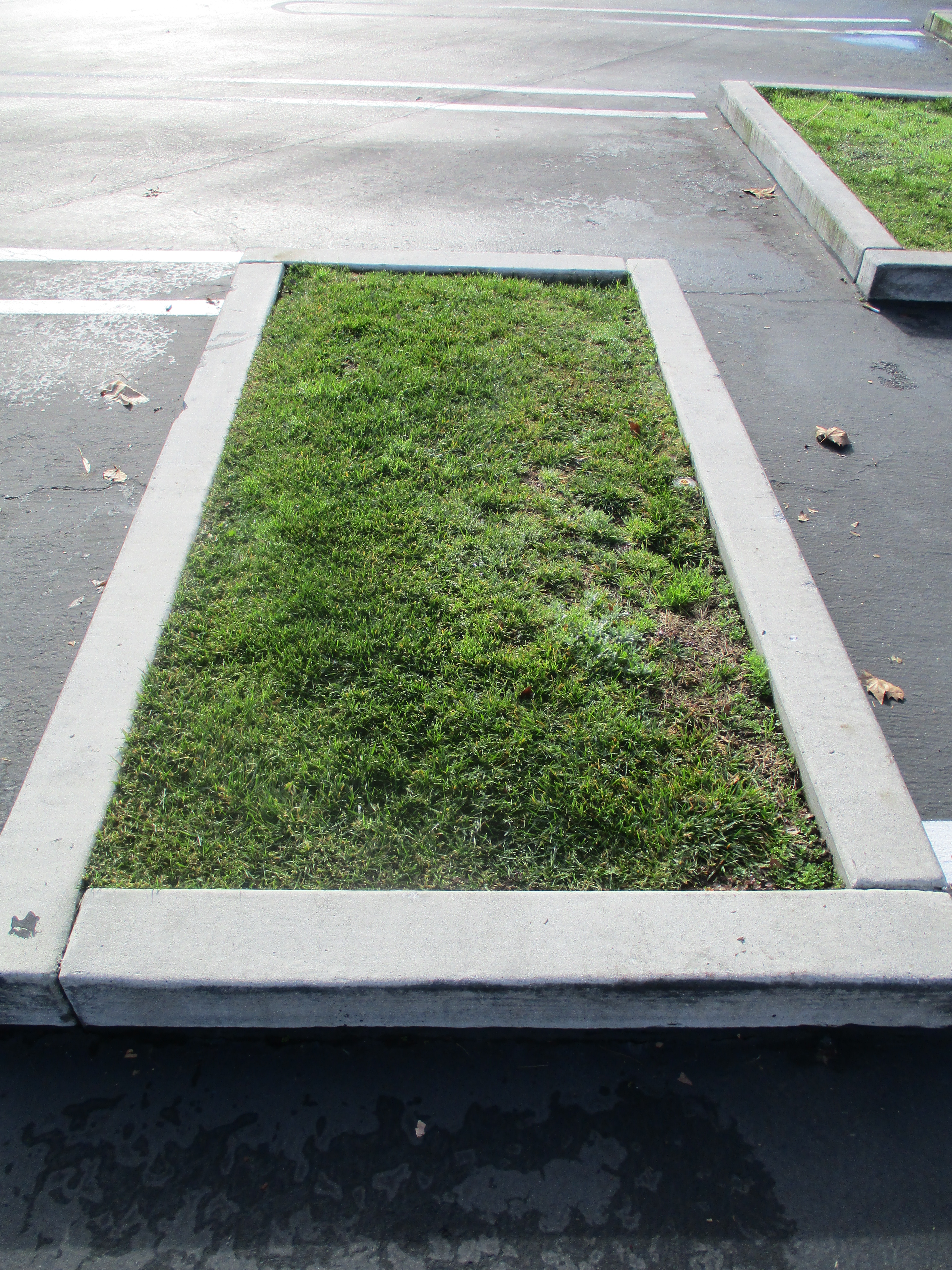
P80120kWhat a waste of space! What a waste of water! What a waste of time for the mow-blow-and-go ‘gardener’ who charges money to mow and edge it, but are too inept to suggest planting something that might actually be pretty, or shade the parking lot. There are a few of these between parking spaces marked for ‘compact’ cars, because it is cool to discriminate against full size cars that can not pull far enough forward to get out of the way.

Even between a Buick and a Chrysler, it is nothing to look at. It looks like something went seriously wrong with a grave site that was supposed to get a slab ‘over’ it (not ‘around’ it). It could be a Chia Pet litter box. There are much better spots to picnic at the park down the road. Whatever it is, it is not much better than the swales that are required in modern parking lots. It has potential to be a tripping hazard, but is not quite as dangerous.

I would make one of only two suggestions.

1 Pave over it. If there is not some building code that limits the area that can be paved, this might be thee most practical long term solution.

2. Landscape it responsibly. Yes; ‘responsibly’. Turf grass is just lame. Those trendy carpet roses that mow-blow-and-go ‘gardeners’ typically plant snag the clothing of those coming and going from the cars they park there. Since parking lots get warm, I would recommend shade trees with complaisant roots that are compatible with pavement. Such shade trees also should get tall enough to not obscure the signs on the buildings.

Parking lot islands contain some of the most deplorable landscapes. Trees commonly get hacked down below signs rather than pruned up and over them. Even if they get properly pruned with up-dos, their canopies must be carve around security lighting. Most problems result from negligent maintenance. Some problems result from design glitches. Realistically though, parking lot islands are very difficult to landscape well.