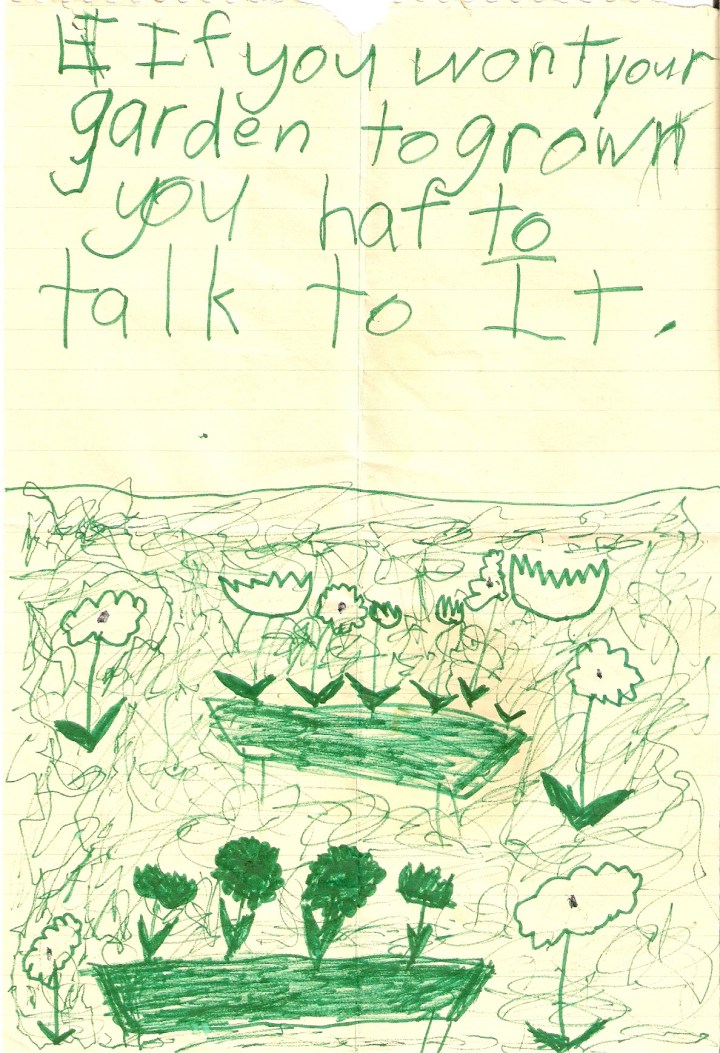
If you want your garden to grow, you have to talk to it.

P80131So the spelling is a bit . . . off. Ignore the ‘E’ before ‘If’ and the ‘n’ after ‘grow’. They are crossed out . . . sort of. ‘wont’ means ‘want’. ‘haf’ means ‘have’, as in ‘have to’ or ‘need to’. It made sense at the time, more than four decades ago. Perhaps I should rephrase it.

If you want your garden to grow, you must talk to it.

You must talk to your garden in order for it to grow.

Your garden requires regular discourse for healthy growth.

This concept dates from a time of big Boston ferns and spider plants suspended by coarse macrame with big wooden beads. Coleus and rubber tree were popular house plants too. Remember terrariums? There were big flowered daisies, tam junipers and big petunias in the yard. A group of three European white birches was cool, as if it was somehow unique . . . even though everyone else was doing it too.

Some people believed that gardens and houseplants were healthier if they were regularly engaged in conversation. Some of us would say that this is true only because those who talk to their gardens and houseplants are more involved with them, and are therefore more attentive to their needs. That makes sense. Otherwise, the theory has been neither confirmed or disproved by any reliably documented data.

I do not need data. My gardens did quite well with this technique. So did many of the annuals, perennials and trees I got to plant back then. The little disfigured Monterey pine that I met on my way to school ( https://tonytomeo.wordpress.com/2018/01/01/new-year-old-school/ ) is still doing well, long after all the others that I did not converse with are gone.

Change of Format

P71019

This blog is now two months old; so it is about time that I start to recycle old articles instead of writing so many ‘elaborations’. The articles are probably more interesting and relevant anyway. They will be from the same time last year, or previous years. Like I have been doing with new articles, the old articles will be split into two separate postings. One will be the main topic. The other will be the ‘plant’ of the week. So, one new article and one old article split into two postings each week leaves only three days for ‘elaborations’. Redundant articles will be omitted. Eventually, I will refrain from daily postings. Also, I will try to keep my ‘elaborations’ brief. I know I tend to get carried away with this. Alternatively, I may recycle another article each week, leaving only one day for ‘elaborations’. I will figure this out as I go along.

While I am taking the time to post something that has nothing to do with gardening, I should also mention that one of my main objections to writing a blog is that so much of what I write about is specifically for the climate in which I live, and not necessarily applicable to other regions. My articles are written for newspapers between San Francisco and Beverly Hills (in Los Angeles County). However, since starting this blog, I have found that not only do the newspapers that I write for already share my articles with newspapers in other regions, but that people who read my articles in other regions are already as aware of regional differences as I am. People in Australia seem to be as interested in reading about autumn during their spring as I am interested in reading about their spring during autumn. People seem to know how much of the information that I present is actually useful to them, and can distinguish information that is not accurate for their respective applications. Now, I feel much better about posting my articles, as well as writing about whatever I want to write about.

If you are wondering how the picture of Rhody above is relevant to the posting, it has no relevance. He just had a way of getting you to read my blog earlier, so I tried it again, and it worked.

Change Of Scenery

blog6

Hollywood is the Capital City of the entertainment industry because there is such a variety of scenery within relatively minimal proximity to Southern California. Before Hollywood, silent movies were made mostly in Niles, located about halfway between San Jose and Oakland, for the same reason. Snowy mountains, foggy forests, arid deserts, idyllic beaches, open prairies, placid lakes, and wild rivers can all be found within only a few hundred miles. California really has it all. The Santa Clara Valley alone has more climate zones than the entire state of Kansas.

I have not moved around California much. I spent a few summers in San Bruno and Montara, went to school in San Luis Obispo, and sometimes work in the Los Angeles area, but otherwise lived in the two adjacent counties of Santa Clara and Santa Cruz, just a short distance from the homes of my ancestors. Los Gatos is actually in both counties. Technically, most of my gardening has been within Sunset Zones 15 and 16. However, my garden in the Santa Cruz Mountains gets more than two feet of rain, which is about twice what the western side of the Santa Clara Valley gets, even though it is in the same zone!

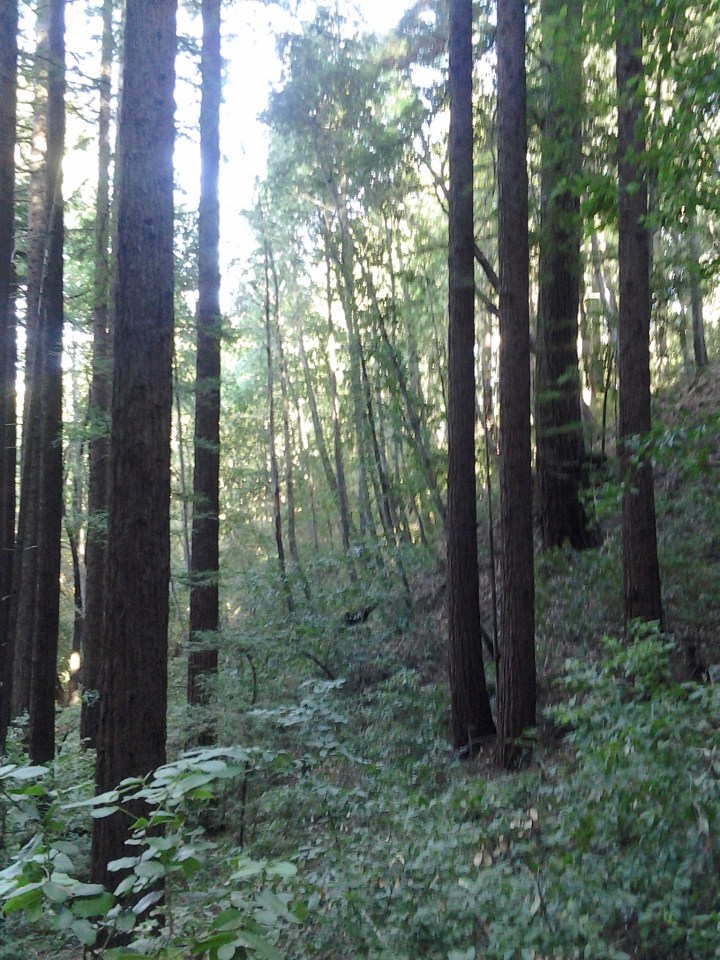
That is not the only difference. Instead of homogeneously rich alluvial Santa Clara Valley soil, I work with a variety of strange soils; sometimes filled with pulverized sandstone, sometimes sand under a thin layer of forest duff. I do not know what I will find until I start to dig. The Santa Cruz Mountains are such that I might have less flat area dispersed over nearly nine mountainside acres than friends in the Valley have on a single flat suburban lot. Much of it is shaded by tall coastal redwoods. The deer in the Mountains eat more than the gardeners in the Valley can steal.

This all makes it very challenging to grow many of the plants that I enjoy so much and acquired from the Santa Clara Valley. Some adapt quite nicely; but many of the most important ones really want to be back in the Valley. The rhubarb from my great grandfather’s garden looks great, but seriously lacks flavor. I just want to keep it going long enough to find a sunnier and warmer spot with richer soil to relocate it to. The two quince trees that were grown from cutting from an old tree in western San Jose seem to be fine, but much of the fruit gets taken away by rodents before it develops.

Then there are the fig trees. There are fourteen of them! About half are copies of the first fig trees I ever met when I was a kid. Some are black figs. Some are white. I think that only one is a honey fig. They are all very important to me. I am very fortunate to be able to grow them. However, like the rhubarb, they need a sunnier and warmer spot. If they make any fruit at all, it is bland and pithy. My objective with them now is to grow them in the cool and partly shaded spot where they are presently located so that they can provide cuttings to plant when a better situations becomes available. In that regard, they are actually doing just fine!

I really wish I could do my gardening in the Santa Clara Valley; but if I had to do it the other way around, it would be just as difficult. I mean that if I had a big garden in the Santa Clara Valley, and had to give up gardening in the Santa Cruz Mountains, many of my favorite plants would not like the transition. The Mountain grown apples that I have always taken for granted would never be as happy in the Valley. Neither would Douglas firs or bigleaf maples. Redwoods are common in the Valley, but are not the same as they are in their natural range. There’s no place like home.