Gophers

Do not underestimate the destructive potential of gophers!

Many of the yuccas that naturally live in deserts where forage may be scarce are equipped with an efficient defense system. Each leaf terminates with a nasty spine. Leaves are so abundant that the spines are impossible to avoid. It is amazing that these yuccas are as vulnerable as they are to gophers, who simple burrow below all the advanced defense technology to eat the starchy roots and any subterranean portions of stems.

Some of the techniques sometimes used to get rid of gophers are too dangerous to even discuss. Rodent poison (for rats and mice for example) is not only dangerous to other animals that may dig it up, but not often effective since gophers prefer to eat fleshy roots and stems. The only practical poisons can only be applied by licensed pesticide applicators.

New plants can be installed within ‘gopher cages’ that should exclude gophers from the root system at least long enough for the plants to get established. Gopher cages can be purchased ready-made, or can be constructed easily from chicken wire. They only need to be as deep as the planting hole, but can be wider for perennials that spread.

Gopher cages do not protect all roots, since some extend through the cage to disperse; but should protect enough roots to keep plants alive if outer roots get damaged. By the time the cages deteriorate, the plants within should be established enough to survive gopher infestation for a while; although even large plants can be killed by unrestrained gophers.

Properly used traps are the most practical means of controlling gophers. Traps should be installed in pairs, even though each pair typically catches only a single gopher. If possible, traps should be installed away from any gopher cages that may be present, since cages are difficult to work around, and nearly impossible to release from a sprung trap.

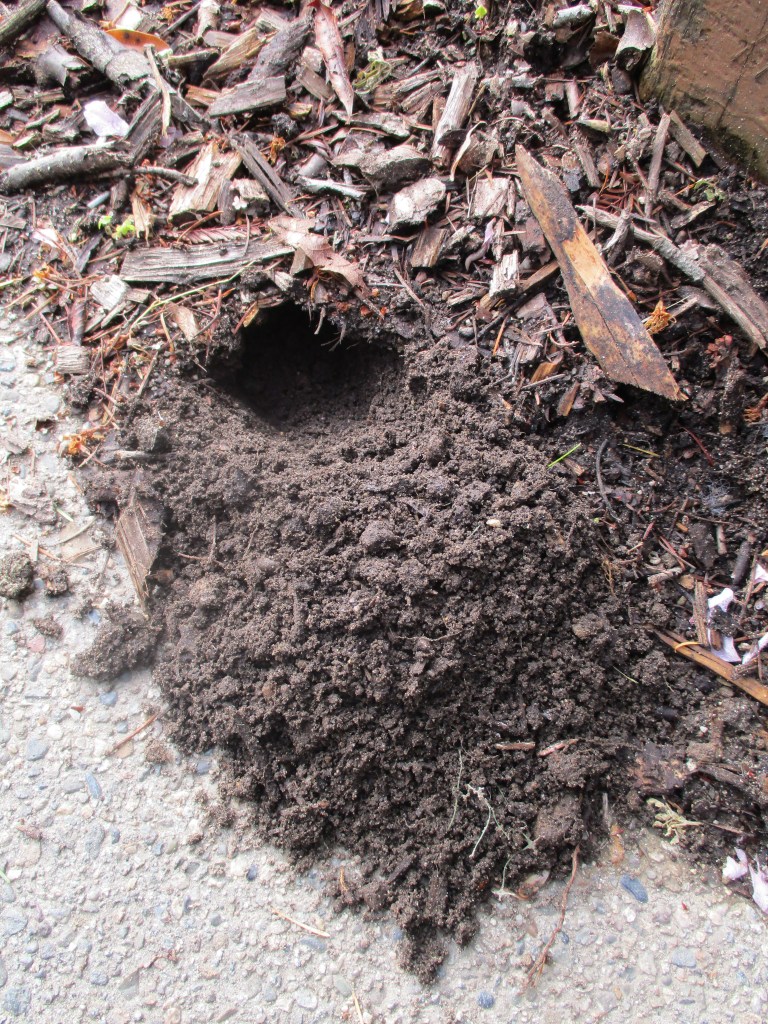
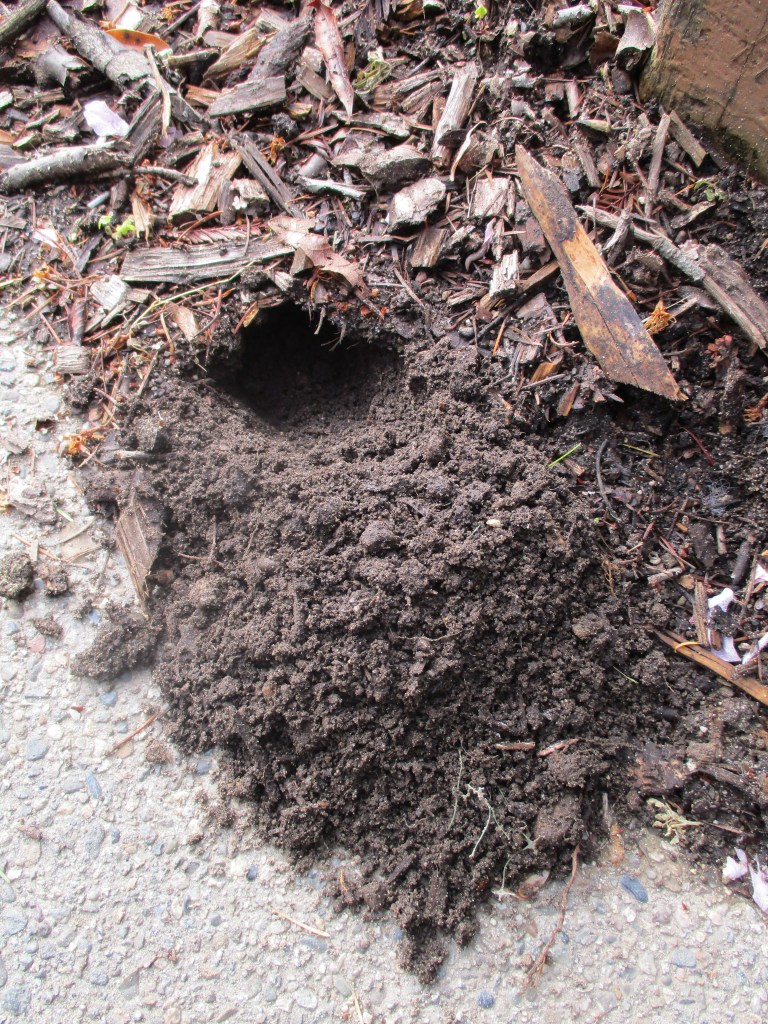
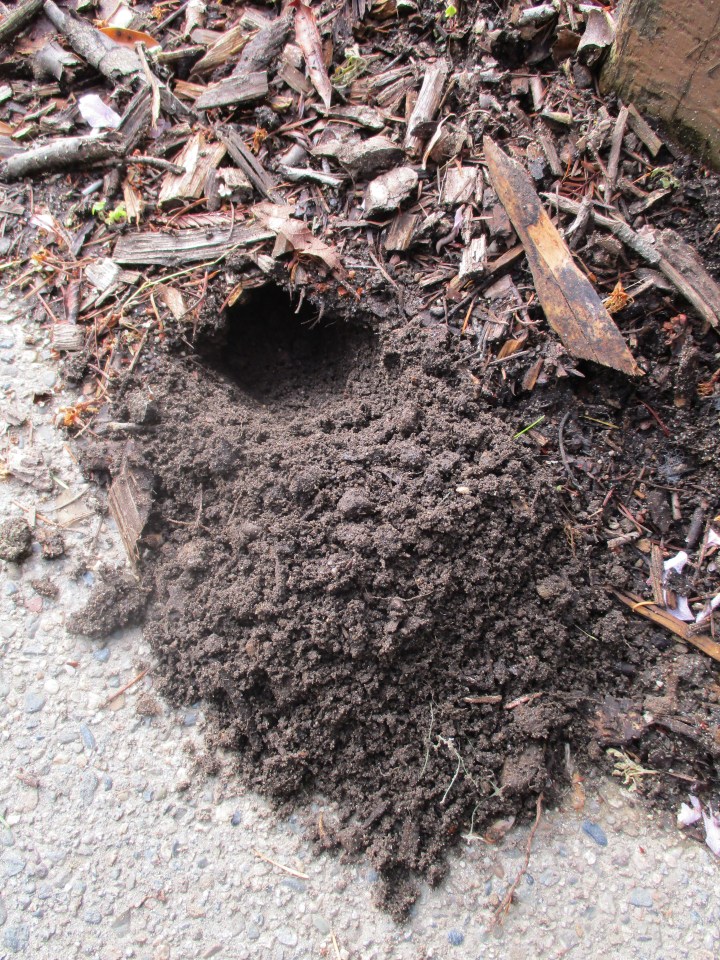
Once the entrance to a gopher run is found under a mound of freshly excavated soil, the entrance, which is typically filled with loose soil, should be excavated back as far as the main run, which extends perpendicularly to the right and left. The main run should be cleared of loose soil.

Each of the two traps can then be set and gently placed within the main run in each direction. A trap should be held by the spring end so that the claws and lever extend into the run. Wires attached to the spring end of the traps are easier and safer to pull the traps out with later, instead of digging the traps out. These wires can be attached to a stake to make them easy to find later.

The entrance hole should then be buried. Air circulation from outside will prompt the gopher to collect loose soil to plug the hole, and push the loose soil ahead, springing the trap prematurely.

The gopher within may not be interested in using the same entrance to expel soil, but will likely use the same run. Two traps are used because there is no way of knowing which direction the gopher will approach from. The unfortunate gopher can be removed in a day or so; so that the traps can be set into another run where fresh excavation has been observed.
FIRST Louisiana Iris!

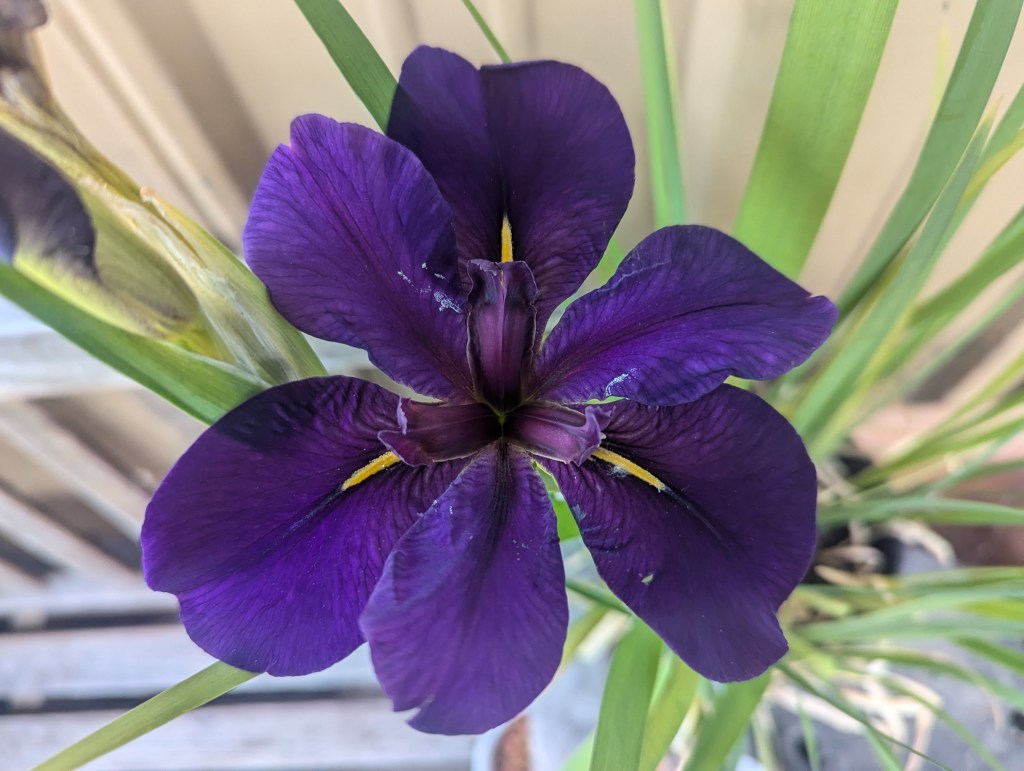
Finally, after two years, ‘Black Gamecock’ Louisiana iris from Tangly Cottage Gardening are blooming! At the end of winter of 2023, I divided a significant clump of them into enough pups for a thirty foot long row on the edge of the irrigation pond. They grew through summer, and should have bloomed for the following spring. Instead, a gopher ate all but a few pups. At the end of winter of 2024, I divided another clump into enough pups for a twenty foot long row in the same location, but closer to the water. Again, they grew through summer, and should have bloomed this spring, but instead, all but a few were eaten by a gopher. These that are now blooming are the survivors from the original batch, which were canned for their safety. They are blooming late, probably because they would rather be in the ground than canned. I will divide these into more cans now so they can proliferate and be divided again later, until there are twice as many as necessary for the edge of the pond. Then, I will plug some at the edge of the pond, into saturated soil that gophers can not dig under.

Gopher Purge

Caustic sap deters gophers.

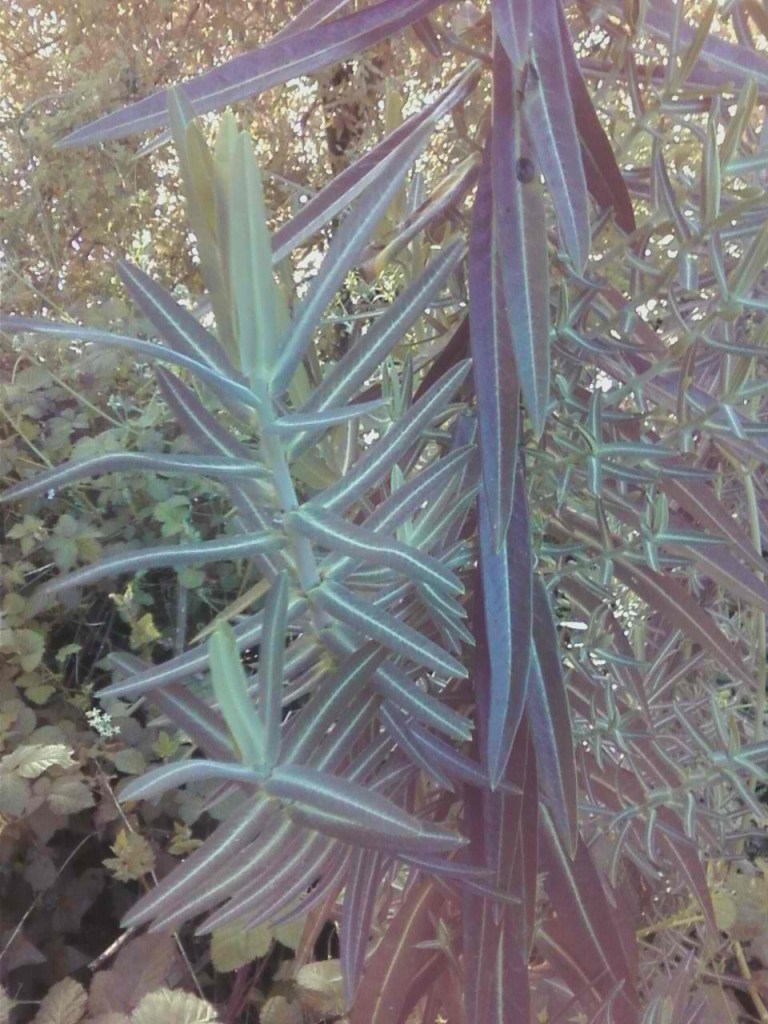
The common name may be derived from ‘gopher spurge’, since Euphorbia lathyris is within the family of plants known as ‘spurge’, and it is also purported to ‘purge’ the garden of gophers and moles. Like all related spurge, it has caustic opaque white sap that is very irritating to the skin and toxic if ingested. This offensive sap prevents anything from burrowing through the roots, but unfortunately does not prevent gophers and moles from going around. Therefore, a garden that is adequately protected may also be crowded by gopher purge.

Individual plants live for only two years, but produce enough seed to seem like perennials. Their mostly solitary stems can grow to nearly five feet tall with foliage that spreads up to a foot wide in the first year. Tiny yellow flowers that bloom in the second summer are not remarkable; and can set seed without getting much notice before the plant dies. Gopher purge can naturalize without becoming too invasive in regularly moist or somewhat shady parts of the garden. It prefers to be watered occasionally in drier and sunnier areas.

The foliage of gopher purge is strikingly symmetrical. Each pair of grayish or bluish green leaves is perpendicular to the pairs above and below it, in a four ranked pattern. Except for the newest upper leaves, each leaf pair is also arranged in a generally horizontal plane, perpendicular to the vertical stem. Gopher purge seems to have been assembled in the garden instead of grown there.

SQUIRREL!

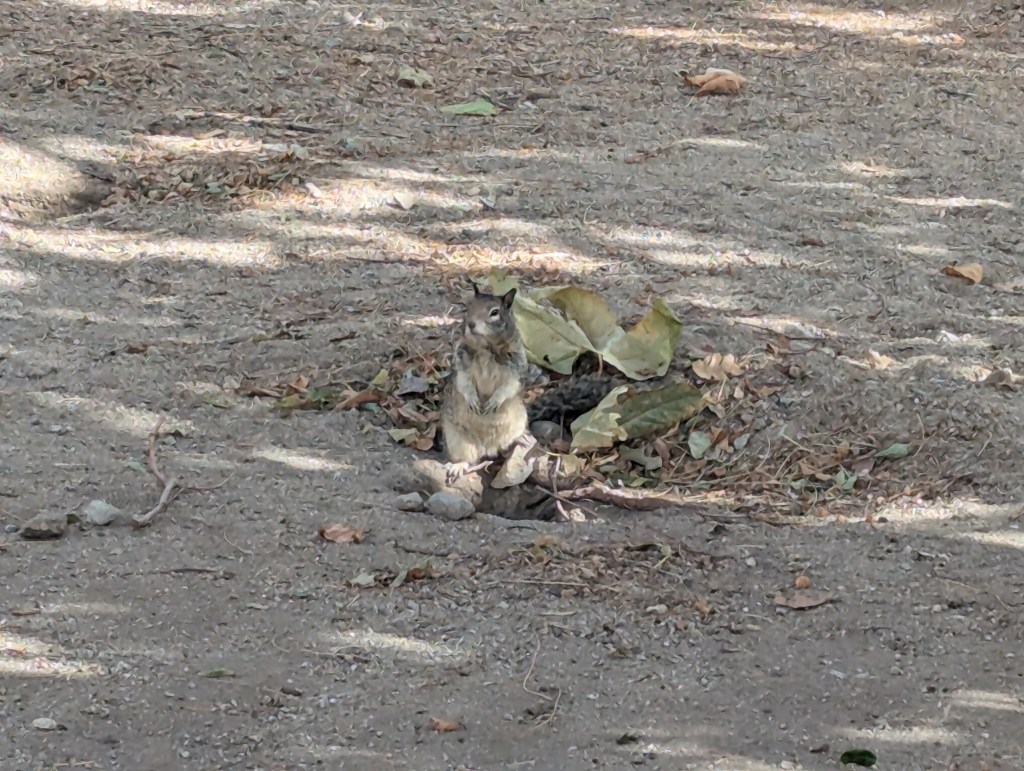
This is no ordinary squirrel. It is likely a ground squirrel, since, as such a designation and its presence on the ground suggest, it likely lives in the ground. That divot on the ground in front of it seems to be a burrow, presumably where it lives. It seems to be rather plump for a ground squirrel. Perhaps it could be a common squirrel who lives on or under the ground because it is too plump to live in trees. I have no idea. We did not get any more acquainted than necessary for me to get this picture from a significant and what I considered to be safe distance. Although a squirrel like this could inflict major injuries, I doubt that it can move very fast. It reminds me how fortunate that we do not contend with such large rodents at work. Gophers are small but very destructive to the vegetation within our landscapes. I do not want to know how much damage this squirrel or whatever it is is capable of. It must consume a considerable volume of roots, foliage or whatever it wants to eat. Supposedly, such squirrels, whether in trees or in the ground, are not as destructive as gophers, but I do not know what to believe. I suppose that some wildlife is more obviously worse. Fortunately for us, deer avoid our landscapes, though we could do nothing to exclude them. No one knows why. Much larger herbivorous wildlife that inhabit other regions, such as the Pacific Northwest are more voracious than deer. I can not imagine the extent of damage that just a single moose is capable of. Nor do I know how such wildlife can be excluded from landscapes. It seems to me that a moose can probably go wherever it wants to.

Horridculture – Gophers!(?)

Who took the Louisiana iris?!

This is more infuriating than the rat or rats who ate the tops off of my rare young banana trees. I do not actually know who the culprit is, but can only guess that it is a gopher or a few gophers. Initially, I thought that it was someone who intended to pull weeds, but instead pulled the beloved Louisiana iris. All I know is that the iris were growing well, and are now completely gone!

These Louisiana iris were a gift from Tangly Cottage Gardening in Ilwaco, so were extremely important to me. After bringing them here at the end of last winter, I split and groomed them, and plugged them into a single row that was about thirty feet long. This row was on the edge of a pond, where I hoped they would form a network of rhizomes to help contain the shifting mud. It was an ideal situation. I watched them grow through the year, and expected them to bloom next season. They were totally awesome!

There is no indication that they were pulled or dug. Nor is there any indication that they were pulled downward from below. Although I found a few gopher tunnels, such tunnels were not sufficiently extensive to reach all of the rhizomes of the Louisiana iris.

Only four very small plugs remained. I dug and canned them to protect them from whomever or whatever took the rest of them. Although they can grow and multiply very efficiently, they will not replace the thirty foot long row for several years. Besides, even when they do proliferate, I do not know if I can safely install them back onto the edge of the pond. Without knowing what happened to the last colony, I can not protect a subsequent colony from the same fate.

Gophers!

The best rodent control devices are useless against gophers.

Punxatawney Phil retreated from his shadow on Gobbler’s Knob, predicting a late spring. That was more than two weeks ago, and we are still waiting for a late rainy season to start! Regardless, Punxatawney Phil did his job and has gone back home to hibernate, or whatever he does this time of year. If only all rodents would do the same. Gophers do not ever seem to take any time off.

There is little agreement on how to efficiently evict gophers from the garden. A rodenticide that can only be applied by qualified pesticide applicators is purported to be the most effective means of extermination for large scale landscapes, but is not available to the general public and is very expensive when applied by professional exterminators.

Thumpers, battery powered devices that emit low frequency vibrations at random intervals, are only moderately effective at repelling gophers, and look rather odd in a lawn. Those cheap plastic whirlie thingies that spin in a breeze, causing their wiry stems to vibrate, are probably just as effective if occasionally relocated to keep the gophers from getting too comfortable with them. People who do not consider them to be appealing lawn ornaments think that they are tacky though.

Flooding gopher runs with water, or leaving sharp objects or chewing gum in the runs are generally not effective. It is nearly impossible to flood a system of runs, which is typically equipped with drainage. Gophers who are unfortunate enough to cut themselves on something sharp will bleed to death because their blood does not coagulate, but they are careful to not do so. Likewise, gophers who eat chewing gum will die because they can not digest chewing gum, but they prefer to eat roots. Besides, who really wants make gophers die in such agony?

Good old fashioned McAbee gopher traps, which incidentally were invented in Los Gatos, are probably the most effective means with which to eradicate gophers. They are difficult to set for a beginner; so it is a good idea to get trained by someone with experience. It is also important to set the traps in pairs with one trap in each direction of the main run below the exit tunnel, instead of setting a single trap in the exit tunnel. It takes some extra digging but is worth it. Because each pair catches only a single gopher, the empty trap should be sprung when pulled from the ground to avoid hurting someone. Do not let dogs dig up traps!

Trapping is only a temporary solution. Eventually, more gophers are likely to move in, necessitating more trapping.

Moles Are Different From Gophers

Gophers are more destructive than moles.

Wildlife belongs in the wild. Many of us appreciate it there, and get pictures of it to share with others as if it is rare and unusual. Deer, raccoons, skunks, squirrels, gophers and so many other residents of the wild are not so appealing in home gardens. They all need to eat. None are tactful about it. Some eat foliage. Some eat fruits. Moles eat larval insects.

That seems like it would be beneficial to the garden. In some situations, it is. Not only do moles inhibit the proliferation of grubs that damage roots, but they also aerate dense soil. The problem is that they heave soil as they excavate just below the surface. This activity damages lawns and shallow ground cover. Uninhibited grubs might cause less damage. 

Gophers often take the blame for damage that moles cause. However, gophers are much more destructive. They excavate more substantially, and generate larger mounds. While moles consume mostly detrimental grubs, gophers devour roots and any other plant part within the soil. Gophers do not hesitate to kill the most important plants in the landscape. 

Like gophers and other rodents, moles can not take much time off for hibernation through winter. The weather is just too mild. Although they are less active during cool weather, or while there is less to hunt, they never stop excavating. They merely become more active now because, as the weather warms, they can plan for a family, and find plenty of grubs.

Mole excavation generates distinctive small ‘berms’ of displaced soil within lawns. Such berms extend randomly in no particular direction, but are impressively consistent in form. Mounds of expelled soil are small and sporadic, or may not be evident. Moles often push their way below the surface of firmly rooted turf, without expelling any soil to the surface.

Unfortunately, moles can be about as difficult to dissuade as gophers. The most practical means of repellent is to eliminate the grubs that they crave, which can be difficult without insecticide. Blood meal and bone meal are fertilizers that can supposedly repel moles by their objectionable aroma, but require frequent application. Traps also require diligence, as well as precision.

Six on Saturday: Revenge of Halston Junior

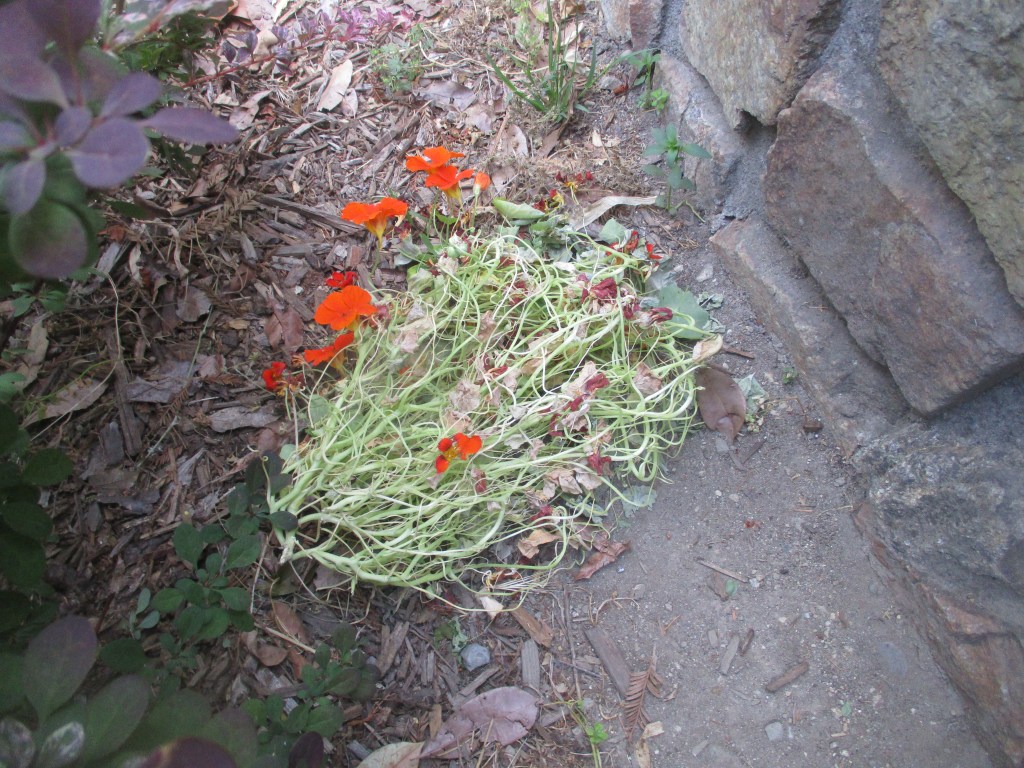
The saga continues. This time, descendants of Halston have invaded a bed that was outfitted with a layer of gopher wire that was intended to prevent such invasion. This apparently ineffective gopher wire now provides a layer of defense for the invaders. Attempts to cut through the wire in order to set traps causes tunnels to collapse, so that there are no intact tunnels in which to set the traps. These pictures are several days old. Not many nasturtiums remain. Some of the adjacent scarlet sage are missing also.

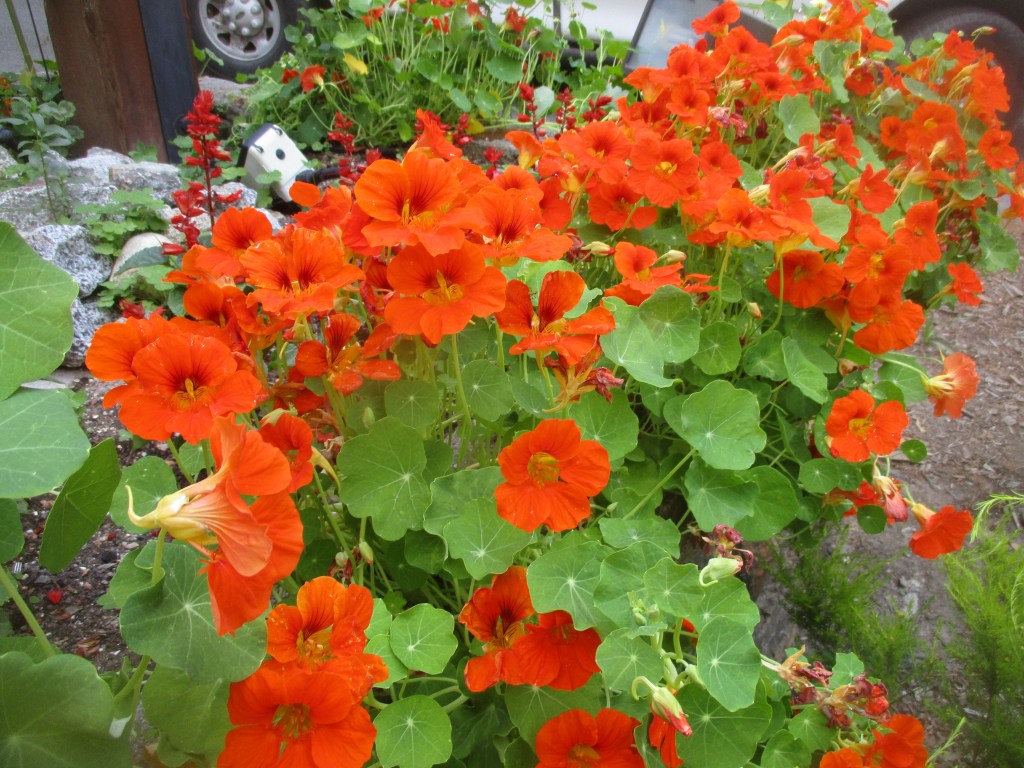
1. Nasturtiums grow like weeds. Perhaps they are. Nonetheless, they are among my favorites. These were supposed to be a mix of colors, but are mostly this vivid orange. I could not complain.

2. Is this very pale yellow or creamy white? Of the many nasturtiums that grew here from seed of mixed colors, this was one of only a few that were not the richly reddish orange shown above.

3. Bright yellow was about as scarce, with only two plants of this color. Another bloomed with rich red flowers; but I neglected to get a picture of it. I never met a nasturtium that I did not like.

4. This was a problem. The entire top of the stone wall had been occupied by healthy nasturtiums earlier. The small plant with yellow flowers to the right of this gap was just beginning to wilt.

5. This was below the gap. The main stem, which is now to the lower left, was chewed through. There was no attempt to hide the evidence, although other plants had been pulled underground.

6. Just in case there was any doubt about who the culprit was, this new volcano appeared nearby. Unfortunately, the gopher wire that was installed below this bed now impedes with trapping.

This is the link for Six on Saturday, for anyone else who would like to participate:

https://thepropagatorblog.wordpress.com/2017/09/18/six-on-saturday-a-participant-guide/

Vermin Run Amok In Spring

Gophers are busy with homemaking projects.

No one really hibernates here. Well, ground squirrels might, but they are unlikely to be a problem in refined home gardens. Winter weather is sufficiently mild for most of the most troublesome vermin to remain active, even if somewhat subdued. Some are more active in autumn before food gets scarce. They store food for later, and eat more to gain weight.

Now that it is spring, vermin are more active than they are at any other time of year, even autumn. Gophers, squirrels, rats and mice want to party like it is 1999; well, like spring of 1999. Although they all fattened up last autumn, and stored plenty of food for winter, they now want to exploit abundant spring vegetation. So do raccoons, skunks and opossums.

Generally most vermin, which most prefer to describe more politely as ‘wildlife’, are not a problem for home gardens. Some might be beneficial. Skunks may trench into lawns, but only because they want the grubs that would otherwise cause more damage from below. They also eat snails and slugs. Opossums eat snails and slugs too, as well as baby rats!

However, skunks and opossums can do more harm than good. They eat vegetables and fruits as they ripen, and pet food. Raccoons cause more significant damage, and can be very dangerous to pets. These three types of vermin are nocturnal, and therefore difficult to dissuade or confront directly. Fortunately, they are not very common in urban gardens.

Conversely, squirrels are everywhere except the harshest desert climates. Although they cause significant damage to new spring growth, and will later damage developing fruits, they are more tolerable than other vermin. Some people actually feed them to draw them to their gardens! Rats and mice are less tolerable, probably because they lack fluffy tails.

Gophers are likely causing more damage than other vermin now. Their growing families voraciously devour many of the fresh roots that disperse in spring. Now that their tunnels are not too muddy, gophers are remodeling to expand accommodations. Young gophers do not live with their parents for very long, so will eventually infest new adjacent territory. Lawns and vegetable gardens are most preferable.

Gopher It!

P00412
Honey badger don’t care. Neither does the gopher who did this.

Deer do not eat all plants. There are a few that are toxic to them. There are more that deer simply dislike. With a minimal bit of research, it is not difficult to find a few lists of plant species that deer are supposed to avoid. The problem with such lists though, is that deer do not read them. Only toxic plants are reliably safe from deer.

It would not be so bad if only deer were a bit more cooperative. They would be welcome in gardens if they ate only weeds that no one wants anyway. We all know that they can eat weeds, they just choose not to do so while they are in our gardens.

For that matter, gophers would not be such a problem if they ate only weeds, and aerated only soil that needs it. Instead, they seem to target the most important plants they can find, and excavate primarily in lawns. There is no effort to cooperate.

For as long as people have been growing vegetation, whether as agricultural commodities or in landscapes, people have been competing with wildlife of one form or another, or several others. Wildlife is no more cooperative now than it was many thousands of years ago. Some animals are even less cooperative than their ancestors were. Some are downright defiant!

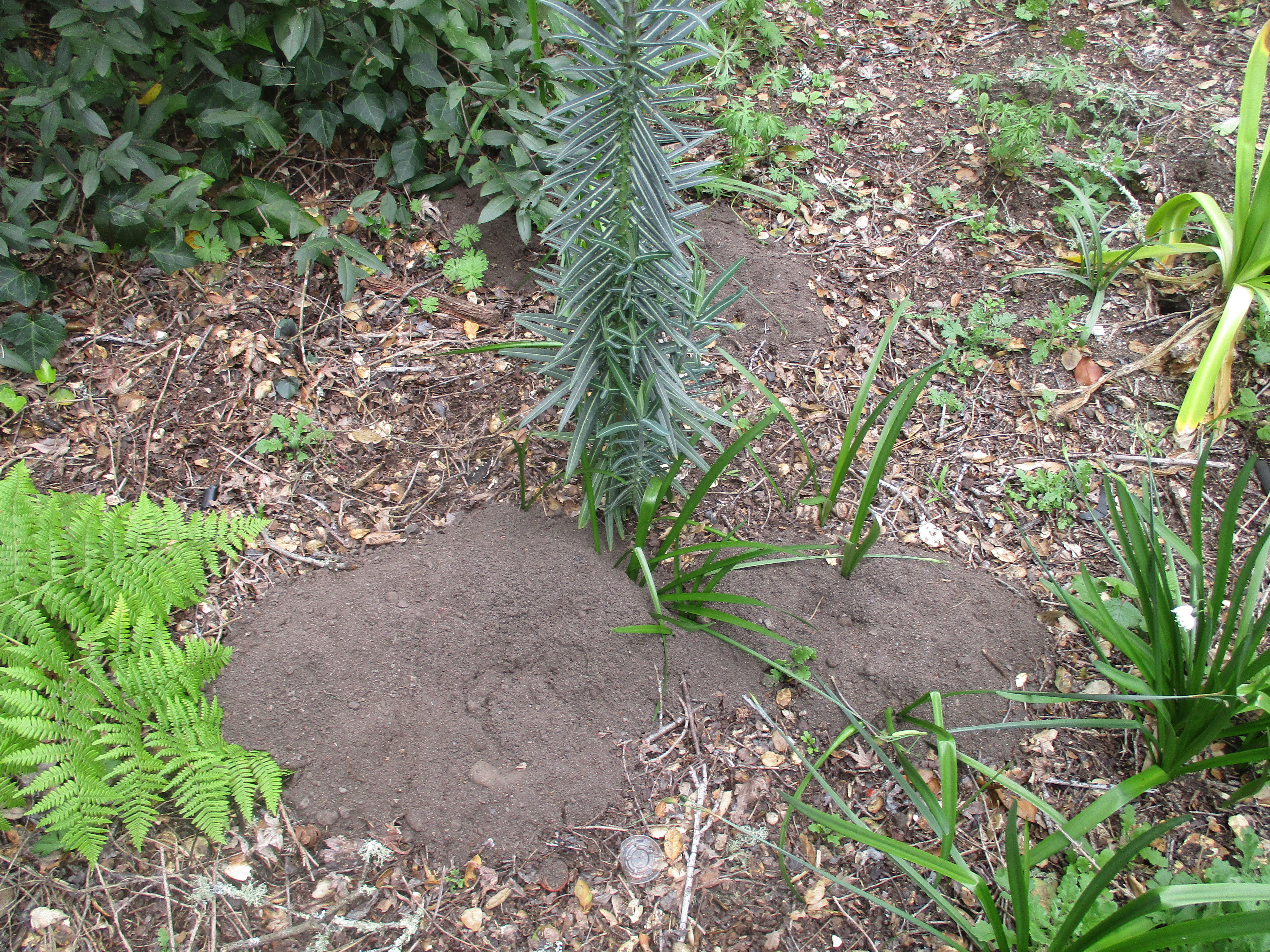
Gophers have been known to push traps out from their tunnels, without springing the traps. Some will emerge from their subterranean tunnels to step over the tops of root cages that are designed to exclude them, just to get to the roots within. The gopher associated with the excavation seen in the picture above was not so defiant, but was certainly undeterred.

The foliage at the center of the picture is gopher purge. Although not planted here intentionally, it used to be planted around vegetable gardens to deter gophers. It has a caustic sap that is very irritating to gophers if they try to excavate through the roots. However, the picture clearly shows excavation to the left, to the right, and behind the gopher purge.