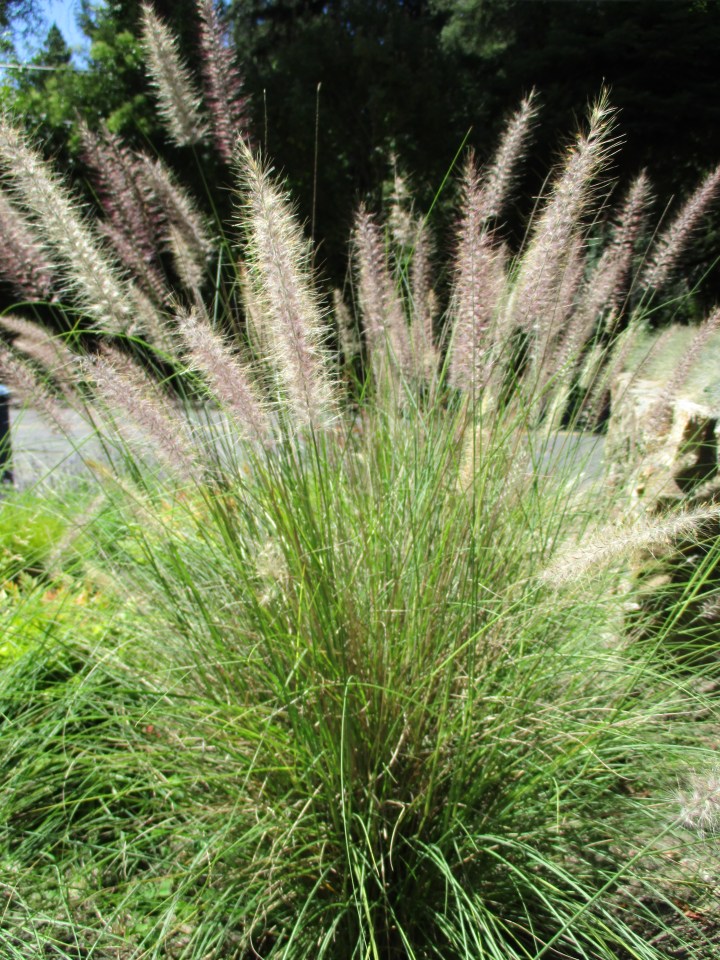
 It was probably a good idea when it was introduced to California, but fountain grass, Pennisetum setaceum, became too much of a good thing for a few temperate regions in which it naturalizes and displaces native vegetation. Although it now works to inhibit erosion where it grows wild on the embankments of highway interchanges, it must sometime be mown because it is combustible.
In home gardens, fountain grass is more appealing if shorn back at the end of winter, and watered occasionally through the warmest part of summer. If feral seedlings need to be removed, a few may be left if they happen to grow where more plants are wanted, or to replace aging plants. Fountain grass should not be planted in regions where it is likely to naturalize but has not yet done so.
Fountain grass has narrow leaves that arch upward and outward so that the tips of outer leaves are just touching the ground. They might sag lower; or they might stand more upright. The fuzzy tan or pinkish tan flowers that bloom in summer may stand as tall as three feet. Individual plants live only a few years. The cultivar ‘Rubrum’ has striking purplish bronze foliage, and does not self sow.
 Winter is the best time for major pruning of most plants. They do not mind it so much while they are dormant. However, there are exceptions. Winter pruning might be a bit too early for a few plants that are grown for their late winter or early spring bloom. It is best to wait until immediately after bloom to prune or trim flowering cherry, flowering plum, flowering crabapple and flowering quince.
 Tony Tomeo