Redwoods & Gravity

Physics are dangerous!

Sequoia sempervirens, coastal redwood is the Official State Tree of California, and the tallest species of tree in the World. One large specimen can contain more lumber than many acres of Douglas fir (really). While some trees ensnare kites, redwoods collect satellites. Redwood lumber can be delivered anywhere in western North America simply by aiming a tree in the direction of delivery while cutting it down. Redwood shadows reach Japan at dawn and New England at dusk. The moon is covered with craters because it could not dodge the growing redwoods while orbiting over California. You can see for yourself how tall redwoods are just by looking in this direction from wherever you are in the World. Unfortunately though, not all of the debris that falls from the huge canopies of redwoods burns up in the atmosphere on its way down. Such huge canopies generate a lot of debris. Almost all of it is finely textured foliar debris. Some is twiggy detritus. The worst of it are significant branches. The descent of most of such branches is slowed by lower branches and foliage that they encounter on their way down. However, the lowest branches of some canopies are very high up, and falling branches resume acceleration after falling past them. Also, some falling branches fall outside of their canopies. Even branches that weigh only a few pounds can be extremely dangerous. Many falling branches weigh many pounds, and some are as big as trees. The fallen branch in the picture above is only several feet long and about three inches wide, (and happened to fall through the only three inch wide plank in a pedestrian bridge. The replacement plank needed to be custom cut.) I am annoyed by this relatively minor damage, but also relieved that it was not worse.
Victim of Gravity

Nature is messy.

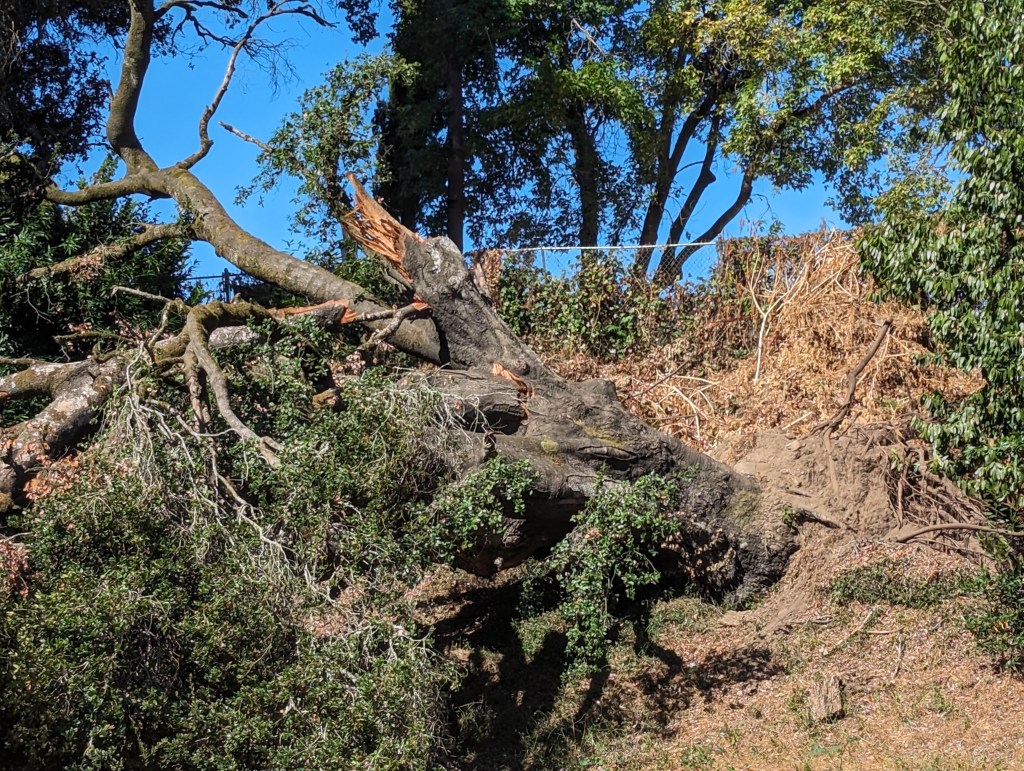
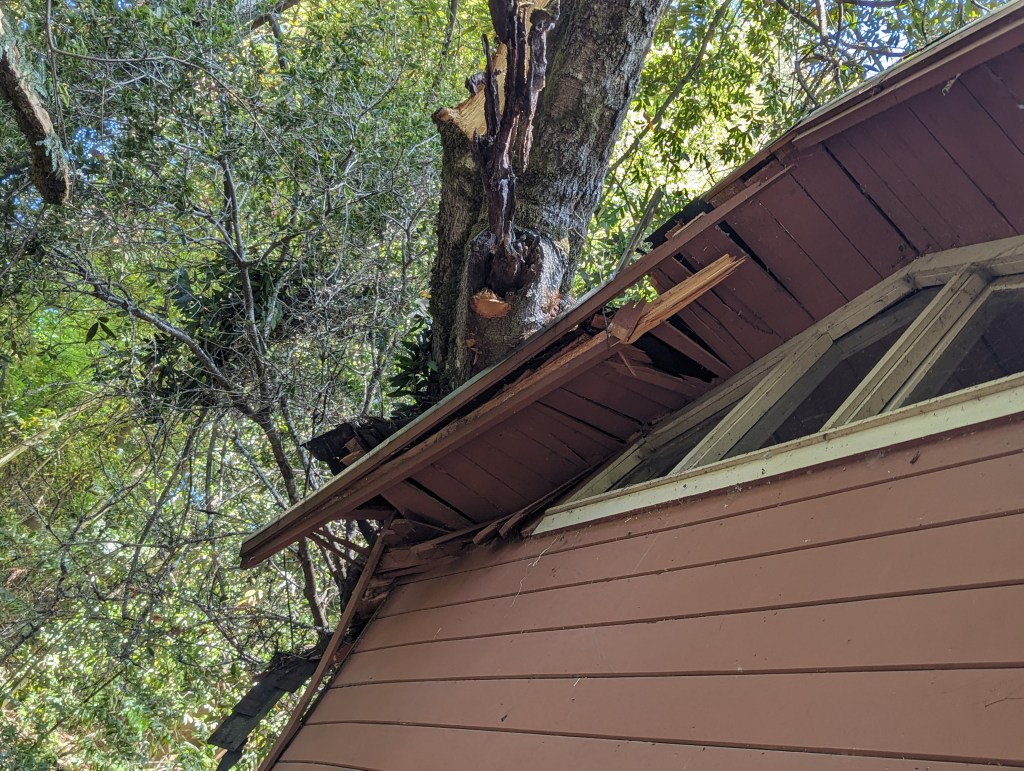
What goes up must come down. This elderly and deteriorated Shreve oak may have taken more than a century to go up, and then suddenly came down within only a few seconds. Unfortunately, it was not at all graceful about doing so, as it landed on this unoccupied cabin and a nearby bay tree. The cabin can be repaired. The bay tree needed to be removed with the fallen Shreve oak. Nature is messy like that. Some might say that it is also inconsiderate. Regardless, it can be difficult to live and work with. Most of our landscapes are adjacent to natural ecosystems. All are dominated by big natural trees, including coastal redwood, which is the tallest species of tree in the World. Even if none of the big trees are directly within some of the landscapes, some of such trees are big enough to drop debris or limbs within landscapes that are significant distances away; or worse, they can fall into the landscapes. As much as we try to limit such risks, nature, besides being messy and potentially inconsiderate, is also generally unpredictable. However, one of only a few aspects of nature that is always reliably predictable is gravity.

Horridculture – Nature

Nature is dysfunctional.

Horticulture is unnatural. It involves unnatural manipulation of exotic species that were unnaturally imported from all over the World. It provides unnatural irrigation and unnatural chemical fertilizers and amendments. It involves unnatural containment of many plants within unnatural synthetic media within unnatural plastic cans or other containers. It strives to eliminate much of what is natural, such as pathogens and competition. It is ironic that so many believe that a simple but totally unnatural houseplant brings a bit of nature into their particular environment.

Nature, although quite natural, is dysfunctional. It is messy. It is dirty. It is tragic. It is potentially dangerous. It is overrated. Realistically, it is a hot mess of problems. Somehow though, it seems to be appealing.

That is why so many of us strive to incorporate more nature into our respective lifestyles by very unnatural means. We crave a sort of idealized version of what we believe nature should be. It would likely be easier and more efficient to accept such attempts as unnatural, and exclude what nature might try to contribute.

Some are quite happy to live and work in high rise homes and offices with minimal natural influence. They still breathe natural air, and appreciate natural sunlight and the stabilizing effects of natural gravity, but shelter themselves from what is most bothersome about nature outside, such as weather, wildlife and most insects.

This unfortunate old coast live oak is an exemplary victim of nature. It grew here naturally for two centuries or so. It obtained all that it needed from the natural soil, air and weather. It survived natural insect infestations, and long ago, may have survived natural forest fires. Ultimately though, perhaps in conjunction with a bit of natural wind and natural fungal organisms associated with decay, it succumbed to natural gravity.

This old oak finally succumbed to the same nature that it exploited for centuries.

Gravitropism Gets Germinating Seeds Oriented

00429thumb
Toward the light. Away from gravity.

Germinating seedlings know which way is up. Perhaps they just know which way is down. They can not see, hear, taste, smell or feel anything like we can. Nonetheless, they know which direction to extend their first root and stem. One thing that they can perceive is gravity. Gravitropism, which was formerly known as geotropism, is how they respond to gravity, or the Earth that generates it.

Positive gravitropism is why the first root to emerge from a seed extends downward toward gravity. Negative gravitropism is why the first stem to emerge from a seed extends upward away from gravity. Positive is toward. Negative is away. Roots and stems that develop after the first, disperse in other directions in response to other stimuli, but never really forget where gravity comes from.

Once a primary stem of a seedling emerges from the soil, it immediately responds to sunlight. Just as it exhibits negative gravitropism to grow away from gravity, it exhibits positive phototropism to grow toward sunlight. Since sunlight comes from above, positive phototropism is compliant to negative gravitropism. Branches will later disperse laterally to avoid the shade of other branches.

While branches are finding their way in the World, roots are doing the same. All of them can not always reach for the center of the Earth. They branch and disperse laterally as they sense that they are sufficiently deep in the soil. Those that venture too deeply sense an inhibition of gas exchange. Those that are too shallow sense if they get too warm or dry. There are a few types of tropisms.

Roots respond to moisture, nutrients, chemicals, temperature and mechanical stimulation within the soil. Branches and foliage respond to humidity, wind, temperature variations and air pollution. In order to function within their dynamic situations, plants somehow coordinate their responses to all of the many stimuli they experience. They are impressively perceptive, as well as responsive.

Even celery, green onions and leafy tops of carrot in a refrigerator can reach upward away from gravity.