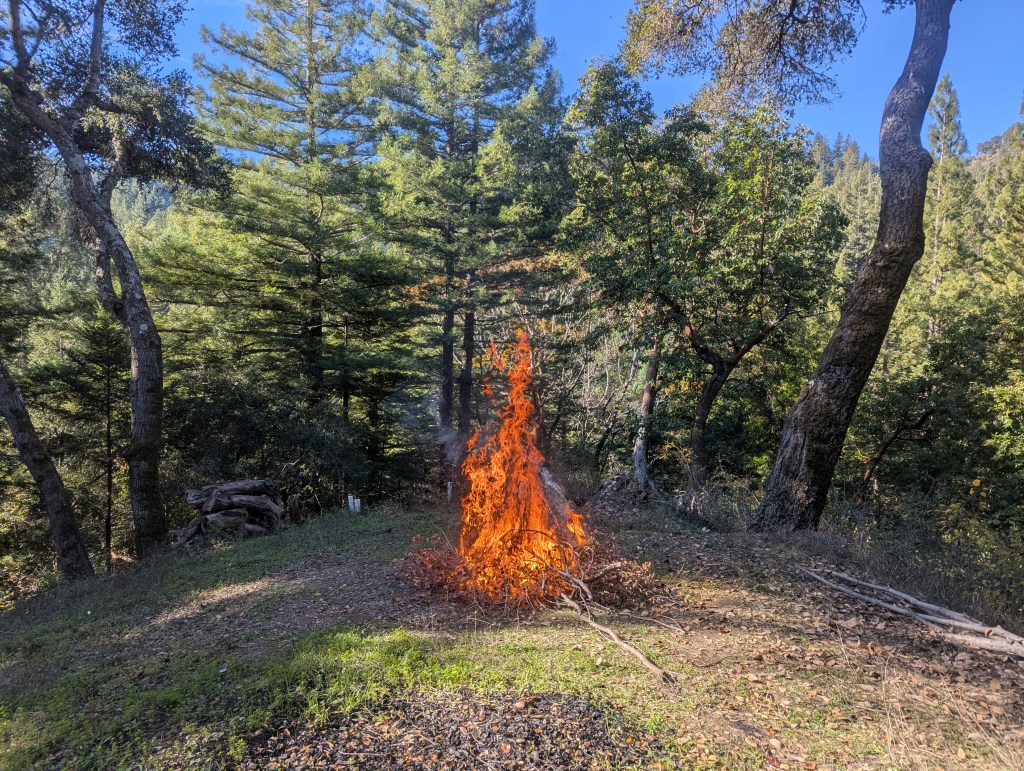
Monday was the first day of burn season, which continues from December 1 until April 30. On designated burn days within burn season, we can burn green waste that would otherwise make our properties more combustible during fire season, which is generally the opposite of burn season. The designation of burn days is determined by multiple meteorological factors, such as temperature, humidity, wind, atmospheric pressure and air quality. It is also limited by the moisture content of the forest, so can be delayed until after the first soaking rain storms. So, not only was Monday the first day of burn season, it was also the first designated burn day within burn season. I took the opportunity to burn some of the green waste that has been accumulating since the previous burn season. It was tedious but gratifying. A chipper would have been faster, but that is something that I lack here. Besides, a chipper can not go where some of the green waste remains. It is so far down steep hillsides that I may try to burn it where it is, rather than drag it up to where this primary burn pile was. There is a lot of green waste!
Green waste from the Arizona Garden is fair game for volunteers.
(This article is from 2010, so contains irrelevantly outdated information.)
Some gardens are native gardens. Some are wildflower gardens. Others are vegetable gardens, white gardens or rose gardens. There are really all sorts of gardens. Mine though is the only garden that I am aware that is described by some as a ‘felony garden’.
This less than appealing distinction originates from my habit of ‘recycling’ green waste from other gardens. From the bits and pieces of debris generated by normal maintenance, I like to propagate copies of plants that I like for my own garden. Sometimes, I get large volumes of material, such as clumps of New Zealand flax or African iris. Sometimes, I just get small bits of pelargonium or English ivy. Sometimes, the small bits are not exactly generated by maintenance.
On March 20, I really scored big! I procured a pick up full of large canes of a somewhat uncommon species of yucca, along with more than a wheelbarrow full of pieces of various cacti, agaves, aloes and succulents! I suppose that I should feel guilty; but I was helping to dispose of the green waste generated by the volunteers at the Arizona Garden at Stanford University.
The historic Arizona Garden could actually use the help of more volunteers during their Volunteer Days every third Saturday of each month. Most of us were pulling weeds last month, and will likely be pulling more this month. Although there is not always booty to be had, (and no one scores like I did!) volunteers are welcome to the debris they generate from any needed grooming and pruning.
The next Volunteer Days will be on April 17, May 15 and June 19. Volunteers can arrive at any time after 9:00 a.m., and should bring heavy gloves since almost everything in the Arizona Garden is equipped with nasty thorns or spines. Some who stay through noon like to bring bag lunches. New volunteers should contact Arizona Garden Coordinator, Christy Smith at 650 – 723 7459 or christy.smith@stanford.edu before attending a Volunteer Day to get any other necessary information and specific directions to access the Garden.
On April 18, the day after the next Volunteer Day at the Arizona Garden, the Going Native Garden Tour will be visiting more than 65 gardens throughout the Santa Clara Valley and the Peninsula from 10:00 a.m. to 4:00 p.m.. The gardens range from newly planted to established, from townhome lots to acre parcels, but all feature native plants. Some gardens feature talks about native plant gardening. A few gardens will have native plants available for purchase.
It is not possible to see all the gardens within this self guided tour, so guests can choose which gardens to visit. Admission is free, but limited; so early registration is recommended. Registration is required prior to noon on the day of the Tour. Registration can be arranged, and more information about the Going Native Garden Tour and about volunteering can be found at www.gngt.org.
They are excellent at weeding and vegetation management too, particularly where brambles are too thick to get through. They also convert unwanted vegetation into useful fertilizer. Goats are remarkably versatile and useful machines around the garden.
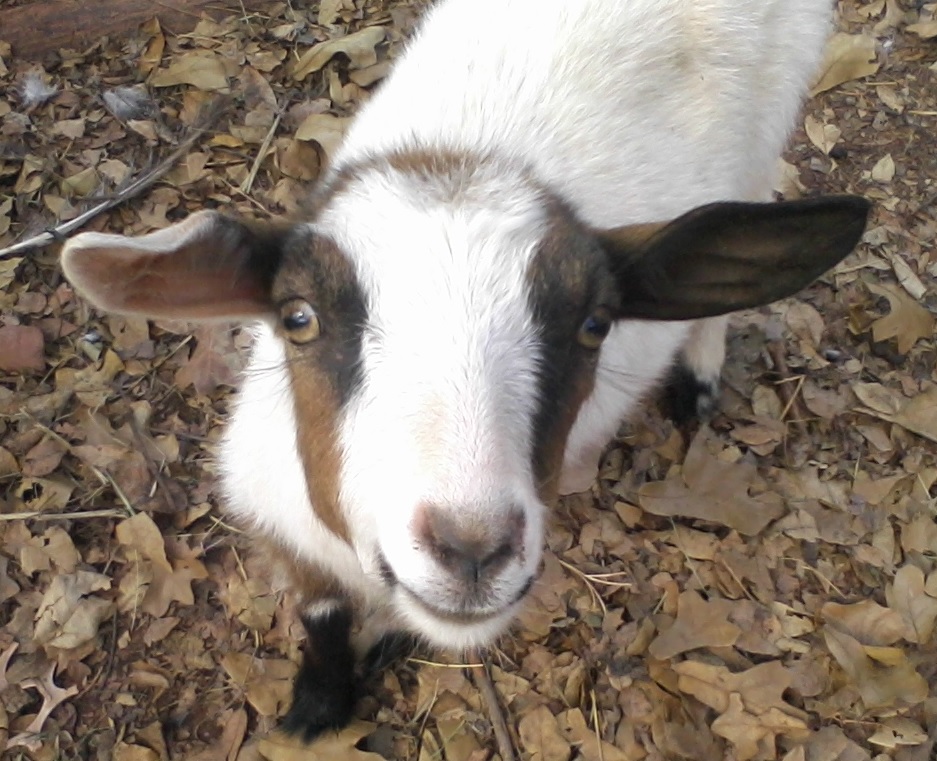
The goat in this picture is no ordinary goat. She is a pygmy fainting goat. Her kind were bred to faint when startled, in order to keep a predator occupied instead of eating other more desirable livestock in their herd. What a strange job description! When we went to Oklahoma a few years ago, we stayed on a farm with quite a herd of these small and pleasantly mannered goats.
It was winter while we were there, so there was not much to do in regard to vegetation management or gardening. There were a few blackjack oaks near the homes that I pruned up for clearance and just to neaten them up a bit. The goats came over to watch what I was doing, and seemed to know to stay back when branches fell. Nonetheless, the commotion of some of the larger branches falling was enough to cause some of the closer goats to faint and fall to the ground. They would get back up within a few seconds and proceed to eat the twigs from the branches. By the time I was finished pruning, only the larger stems remained to be dragged off and staged next to a burn pile of other debris that had accumulated earlier in the year.
Late one evening, my friend Steven decided to burn the burn pile. ( https://tonytomeo.wordpress.com/2017/11/19/oklahoma/ and https://tonytomeo.wordpress.com/2017/12/13/birthday/ ) I do not know why Steven thought that it would be a good idea to burn it in the dark. The neighbors off in the distance were probably wondering the same thing. Once it was started, there was no point in extinguishing it for a more convenient time. I went out to help him finish the job.
The initial pile flared up pretty well, and then took some time to die down. All the goats who happened to be in the main pasture at the time came over and gathered around to watch. They all seemed to be so interested, and formed a very neat and uniform circle around the fire. Their happy faces glowed like those of a really big troop of Boy Scouts.
It took a while, but the fire eventually died down enough to start throwing on the staged limbs of the blackjack oaks. The goats did not seem to mind as Steven shooed a few of them aside to get a nice hefty limb. From a few feet back, Steven innocently dropped the limb onto the fire.
The limb went down.
The flurry of sparks went up.
The entire herd of goats went down.
Neither Steven nor I saw much of what happened after that. As fast as the goats got back up, we both went down, laughing too hard to stand. The neighbors must have thought we were crazy. The goats were more certain of it. By the time we recovered and got back up, all the goats were gone . . . off into the distance and the darkness of that cool winter night in Oklahoma.

 Tony Tomeo