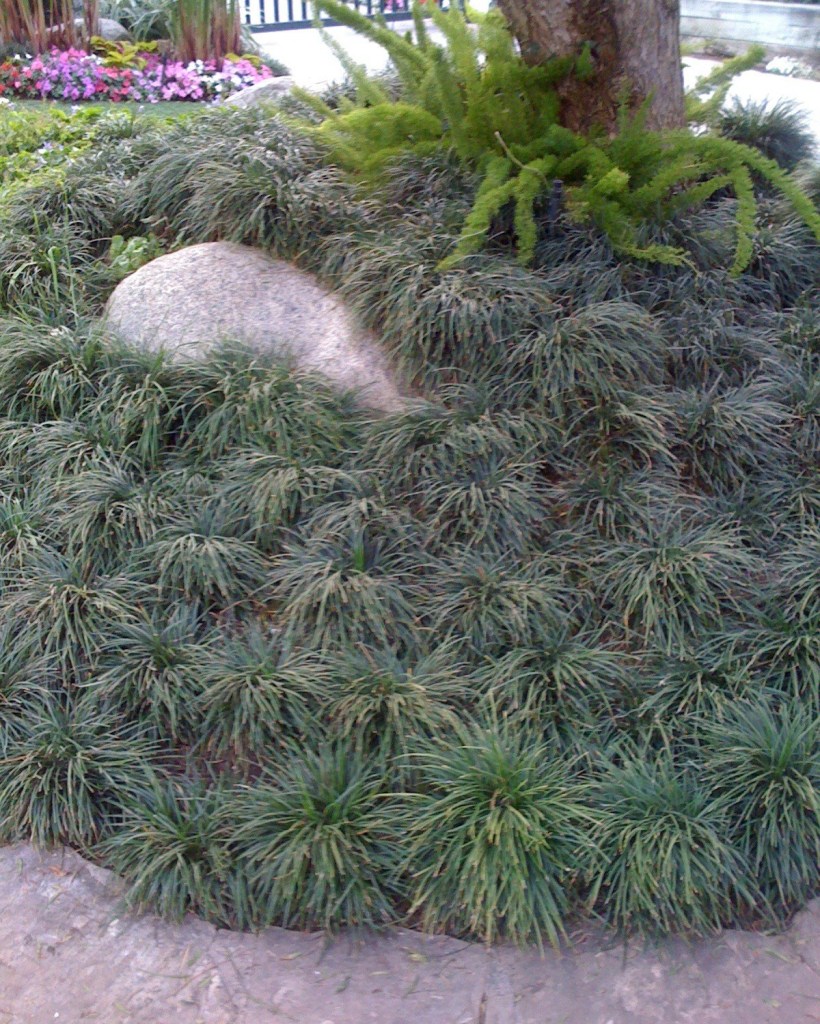
The thick clumps of evergreen grass-like foliage of mondo grass, Ophiopogon japonicas, make a nice lumpy ground cover for small spaces. Because it is rather tolerant of shade, and actually prefers partial shade to full sun, it works nicely under Japanese maples or highly branched overgrown rhododendrons. It gets only about half a foot deep. Narrow stems with small pale purplish blue flowers that bloom in summer are not too abundant, and are generally obscured below the foliage, but can actually get taller. ‘Silver Mist’ is variegated with white.
New plants are easily produced by division of large clumps. Overgrown or tired looking clumps can be shorn down at the end of winter, before new growth begins. Slugs and snails can be problematic.
Sprawling ground cover forms of rosemary, Rosmarinus officinalis, that get only a foot or so deep are the most familiar. Taller upright types that can get to six feet tall can be quite sculptural. There are several shorter shrubby types in between that can be allowed to grow wild or shorn into tight hedges.
All rosemary is densely foliated with small narrow leaves not much more than an inch long. It is used as an herb because it is so aromatic and flavorful. Tiny flowers bloom in various shades of blue through winter and spring, and sometimes again in autumn. Stems that root where they touch the ground can be dug and moved as new plants.
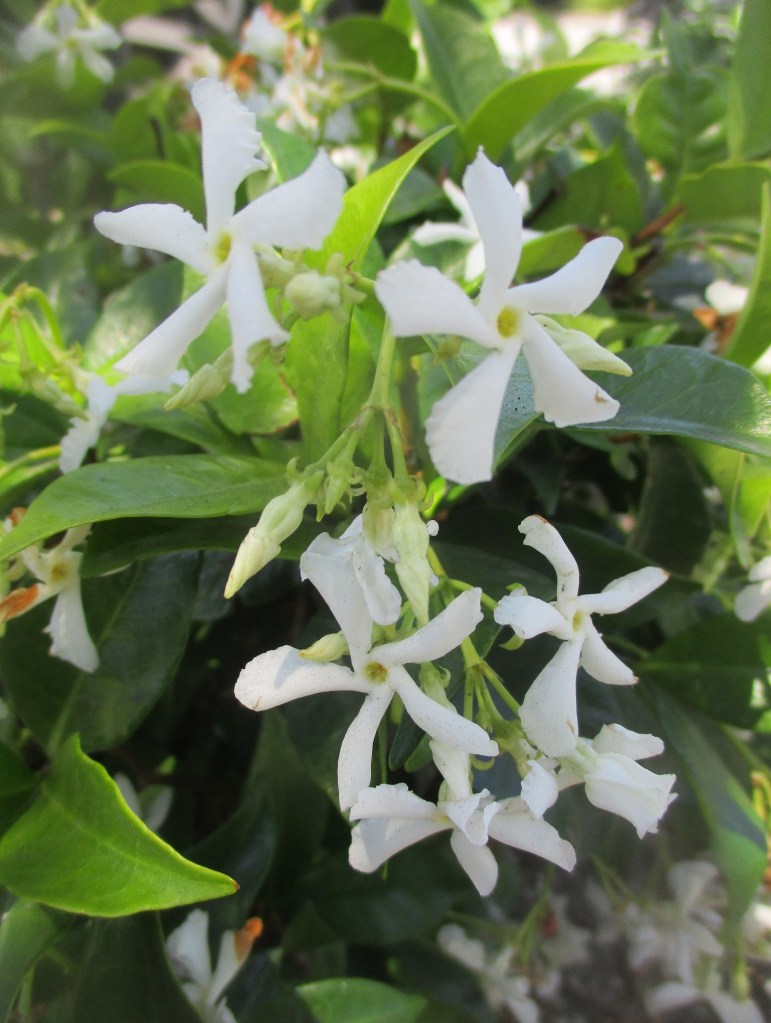
It is certainly a star within many gardens, but it is technically not a jasmine. Star jasmine, Trachelospermum jasminoides, is actually closely related to Plumeria. Its floral fragrance can be comparably rich with copious bloom, but is distinctly vanillish. Bloom is abundant for late spring and early summer. Sporadic bloom can start early and continue to autumn.
Without bloom, the distinctly glossy foliage is handsome alone. Individual leaves are not much longer than two inches, and not much wider than one. Their deep green foliar color and lustrous sheen almost seem artificial. Pruning or any disturbance of foliage or stems releases caustic and toxic sap. Twining vines ascend by wrapping around their supports.
Star jasmine can get two feet deep as a ground cover without support. It requires pruning to prevent it from overwhelming shrubbery or climbing into trees. It also requires frequent pruning around its edges. As a climbing vine, it grows fast to ten feet high, and can grow much higher a bit slower. It can become a neatly shorn faux hedge on a chain link fence.
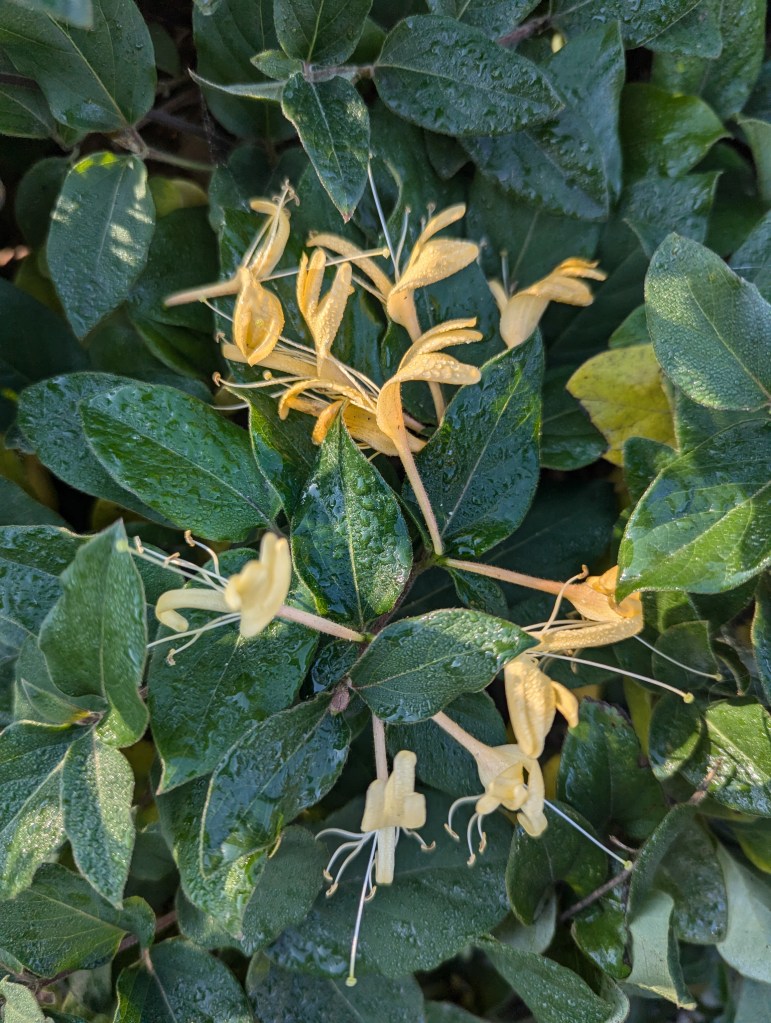
Bloom should be most abundant during late spring and summer. Within this mild climate though, it often continues sporadically through autumn. Japanese honeysuckle, Lonicera japonica, is presently blooming nicely in some areas. Its trusses of ribbony creamy white flowers fade to pale yellow. Although unimpressively colorful, they are alluringly fragrant.
Japanese honeysuckle here is almost exclusively Hall’s Japanese honeysuckle. It might be recognizable by a cultivar name of either ‘Hall’s Prolific’ or ‘Halliana’. Some botanists consider halliana to be a variety rather than a cultivar. (Variety names are neither quoted nor capitalized like cultivar names.) ‘Purpurea’, with dark but not purplish foliage, is rare.
Japanese honeysuckle, like star jasmine, is a vine that can be a ground cover. As a vine, It can climb more than thirty feet high. Unfortunately, it sometimes overwhelms shrubbery and small trees. Its twining stems can constrict the stems of other vegetation that it wraps around. As ground cover, it can get three feet deep. Leaves are two or three inches long.
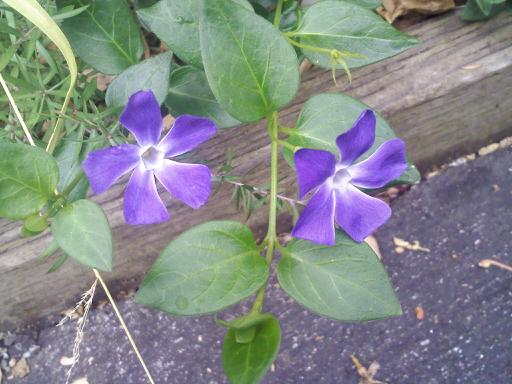
Conflict would likely erupt from any discourse between the city mouse and the country mouse regarding the topic of periwinkle, Vinca major. In rural areas, periwinkle can aggressively invade any area that stays even slightly damp through summer; and it is nearly impossible to eradicate. In urban areas, periwinkle can be a useful and appealing ground cover for difficult situations. It clings to steep embankments, and ventures into shade that is too dark for other ground covers.
Periwinkle can mound up to more than a foot and a half deep with wiry stems and rich green leaves about two and a half inches long. It looks neater and stays lower if shorn or mown down just before new growth develops at the end of winter. Two inch wide sky blue periwinkle flowers bloom mostly as new growth develops through spring, and can bloom sporadically through the end of autumn. ‘Variegata’, with wide white leaf margins, brightens up urns or planters of mixed ferns, and also looks good cascading from planters of mixed annuals or perennials.
During the 1990’s, English ivy, Hedera helix, evolved beyond small scale ground cover and became popular for pseudo-‘topiary’. It is now commonly trained onto wire frames formed into spheres, cones and all sorts of shapes. English ivy is also a nice greenery to fill in between flowering annuals and perennials in mixed urns and planters, especially where it can cascade downward.
There are all sorts of cultivars (cultivated varieties) for all sorts of applications. ‘Hahn’s Self Branching’ English ivy is probably the most practical for ground cover, since it fills in so reliably and is somewhat tolerant of partial shade. ‘Needlepoint’ had darker and more finely textured foliage; but since it does not cover larger areas so efficiently, it is instead more commonly used as greenery with mixed annuals and perennials, or for pseudo-‘topiary’. All sorts of variegated English ivy, whether alone or as a component to mixed plantings, brightens slightly shaded spots. Variegation ranges from greenish white to yellow. Leaves can be lobed, ruffled, elongated, cleft or even nearly compound; but are generally two to three inches wide. Most have three to five ‘corners’.
Adult ghost ivy growth is shrubby rather than vining. Also, it blooms and produces seed.
Ghost ivy is actually just a fancy name for variegated Algerian ivy, Hedera canarienses ‘Variegata’. Their glossy six inch wide leaves with three or five ‘corners’, are irregularly blotched with dark green, very pale green and white. Like all ivies, ghost ivy can grow as a ground cover, climb like a vine, and eventually develops self supporting branches that bloom and set seed. It may be somewhat less aggressive than unvariegated Algerian ivy, but can still overwhelm perennials, small shrubs, and even small trees.
Ivy can be allowed to climb tree trunks only if it is not allowed to wrap around and graft onto itself. Otherwise, tree trunks will become constricted as they grow and expand within their ivy wrappers. Because they climb by aerial roots, the various ivies should not be allowed to climb painted or wooden surfaces that can be damaged or succumb to rot. However, some people like the look of ivy cascading down from hefty arbors and porches enough to not mind replacing rotten parts occasionally.
Contrary to the deep green of Algerian ivy, which adds a cooling effect to sunny landscapes, ghost ivy lightens up dark areas. Ghost ivy is only rarely available in ground cover ‘mud’ flats, or in #1 (1 gallon) cans. Larger plants are not practical, since they take too much time to recover from transplant. New plants are very easy to propagate from cuttings made from pruning debris. Cuttings from shrubby adult growth become shrubby plants.
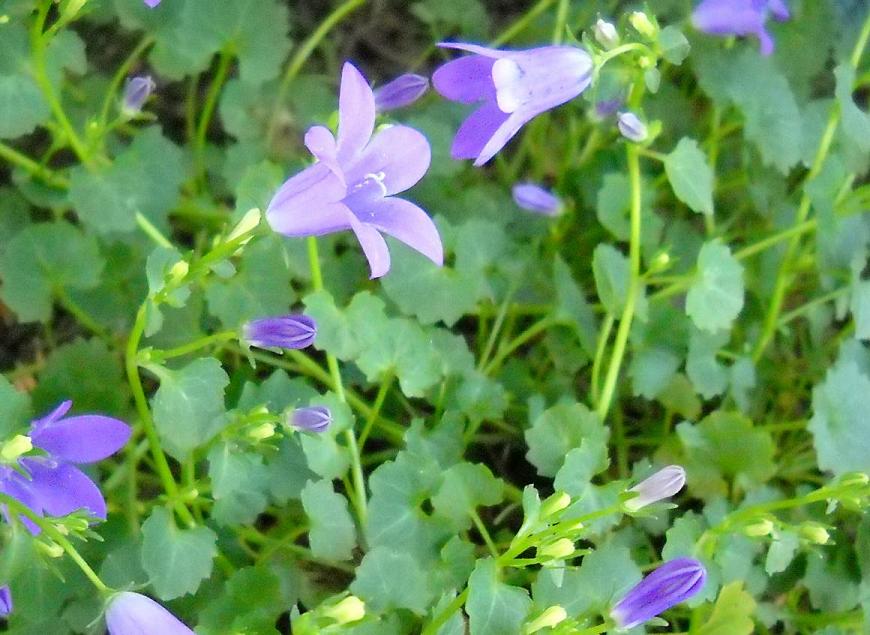
Many home garden Campanula are easier to identify by cultivar name than by species.
Of the hundreds of varied Campanula (Campanula spp.) that can be found in the wild, almost all of the few grown in gardens are small scale ground covers or creeping perennials, with blue or white bell or star shaped flowers. Most campanula fill in nicely between clumping perennials, and will spread wherever they have other plants or features to shelter them, although they are rarely reliable as ground cover for exposed areas. Campanula can be grown from seed, but is easiest to propagate by division. Pieces trimmed off from around the edges or pulled out of shrubbery also root very easily.
Garden verbena sort of resembles lantana, with more variety of color.
When I first saw ‘Peaches ‘N Cream’ garden verbena, Verbena X hybrida, that was trendy in the early 1990’s, I thought that the variable shades of pale pink and nearly white of its flowers were too dull. Then I saw the flashy bright red, purple, blue and fluorescent pink of other modern varieties at the time, and gained a new appreciation for the more subdued color range, including white and more ‘normal’ pink. The flower color range may not be very extensive, but it is diverse.
Even though it is commonly grown as an annual, garden verbena is actually a short term perennial. It is a traditional component of mixed flower urns and planter boxes, but does not necessarily need to be replaced along with other annuals. Like English ivy and ferns that are so often planted with annuals, garden verbena can be salvaged, at least for a few seasons, as annuals come and go. It looks good in hanging pots or large urns where its slightly cascading form can be appreciated. In good soil, garden verbena can become a colorful small scale ground cover.
Mature plants do not get much more than six inches deep or two feet wide. Their coarsely dentate leaves are about two inches long. Their flat, two inch wide trusses of small flowers bloom mostly in summer. Hard pruning at the end of winter helps restore plants in spring, and keeps plants healthy longer. Mildew can become a problem in humid areas, particularly if air circulation is inhibited by crowded foliage.
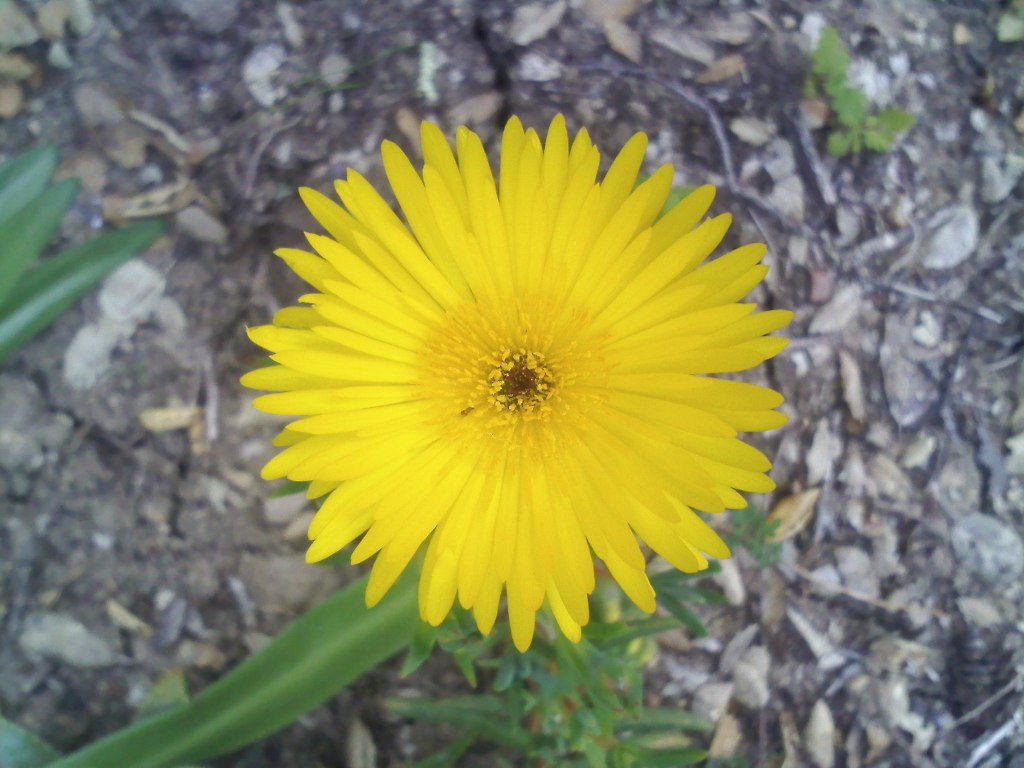
Other types of ice plant bloom with different colors.
The bright orange, inch and a half wide flowers of Lampranthus aurantiacus, a type of ice plant, should bloom between winter and spring, but a few are brightening my garden right now. This bright yellow flower in the picture is that of the variety ‘Glaucus’, which I grew from a cutting last year. My single low mounding plant is about a foot wide now and will eventually spread to about two feet wide, and can get about a foot deep. Stems can root where they lay, forming new plants that will spread farther. To accelerate the spread, more plants are very easy to propagate from small cuttings. Lampranthus aurantiacus has narrow, inch long leaves, and a relatively shrubby basal branch structure.




 Tony Tomeo