Variegated Coprosma X kirkii has very glossy light green leaves with white margins that look great cascading over retaining walls.
Coprosmas are so innately undemanding and complaisant to all sorts of conditions, that some types self sow and thrive untended in riparian or coastal environments. If they were more aggressive, they would likely naturalize (proliferate as if native) where the soil does not get too dry through summer. With such glossy foliage that looks like plastic, they might be appealing weeds.
Coprosma X kirkii is a resilient ground cover that mostly stays less than two feet deep and five feet wide, although overgrown plants can get three feet deep. Varieties with colorful or variegated foliage probably stay too small to be reliable ground cover over large areas, but make nice edging, or can cascade nicely from raised planters or urns.
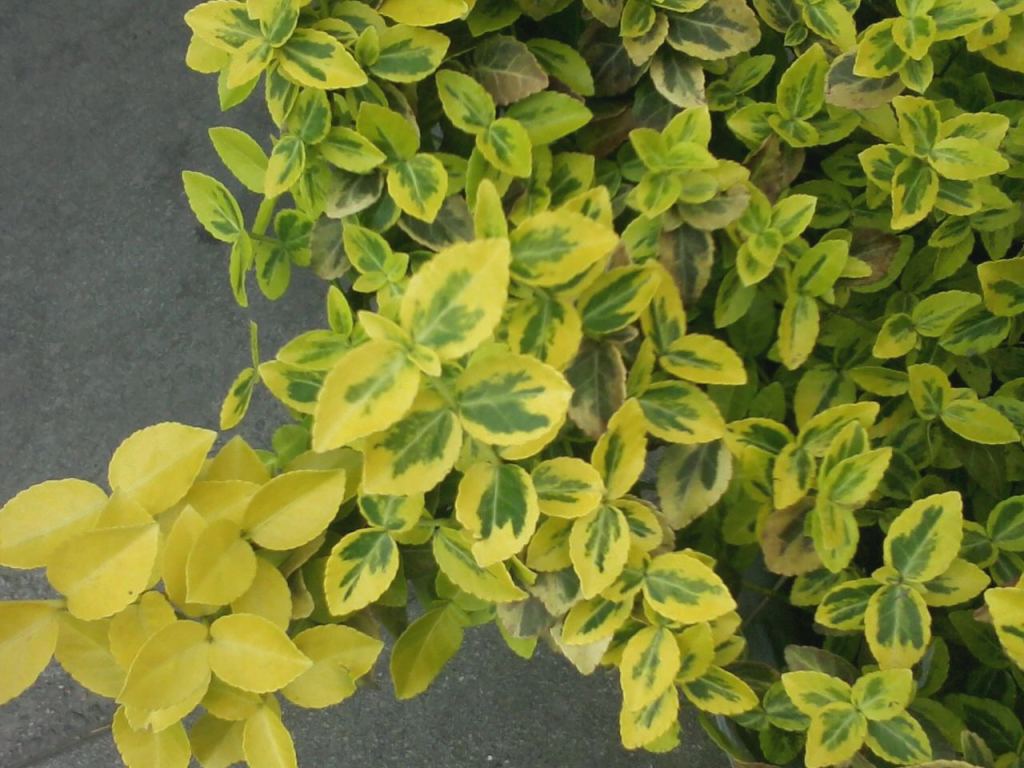
Most euonymus are upright shrubbery. This one though, stays low enough to be useful as a shallow shrubby ground cover.
Of all the functions that the many and various plants in the garden serve, ground covers have the lowliest job description. Well, maybe it is just the lowest job; covering the ground. It is an important job though. Ground covers fill in the space between other desirable plants to obscure otherwise bare soil. They also control weeds. Some ground covers help to limit erosion. Others help to insulate the soil for plants with sensitive roots.
There certainly are all sorts of ground cover. Lawns are the most familiar. Many other ground covers are perennials like gazanias, African daisies and iceplants. Some, like ivies, honeysuckles and star jasmine, are vines. Others are low growing shrubs like certain coprosmas, cotoneasters and junipers. Some lay about as flat as carpeting. Some get a few feet deep.
Many perennial ground covers as well as some of the vines and low growing shrubbery provide colorful flowers. Japanese honeysuckle and star jasmine are not as colorful, but provide delightful fragrance. Some of the cotoneasters have colorful berries in winter. Although not seen, many ground covers are appreciated more for their network or roots that help to stabilize soil that might otherwise erode. One feature that most ground cover plants have in common though, is their foliage that is dense enough to keep weeds out, as well as to obscure the soil below.
Like all other plants in the landscape, ground cover plants need maintenance. Lawns probably need more maintenance than any other ground cover, since they need to be mowed, weeded, fertilized and watered quite regularly. Vine ground covers need to be pruned so that they do not get into trees and shrubbery. Some ground covers look best if mowed annually (typically at the end of winter) or even more frequently. Some of the deeper ground cover shrubs should be pruned down to stay low. Almost all ground covers need to be edged for confinement.
Ground cover plants must be selected for their appropriateness to particular applications. For example, most low growing shrubbery needs space, so is best for larger areas. Smaller iceplants that may not be aggressive enough for big areas are great for tight spots, or for mixing with other perennials. Tough Algerian ivy that is so useful for freeway embankments may be too aggressive for home gardens. As with all plants in the garden, careful selection helps to get the best ground cover plants for each particular situation where ground covers are needed.
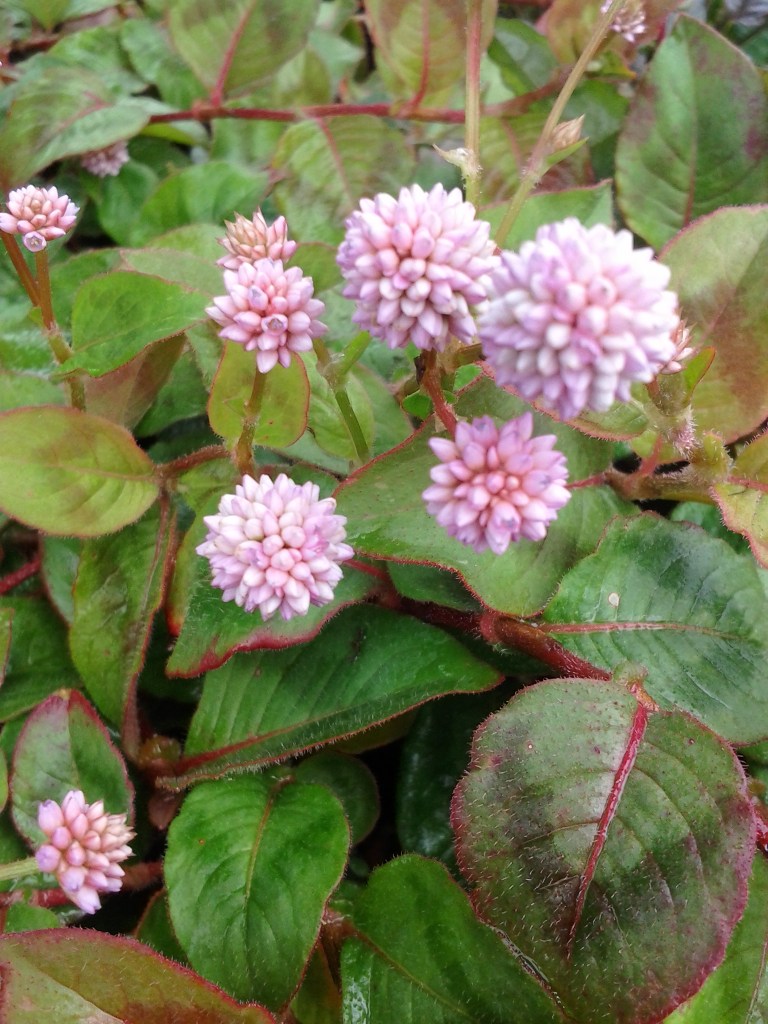
There are no fancy varieties, but many different fancy names for knotweed. It used to be known as Polygonum capitatum, but is now easier to research as Persicaria capitata. The many common names include pink knotweed, pink clover, pink fleece flower, pinkhead, pink bubbleweed and smartweed. Obviously, the tiny and spherical blooms are pink, about the color of bubble gum. Each small leaf has a distinctive brown chevron, which makes the collective foliage rather bronzy. The wiry stems can not stand much more than three inches high, but creep indefinitely, rooting as they go. Knotweed is an excellent but potentially invasive groundcover, and is also a nice component to mixed plantings in large urns or behind retaining walls, where it can cascade several inches over the edges. A bit of partial shade is no problem. Bloom continues through the end of summer, and resumes at the end of winter.
Lawn is both the most common and the most horticulturally incorrect of landscape features. Not many landscapes lack lawn. After all, it is the most useful part. Yet, with few exceptions, it requires more water and maintenance than anything else, and in most situations, than everything else combined!
Other groundcover plants are not nearly so greedy. Some need only occasional attentions. Most want less water, and some need very little water or none at all once established. No other groundcover functions like lawn. However, they each have particular advantages.
Ideally, groundcover plants do more than just look good. Most cover otherwise exposed soil so that weeds or other unwanted plants do not dominate. Some groundcovers help to stabilize soil. A few even work as living mulch so that soil does not stay too harshly exposed for other plants to be comfortable in it.
Low growing shrubbery, like creeping ceanothus and some types of juniper, can get too deep and unmanageable for confined areas. They tend to work better where they have room to spread outward uninterrupted. Otherwise, the edges can get quite shabby if they need to be pruned back for confinement. Some sprawling cotoneasters tolerate pruning better, both on top and the edges.
Coarse vines, like honeysuckle, naturally stay low where they have nothing to climb, although they need occasional pruning to stay tidy and confined. High branched trees, like most types of eucalyptus, are beyond the reach of busy tendrils or twining vines. However, Algerian and English ivies, although considerably tidier and uniform, can cling directly to the trunk of any tree to become a wicked mess out of reach!
Old fashioned Hottentot fig (freeway iceplant) can be aggressive where it needs to be pruned around the edges, but is actually quite complaisant otherwise. It does not pile up too deeply because older stems decay as readily as they get overwhelmed by new growth above. Vigorous growth is an advantage for filling in quickly, and subduing weeds. ‘Real’ iceplants are smaller, more docile around the edges, and much more colorful when they bloom.


 Tony Tomeo