Shore juniper is a ground cover that can cascade splendidly.
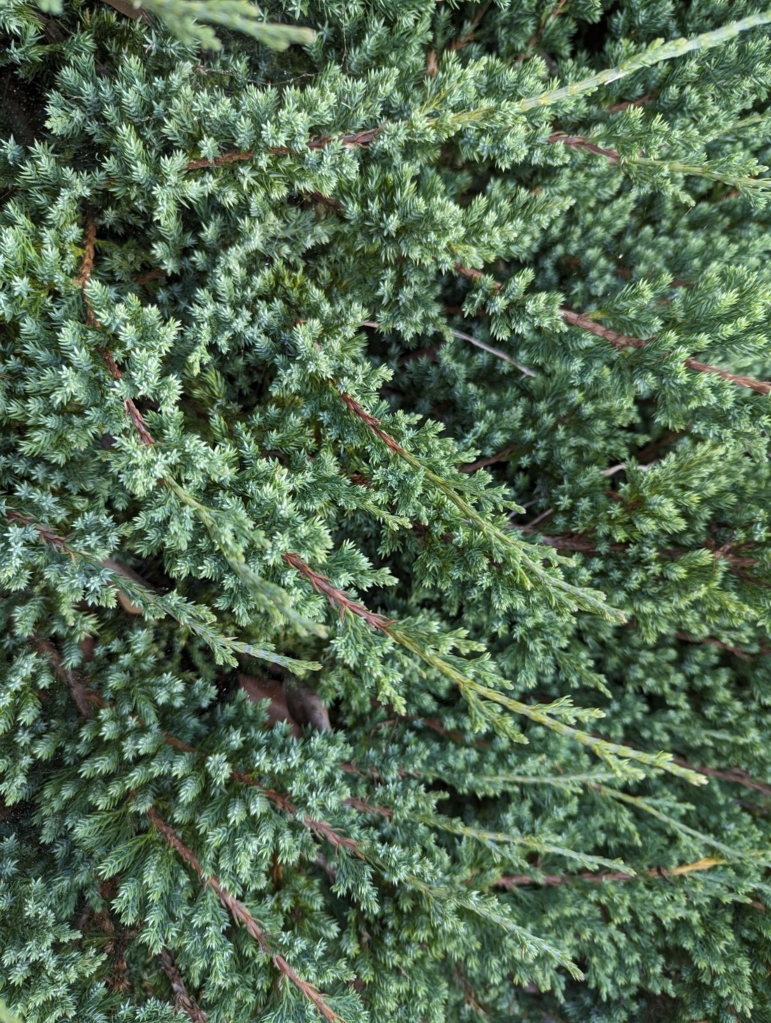
Like so many other junipers, the old fashioned shore juniper, Juniperus conferta, is recovering from decades of a bad reputation. Through the 1950’s and 60’s, junipers had been so overly common and were so commonly planted where space was insufficient for their mature size that just about anyone who enjoys gardening now likely knows how irritating prickly juniper foliage can be, or how to remove overgrown junipers. I prefer to blame the icky tam junipers for this.
Now that they are actually regaining popularity, junipers seem to be commanding more respect; perhaps with the exception of tam junipers, which are just as useless now as they ever were. Junipers that grow into small trees are getting planted where they can be appreciated for their sculptural forms. Shrubby junipers are being employed as informal barriers where they do not need to be pruned for confinement. The shore juniper, like other low growing or creeping junipers, is a practical ground cover. Mature shore junipers spread about six feet wide without getting deeper than a foot. The finely textured bluish green foliage is actually a bit more bristly than it first appears, with small pine needle shaped leaves. The soft berries are lighter grayish blue to purplish black. ‘Emerald Sea’ has greener foliage that seems to be a bit more lax. ‘Blue Pacific’ has denser and more bluish foliage.
P was for pea last Sunday. Although the spelling has not changed since then, this is a different topic now, so is not actually a sequel. P just happens to also be for the floral fragrance of Hibbertia scandens, which, to some, resembles that of what tomcats do to designate their territory. Its several common names are no more appealing. It is known as golden guinea vine, climbing guinea flower and twining guinea flower. Rather than possibly offending others of Italian descent, I refer to it simply as snake vine. Contrary to its several other common names, it is not actually from the Guinea Region of Western Africa, but is instead from Eastern Australia and New Guinea. Incidentally, New Guinea is no more affiliated with Western Africa than it is with descendents of Italian Immigrants in America, or plump rodents who identify as pigs of the Andes Mountains on the West Coast of South America. I got a few cuttings of snake vine at the end of last September. One cutting is growing quite nicely. Another took time to bloom with this single flower that looks like Carl Junior did not quite beat the train. Its floral fragrance is almost disappointingly unobjectionable. I suspect that more are necessary to be perceptibly fragrant. From my limited experience with the species, I remember than only a profusion of bloom produced merely a slightly objectionable fragrance. Like so much of what I grow here, I have no idea of what to do with these new snake vines. Fortunately, they are more docile than the white perennial pea that I mentioned last Sunday, or the cup of gold vine that I mentioned earlier. Eventually, I should be able to accommodate some within at least one of the many refined landscapes at work. If so, I will not put enough of it within the same situation to generate annoyingly objectionable floral fragrance. Nor should any individual specimen be allowed to grow large enough to do so. I would be more tolerant of a slight bit of such fragrance within my home garden only because I happen to be fond of this species now that I have reacquainted with it.
Bougainvillea does not cling to its support. It merely leans on it, or must be tied.
Harvesting grapes from a pear tree last summer reminded me why it is so important to control the grape vines this year. Without proper confinement to the fence below, the grape vines had climbed into and overwhelmed the pear tree above. My neighbor who witnessed the consequences of my lack of diligence in the garden, and helped me with the harvest, mentioned that the ‘grape tree’ was more productive than the vines had been when properly maintained during the previous year. I was embarrassed about my transgression nonetheless.
My colleague in Southern California has no problem grooming the many different kinds of vines that adorn arbors, trellises, walls, fences and railings in his garden. I certainly could not let him find out that I was vanquished by my single grapevine, which he refers to as ‘Dago wisteria’. I probably remind him of how important it is to control his vines more often than I am offended by racial slurs.
The trick is to select vines that are appropriate to each particular application. Vines for small, light trellises must be relatively complaisant, like lilac vine, pink jasmine, Carolina jessamine or clematis. Aggressive vines like wisteria, grape (the ‘other’ wisteria) and the larger trumpet vines need hefty trellises or arbors. Brambles and scrambling plants like bougainvillea and climbing roses do not actively climb, so need to be tied or ‘tucked’ into their supports.
Some of the seemingly innocent vines can actually become somewhat aggressive. Mandevillea, potato vine and star jasmine have wiry stems that seem harmless enough, but can eventually tear apart lattice or light trellises. Perennial morning glory and passion vine are potentially invasive. Trailing nasturtiums and annual morning glory really are as innocent as they look, so are nice small annual vines where space is limited. I prefer pole beans though.
Vines like Boston ivy, Virginia creeper and creeping fig that attach to their supports with roots or discs (modified tendrils) are too destructive for most applications in home gardens. They are fine on unpainted reinforced concrete buildings and concrete walls, such as the retaining walls and sound walls of freeways, but will ruin paint, siding, stucco and shingles. Unlike the other vines, these lack colorful bloom. Boston ivy and Virginia creeper produce remarkable fall color though, but then defoliate revealing bare stems through winter.
Algerian and the various English ivies are good ground cover plants that will become climbing foliar (without showy blooms) vines if they reach support. Unfortunately, they root into their support like creeping fig does, so have limited practicality. Honeysuckle is an aggressive vine that can also double as a ground cover.
The thick clumps of evergreen grass-like foliage of mondo grass, Ophiopogon japonicas, make a nice lumpy ground cover for small spaces. Because it is rather tolerant of shade, and actually prefers partial shade to full sun, it works nicely under Japanese maples or highly branched overgrown rhododendrons. It gets only about half a foot deep. Narrow stems with small pale purplish blue flowers that bloom in summer are not too abundant, and are generally obscured below the foliage, but can actually get taller. ‘Silver Mist’ is variegated with white.
New plants are easily produced by division of large clumps. Overgrown or tired looking clumps can be shorn down at the end of winter, before new growth begins. Slugs and snails can be problematic.
With adequate time, this prostrate juniper slowly evolves from ground cover to shrubbery. Japanese garden juniper, Juniperus procumbens, can sprawl more than ten feet. Without obstruction, it might do so without getting higher than a foot. It grows higher as it depletes space to expand, or reaches its maximum width. It may eventually grow a few feet deep.
The evergreen foliage of Japanese garden juniper is elegantly grayish or bluish green. It contrasts splendidly with deep green junipers or other rich green foliage. The tiny leaves display a visually fine texture, but are actually rigid and prickly. New stems are short and somewhat pointy until they widen with new foliage. Foliar density excludes most weeds.
Like most junipers, Japanese garden juniper is challenging to prune. Because foliage is so dense, it does not extend far below its outer surface. Consequently, there is not much growth to prune back to. Exposed inner stems are unlikely to foliate efficiently. Shearing, although effective, temporarily compromises natural form. Frequent light pruning is best. ‘Nana’ is the more compact cultivar.
As its common name suggests, it is a sprawling relative of common jade plant. Both are different species of the same genus. Carpet jade, Crassula nudicaulis var. platyphylla, grows only about six inches high. It sprawls slowly over the ground without getting much higher or lower. It roots where it sprawls, so can eventually develop significant colonies.
The evergreen foliage of carpet jade is a bit more dense than that of common jade plant. It is also a bit less glossy. Foliar margins blush a bit more through winter. Most popular cultivars become appealingly ruddy. Sun exposure enhances foliar color. However, frost can damage their exposed succulent leaves. Pale white winter bloom is unimpressive.
Carpet jade, like many succulents, is not very discriminating in regard to water or soil. It is likely to be more vigorous with regular irrigation. With less irrigation, it likely develops better ruddy foliar color. It provides appealing contrast to other small succulents with gray foliage. It performs well within pots, and may eventually cascade slightly over the edges.
Delightfully fragrant star jasmine can be either a ground cover or a climbing vine.
The strong fragrance of the inch-wide, star shaped flowers of star jasmine, Trachelospermum jasminoides, gets attention from quite a distance. Whether they bloom lightly in partial shade, or profusely enough to obscure nearly half of the foliage below, their crisp white shows up nicely against the rich waxy green of the simple two or three inch long, and inch wide leaves. Star jasmine is among the more complaisant of vines, so only climbs or creeps along the ground to about ten feet; perhaps twice as much when very mature.
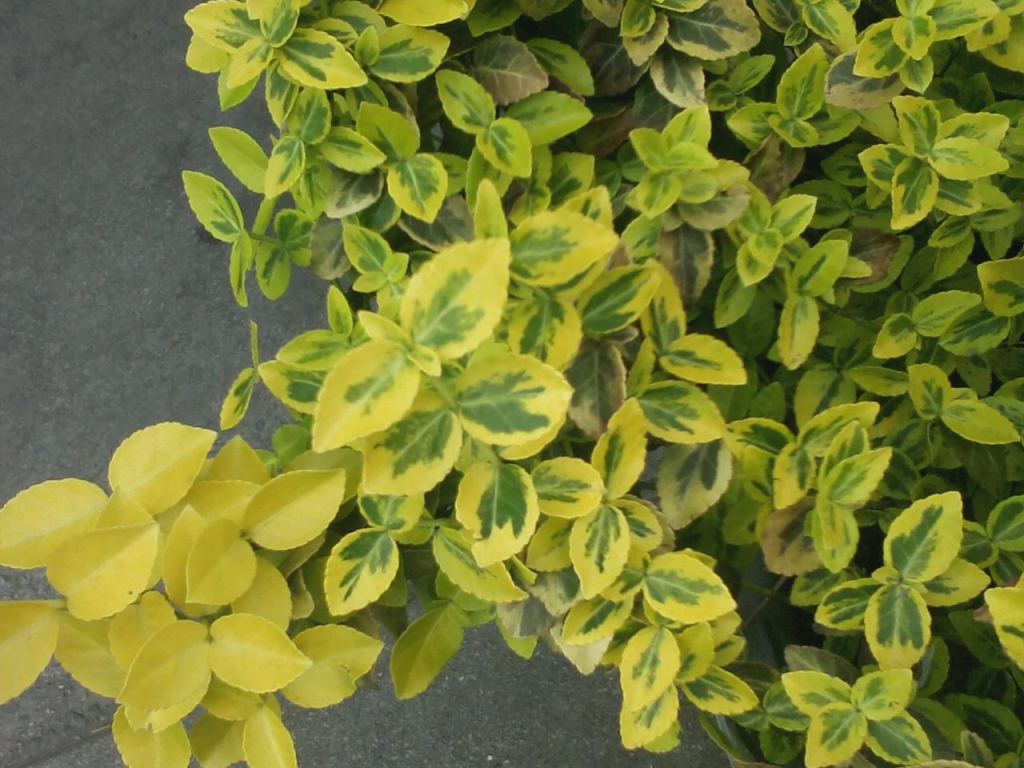
Like ivy, Euonymus fortunei creeps along the ground while juvenile, then climbs as a clinging vine where it finds support, and finally produces shrubby adult growth that can bloom and produce seed when it reaches the top of the support. Most cultivars (cultivated varieties) are juvenile plants that make good small scale ground cover that will eventually climb and mature to adulthood if not contained. As vines, they work nicely on concrete walls, but should not be allowed to climb wooden walls or painted surfaces that they can damage with their clinging rootlets. Cultivars that are grown from cuttings of adult growth are strictly shrubby.
The finely serrated, paired leaves are about three quarters to two inches long and about a quarter to one inch wide. The most popular cultivars of Euonymus fortunei that are grown for their variegated or yellow foliage do not grow too aggressively or get too large. Those with green, unvariegated foliage can slowly but eventually climb more than three stories high. Docile variegated plants can sometimes revert to unvariegated and become more aggressive. (Reversion is mutation to a more genetically stable state.)
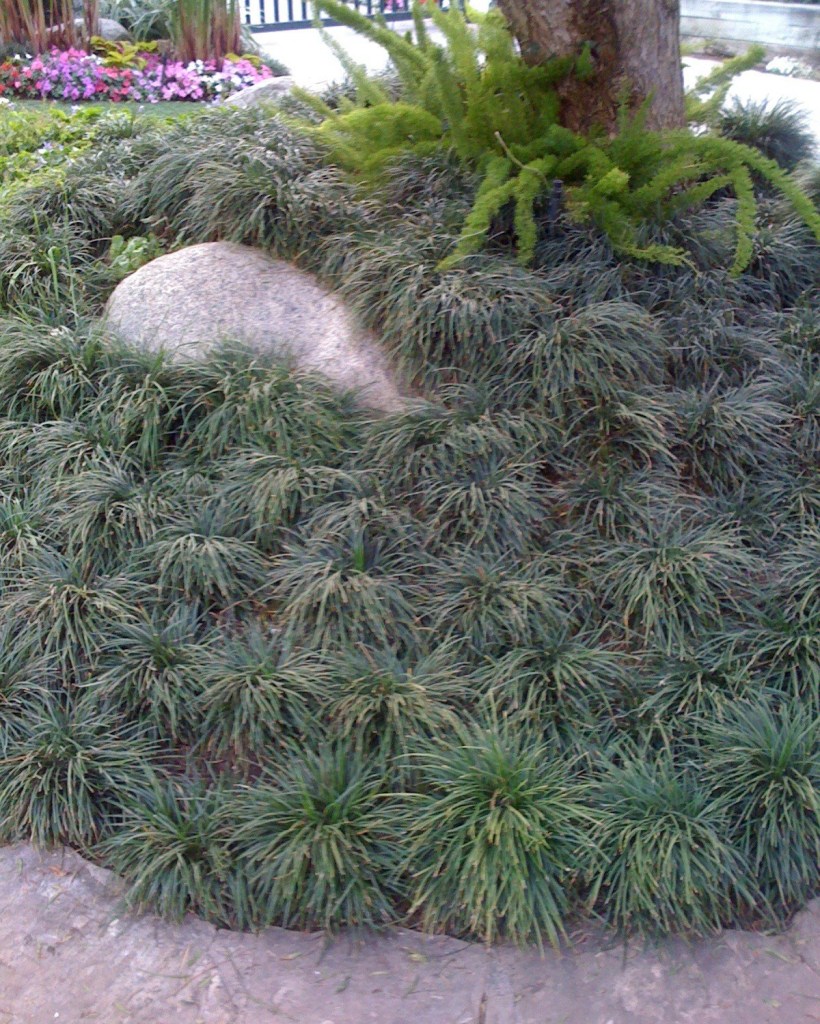
This simple green (unvariegated) mondo grass has been doing well.
The thick clumps of evergreen grass-like foliage of mondo grass, Ophiopogon japonicas, make a nice lumpy ground cover for small spaces. Because it is rather tolerant of shade, and actually prefers partial shade to full sun, it works nicely under Japanese maples or highly branched overgrown rhododendrons. It gets only about half a foot deep. Narrow stems with small pale purplish blue flowers that bloom in summer are not too abundant, and are generally obscured below the foliage, but can actually get taller. ‘Silver Mist’ is variegated with white.
New plants are easily produced by division of large clumps. Overgrown or tired looking clumps can be shorn down at the end of winter, before new growth begins. Slugs and snails can be problematic.
It is not actually moss. It is of the same family as carnation. Of course, any distinguishing characteristics of its family are difficult to recognize. Iris moss, Sagina subulata, has such exceptionally fine foliar texture and diminutive bloom. Its slim leaves are not much longer than a quarter of an inch. its tiny white flowers are barely wider than an eighth of an inch.
Irish moss is a luxuriantly dense and richly evergreen ground cover for confined spaces. It works well within small atriums and big pots that contain sculptural plants that lack low foliage. It is a popular accessory for Japanese maple and citrus within tubs. Since it gets no more than two inches deep, Irish moss can fill in between pavers and under benches.
However, Irish moss dislikes how pavement enhances harsh exposure. Although it does not require shade, it appreciates a bit of partial shade while the weather is warmest after noon. Also, it craves somewhat frequent watering to compensate for locally arid warmth. Scottish moss is the cultivar ‘Aurea’. It is lighter chartreuse green, but otherwise identical.





 Tony Tomeo