Compared to Algerian ivy, English ivy, Hedera helix, may seem to be more complaisant. As ground cover, it mostly stays a bit lower, with smaller leaves, and a more refined foliar texture. It is generally easier to maintain and to mow if it does not get too deep. However, where it naturalizes, English ivy is more aggressive and more invasive than Algerian ivy.
If contained, English ivy is a splendidly dense and evergreen ground cover that excludes most weeds. Containment is very important! English ivy must not climb into shrubbery or trees. It otherwise overwhelms its support and disperses seed. Although reasonably safe on bare concrete walls, it ruins wooden, painted and stucco surfaces. Growth is very fast!
‘Hahn’s’ is likely the most popular cultivar of English ivy. It branches well, to fill out fast as ground cover. Cultivars that are variegated with white or yellow grow significantly slower, but provide elegant foliage for big pots or planters of mixed annuals or perennials. Foliar lobes are variable. For example, lobes of ‘Needlepoint’ are distinctly narrow and pointed.
Weeding otherwise bare and unused ground is no fun. Nor is weed whacking. Mulching inhibits future weed growth, but requires occasional replenishment. For many situations, ground cover plants are more practical. Once established, many sorts effectively exclude most weeds. Even more contain dust, and inhibit erosion of the surface of the soil below.
As the terminology implies, ground cover plants are simply plants that disperse laterally, over the surface of the ground. Many migrate by subterranean stems known as rhizomes, or by stems on the surface of the soil, known as stolons. Some are vines that behave like stolons. Also, many are merely prostrate shrubbery that does not stand upright very high.
Ground cover plants generally require more maintenance than mulch, and most want for some degree of irrigation. Conversely they require less effort than weeding. Furthermore, ground cover plants can live on slopes that are too steep for mulch to adhere to, and are more appealing than mulch. They might be as colorful or fragrant as other sorts of plants.
Prostrate shrubbery, such as creeping cultivars of juniper, manzanita and ceanothus, are best in areas that are big enough to accommodate their width at maturity. Within confined spaces, they need pruning around the edges, which exposes unappealingly bare interior stems. Prostrate shrubbery generally gets higher than other types of ground cover plants.
The many vines that work as ground cover probably stay lower than prostrate shrubbery, unless of course they climb into bigger shrubbery and trees. Algerian ivy and English ivy are famously aggressive if they overwhelm other vegetation. Also, they can cling to walls and ruin paint and siding. Star jasmine climbs too, but does not cling, and is more docile.
Perennial ground cover plants, such as various iceplant, trailing gazania, trailing African daisy and pigface (freeway iceplant), tend to stay lower than other types. Most require no grooming over their upper surface, so only need trimming around the edges. Scraps from trimming during winter can become cuttings for bare patches or elsewhere in the garden. Several types root efficiently.
This jasmine is quite a star. However, this star is technically not a jasmine. Star jasmine, Trachelospermum jasminoides, is instead related to mandevilla and oleander. For many years, it has been one of the most popular vines for home gardens as well as large scale landscapes. It works well either as a ground cover, or as a relatively docile climbing vine.
As ground cover, star jasmine gets about two feet deep. It will be lower and more refined with shearing, but will likely bloom less. It tries to climb shrubbery and trees, so will need exclusionary pruning. However, on a chain link fence, star jasmine works splendidly as a shorn faux hedge. It grows fast to more than ten feet high, but can get significantly higher.
The richly fragrant bloom is most profuse about now, and can continue sporadically until autumn. The inch wide and bright white flowers are shaped like stars, and hang in small clusters. After bloom, the distinctly glossy and dark green evergreen foliage is handsome alone. Individual leaves are a bit longer than two inches and a bit broader than one inch.
Dwarf periwinkle, which is a vigorous but manageable ground-cover here, is an invasive weed in other regions. Locally, common periwinkle, Vinca major, is the more aggressive sort. It naturalizes in riparian situations and damp parts of unrefined landscapes. Stolons can be difficult to pull completely from the soil. Seed disperses secretively but efficiently.
Periwinkle is almost never available in nurseries nowadays. It tends to infest gardens by sneaking in. Then, the foliage and bloom can be too appealing to eradicate. More plants are easy to divide from established colonies. Growth is tidier if mown at the end of winter. As it regenerates, it gets more relaxed, and finally gets floppy. It looks shabby if trampled.
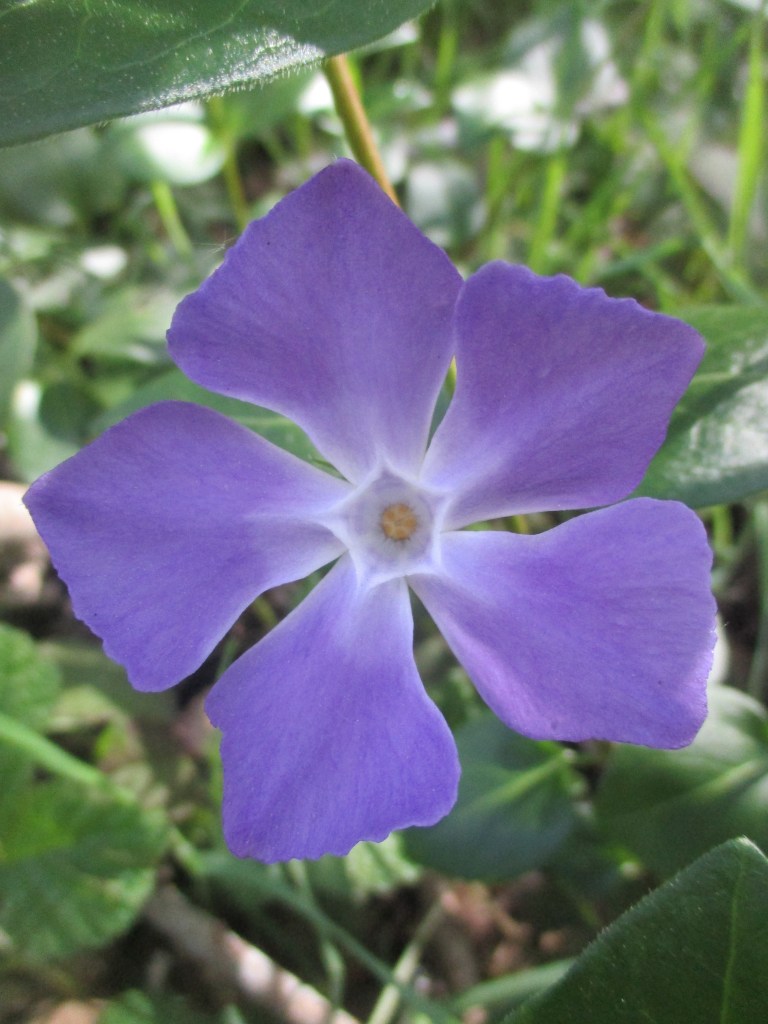
Periwinkle blooms with sporadic but delightfully clear blue bloom. Individual flowers are about an inch and a half wide. The evergreen leaves are an inch or two long. Wiry stems get a foot or two deep. Cultivars with white or purplish blue bloom were available before
periwinkle naturalized. Periwinkle with foliar variegation still inhabits some old gardens. It is slightly more complaisant.
The few rudimentary rockroses that were available years ago have been bred into too many cultivars to keep up with. Some of the traditional types can get a few feet tall, with delightfully irregular growth, and flowers that are almost three inches wide. Most of the modern types are relatively dense, low and mounding, like a deep ground cover, with smaller but more profuse flowers. Most bloom pink. Some bloom white. After the initial spring bloom phase, a few flowers continue to bloom sporadically through summer. The grayish and aromatic foliage is not as impressive as the bloom. Rockroses want well drained soil and good warm exposure.
Sctoch moss resembles Irish moss, but is lighter yellowish green rather than dark green.
Too much water can be as much of a problem as not enough. Too much direct sun exposure can likewise be as much of a problem as not enough sunlight. Scotch moss, Sagina subulata ‘Aurea’, wants regular but not excessive watering, and only a bit of shade without darkness. To propagate, pieces with roots can be torn from healthy plants and ‘plugged’ (planted) as new plants where more are desired in early spring or autumn.
The remarkably finely textured and dense foliage makes a nicely refined ground cover for confined spots, or fills in the spaces between stones in a wall or walkway. It gets only about an inch deep, with tiny and obscured stems that get no longer than four inches. Stems develop roots where they touch the ground to creep any farther. The tiny and narrow leaves do not get much longer than a quarter inch. Tiny white flowers that bloom late in spring may not get noticed. What distinguishes Scotch moss from richly deep green Irish moss is that it is instead yellow or almost chartreuse.
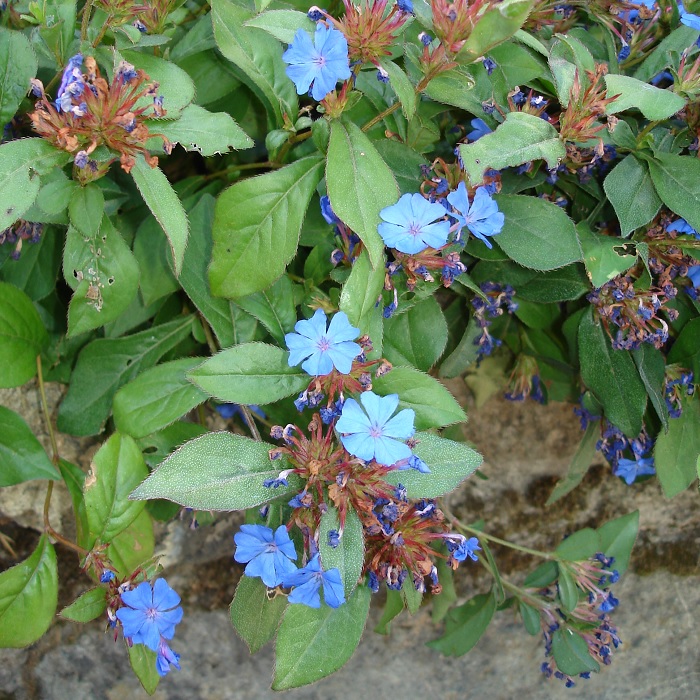
There are not many flowers as blue as those of plumbago, Ceratostigma plumbaginoides. Individual flowers are not much more than half an inch long, but can be quite abundant until autumn. Each of the many terminal flower clusters is on a rather reliable schedule, so that new flowers begin to open as older flowers begin to fade.
Thin stems stand only about half a foot to a foot above underground rhizomes. Individual plants get about 3-feet wide, but realistically, will slowly spread farther if conditions are right. They do not spread fast enough to be invasive, but can get into some unexpected spots if not controlled. The simple leaves are about two inches long.
The main problem with plumbago is that it is deciduous, so it dies back to the ground in autumn. The weather is too mild here to produce the good fall color seen where autumns are cooler. Plumbago is a popular bulb cover because new growth, although slow to develop, emerges just in time to obscure fading foliage of early spring bulbs like daffodil and tulip.
Plumbago also works well with stone, since the stone is still appealing without the foliage through winter. The wiry stems weave nicely through otherwise bare cobbles, or spill slightly over low stone walls. Even though shade inhibits bloom, plumbago makes a nice informal ground cover under open shrubbery.
Bloom is sporadic, but the delightful purplish blue color is worth it.
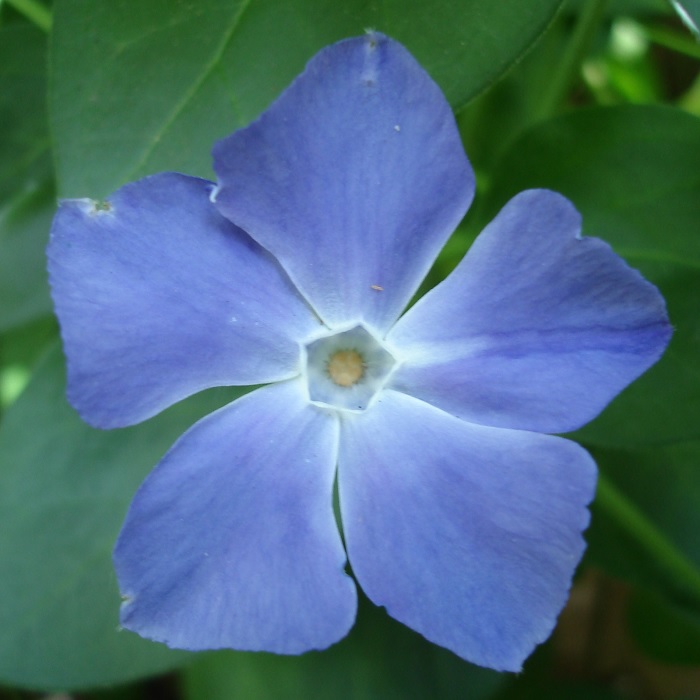
If the Latin name of dwarf periwinkle is Vinca minor, it is logical that large periwinkle should be Vinca major. Large periwinkle is more commonly known simply as periwinkle or common periwinkle, although it is not as common as dwarf periwinkle is, at least in landscapes. In some regions, it has naturalized as an invasive weed.
Some might accurately say that periwinkle is shabbier than the relatively neat and dense dwarf periwinkle. Others might say that it is just rustic or informal. The wiry stems stand less than a foot tall before they bend over from their own weight. Fallen stems can root where they touch the ground, and grow into new plants over winter.
The evergreen foliage is rich green, and a bit darker than the top of a billiard table. The simple paired leaves are about an inch and a half to two inches long. The slightly purplish blue flowers are about an inch and a half wide, with five petals each. Bloom is sporadic, but almost continuous, except for a lapse through winter.
The small yellow flowers are the giveaway. Real strawberries have white or maybe pink flowers. Otherwise, mock strawberry, Potentilla indica, looks very much like wild strawberry, with similar small red fruits and neatly serrate trifoliate leaves (that are palmately divided into three leaflets). The berries are edible, but do not taste like much.
Like real strawberries, mock strawberry spreads efficiently by stolons. If watered occasionally and sometimes fertilized, it is probably a better groundcover than the common ornamental varieties of wild strawberry. It is invasive in some areas.
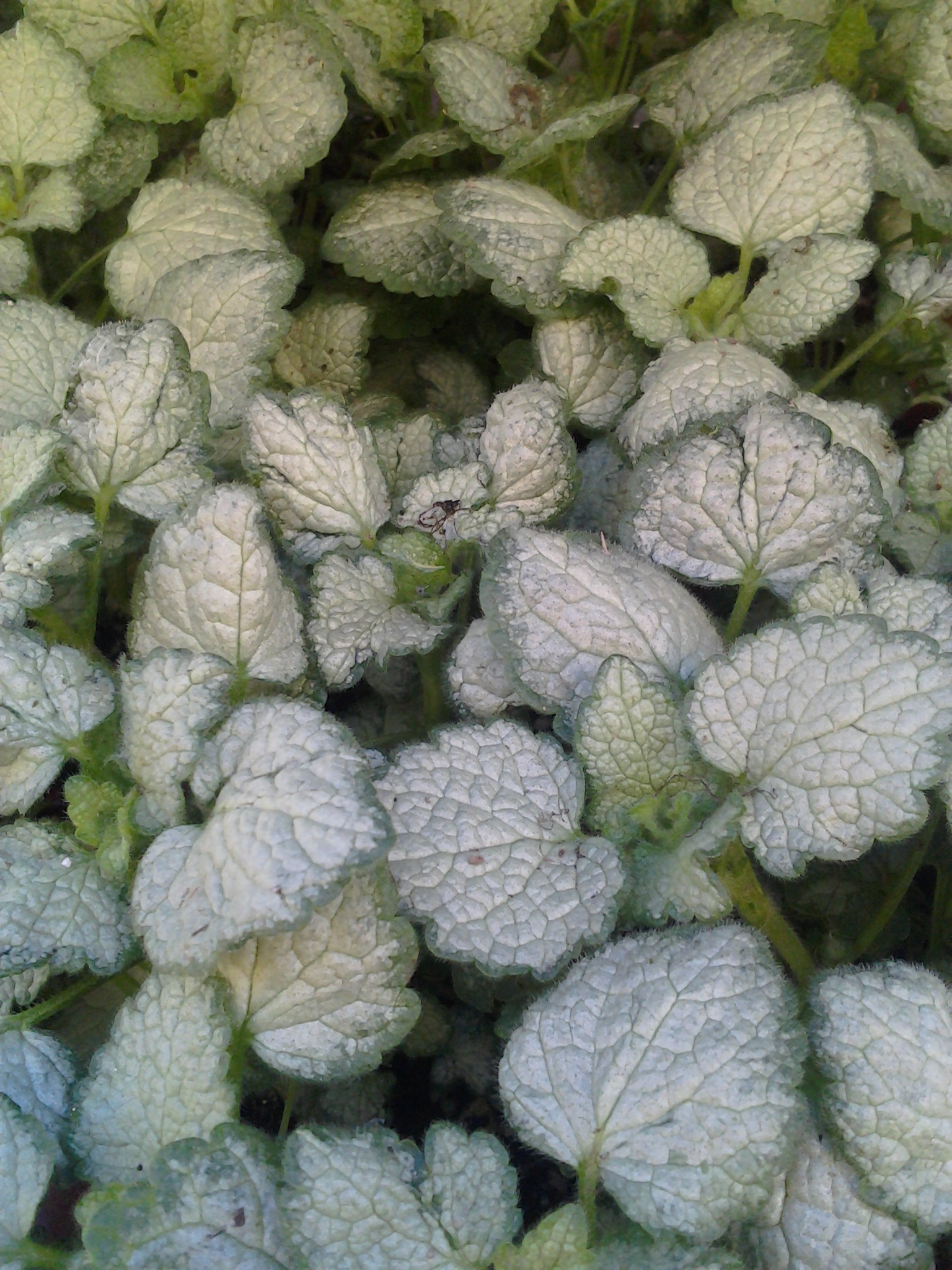
Because its common name is so unappealing, dead nettle is more commonly known by its Latin name, Lamium. or more specifically, Lamium maculata. It is a low and subdued plant with pastel pink, lavender or white blooms, and small deep green leaves. However, modern garden varieties have silvery variegated foliage that brightens shady spots. Some are yellowish green.
The herbaceous stems spread only one or two feet at first, but then root into the soil where they land, and continue to spread some more. The mounding growth can get about half a foot deep, or a bit deeper where it can pile up on other plants or rocks. After late spring or early summer bloom, deteriorating flower stems should be shorn back to enhance density of foliar growth below.
Stems that begin to spread a bit too far into areas where they are not wanted can be left long enough to develop roots through spring, and then pulled up and planted where they are wanted. Even before they spread that much, no one would miss a few rooted stems discretely taken from established plants to make copies. Plants in sunnier spots want richer soil and more water.





 Tony Tomeo