Other types of ice plant bloom with different colors.
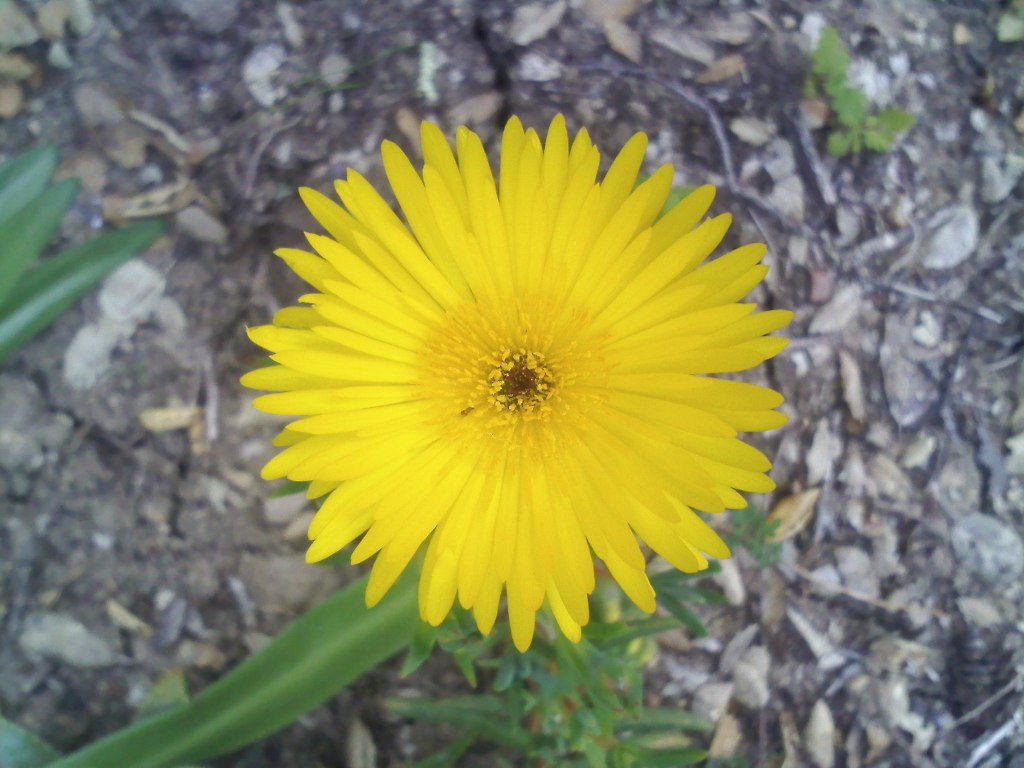
The bright orange, inch and a half wide flowers of Lampranthus aurantiacus, a type of ice plant, should bloom between winter and spring, but a few are brightening my garden right now. This bright yellow flower in the picture is that of the variety ‘Glaucus’, which I grew from a cutting last year. My single low mounding plant is about a foot wide now and will eventually spread to about two feet wide, and can get about a foot deep. Stems can root where they lay, forming new plants that will spread farther. To accelerate the spread, more plants are very easy to propagate from small cuttings. Lampranthus aurantiacus has narrow, inch long leaves, and a relatively shrubby basal branch structure.
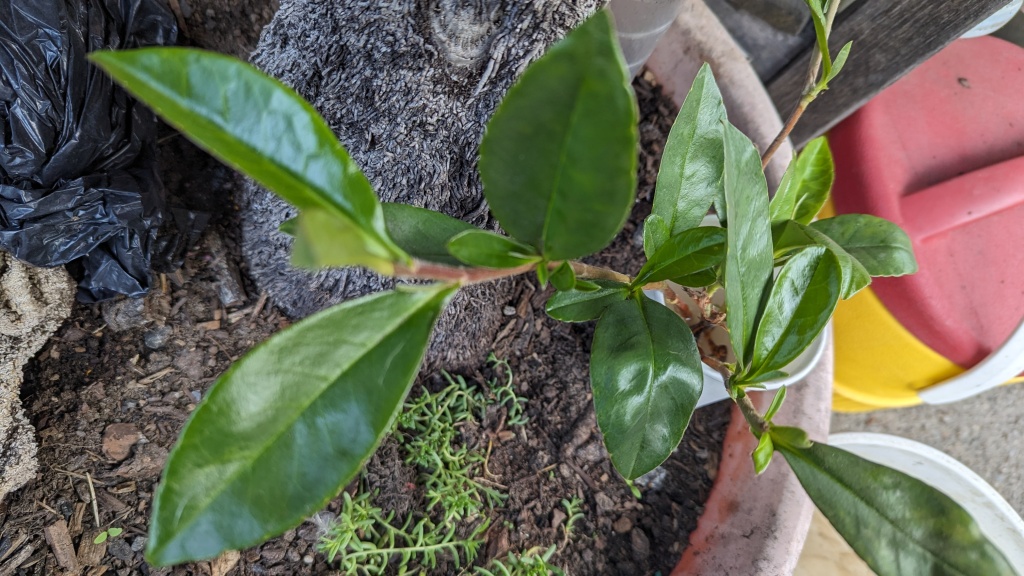
Obviously, it is not cup of gold vine, Carolina jessamine, yellow jasmine, yellow trumpet vine, yellow orchid vine, yellow black eyed Susan vine or any of the vines with yellow flowers that Google suggested as its identity. It is more than obviously not lotus, which incidentally blooms with orange flowers rather than yellow, but was somehow, according to Google, a candidate for vines with yellow flowers. It is amazing what can and can not be found on Google.
Brent recognized this vine just like I did, but also like me, could not remember its identity. We had not seen much of it in many years, but could remember that it was somewhat common in coastal regions while we were in school during the late 1980s. It lived at a doughnut shop that we sometimes went to in Morro Bay, and seemed to smell as if a tom cat had marked his territory on it. I can remember it within old gardens of Carmel and Monterey, as well as Santa Cruz, where I found these cuttings. I also remember encountering it while inspecting median landscapes of some of the major roads of Morgan Hill in the late 2000s, and that it did not perform as well within the somewhat inland climate there. Brent observed that specimens in Santa Monica and Beverly Hills seemed to express the same preference for the more coastal climate of Santa Monica.
Now that I got it, I have no idea of what to do with it. I suppose that, without mentioning the faint but potentially slightly objectionable floral fragrance, I can convince neighbors that they want it in their gardens. Some of our landscapes are big enough for it to be pretty at a distance. At least I know what it is, Guinea flower, Hibbertia scandens.
This bender board does nothing that the curb should not do.
The truth of this bender board is that it is not necessary. Seriously, what it is supposed to accomplish there that the curb should not already be doing? That stake wedged between the curb and the bender board to the upper left makes it seem even sillier than it already is. I realize that bender board is designed to bend, but this just draws attention to bad design. Perhaps this is one of those rare situations in which the stake should be on the inside, with the bender board screwed onto it, like might have been the intention for the unattached stake to the lower right. Heck, the curb does almost all of the work of holding the bender board in place anyway.
The dyed chipped wood to the upper right of the bender board seems to rely on the bender board for containment. That would be a realistic application for bender board in a situation that lacks a curb. For this situation, the curb should be adequate. If the soil below the chips is too high, it should have been excavated to a lower level prior to the installation of the chips. As one can see in this picture, such excavation would have been minimal.
Bender board certainly has practical application, such as separating chips like these from turf grass or ground cover. It might contain or provide a neat edge for vigorous ground cover. However, it does nothing that a curb does not already do. In some landscapes it merely adds another component to an innate tripping hazard. It gets dislodged or damaged if vehicles drive over it, or if enough people trip over it.
Unfortunately, for so-called ‘landscape professionals’ it is too easy to install; and such installation is too lucrative. Simplicity is much less lucrative.
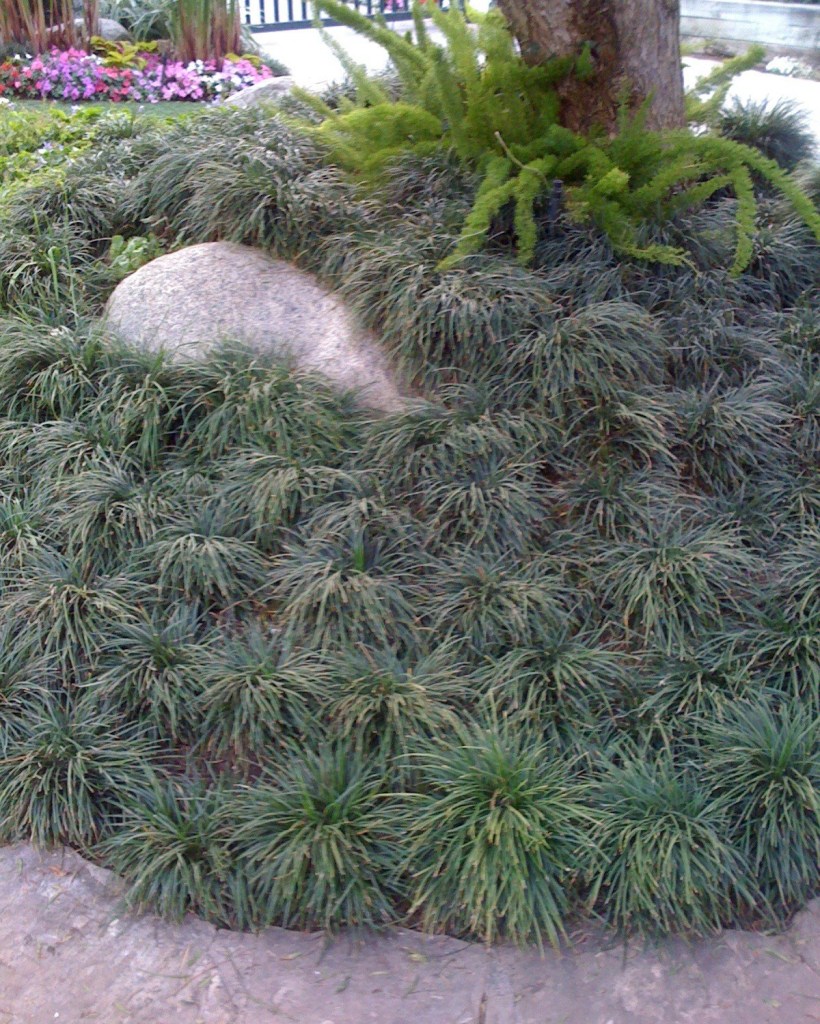
This simple green (unvariegated) mondo grass has been doing well.
The thick clumps of evergreen grass-like foliage of mondo grass, Ophiopogon japonicas, make a nice lumpy ground cover for small spaces. Because it is rather tolerant of shade, and actually prefers partial shade to full sun, it works nicely under Japanese maples or highly branched overgrown rhododendrons. It gets only about half a foot deep. Narrow stems with small pale purplish blue flowers that bloom in summer are not too abundant, and are generally obscured below the foliage, but can actually get taller. ‘Silver Mist’ is variegated with white.
New plants are easily produced by division of large clumps. Overgrown or tired looking clumps can be shorn down at the end of winter, before new growth begins. Slugs and snails can be problematic.
It is not actually moss. It is of the same family as carnation. Of course, any distinguishing characteristics of its family are difficult to recognize. Iris moss, Sagina subulata, has such exceptionally fine foliar texture and diminutive bloom. Its slim leaves are not much longer than a quarter of an inch. its tiny white flowers are barely wider than an eighth of an inch.
Irish moss is a luxuriantly dense and richly evergreen ground cover for confined spaces. It works well within small atriums and big pots that contain sculptural plants that lack low foliage. It is a popular accessory for Japanese maple and citrus within tubs. Since it gets no more than two inches deep, Irish moss can fill in between pavers and under benches.
However, Irish moss dislikes how pavement enhances harsh exposure. Although it does not require shade, it appreciates a bit of partial shade while the weather is warmest after noon. Also, it craves somewhat frequent watering to compensate for locally arid warmth. Scottish moss is the cultivar ‘Aurea’. It is lighter chartreuse green, but otherwise identical.
Within the outdoor rooms of home gardens, shade trees are ceilings, shrubs and hedges are walls, and turf and ground cover plants are floors. That is why the selection of plants for such purposes is as important as the selection of paint and carpet for indoors. Among ground cover plants, durable turf grasses for lawns are the most common and functional.
There are so many more types of ground cover plants besides turf grasses though. A few of the lower, denser and more resilient types of ground cover plants can function as turf if necessary. Many more function as mulch to control erosion, contain dust or conceal mud. Many inhibit proliferation of weeds. Some retain a bit more moisture than they consume.
Appropriate ground cover plants most definitely have many advantages. They also have certain disadvantages. Although most require less maintenance than the weeds that they exclude, they require more maintenance than simple mulch. Also, most require irrigation. They might be trailing perennials, sprawling shrubbery, or unsupported wandering vines.
Trailing gazania, Hottentot fig (freeway ‘ice plant’) and various ice plants are some of the more popular perennial ground cover plants. They and others migrate by trailing stolons or rhizomes. They are among the lower and more compact types of ground cover plants. Some need no more pruning than edging. Many propagate easily by division or cuttings.
Sprawling sorts of juniper, ceanothus, cotoneaster, myoporum and rosemary are shrubby ground cover plants. They get significantly deeper than perennial plants, and some sorts can eventually get too overgrown to be practical. Rosemary, myoporum and cotoneaster are conducive to shearing as they mature. Ceanothus and juniper need significant area.
English ivy, Algerian ivy and star jasmine are vining ground cover plants that should stay rather low if properly maintained. However, they can climb into shrubbery and trees, and even buildings. The ivies are famously aggressive, and spread indefinitely by rooting as they migrate. Severe pruning can renovate some overgrown vining ground cover plants. Bougainville gets rather shrubby and deep, even without support.
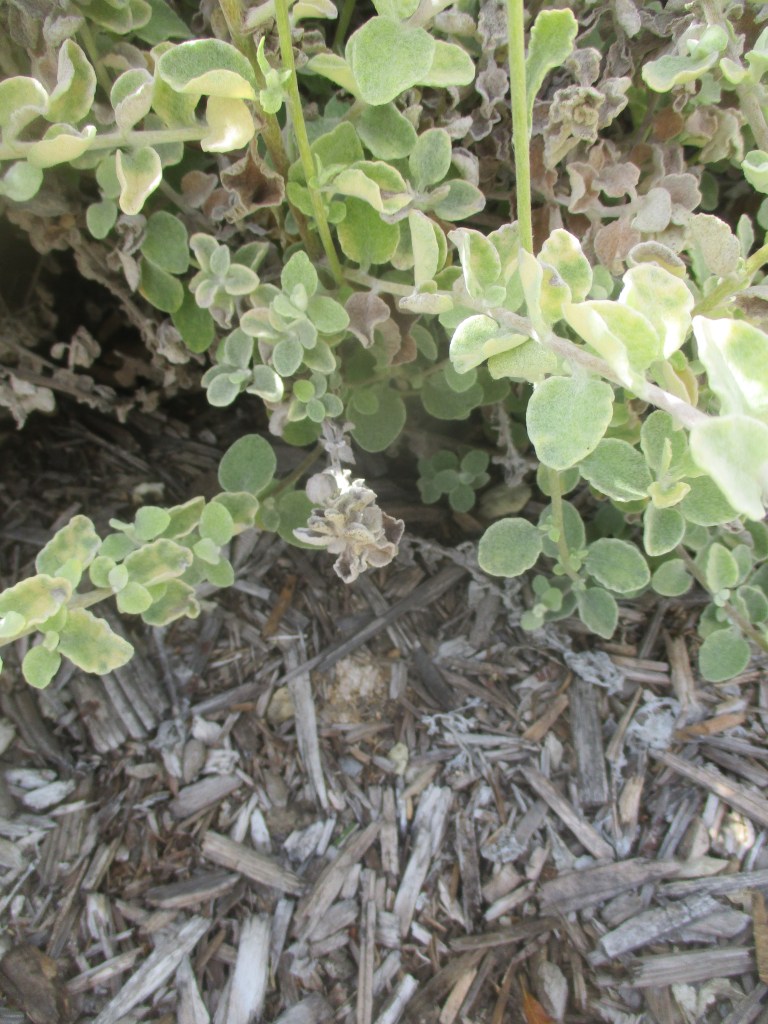
This is not the genuine licorice of confectionery. This more popular home garden licorice plant, Helichrysum petiolare, is more of an ornamental plant than a culinary herb. Its mild foliar aroma resembles that of genuine licorice, but is very faint. Without disruption of the foliage, the aroma is imperceptible. Since the foliage can be toxic, the flavor is irrelevant.
Licorice plant is popular for its appealingly silvery foliage. Some cultivars are variegated. ‘Limelight’ is strikingly pale silvery chartreuse. The small, rounded and evergreen leaves are distinctly tomentous (slightly fuzzy). The sprawling stems tend to disperse over older growth, and might get deeper than a foot and a half. Mature plants get wider than six feet.
Licorice plant is susceptible to extremes of temperatures. Within more severe climates, it appreciates a bit of partial shade during excessively warm and arid weather. Foliage can roast from harsh exposure. Where winters are cool, foliage appreciates shelter from frost. Roots are susceptible to rot with excessively frequent watering, or inadequate drainage.
Nature is smart. It should be. It has been operating efficiently since the beginning of time. That is certainly longer than anyone has been gardening in defiance of nature. Imported plants that need unnatural watering and soil amendment continue to benefit from nature. Some assets, such as weather, are direct from nature. Some, such as mulch, are copied.
Summers are long, dry and somewhat warm here. Without rain, there is plenty of time for the soil that roots inhabit to become dry. Warmth and aridity increase the consumption of moisture by plant species that are not accustomed to such extensively dry weather. That is precisely why landscapes and home gardens are so reliant on supplemental irrigation.
Because water is expensive, plants that do not require much of it are popular. Automated irrigation systems should operate as efficiently as possible to minimize waste. Since turf grass is very consumptive, lawns should not be overly expansive. Conservation of water is common here. There are several techniques for doing so. Mulch is one of the simplest.
Although adding mulch to a garden is unnatural, it works like the natural detritus within a forest. It retains moisture and insulates the surface of the soil. Without mulch, surface soil can become uncomfortably dry and warm for roots. Mulch also inhibits the proliferation of weeds. Because weeds consume moisture, their absence indirectly conserves moisture.
Mulch generally goes into the garden during early spring, before weed seed germinates, and after the removal of the detritus of winter. It can be practical at any time though, even as the soil becomes dry and dusty through summer. Various forms of mulch are available from garden centers. Home compost works splendidly, but costs nothing more than labor.
Alternatively, several types of groundcover can function as mulch. Some types consume more moisture than they conserve, but exclude weeds. Some types, such as ceanothus, lantana and licorice plant, might not crave any more water than the plants they surround. Their maintenance should involve less effort than removal of weeds which they displace. They are more visually appealing anyway.
Regardless of how appealing many of them are in home gardens and landscapes, vines are flagrantly exploitative. They rely on shrubbery, trees or anything they can climb on for support. As they reach the tops of their supports, they extend their foliar canopies above. Vines have no reservations about overwhelming and maybe killing their own supporters.
Vines climb with clinging roots, twining stems, tendrils, twining leaves, or even thorns or spines. Some vines are annuals or perennials. The most aggressive or destructive sorts are woody plants. Some creep along the ground while young, and then climb when they find support. Some mature to support their own weight as they lose their original support.
English ivy and Algerian ivy, in their juvenile forms, can be practical ground cover plants. However, when they encounter shrubbery, trees or buildings, they become clinging vines that can overwhelm their supports, and ruin infrastructure. As they mature, clinging vines evolve into shrubbier and obtrusively bulky adult growth that blooms and produces seed.
Boston ivy, which incidentally is not actually ivy, is more practical as a clinging vine than the other ivies. It does not grow as ground cover anyway. Nor does it develop bulky adult growth. However, it also has limitations. Because it attaches to its supports with clinging tendrils, it is only practical for surfaces that it can not wreck, such as reinforced concrete.
Bougainvillea is a delightful and shrubby vine. It neither clings to surfaces nor grips onto support by twining. It simply generates long and vigorous canes that eventually lie down onto its surroundings. Long thorns help to anchor these canes in place. Canes should be satisfied with trellises, but sometimes mingle with shrubbery or trees, or spill over fences.
Carolina jessamine, lilac vine and mandevilla climb with twining stems, but are relatively docile. Star jasmine, which performs well both as a ground cover plant and as a climbing vine, can crush flimsy lattice with its twining vines. Wisteria might crush substantial trellis beams. Passion flower climbs with wiry tendrils, but can be overwhelmingly voluminous.
The most familiar of the gazanias are the ‘trailing’ types commonly appreciated as ground cover. They are rather shallow, but dense enough to prevent most weeds from getting through. Their yellow or orange composite (daisy like) flowers bloom initially in spring, and then continue to bloom sporadically as long as the weather stays warm into autumn. Some trailing gazanias have interesting silvery foliage.
‘Clumping’ gazanias do not spread efficiently or thoroughly enough to be practical as ground cover over large areas, but bloom a bit more profusely with bigger flowers in shades of yellowish white, light yellow, bright yellow, orange, brownish orange and brownish red. The foliage gets a bit deeper to form irregular but dense low mounds. Clumping gazanias can be lined up as an informal border around blooming annuals or perennials, or incorporated individually into mixed urns or vertical gardens.
Gazanias are not too discriminating about soil quality or frequency of irrigation. They only need good sun exposure. Trailing gazanias are rather easy to propagate by cuttings made from scraps from pruning around the edges. Clumping gazanias do not get pruned as much, but are easy to propagate by division from dense clumps.





 Tony Tomeo