Tangly Cottage Gardening made good use of obsolete water meter lids as stepping stones. Now that I procured quite a bunch from where I work part time, I can try something similar. Because they are rectangular and of standardized dimensions, they can alternatively function as contiguous pavers. I intend to eventually pave a small patio with them. Forty-three are identical, 20.75 inches long by 10.5 inches wide, which is approximately 1.5 square feet. One is slightly different, but of the same dimensions. Two are smaller. Because they are not exactly twice as long as wide, all must be set in the same orientation, but that will not be a problem. They can be arranged in five rows of nine, or nine rows of five, as an almost square patio of approximately 68 square feet, with approximately eight foot long sides. Only one lid will be different, and one lid, likely in a corner, will be lacking. If necessary, I can add the two smaller lids to awkwardly fill the otherwise lacking corner, or simply find another lid somewhere. More will be available later. Although it is not yet constructed, I am already pleased with this recycled cast iron patio.
This bender board does nothing that the curb should not do.
The truth of this bender board is that it is not necessary. Seriously, what it is supposed to accomplish there that the curb should not already be doing? That stake wedged between the curb and the bender board to the upper left makes it seem even sillier than it already is. I realize that bender board is designed to bend, but this just draws attention to bad design. Perhaps this is one of those rare situations in which the stake should be on the inside, with the bender board screwed onto it, like might have been the intention for the unattached stake to the lower right. Heck, the curb does almost all of the work of holding the bender board in place anyway.
The dyed chipped wood to the upper right of the bender board seems to rely on the bender board for containment. That would be a realistic application for bender board in a situation that lacks a curb. For this situation, the curb should be adequate. If the soil below the chips is too high, it should have been excavated to a lower level prior to the installation of the chips. As one can see in this picture, such excavation would have been minimal.
Bender board certainly has practical application, such as separating chips like these from turf grass or ground cover. It might contain or provide a neat edge for vigorous ground cover. However, it does nothing that a curb does not already do. In some landscapes it merely adds another component to an innate tripping hazard. It gets dislodged or damaged if vehicles drive over it, or if enough people trip over it.
Unfortunately, for so-called ‘landscape professionals’ it is too easy to install; and such installation is too lucrative. Simplicity is much less lucrative.
As a landscape feature, lawn and turf are in a distinct category. Just as arborists specialize in arboriculture (horticulture of trees), there used to be horticulturists who specialized in turf. Even though it is just as interesting, and in most regards, much more demanding than other plant material, many horticulturists who are not specialists with turf do not want to bother with it.
Turf is undeniably the most useful of all plant material, which is why there is so much of it. Unfortunately, it is also the most demanding. It requires more water than any other plant material, except only for aquatic plants and some bedding plants. (Small ponds with aquatic plants are actually less consumptive than larger lawns.) Mowing and edging needs to be done almost weekly.
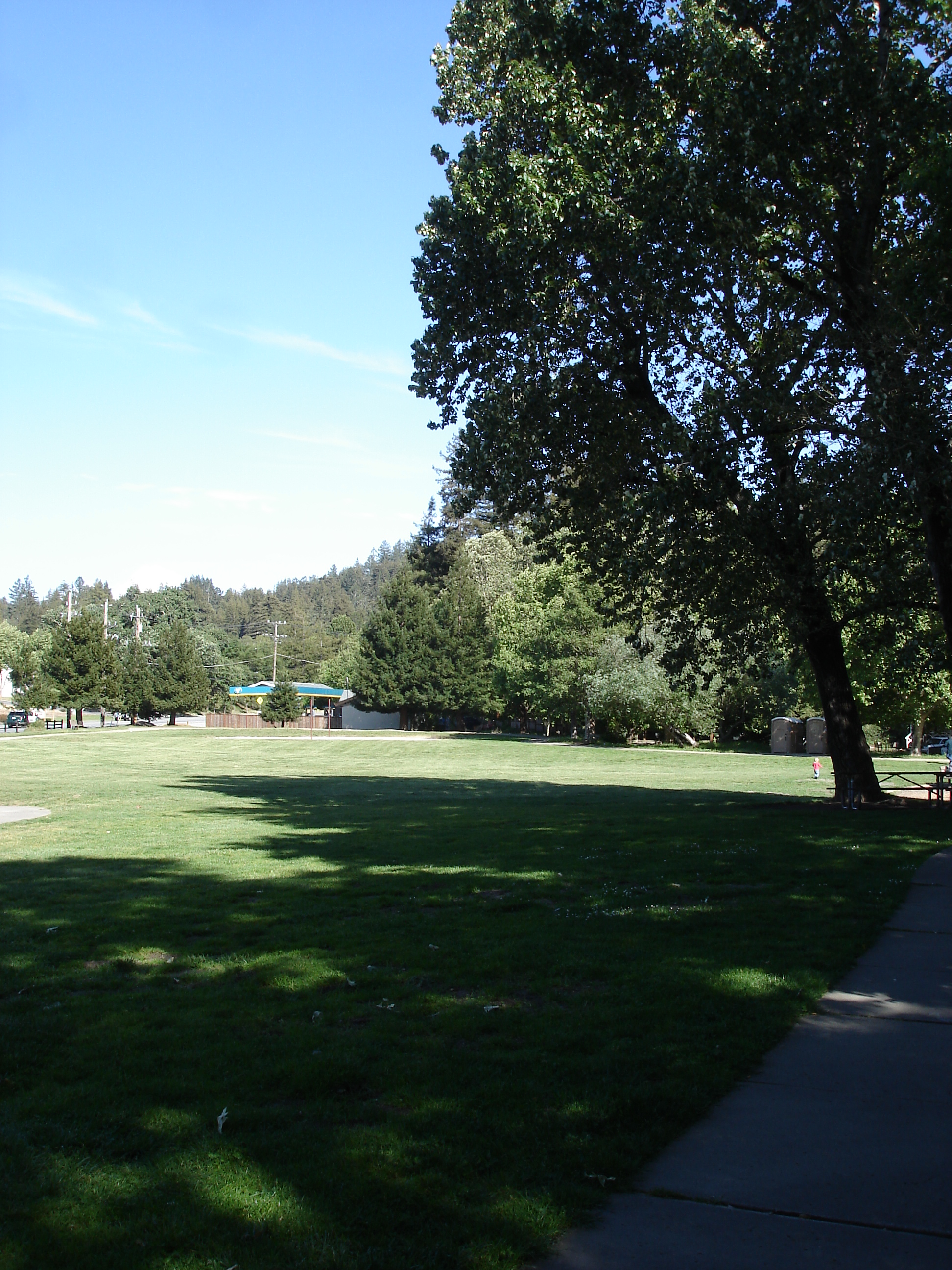
All this work and water is probably worth the effort where turf gets the most use, such as athletic fields and parks. Yet, it is good incentive for alternatives where applicable. Larger patios and decks mean smaller lawns, and are usable ‘hardscape’ areas. Less demanding ground cover plants, and even old fashioned gravel and bark, work nicely over unused areas.
Since it was invented for the athletic field of the Astro Dome, artificial turf has had a bad reputation. It did not feel or look like real turf, and eventually succumbed to wear and tear. Realistically though, it worked. The main problem was that it was constantly compared to real turf, instead of recognized as an alternative to turf, like carpeting for garden space.
Modern artificial turf is much more convincing. It actually looks and feels something like turf, and is more resilient to weathering and wear. It is convincing enough to be used for athletic fields and playgrounds. It would be just as appropriate for landscapes inhabited by dogs if the dogs do not dig. Artificial turf can be expensive, but saves so much in water and labor.
Removing a real lawn and leveling the area for new artificial turf can be stressful to the root systems of mature shrubbery and trees around it, and even in neighboring gardens if the lawn is near a fence. Because artificial turf needs no soil amendment, excavation should be minimal. Because it needs no water, artificial turf can be placed right up against tree trunks.
After artificial turf is installed, some adjacent shrubbery and trees may want to be occasionally watered through the first few summers until they adapt to the lack of watering where the former lawn was. Such plants will not need as much water as the original lawn got, and will only need it temporarily if they get enough water in other areas of their roots zones.
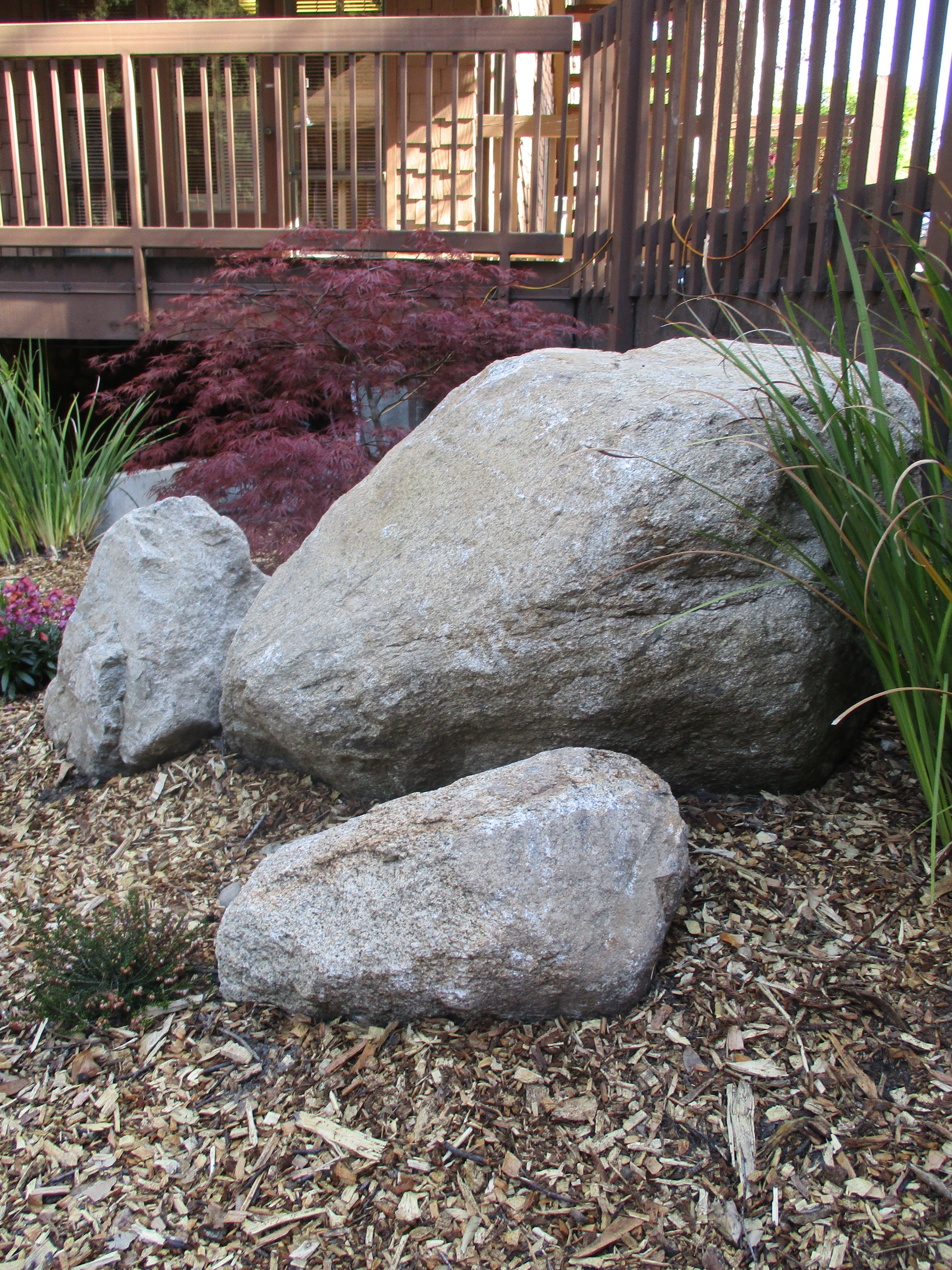
It is hard to say why boulders and sculptural stone are sometimes incorporated into American landscapes. A long time ago, boulders were only left in landscapes if they were to big and heavy to move out of the way or break apart. Early American landscapes were designed to express dominance over nature by replacing as much of it as possible with unnaturally organized landscapes.
Slowly through history, less refined and more relaxed landscapes became more tolerable, and then became popular as an expression of rebellion to earlier formality. Nowadays, most landscapes are inevitably informal, partly because so many believe that informality is more natural, and partly because few landscape designers will design anything else. Simplicity and symmetry are passe.
This informality allowed for the incorporation of various elements from various styles of landscaping, regardless of how incompatible some of such elements were with each other. Boulders and sculptural stone that had been traditional with many Asian styles of landscape design were added to American landscapes in rather nontraditional fashion. It has been a slow process of evolution.
Boulders are obviously nothing like viable and dynamic plant material, although they do contribute form, texture and color to a landscape. Designers might say that bigger and sculptural boulders add drama without even trying. In some situations, boulders are as functional as they are aesthetically appealing. They can obstruct unwanted traffic or hold back soil that is at a higher elevation.
If they need not conform to any of the various Asian landscape design traditions, there are not many rules for the use of boulders and sculptural stone. Exotic stone that might be incompatible to big open landscapes where exposed endemic stone is visible nearby, might be just fine in enclosed gardens where there is no reference for what is natural.
The standard rule of burying as much as two thirds of a boulder to make it seem as a natural outcropping is only valid if it is intended to look like a natural outcropping.


 It is hard to say why boulders and sculptural stone are sometimes incorporated into American landscapes. A long time ago, boulders were only left in landscapes if they were to big and heavy to move out of the way or break apart. Early American landscapes were designed to express dominance over nature by replacing as much of it as possible with unnaturally organized landscapes.
 Tony Tomeo