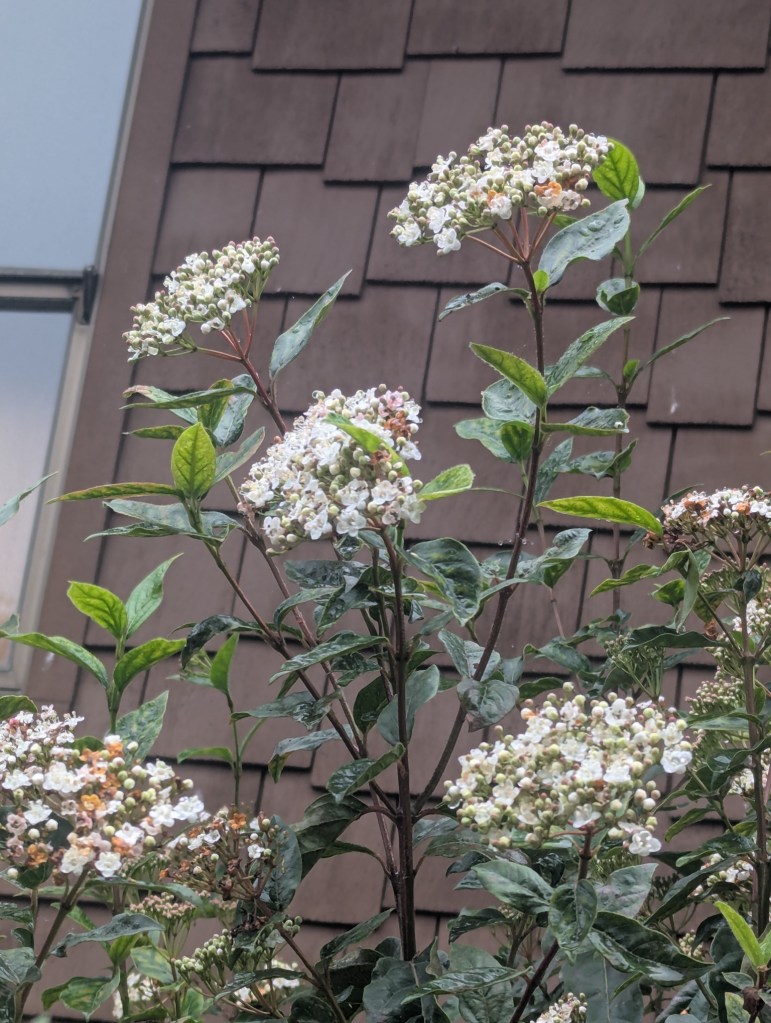
Winter bloom may or may not be an benefit of laurustinus, Viburnum tinus. Most grow as regularly shorn hedges that are unable to bloom much between shearing. Those that do bloom often generate a floral fragrance that some find to be objectionable. Nonetheless, with only timely pruning, laurustinus does bloom for winter. Many consider this an asset.
Flowers are small and white or blushed with pink. They huddle together in dense cymes, which are about two or three inches wide. Their dense evergreen foliage is forest green. Individual leaves are paired, about two or three inches long, and half as wide. They have a very slightly raspy surface texture. Mature laurustinus can sucker from their basal roots.
If bloom is not a concern, laurustinus can be a dense shorn hedge, only several feet tall. Otherwise, it can become a dense small tree more than twenty feet tall and ten feet wide. Once established, it does not need much water and can actually survive with just rainfall. It is not very discriminating about soil quality. Mites or mildew can become problematic in damp coastal climates, particularly among shaded or very congested specimens.
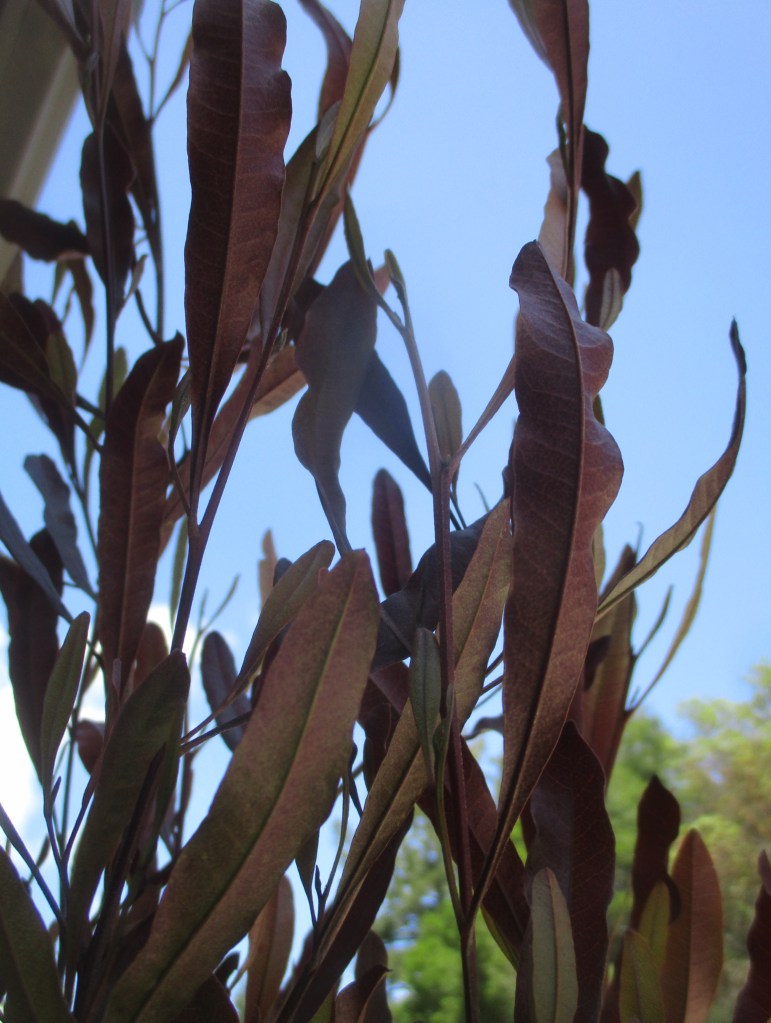
Its silly name is actually justifiable. The papery fruits of Hopbush, Dodonea viscosa, can be useful as a substitute for hops. Almost all hopbush are female, so produce such fruits. However, bloom and subsequent fruit production is variable. Vigorous plants are likely to produce less fruit. Also, some specimens might become male, and therefore be fruitless.
Hopbush is most popular as an informal evergreen hedge. It also works well as a formal hedge. With selective pruning, it can become a small tree with shaggy bark on sculptural trunks. It develops a narrowly upright form while young, but may eventually grow ten feet wide. It grows about twice as tall. Overgrown specimens are quite conducive to pruning.
Hopbush exhibits a uniformly fine foliar texture. Individual leaves are two or three inches long, but narrow. Foliar color is soft bronzy green. ‘Purpurea’ is more purplish bronze, but is not quite as vigorous. Roots are very complaisant, but do not disperse well if irrigation is too generous. Established hopbush is undemanding, so does not require much water. It tolerates soil of inferior quality too.
Back before gardening was cheapened to the degree that it is now, and before most of everything within reach was shorn into submission, many plants were pruned, or not pruned, as necessary to enhance their naturally appealing characteristics. New Zealand flax got planted where it had room to reach out, and only got ‘plucked’ as shoots ventured too far from the center. Lily-of-the-Nile got ‘chopped’ where it crept too far, and ‘thinned’ where it got too crowded to bloom.
Only hedges were shorn; and they were shorn properly, to be slightly narrower on top. Trees actually grew as trees above, and got pruned for clearance below. Vines were selectively groomed, but allowed to climb their trellises. Deciduous fruit trees got the specialized pruning that they require in winter.
Many different kinds of plants that produce generally vertical stems from the base were maintained by a pruning technique known as ‘alternating canes’. This procedure is almost opposite of removing watersprouts or suckers (watersprouts that develop below a graft union) to favor a primary stem. It is actually the removal of primary stems as they get replaced by their own basal watersprouts.
For example, glossy abelia is naturally rather limber with upright growth that spreads outward. Without pruning, it can become an overgrown mounding thicket. However, shearing deprives it of its naturally appealing form, and interferes with bloom. Instead, the technique of alternating canes removes older canes as they begin to deteriorate, allowing new canes to grow more vigorously, arching gracefully outward from the center.
Elderberries and pomegranates may not actually require regular pruning, but are easier to manage if some basal stems are allowed to mature and replace tall and awkward older trunks. The newer growth is more productive (after the first year), easier to reach, and simply looks better. Alternating canes also promotes bloom while preventing thicket growth of mock orange and lilac, particularly since they produce such abundant basal growth.
Heavenly bamboo (Nandina spp.) and real bamboo are two completely different and unrelated plants that both benefit from alternating canes. Heavenly bamboo likes to get its deteriorating or floppy older stems cut to the ground, to allow more space for fresh new foliage to unfurl. Bamboo simply needs old canes cut out as they die.
Almost all pittosporums appreciate sunlight and warmth. Pittosporum tobira ‘Variegata’ is no exception. However, it tolerates a bit of more partial shade than most. Furthermore, its grayish and creamy white variegation brightens shady situations. Its distinctively convex and glossy leaves are a bit flatter and broader where shaded. Shade inhibits bloom also.
Pittosporum tobira ‘Variegata’ is more popular as a foliar hedge anyway. Its small trusses of pale white flowers are neither prominent nor colorful. They can be delightfully fragrant in abundance, though. Stems are quite stout and can eventually grow more than six feet tall. They are resilient to frequent pruning and hedging, and can be cut back if necessary.
Pittosporum tobira ‘Variegata’ seems to lack a common name that is genuinely common. That is why its botanical name is most popular. Some know it as mock orange, but this is also a common name of Philadelphus. Some know it as Australian laurel, but it is neither a laurel nor from Australia. Regardless of name or origin, it is content with local climates. Once established, it is undemanding, and may need no watering.
Motorized hedge shears are the most overused home garden power tools. They are very useful for hedging evergreen shrubbery into hedges and privacy screens. However, they too often shear vegetation that requires different types of pruning. They are fast and easy but not appropriate for all pruning applications. Even hedging is a specialized technique.
Unfortunately, the rules of hedging are too often ignored. Hedges are utilitarian features. Many provide privacy. Many obscure unwanted scenery. Some divide large gardens into smaller and cozier spaces. Most continue to function as they should even without proper maintenance. Consequently, problems associated with maintenance may not be evident.
Unshorn informal hedges are mostly simpler to maintain, but only if they remain unshorn. Ideally, they use species or varieties that mature to a desirable size and form. Therefore, they should not become too large or Obtrusive. Only a few wayward stems need pruning. Of course, species or varieties that grow too large for such application will need hedging.
Shorn or formal hedges are more likely to develop problems. They need regular hedging to maintain their size and strict form. Yet, even with the most diligent maintenance, many become overgrown. Many gain depth from front to back, to become obtrusive. Many gain more height than they should. Most become distended up high while subdued down low.
This happens because pruning cuts can be slightly farther out than they were previously. They are a bit farther out higher up because that is where most growth is. Hedging within former cuts can renovate overgrowth, but damages hedge facades. Fortunately, damage should be temporary. Severely overgrown hedges might require severe pruning, though.
As mentioned, hedges are utilitarian. They should perform their primary purpose without encroachment into usable spaces. Their typically evergreen foliage is generally external. Their interiors are generally bare stems and empty space. Therefore, a hedge can be as effective whether two or four feet from front to back. Four feet is merely a waste of space.
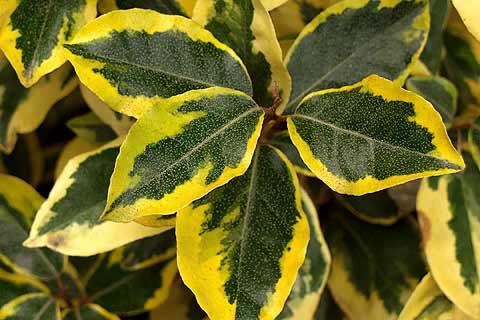
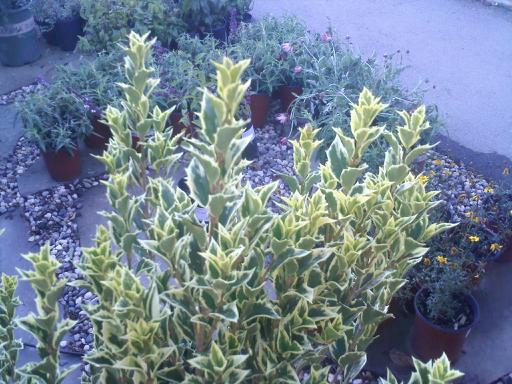
Most modern silverberry is variegated with yellow or white.
Old fashioned silverberry, Elaeagnus pungens, has always been useful for large informal hedges and barriers in difficult locations. It may not be as refined or as bright green as other plants that are more commonly used for formal hedges; but it is more adaptable to harsh exposure, since it has no problem with heat and reflected glare.
If necessary, silverberry can be shorn like privets, but is at its best with only occasional selective pruning to keep it within bounds. Without pruning, it can grow to more than ten feet high and nearly as wide. Despite its slower growth at maturity, it grows faster and fills out quite efficiently while young.
All parts of silverberry are covered with slightly raspy and silvery or ‘rusty’ tomentum (fuzz – although it is not exactly ‘fuzzy’). The one to two and a half inch long leaves often have undulate margins. The less than abundant, half inch long brownish berries taste better than they look. Somewhat spiny vigorous stems efficiently deter intrusion. Trespassers that might get through them once will not try again.
Modern cultivars (cultivated varieties) are neither as rugged as the straight species, nor as large, but have more colorful foliage. Leaves of ‘Variegata’, which is shown in the illustration, have lemony yellow or nearly white margins. ‘Marginata’ has brighter white leaf margins. ‘Maculata’ leaves are instead equipped with bright green margins around bright yellow centers. ‘Fruitlandii’ has larger silvery leaves.
Old landscapes of the Victorian Era may still include myrtle, Myrtus communis. It is quite a survivor. It had been popular for centuries because of its resiliency. It is very conducive to the sort of formal hedging that was popular during that time. As formal hedges became old fashioned, so did myrtle. Yet, it is still more sustainable than more popular shrubbery.
Besides, myrtle is not limited to refined shorn hedges. It can just as efficiently become an unshorn and informal hedge or screen. It can grow as tall as fifteen feet, but rarely grows higher than first floor eaves. Without pruning, it typically grows about half as wide as it is high. Selective pruning rather than shearing limits its size without ruining its natural form.
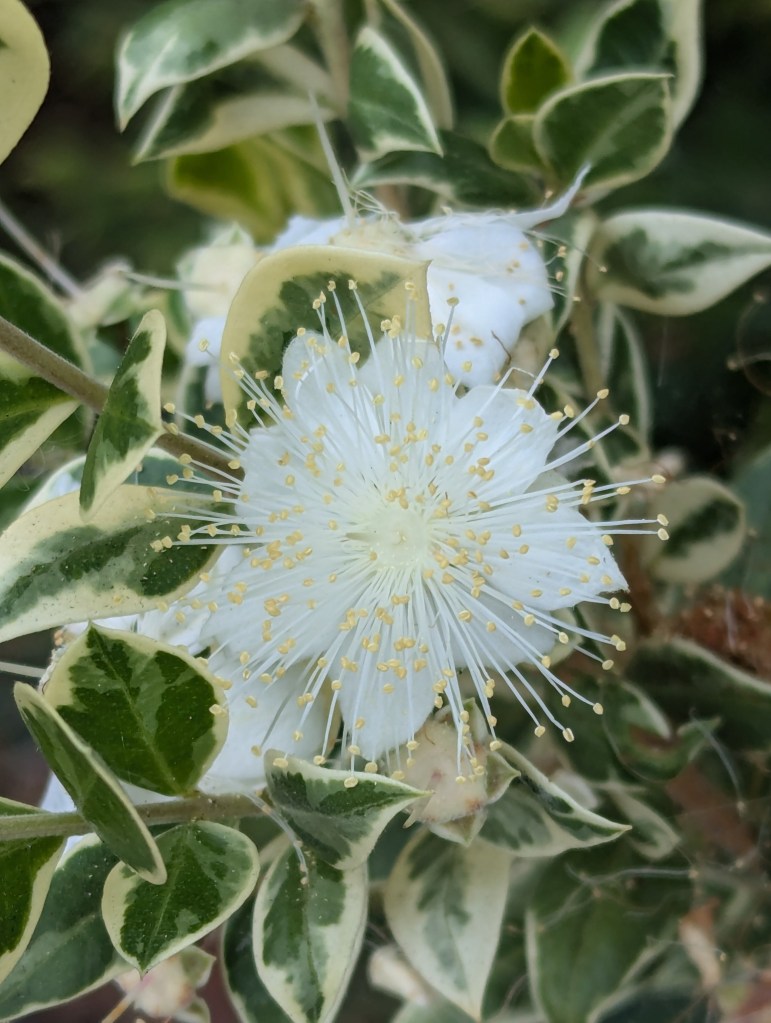
Myrtle foliage is densely evergreen and pungently aromatic. Individual leaves are merely an inch or two long. Small white flowers with prominent stamens may not be very showy. Small and darkly bluish black berries are sparse. ‘Compacta’ grows only about three feet high and wide. ‘Compacta Variegata’ is slightly more compact and variegated with white.
As much as I like junipers, even I have my limits. The tamarix juniper or tam, Juniperus sabina ‘Tamariscifolia’, is the juniper that gave junipers a bad name decades ago by being too common in too many of the wrong situations, and remains one of the most commonly planted junipers. What I do not like about it is that it is classified as a ‘ground cover’ juniper and can sprawl more than eight feet wide, but actually piles up more than two feet deep! However, I have noticed that it can be practical for certain situations as a ‘sprawling shrub’ instead.
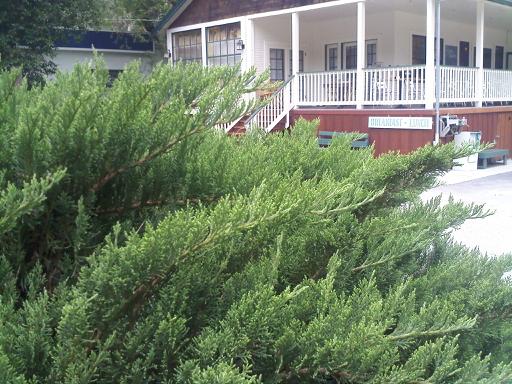
Even without the foliar color or sculptural branch structure of other shrubby junipers, the dense dark green foliage and compact branch structure give the tam its own appeal and practicality. It can be shorn into low informal hedges as frequently as annually. It readily recovers its feathery texture if shorn as the weather starts to get warm in spring. All it wants is sunlight and infrequent but deep watering in summer.
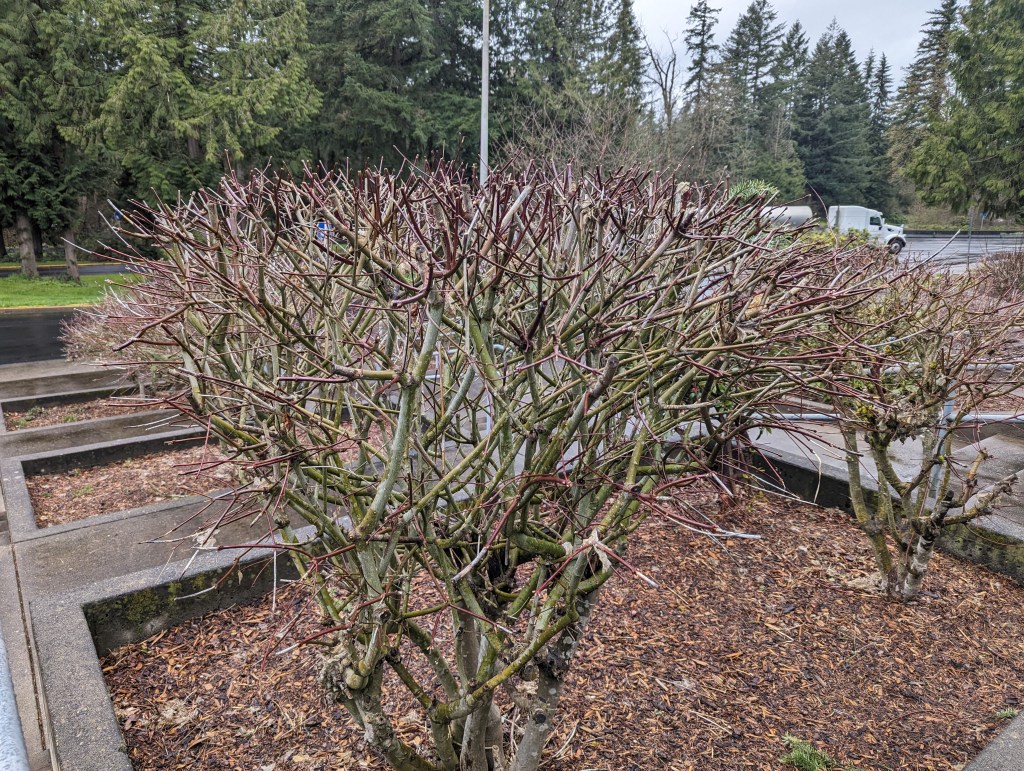
Vine maples should be small trees, not . . . this.
In the short time it took me to run to the back yard to get some big stakes and something to pound them into the ground with, the unfortunate deed had been done. I had come home to find that one of my neighbor’s new Canary Island pine trees had blown down. I also noticed that the gardeners were there; so I wanted to get the tree staked properly before the gardeners got to it. Sadly, as I returned with stakes, ties and a mallet, I found that the gardeners were faster. Instead of standing the small tree up and staking it, they had already shorn the formerly well structured canopy into a globular mound that was about the same size and shape as most other items throughout the landscape, for no other reason than it was within their reach.
This same landscape had egg shaped African iris ‘bushes’ that only rarely bloomed if they happened to get an errant flower stalk out between shearings, and short, round trumpet vine ‘bushes’ in front of hefty but bare trellises that they were never allowed to climb. Everything that was within reach was shorn, even the underside of an elegant Chinese elm that really should have been pruned properly by an arborist. The landscape was actually well designed, but could not perform as planned because of the shear abuse.
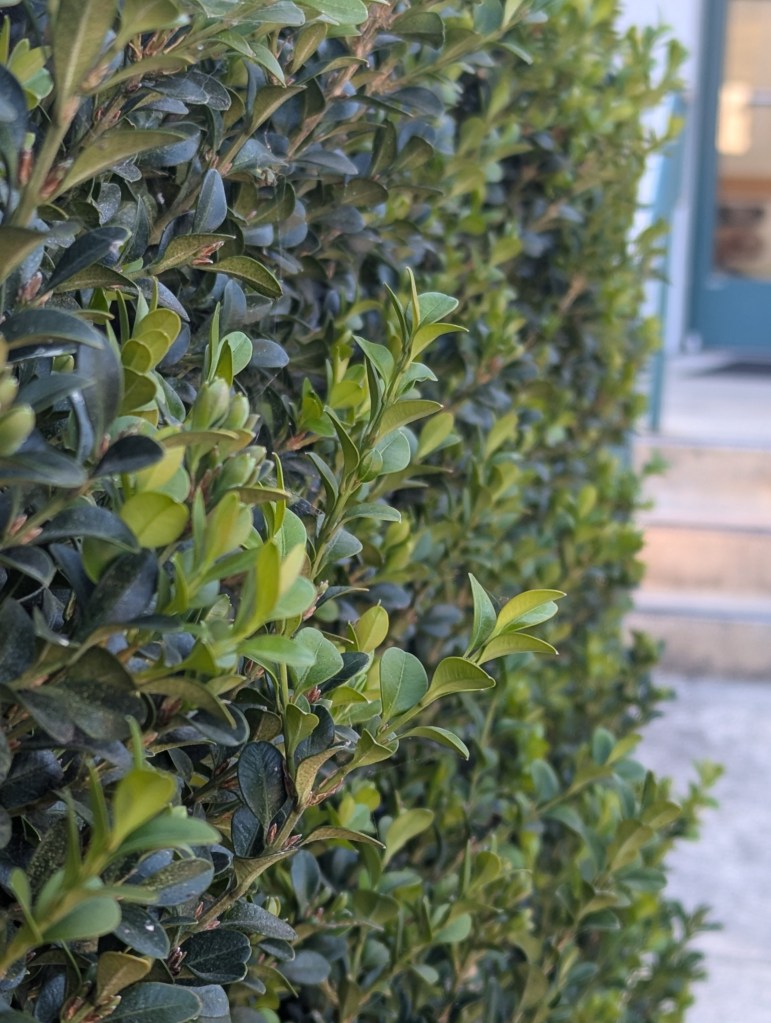
I really do not mind proper shearing of particular shrubbery that is intended to be shorn. I actually like old fashioned privet or boxwood hedges. However, even hedges need to be shorn properly; and realistically, not much else should be shorn as often. If it needs to be shorn regularly, but is not a hedge, it is probably not the right plant material for the job.
Properly selected plant material is proportionate to its particular application. This certainly does not mean that it does not need to be pruned. Most deciduous fruit trees and roses need to be pruned aggressively every winter, and almost all plant material needs to be pruned in some manner at one time or another. The difference is that shearing is indiscriminate pruning of outer growth without regard for foliage, bloom or branch structure. This is fine for hedges, but disfigures many other plants, and deprives them of their blooms and natural foliar textures that they were planted for.
For example, wisteria is an abundantly blooming robust vine that becomes a gnarled shrub that cannot bloom if shorn. Heavenly bamboo (nandina) is grown for its graceful and colorful foliage, but becomes a grungy rigid thicket of tattered leaves and stems with shearing. Although some shrubby junipers can make nice low hedges, frequent shearing deprives them of their feathery texture.
This is why it is so important to know what the various plants in the garden need. They can only perform as intended with the proper care and maintenance, which includes proper pruning. Hedges may only need to be properly shorn, but almost everything else needs to be selectively pruned, thinned, elevated (raised), divided, groomed, trimmed, trained or even cut back.
Holly-leaf osmanthus resembles both English holly and Euonymus.
English holly happens to be one of my all time favorite plants, even though it rarely produces the abundant berries that are expected of hollies. Its deep rich green foliage is so glossy and distinctively textured. Because English holly does not mind partial shade, the variegated varieties can add a bit of color where it is too dark for most other plants to bloom. I really do not mind that it is so prickly.
For those who do mind, the holly-leaf osmanthus, Osmanthus heterophyllus (or ilicifolius) is a worthy substitute for English holly that is just as happy with partial shade. The foliage is very similar in appearance, but a bit less glossy, and much less irritating. Holly-leaf osmanthus is sometimes mistaken for English holly, but can be distinguished by its opposite leaves. English holly has alternate leaf arrangement.
Mature holly-leaf osmanthus can get as large as English holly, but rarely does. It is more often less than 10 feet tall and wide, and is somewhat more adaptable to shearing into hedges. ‘Variegatus’, the most popular variety with pale white leaf margins, grows a bit slower and stays more compact, and actually looks better in partial shade than out where it is too exposed. Holly-leaf osmanthus flowers that bloom about now are not much to look at, but produce a delicate fragrance if the weather gets warm.

 Tony Tomeo