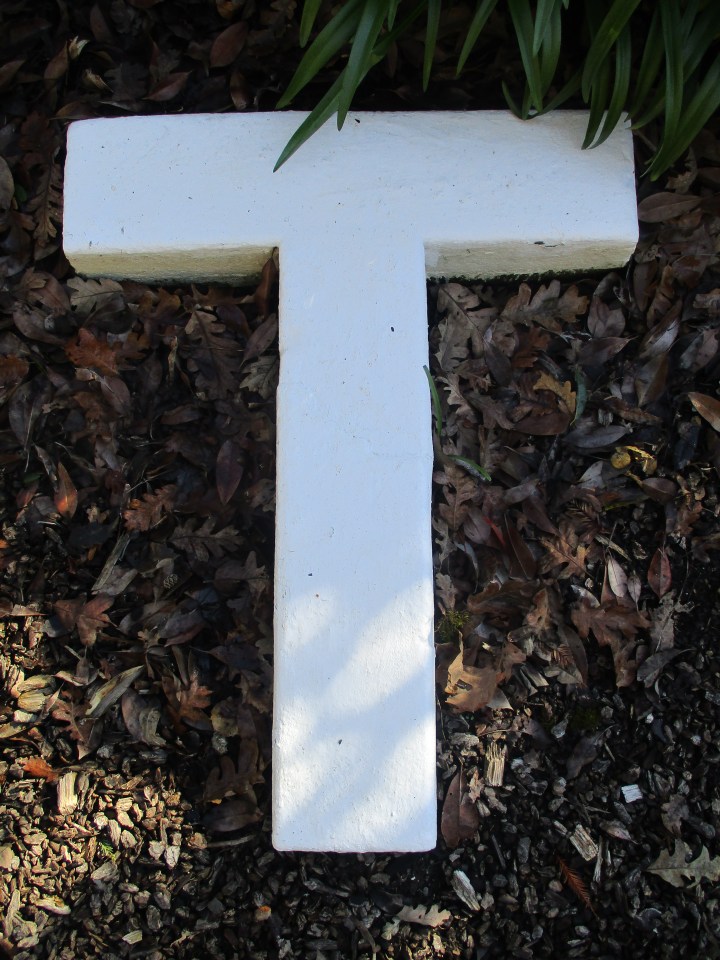
 Today’s episode is brought to you by the letter ‘T’.
This is not Sesame Street.
Nor is this freshly painted concrete ‘T’ a monogram that designates the garden as mine. Even I am not ‘that’ vain.
It is part of a sign at the train depot. There happen to be enough of the right letters for my last name. I suppose that with a pry bar and a shovel, I could be ‘that’ vain.
There is no ‘Y’, so my first name would not work, particularly in conjunction with my last name, which would take the only ‘T’ and ‘O’ available. Am I really vain enough to be putting this much thought into this? Oh my!
For right now, I should only be concerned with keeping the vegetation clear of the sign. The amaryllis foliage above barely flops into it. The overgrown photinia hedge behind the amaryllis was just removed. The arborvitaes that will be installed to replace the photinia hedge will not likely get wide enough to ever reach the sign. They will be set several feet back. We are still trying to decide what to install between the arborvitaes, which will be far enough from each other so that they will not become a continuous hedge like the photinia were.
You would not believe how many bay trees and valley oak trees were trying to grow amongst the photinia! They ranged in size from fresh seedlings all the way up to a nearly six inch wide coppiced stump of a valley tree that was cut down a few years ago. There are still a few small oaks that must be removed nearby. We want to remove them while we are working on the site, and before they get big enough to displace the concrete letters with their roots.
Winter Dormancy Begins In Autumn
 Autumn is for planting . . . but not much else. While it is important to get certain new plants into the garden before cool and rainy weather, other gardening chores will not be necessary while plants are becoming less active before winter dormancy. Raking falling leaves is probably the biggest of the new chores that are specific to autumn.
Formal hedges that have been getting shorn regularly since spring may not need to be shorn again until next spring. They simply will not grow much between now and then. If possible, pittosporum and photinia should not be shorn once the weather gets rainy. Their freshly cut stems are more susceptible to certain diseases while wet than during dry weather.
Citrus and tropical plants should not be pruned late because pruning stimulates fresh new growth that will be susceptible to frost later in winter. Even if tender new foliage does not get frozen, it can get discolored and disfigured by cold weather. Cool weather inhibits vascular activity necessary to sustain the development of healthy new foliage anyway.
For the same few reasons, fertilizer will not be necessary later in autumn. Fertilizer can potentially stimulate new growth when it is not necessarily wanted. Also, some nutrients in fertilizer are less soluble (or chemically unavailable) while the weather is cool. Only plants that grow through winter, like cool season annuals, vegetables and grasses, will want fertilizer.
Planting is done in autumn because plants are either dormant or less active than they had been during warmer weather. They can take their time to disperse their roots into comfortably cool and damp soil. Evergreen plants do not draw as much moisture from their roots while foliage is cool and damp. Deciduous plants draw even less moisture without foliage.
Spring blooming bulbs get planted in autumn not only so that they can disperse their roots leisurely, but also because they need to get chilled to bloom well. Bulbs can be phased, so that those planted earlier will bloom before those of the same kind planted later. However, if planted too late, they may not get sufficient chill.
Guilt Trip
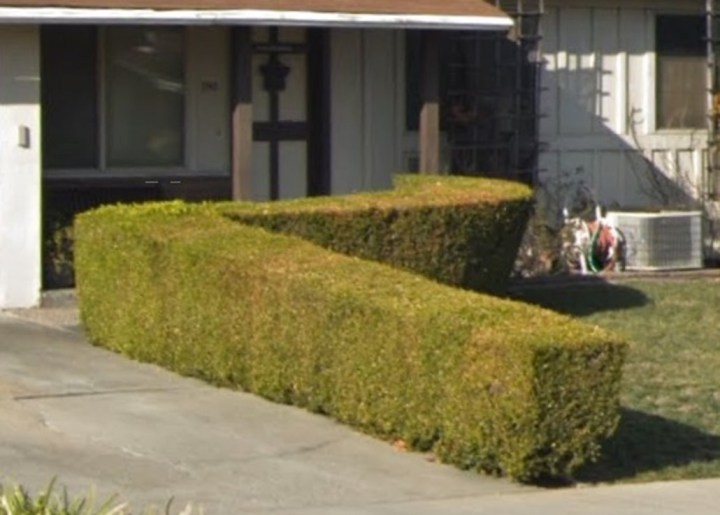 It was so long ago that I barely remember it. I was just a little tyke. My older sister tripped on the driveway and broke one of the Japanese boxwood shrubs in the hedge on the edge of the driveway and front walkway. The hedge was still young then, and not completely filled in. My Pa replaced the missing shrub shortly afterward, but not before my younger brother and I learned that the gap was a shortcut through the hedge. The puny new shrub was not enough to compel us to go around like we had done before. Of course, it did not survive for long. It too got broken off.
We did feel sort of guilty, but only for a while. The second shrub was replaced with a third, which seemed like it should be sufficient to patch the gap in the otherwise formally shorn hedge. We were careful with this one, and actually got into the habit of going around the hedge to avoid altercation with it. However, it died even without our influence. Again, we felt guilty about the g. ap.
I do not remember if there were more attempts to fill the gap in the hedge with other shrubs. When we moved away from that house, the shrubs on either side were slowly filling in to obscure the void. A few years later, the gap could not be seen.
However, many years later, the hedge was pruned with an up-do, which exposed the lower few inches of trunk of each of the individual shrubs. Although there was no gap in the very uniform hedge, it was very obvious that one of the trunks was lacking, right where it had always been lacking. Oh, the guilt!
Even if someone wanted to go through the effort to cut a hole in the otherwise exemplary hedge to replace the missing shrub, it would be very difficult or impossible to find a shrub of that now old fashioned cultivar of Japanese boxwood. Modern cultivars are darker green. A single shrub of a modern cultivar would only compromise the uniformity of the now very uniform hedge. The missing shrub will need to stay missing forever. More guilt on top of guilt!
The satellite image below and the street level view from Google Maps shows that the hedge is now foliated all the way down the the ground. I will not even bother mentioning where the the missing shrub is missing from. I know you could not see it anyway. The hedge is a bit more overgrown than I can remember it ever being before, and it has a bit of that fat hedge syndrome going on, but it still looks great for half a century old. The gap is long gone. Only the guilt remains.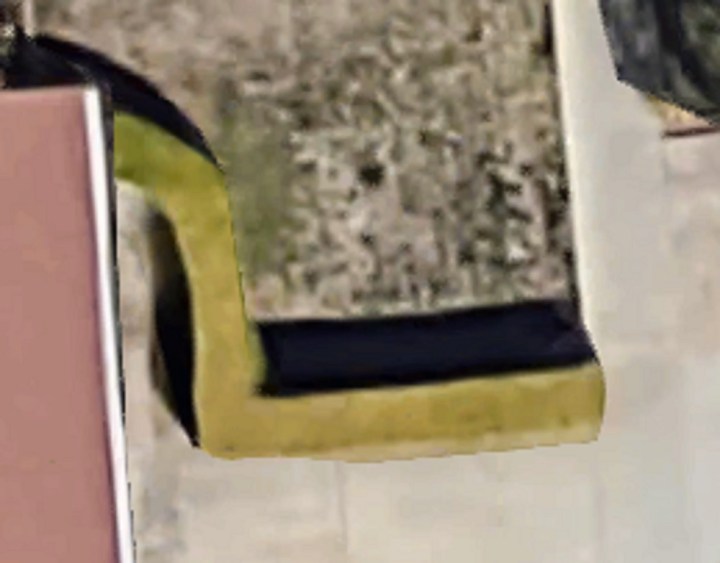
Horridculture – Neapolitan
 Baldness was not yet cool while Brent and I were studying horticulture at Cal Poly in San Luis Obispo back in the late 1980s. Nor were hairpieces yet tacky. Consequently, some middle aged men work toupees. As these men aged and grayed, their formerly well matched topees did not.
Hedges of Pittosporum tobira ‘Variegata’ are notorious for developing green sports (unvariegated mutant growth). https://tonytomeo.com/2018/07/04/horridculture-mutants/ Because gardeners do not prune these sports out, they become prominent green blotches in otherwise nicely variegated hedges. Pruning large blotches out would only leave big bald spots. That is why such hedges, as well as similarly blotched hedges of other variegated plants, are known as ‘bad toupee’ hedges.
‘Neapolitan’ hedges are a variant of that concept. They are not composed of formerly identical plants that later challenged their respective identities. ‘Neapolitan’ hedges are actually composed of different plant material that has been shorn together. They sometimes develop as feral plants grow up and into formerly uniform hedges. They are often composed of what should have been distinct plants within a well designed landscape, that were merely shorn collectively by ‘gardeners’ who simply did not care.
This hedge in a median of a driveway into a mall in town is a classic example of the latter. The landscape designer likely intended the deep green Burford holly, Ilex cornuta, to develop naturally as dense and low mounds between the more upright variegated holly olive, Osmanthus heterophyllus ‘Variegatus’. Apparently, it is too much to expect a well paid ‘gardener’ to figure that out. Fortunately, this particular ‘Neapolitan’ hedge happens to look good in this particular application, but would look better if the ‘gardener’ would replace the variegated holly olive that has been missing for years from the gap between two Burford hollies to the left.
Horridculture – Fat Hedges

This is the first article within the designated ‘rant’ format, that will continue each Wednesday. Articles for the other six days of the week will be more cheerful, or at least less objectionable. These articles may not always be rants, so might alternatively include discussions of particular fad, trends, gimmicks and so on. Perhaps some topics will remain just that; discussions in which the advantages and disadvantages of a particular subject are compared. Categories may develop, so besides ‘Horriduclture’, there could be a category for discussions of fads, for example. This is a new format for me, so I will keep it open to modification, and see how it goes.
Fat hedges are one of my serious peeves!
Hedges done properly are very useful landscape features, that provide privacy, obscure undesirable views, muffle outside sound or simply divide a large garden space into smaller garden rooms. Landscape designers know how to use them, and are good at planning their locations and orientations, as well as designating the plant material to be used for particular hedges. Some informal hedges or screens are outside of useful space, where they have plenty of room to grow plump and wild without becoming obtrusive. Formal hedges are those that require shearing for confinement within limited space.
Fat hedges are those that are designed to be contained, typically by formal shearing, but are instead allowed to encroach into the usable space within the landscape that they are designed to enclose. They can be a serious problem in confined garden space, and sometimes occupy most of the space themselves.
Seriously, they are very often several feet deep (from front to rear). Fat hedges on either side of a small garden room that is only about twelve feet wide can easily occupy more than half of the area. Think about it. If each hedge is just three feet deep, and there are two hedges, that means that six feet of the width of the twelve foot wide space is occupied by fat hedge! That is half of the area available! Some fat hedges are even deeper! A fat hedge does nothing more than a properly maintained hedge. Really, a three foot hedge accomplishes no more than the same sort of hedge that is only one foot deep. The interior is only bare twigs.
Fat hedges are mostly the result of inept gardeners who allow the hedges to gain a bit more width with each shearing, without ever renovating overgrown hedges. To make matters worse, they allow the tops of the hedges to get wider, which shades out lower foliage, which becomes sparse. Then the fat hedge becomes a top heavy hedge, leaning into usable space where it should be leaning slightly away. Ends of top heavy hedges often protrude a bit more than the sides of the hedges. If these hedges flank a driveway or walkway that is perpendicular to the sidewalk or a patio, the distended end is particularly obnoxious.
In the picture above, the low hedge seems to be well maintained. If it is a fat hedge, it is in a situation where it is not really crowding much. However, notice the width of the sidewalk. It is quite broad. Then there is a significant constriction where the hedge protrudes over the sidewalk. What is the point of so much concrete and such a wide sidewalk if almost a quarter of the width of it is overwhelmed by vegetation? It is like four lanes of freeway that merge into three, only to merge back into four.
Cherry Laurel
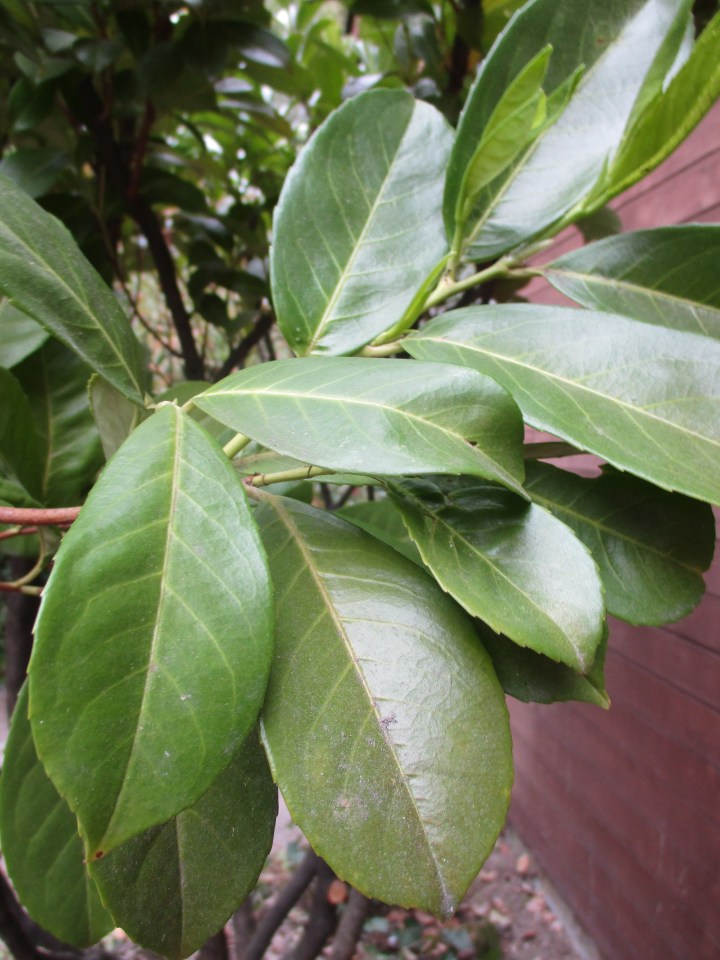 There is a reason why the most popular specie for frequently shorn formal hedges have small leaves and finely textured foliage. Technically, a formal hedge of cherry laurel, Prunus laurocerasus, can be shorn as well, but should be shorn only once or twice annually, and then allowed to fluff back out. Otherwise, the big leaves get shredded as quickly as they recover from previous shearing.
If pruned more frequently, hand pruning works best, and is not as tedious as it sounds. Informal pruning is even easier, and is done primarily to prevent hedges from getting to deep (from front to back), and to prevent individual shrubs from dominating or subordinating. Pruning also eliminates most of the abundant summer bloom of upright trusses of thirty or so tiny creamy white flowers.
Cherry laurel is densely foliated and quite stout, even without shearing or pruning, and can eventually but rarely get thirty feet tall! The glossy evergreen leaves are about three inches long. There happens to be a few cultivars, including one that is variegated with light yellow, and others that are compact dwarfs. (Prunus caroliniana is different species that is also known as cherry laurel.)
Wax Privet
 The pros and cons of wax privet, Ligustrum japonicum ‘Texanum’ might get it a rating of about 2.5 out of 5. It seems that every asset is offset by a liability. The profuse clusters of tiny white flowers are sweetly fragrant, but are also a serious problem for those allergic to pollen. The berries attract birds, but are also very messy, and contain seeds that can germinate in the strangest of places.
The dense evergreen foliage is prettier and actually glossier than that of the more common glossy privet. Growth is slower, and therefore easier to maintain as a shorn hedge. Regular shearing deprives wax privet of most, but not all of its bloom and seed. Glossy privet is more invasive if allowed to set seed, but less invasive as a shorn hedge deprived of bloom before producing seed. Without shearing, wax privet eventually reaches ground floor eaves, and gets about half as broad. It can be groomed into a small tree.
Unwanted feral seedlings should be pulled as soon as they are detected. If cut instead of pulled, they are likely to regenerate, and will be impossible to pull the second time around. Roots are rather greedy.
A Hedge Between Keeps Friendship Green
 If good fences make good neighbors, what about hedges? If only it were that simple. There are all sorts of evergreen hedges to provide privacy, obstruct unwanted views, disperse wind, define spaces, or muffle noise. They can do much of what fences do, and muffle sound better. The problem is that they are composed of living plants, shorn into submission and very unnatural shapes.
Unlike fences, hedges need to be shorn very regularly. Otherwise, the shrubbery that they are composed of tries to grow into its natural forms. Slow growing plants like Japanese boxwood may only need to be shorn twice annually, especially if no one minds if it looks somewhat shaggy. Old fashioned glossy privet is so vigorous that it likely needs to be shorn a few times before autumn.
Even if the work of shearing is not a problem, accessibility might be. Hedges are popularly planted between properties. The outsides of such hedges are therefore accessible only from adjacent properties, which might have other plants or landscape features in the way. There is also the risk that the neighbors might not want anyone coming over to shear such a hedge! Beware of the dog!
Hedges in conjunction with backyard fences are easier to maintain as long as they are kept below or at the same height as their fences. They only need shearing on the inside and on top. Fences might be needed to keep dogs in or out anyway. When planning for a new hedge, other plants and garden features that might obstruct access within the same landscape must be considered too.
Taller hedges should be shorn so that they are slightly narrower on top, and wider at the bottom. This promotes more uniform growth, and hopefully prevents basal baldness. Upper growth gets more sunlight than lower growth, so grows faster, and too often shades out lower growth while becoming distended up high. Hedges should also be watered and fertilized evenly from end to end.
It is important to remember that hedges work for the landscape, and should not be allowed to dominate. Fat hedges waste space. A well groomed hedge that is only two feet from front to back works just as well as a hedge that is three times as plump. Feral plants that ‘volunteer’ within a hedge must be removed instead of shorn along with the hedge. They only compromise uniformity.
‘Emerald Green’ Arborvitae
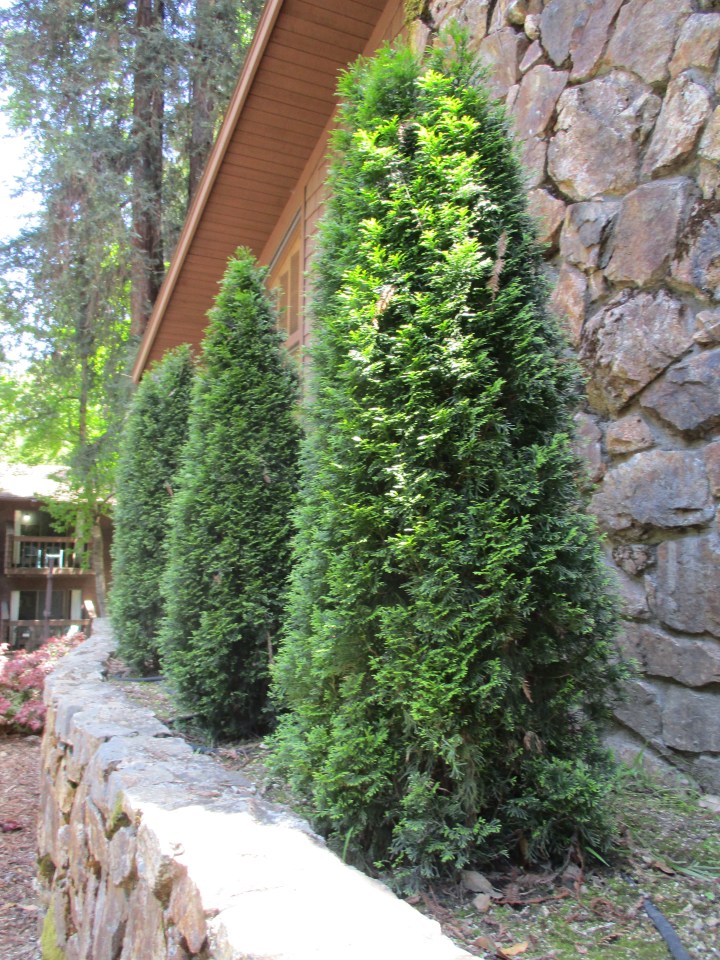 The many cultivars of arborvitaes of home gardening have been so extensively bred and selected that only the foliar texture resembles that of their ancestors. ‘Emerald Green’ which is also known by its Danish name ‘Smaragd’, is a cultivar of arborvitae that was developed from the white cedar, Thuja occidentalis,which grows wild from Minnesota to New Brunswick, as a forty foot tall tree!
‘Emerald Green’ grows quite fast while young, but should get no taller than about fifteen feet, and no wider than about four feet. It is one of the best columnar arborvitaes for tall hedging. Although they can be shorn, they are so dense and uniform that they are at their best if only occasionally trimmed of stray stems, or to keep taller specimens from getting too much taller than shorter ones.
The tiny evergreen scale leaves are tightly arranged on vertically arranged flat foliar sprays. Foliage is quite dense, and softer than that of most other conifers. A bit of shade is tolerable, but too much compromises foliar density. Bloom is barely noticeable, and seeded cones are not much to look at. The shaggy ruddy brown bark is handsome but seldom seen on well foliated specimens.
Hedges Are Like Green Fences
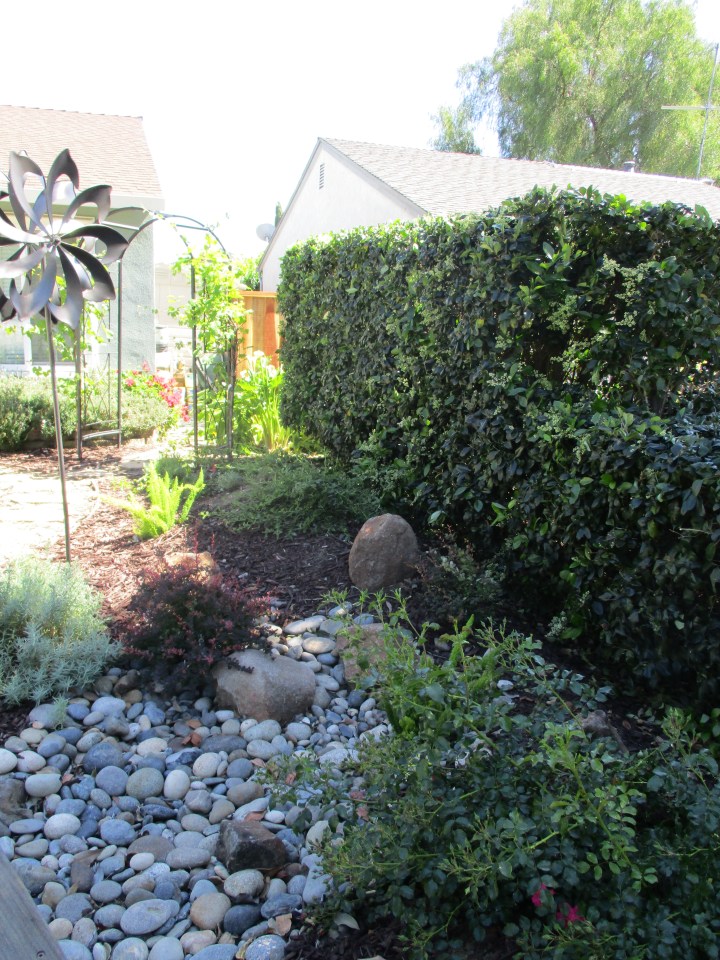 Hedges are a complicated topic! Like lawns, they are among the more functional features of a landscape. They can be used to provide privacy within, obscure unwanted views beyond, or merely to separate a large landscape into cozier or more functional spaces. Except for hedges that are grown for spring flowers or autumn color, most hedges are evergreen with finely textured foliage.
Informal screens, which might also be know simply as informal hedges, can function like hedges, but are a bit different. They are not regularly shorn, so do not need such finely textured foliage. They are either compact plants that stay proportionate to their particular situations, or are grown outside of a refined landscape, where they have plenty of space to grow wild to their natural size.
Although they do the work of fences and walls, hedges do not substitute for them. Fences are relatively ‘low maintenance’. Hedges are quite ‘high maintenance’. They need everything that other plants need, as well as dutiful shearing. Espaliers, trellised vines or vines clinging to fences or walls are also very different, with their own intense maintenance requirements and innate problems.
Most hedges were shorn late last summer or early autumn, but have not done much since then. They should have been shorn early enough for new growth to toughen up a bit to not look shabby or sparse through winter. Now that hedges are growing again, they will need to be shorn again. If space allows, shearing of photinia hedges can be delayed until the red new foliage fades to green.
While hedges get shorn, any volunteer plants that have self sown into them must be removed. Different species of shrubs or vines that sneak in will ruin the symmetry. This is also very important when adding new shrubs to replace any that might be missing. Even different cultivars of the same species will exhibit different color and growth rates. The sides of hedges should be sloped slightly inward at the top to allow more sunlight to reach the bottom, and to compensate for faster upper growth.
 Tony Tomeo