Herbs

California bay can work somethin like culinary sweet bay.

While the winter weather is still cool and damp, most of the herbs in the garden are not very impressive. Like vegetables though, herbs that are new to the garden should be planted as winter ends when no more frost is expected. Also like vegetables, some herbs are easier to grow from small plants or seedlings purchased from nurseries, and others are easier to sow directly from seed. Some are annuals or biennials. Others are perennials. Still others are woody plants.

Basil, cilantro and dill are commonly and easiest to grow from seed. Tarragon, sage, marjoram, mint and thyme are probably easier to grow from small plants found in nurseries. Chives, oregano, fennel and parsley are easy to grow by either means. Woody plants like rosemary, lavender and sweet bay can be grown either from small plants in the herb section of a nursery, or more substantial landscape plants.

All sorts of plants are grown as herbs to be used as seasoning, aroma (foliar fragrance) or even medicinally. Some are best grown strictly as herbs in an herb garden or incorporated into the vegetable garden because they lack visual appeal or because they eventually get cut and harvested. Others function quite well out in more refined landscapes.

Basil, cilantro, tarragon, sage, dill and marjoram are more utilitarian but less visually appealing herbs for the herb or vegetable garden, although some look good until they get harvested. Chives, mint, oregano, parsley and thyme look good enough for a landscape, and are not often harvested in quantities large enough to compromise their appearance. Fennel also looks good enough for the landscape, but then gets removed completely when harvested.

A few herbs are actually more often grown for their practicality in the landscape than in the herb garden. Thyme sometimes gets planted as a ground cover between stepping stones, since it is so compact and imparts its fragrance if trampled. Rosemary is actually a rather common ground cover where the soil does not hold enough moisture for more demanding plants. The various lavenders are nice ‘perennial’ shrubs. (‘Perennial’ shrubs do not last as long as woody shrubs.) Sweet bay is a nice small tree where space is limited, or can be shorn into a small hedge.

It seems that most herbs like good sun exposure and warmth during the summer, with well drained soil. Most do not need too much water once established. Only basil and parsley need regular watering. Chives and mint are not so needy, but do prefer to be watered regularly as well. Mint is commonly grown in pots because it can be somewhat invasive.
Herbs Are Not Confined To Herb Gardens.

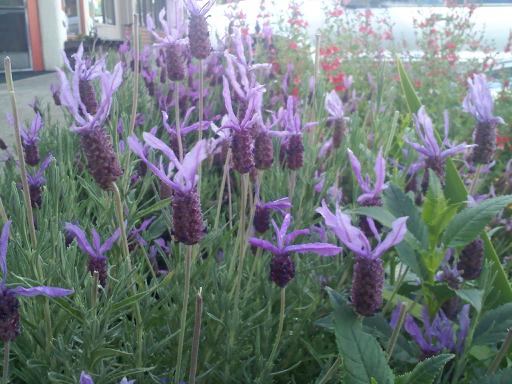
Spanish lavender is as herbal as English lavender.

While waiting for my white mocha at the White Raven coffee shop, I noticed white sage smudge sticks (incense) for sale. I also noticed that white sage is a component of at least one of the many herbal teas available. Although white is my favorite color, I am doubtful that it would be one of my favorite flavors. White sage seems to me to be much too pungent. I suppose that I should at least try it to satisfy my curiosity. Otherwise, the many other herbal teas included more docile but equally compelling herbs like sunflower petals, cactus flowers, chamomile, lavender, mint, catnip and various geraniums.

My mocha was ready too quickly, before I could investigate all of the herbal teas. Since I needed to get out of the way at the counter, I went to peruse the incense, where I again noticed some familiar herbs, like various sages, lavender, rosemary and bay laurel. A few plants that I do not commonly think of as herbs are common components of incense as well, such as juniper, cedar and pine. This was all too baffling; so I took my mocha to a table out front by a roadside garden, where I noticed some of the exact same herbs that I came outside to get away from!

All these fancy herbs and incenses and girly boutique beverages are simply not my cup of tea. Although at the White Raven, I know better than to be surprised by what might be in an excellent tea. Regardless, the garden out front is still more my style, and reminds me of how so many utilitarian herbs can also be very appealing ornamentals.

Rosemary, lavender and several of the sages are actually quite common in ordinary landscapes, whether or not anyone even notices that they have herbal merit. Some types of creeping thyme are sometimes used as ground cover in small areas, particularly around pavers or stepping stones where they release their fragrance if lightly trampled. Santolina and various yarrows and scented geraniums are less ordinary, but are similarly grown more often for their aesthetic value than as herbs. In my own garden, I really do not know what yarrow is good for. I like to add geranium leaves to sun tea, even if it makes it a girly boutique beverage.

Some herbs are almost too happy in my garden. The feverfew, chamomile and nasturtiums (my favorites!) that grew from seed from Renee’s Garden two years ago have spread outside of their area. I actually gave my mints away before they could escape. The catnip is confined to a hanging pot by the neighbor’s cat who gets sufficiently overindulgent to eradicate any self sown seedlings below. I never would have guessed that an inebriated cat could be so useful! Calendula, chive and oregano have all been grown from seed and become happily naturalized. 

Sage

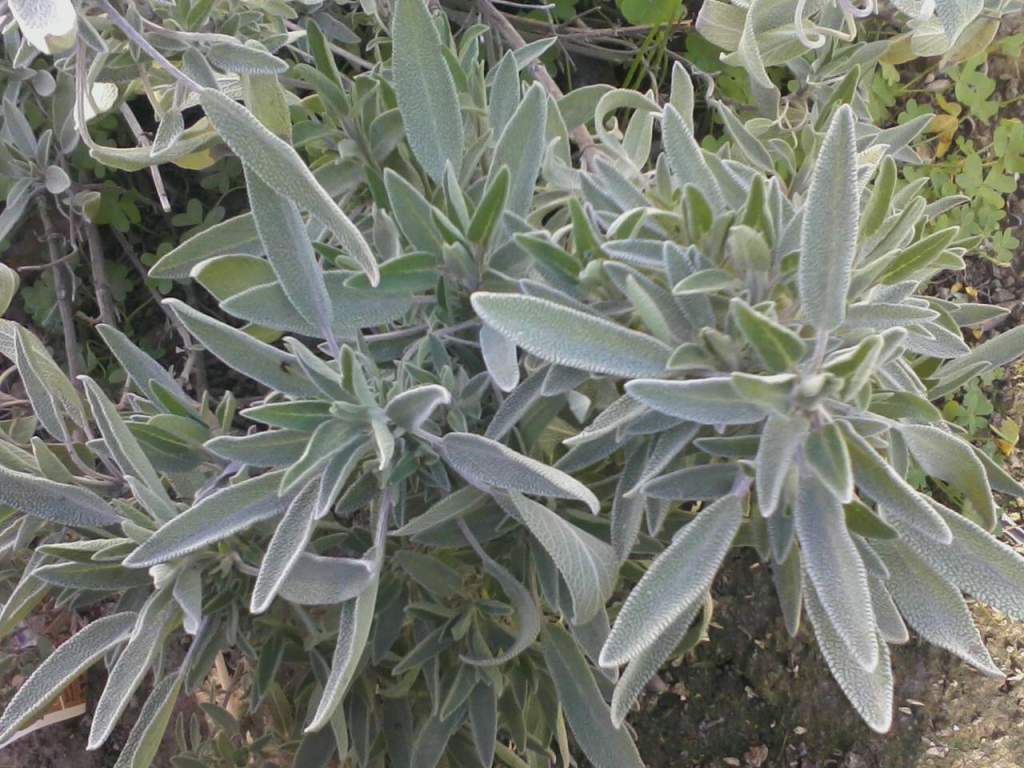
Some cultivars of culinary sage are more colorful for home gardens.

The sage that is most popularly grown for herbal and culinary uses (Salvia officinalis) is originally from the Mediterranean region, so is right at home in much of California. Like the various lavenders and some of the other related herbs, it is a shrubby perennial that behaves like a woody shrub, but lives only a few years like some perennials. Lower stems can be layered (buried where they touch the ground so that they form roots and grow into new plants) to replace older plants before they die.

Modern cultivars are quite variable with purplish, pink, pale yellow or pale white coloration or variegation to new foliage, as well as lower growth habit. The original sage gets almost two feet tall and broad, with very aromatic gray foliage.  The narrowly oblong leaves are nearly two and a half inches long and one inch wide. The flowers that bloom in late spring or summer are typically pale blue, but can be purple, pink or white.

Culinary Herbs With Landscape Appeal

Rosemary is more common in common landscapes than within dedicated herb gardens.

Because of the unusually mild weather this past winter, many plants are waking up from winter dormancy early. The shrubby herbs like sage, rosemary, lavender and tarragon are already outfitted with fresh new foliage that will soon obscure the foliage that lingered through winter. Those that have not yet bloomed may do so sooner than expected.

New herb plants can be added to the garden any time now. Even if rain resumes (or actually ‘starts’), there should not be enough to cause new plants to rot, particularly since the warming weather will keep plants growing faster than the root rot that can kill them through cool and damp winter weather. Sage, tarragon, marjoram, mint and thyme are easier to grow from small plants. Dill, cilantro and basil are easier to grow from seed sown directly into the garden. Oregano, fennel and chives can be grown by either means.

Many of the woody herbs, like rosemary and the many varieties of lavender, are commonly used in landscaping, so can be found in even the most basic nurseries that do not feature a selection of other herbs. Because almost all herbs have sensitive root systems, they should be planted while small. The smaller 1 gallon plants are easier to grow (as well as less expensive) than the larger 5 gallon plants are. However, sweet bay is an exception that does not mind being planted as a 5 gallon or even larger tree where it needs to look mature now, even if only a few leaves get used in the kitchen. Low growing rosemary is a common ground cover. Upright varieties can be shorn into small hedges. Thyme makes a nice small scale ground cover between stepping stones, where it shares its fragrance when stepped on.

Chives, oregano, parsley, mint and thyme are not often marketed as common landscape stock, but are visually appealing enough to appear in the landscape. Herbs that are not so visually appealing can be planted in a separate herb garden, among vegetables in a vegetable garden, or simply out of the way. Basil, cilantro, tarragon, dill, sage and marjoram can be too unkempt at times. Basil and cilantro look good most of the time, but then get harvested in large enough quantities to leave bald spots. Fennel can be a striking foliage plant for a while as long as no one minds that it will eventually get harvested.

Culinary Herbs With Landscape Appeal

00715thumb
Culinary herbs work well within landscapes.`

Vegetables grow mostly in designated vegetable gardens because they are not appealing enough for the rest of the landscape. Flowers for cutting might grow in designated cutting gardens, from which they are not missed after harvest. Culinary herbs can grow in herb gardens for the same reasons. Some might not be very pretty. After harvest, some might be too shabby for the landscape.

Of course, such perceptions are debatable. Home gardens are casual and customized. If Swiss chard, artichoke and other vegetables can grow in front yard landscapes, then culinary herbs can too. In fact, some already do. Rosemary, thyme, lavender and a few other culinary herbs happen to be popular for landscapes because they are so appealing and practical. There is a slight catch.

Culinary cultivars of herbs are distinct from landscape cultivars. Trailing rosemary is a landscape cultivar with sprawling growth that works well as a resilient ground cover. Another cultivar exhibits more sculptural upright growth. Both are well flavored. However, neither is as richly flavored as culinary cultivars of the same species. Yet, culinary cultivars are not so remarkable for landscaping.

Most of us are satisfied with landscape cultivars of rosemary for culinary application. Alternatively, culinary cultivars, which are rare in nurseries and landscapes, can adapt to landscape functions. Cultivars of culinary rosemary happen to make nice low and mounding hedging. Infrequent shearing or selective pruning does not constantly deprive it of too much of its more flavorful new foliage.

The same applies to several herbs that have both culinary and landscape applications. Compromise might be in order.

Incidentally, two culinary herbs, Grecian bay and bronze fennel, are presently quite trendy. Grecian bay or sweet bay (which is not California bay) is a very popular potted plant. In the ground, it can grow into a midsized tree. Bronze fennel is supposedly comparable to common fennel, but with sepia toned foliage. Chive, parsley and borage all work nicely with mixed perennials and annuals.