Why Bother?

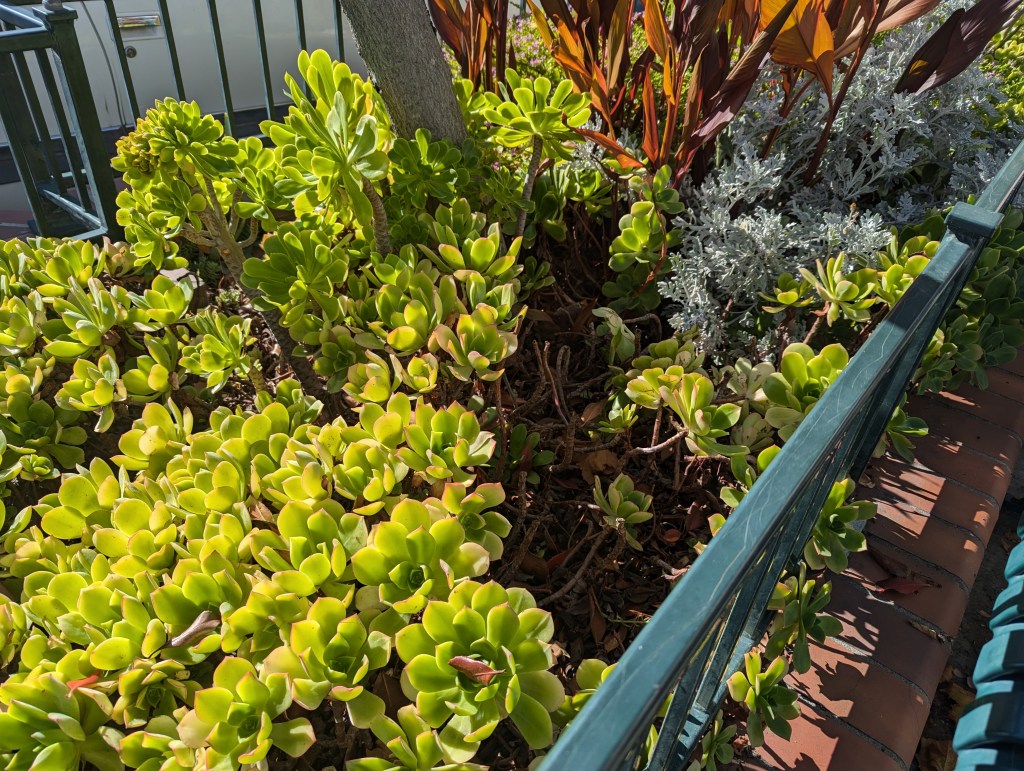
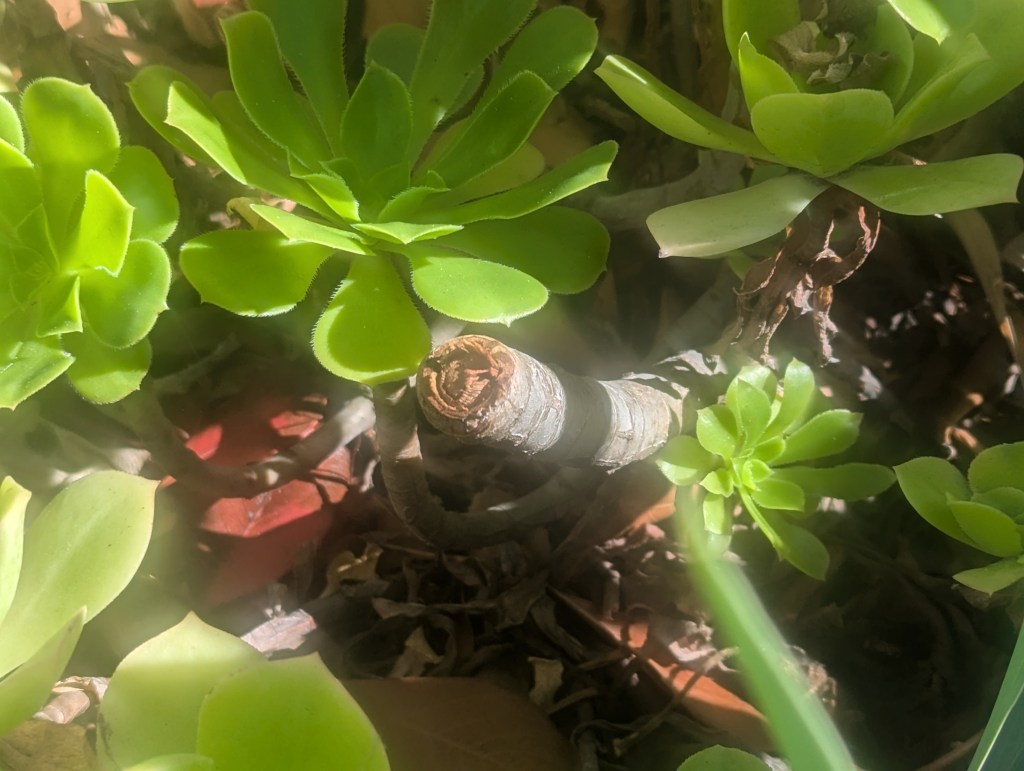
Nasturtiums were a good choice for my downtown planter box, or so I thought. I know that people pick flowers from such planter boxes. I figured that nasturtiums bloom so abundantly that no one could possibly pick all the flowers from them. Technically, I was correct. Technically, not all of the flowers were picked. However, there were times when only a few of the abundant flowers remained. I replaced them with some sort of compact aeonium like perennial that I can not identify. It forms dense mounds of yellowish green succulent foliage that I figured no one would bother. I do not mind when I notice a few pieces missing. There is enough to share. What I do mind is that someone clear cut harvested enough to leave this bald patch. The left half of the picture demonstrates what it should look like. What is worse is that there is so much of it extending outside of the railing that would not have been missed if it had been taken. Also, as the picture below shows, the more prominent common aeonium is not exempt from such pilferage. So, why do I bother? Well, I still enjoy my downtown planter box.
Horridculture – Common Names

Snowdrop is Galanthus nivalis. Snowflake is Leucojum vernum. Snowdrop is the rarer of the two. I have seen it only in pictures from other regions. The potential for consequences of its misidentification are therefore quite minimal. That is fortunate. I learned Leucojum vernum as snowdrop. Locally, no one ever corrected this transgression, probably because no one here was aware that it was a transgression. Most likely learned it the same as I did. Similarly, we learned heaths as heathers. Since heathers are very rare here, there is not much to compare heaths to. Fortunately, snowdrop, snowflake, heath and heather all have botanical names, which are universally the same everywhere. Well, at least they should be. During the past few years, I have noticed that the tree that I leaned as Eucalyptus pulverulenta is now Eucalyptus cinerea, and what I knew as Eucalyptus cinerea is now Eucalyptus pulverulenta. It is as if the two have simply traded names. Now that more information than ever in history is so readily available online, it is amazing what information is unavailable. I can confirm the identity of neither species of Eucalyptus! Many modern cultivars, particularly hybrids, lack species names between their genus name and cultivar name, as if such designations are no longer important. In that regard, their botanical names are no more defining than their common names. At least some of the common names are entertaining, such as pig face, pig squeak, chicken liver plant, brazen hussy, naked lady, twisty baby, mother-in-law’s tongue, sneezewort, shaggy soldier, corpse flower, sticky monkey flower, bear’s breeches, sticky willy, turkey tangle frog fruit, laurel-leaf snail seed, love in a mist, love in a puff, dead nettle, butter and eggs, teasel, fleabane and yesterday, today and tomorrow. Goodness, that is a big list, and it could go on.

Horridculture – Mail Order Glitch

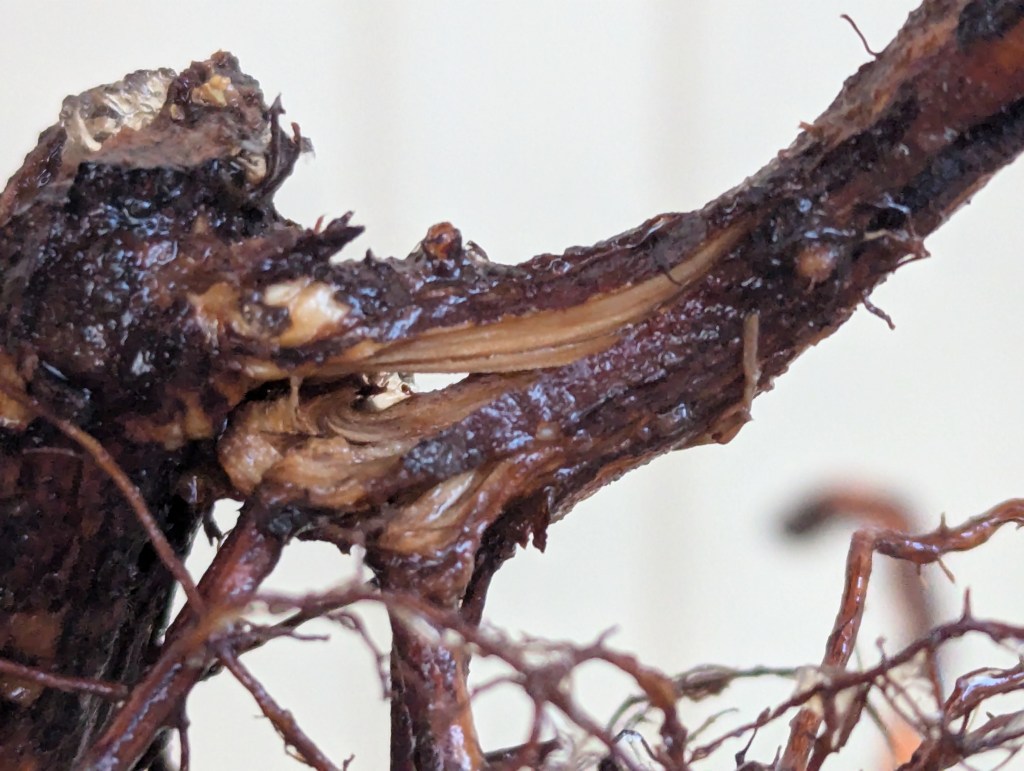
Of a dozen or so items of a mail order purchase that included various cane berries, mulberries, grapes and mayhaws, only a ‘Cumberland Black’ raspberry was less than exemplary. Unfortunately, it was majorly less than exemplary. It was broken at the base of its newest cane, just above where it extended from the older cane that the cutting was made from. If only it had not been broken, it would have been an excellent bare root specimen, with more roots than typical, and a substantial cane with several plump and turgid buds. I realize that it could either extend new canes from latent buds just below where it broke, or extend new roots from the base of the younger cane just above where it broke; so I should simply wait to see what it does. It could even do both, to provide me with two specimens for the price of one. However, I also realize that it could potentially do neither, but instead succumb to its damage. Regardless, its recovery from such damage should not be my concern. It is not in a condition that I intended to purchase it as. The provider should either provide a replacement, or refund what was paid for this particular item. Instead, I was instructed to wait to see if this damaged raspberry cane recovers. Well, at least I got a response. Perhaps that is all that is necessary. I am now more intent on keeping this raspberry cane alive, partly because I doubt that its purchase would be refunded if it succumbs to its damage, and partly because I would likely be to embarrassed to request such a refund if it becomes justifiable. Besides, as I mentioned, all other items of the purchase are of exemplary quality. I should be satisfied with that.

Horridculture – Pseudopalm

Strelitzia nicolai, is giant bird of Paradise. Unlike the more familiar bird of Paradise, with basal foliage and its distinctive orange flowers, this species develops several tall trunks and less colorful but interestingly large white flowers. We recycled several into one of the landscapes here from a home garden in Morgan Hill about two years ago. Originally, they were three somewhat mature groups, with rather tall trunks. Then, they were divided into individual trunks and pups. Ultimately about sixteen were installed into the landscape, with a few spare pups canned as spares, just in case some of the others do not recover from their division. I predicted that those with tall trunks would not last long before replacing themselves with basal growth, and then shedding their unusually tall trunks. Not only are they not developing basal growth yet, but their upper foliage on top of their lanky tall trunks is actually growing and developing into new foliar canopies. They sort of look like silly palm trees that are getting less silly as they continue to grow. I mean that they actually look rather appealing, and probably look more appealing to those who do not know what they should look like. They seem to be pretending to be faux palm trees. I can do nothing about their behavior, and even if I could, I would not. I want to see what they do next. I suspect that they will eventually perform as expected. I also suspect that, because they are already so tall, that, for as long as they retain it, their upper foliage will never be as lush as it would be if lower. That is normal for the species, and how those who maintain such specimens know when to cull the taller trunks by cutting them to the ground.

Horridculture – Invasive Species

It blooms splendidly, and has stayed compact for many years, but I do not trust it.

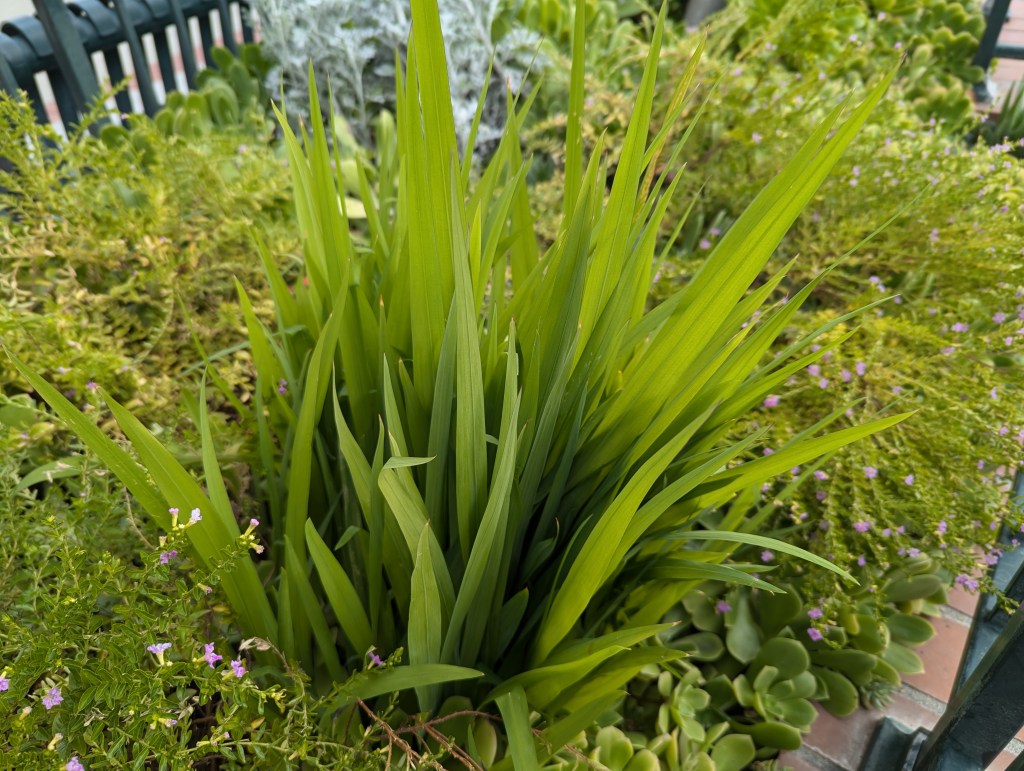
Many exotic species that became aggressively naturalized here escaped from home gardens and landscapes before anyone who enjoyed growing them was aware of how invasive they could be. Although I am aware of this, I was not particularly concerned with it while I lived within a suburban area in town through the 1990s. If I chose to grow something there that had potential to be invasive, it had no place to escape to. I mean that, from my suburban home garden, it could not migrate into a natural ecosystem to naturalize into it. Even if seed from something managed to get into the suburban drainage system, which flows into Los Gatos Creek, it would not be the first. I mean that anything that could naturalize there had likely already done so from seed from the countless other home gardens and landscapes in town. I have not lived within that suburban neighborhood for a very long time, though. I need to be more careful with what I select to inhabit my home garden. For example, the yellow flag iris and montrebetia that I enjoy growing at work can not inhabit my home garden, from which each has potential to escape and naturalize into the wild. The montbretia seems to be sterile and noninvasive, and I have been acquainted with it since childhood, but I just do not trust it. Another variety of montbretia that has inhabited my downtown planter box since before my time, and that I have been acquainted with for many years, also seems to be sterile and even less invasive than my first variety. After all this time, it was tediously slow to migrate outwardly, and provided me with only a few spare bulbs. Nonetheless, I can only enjoy it within the confinement of the downtown planter box.

Horridculture – Aberraculture

Totem of aberrative arboriculture

“Aberraculture” is no more a real word than “horridculture” is. Just as “horridculture” is like a contraction of “horrid” and “culture” that seems to describe horrid horticulture without actually doing so, “Aberraculture” is like a contraction of “aberrative” and “culture” that seems to describe aberrative arboriculture without actually doing so. Perhaps the illustration above provides a better explanation. I suspect this happened because the entire canopy of this particular Quercus agrifolia, coast live oak, extended over the fence and the driveway within the fence from which it needed to be pruned for clearance. However, because of the fence at the edge of the driveway, the trunk could not be cut completely to the ground. Whoever did this lacked access through a nearby gate. The dinky limb and stubbed limb at the top of this severed trunk seem to be a pathetic attempt to cut back to a lateral limb, as if it somehow makes this a proper cut. If this trunk had remained, it would have generated rampant growth that would extend in all directions, including back over the driveway that necessitated this procedure. It is gone now, and the stump should be dead. Because this was on a property where I work, I did not want anyone to see it there. I have no idea who did it, since it was done for an adjacent property, and whoever made arrangements for it did not want to trouble us with it. I only noticed because the adjacent property happens to be a bank that I do business with. I probably should occasionally inspect such fenclines for potential problems before something like this happens again. They are easy to neglect because, although close to some landscapes outside, they are so far from the trees and refined landscapes that we maintain within.

Does cutting back to a lateral limb somehow make this a proper cut?!

Horridculture – Deferred Road Maintenance

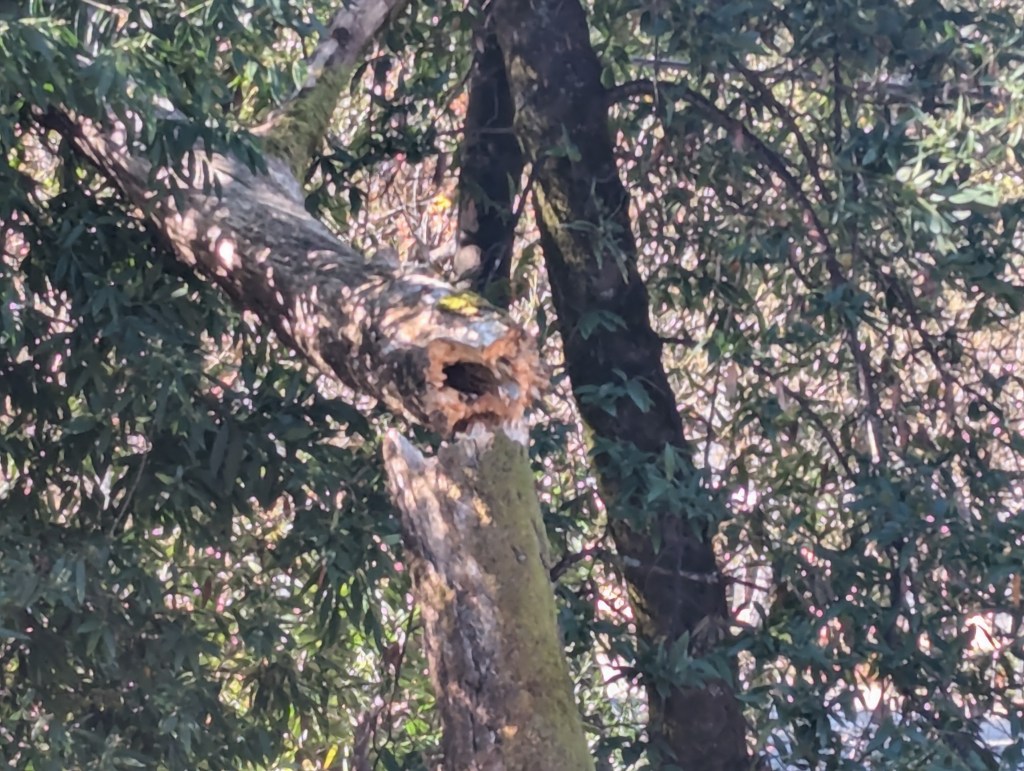
It is not on the road yet, but will be soon. This box elder has been deteriorating for several years. Only a few viable watersprouts remain within about ten feet of the ground. All limbs above are gone, leaving only this decomposing trunk. Several more similarly deteriorating trunks, with more or even less of their associated canopies remaining, are barely standing nearby. Most succumbed to an unidentified pathogen a few years ago. Some were dead prior to that. This one is special because such a significant portion of its upper trunk has broken off, and now remains suspended by the unbroken portion of the same trunk and the collective canopy of adjacent bay trees. This would not be such a concern if this broken portion of the trunk was not suspended so closely to the busy road below. (The picture above shows where the trunk broke. The picture below shows its proximity to the road below.) I suspect that when the broken portion of trunk eventually falls through the canopy of bay trees, the heavier basal end will fall first, and guide the lighter upper portion to land closer to the base of the remaining trunk, and safely away from the road, but I can not be certain until it actually happens. Those who maintain the road will not remove the broken portion of trunk until this does not actually happen, and the debris instead falls into the road. I can do nothing about it because I can not direct how the broken portion of trunk will fall once it is dislodged, and the traffic on the road is nearly constant during the day. It would be safer with a crew to stop traffic while the trunk is removed, and even better if they remove all of the several decaying trunks.

Horridculture – Saturation

Saturation is almost a universal problem within almost all of the landscapes that I inspect that are ‘maintained’ by mow, blow and go ‘gardeners’. Without exception, all of such landscapes are outfitted with automated irrigation systems. Some of such systems are scheduled to apply much more water than they should for more time than they should. More typically, irrigation is applied much too frequently. Sometimes, irrigation is both too abundant and too frequent. Such excessive irrigation maintains unhealthy saturation within the soil. Roots are unable to disperse their roots into such saturated soil, and many roots that try ultimately rot. Some trees try to compensate by dispersing roots close to the surface of the soil, but because they are unable to disperse their roots deeply, they lack stability. Also, their shallow roots damage pavement and compete with other vegetation. What is even more egregious about saturation within ‘maintained’ landscapes is that, almost without exceptions, the so-called ‘landscape’ companies that ‘maintain’ them, likely after installing them, brag about their ‘water-wise’ and ‘sustainable’ landscape maintenance techniques. They install irrigation systems that could be quite efficient if they were to operate properly, but then never operate them properly. They install drought tolerant species that can survive with minimal irrigation, but then kill them with excessive irrigation. They replace the deceased plant material, only to kill and replace it again. They do not mind wasting water that their clients pay for, any more than they mind wasting plant material that their clients pay for. In fact, replacement of plant material is profitable for them, since they get paid for procedures associated with removal and installation. Realistically though, they are probably as oblivious to the profitability of their technique as they are to proper technique. In other words, they simply do not care.

Horridculture – Queen Nefertiti

Ancient Egyptian influence within a modern landscape

Queen Nefertiti, during the fourteenth century BC, was the most famous and most influential Queen of Ancient Egypt. She wore a cool hat too. It was sort of cylindrical shaped, but also tapered so that it was wider on top, sort of like a funnel. So, not only was Queen Nefertiti very influential during her time, but she remains influential in modern mow, blow and go gardening. So-called ‘gardeners’ everywhere still shear shrubbery into the shape of Queen Nefertiti’s cool hat! Not many species of shrubbery are exempt. Just about any get shorn into a sort of cylinder shape that is wider on top, sort of like a funnel, but also tilted in one direction or another, just like Queen Nefertiti’s hat tilts toward the back. Such shearing typically deprives blooming shrubbery of its bloom, but bloom is apparently not a priority, as long as the ancient Egyptian form is maintained. The picture above includes four oleanders, a Texas sage and what seems to be two trailing lantana. The Texas sage and trailing lantana are more cylindrical than hat shaped, but the hat shape of the three oleanders is impossible to deny. It is such a universal technique that is performed so precisely wherever vegetation is maintained by mow, blow and go gardeners that it seems to be taught in classes as standard procedure. I am significantly more educated in horticulture than most mow, blow and go ‘gardeners’, but I somehow missed this in my curriculum. Instead, I learned that vegetation should be allowed to exhibit its natural attributes, such as form, texture, bloom and so on. If I wanted a herd of ancient Egyptian hats in my garden, I would probably construct something that resembled ancient Egyptian hats from an inert material that never needs shearing or irrigation.

the Original
a modern version of an ancient Egyptian fashion show

Horridculture – Headless

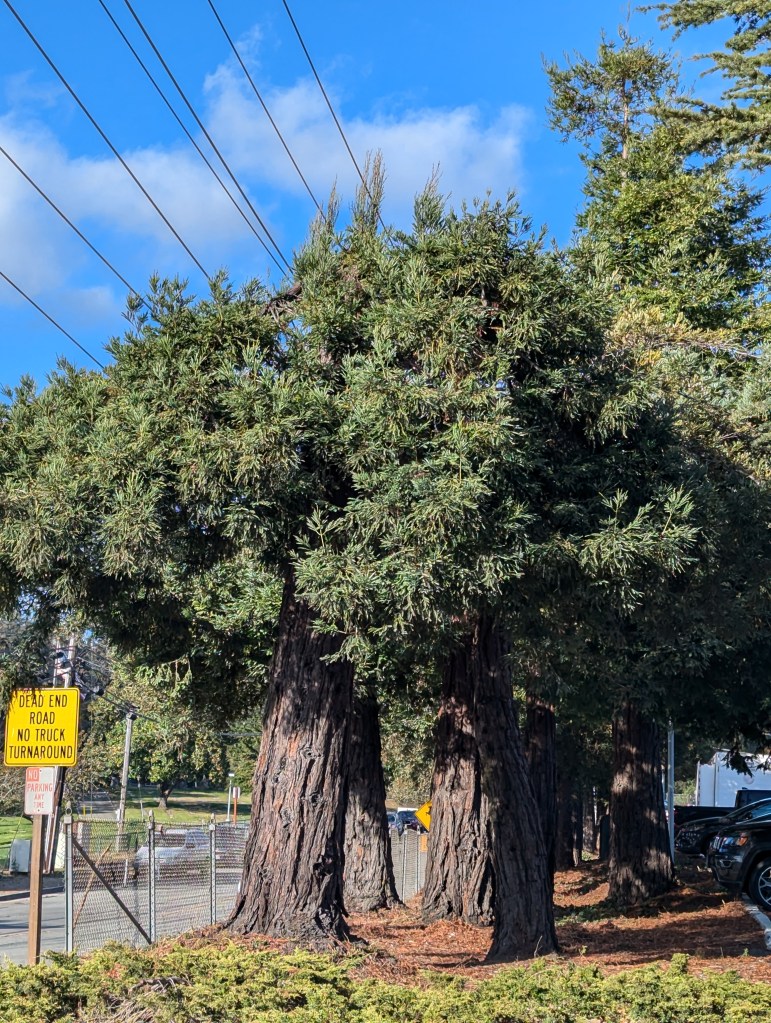
Appropriately, this picture was taken on Halloween. The ‘DEAD END’ sign and cemetery beyond, which are visible to the lower left of the picture, were also coincidental. The several headless redwood trees are the primary topic. Obviously, they were decapitated because of the electrical cables above. Otherwise, redwoods with such healthily plump trunks would be rather tall by now. After all, coastal redwoods are the tallest trees in the World. Unfortunately for them and those who are now appalled by their disfigurement, reliable and safe electrical service is more of a priority than poorly situated trees. It is no fault of the trees. Nor should this atrocity be blamed on those who executed it. Their only better option would be complete removal of the subjects, and perhaps replacement with smaller trees that will not grow tall enough to get too close to the electrical cables above. Maintenance of clearance of the vigorously upright redwoods from the cables above is a chronic problem that must be morally challenging for the arborist who must perform the necessary procedures. However, removal of several such significant trees would be very objectionable to the Community, which is very likely why these trees remain, regardless of their severe and irreparable disfigurement. Application for permits for their removal requires posting of such intentions on the trunks of the subject trees, to which neighbors would very likely protest. None of this would be such a problem now if only trees that are more appropriate to this particular situation were installed instead! Did the landscape designer who designed this landscape even visit the site during the design process, or was it all done on paper in a remote studio? Why did those who installed these trees not foresee this problem and modify the landscape plan and species selection accordingly?